Today's Korean Expression: 짝사랑 (jjaksarang) — The Language of Tender One-Sided Love in K-Dramas
When you watch Korean dramas, there’s always a scene where the main character can’t even speak properly in front of the person they like, and just secretly watches them from afar. Their heart has already gone to the other person, but that person has no idea. This feeling of loving someone longingly from just one side is called 짝사랑 (jjaksarang) in Korean. Today, we’ll take a deep look at this word — one every fan of Korean culture absolutely needs to know, and one you’re bound to experience at least once in your life.
짝사랑
짝사랑 (jjaksarang) is a noun. ‘짝’ originally means a matching pair, two things that go together — but when ‘사랑’ (love) is added, it ironically comes to mean ‘a love where the pair doesn’t match,’ that is, a love where only one person gives their heart. When you want to use it like a verb, you add ‘-하다’ to the end to make 짝사랑하다 (jjaksaranghada).
The nuance matters. 짝사랑 isn’t simply ‘to like someone’ — it’s a word that carries both the ache and the flutter of the other person not knowing how you feel. That’s why it holds such a sad yet fresh, very Korean kind of emotion.
Checking with the National Institute of Korean Language Dictionary
The authoritative Basic Korean Dictionary from the National Institute of Korean Language defines 짝사랑 as follows.
짝사랑 (noun): Loving the other person from only one side, rather than the two loving each other. [en] unrequited love; unanswered love; one sided love [es] amor secreto [zh] 单相思,单恋 — National Institute of Korean Language, Basic Korean Dictionary (krdict.korean.go.kr)
Since the Portuguese translation isn’t included in the dictionary, we’ve added our own for reference: [pt] amor não correspondido (translated by the author).
Let’s also look at the real usage examples the dictionary provides.
유민이는 짝사랑하는 남자에 대한 가슴앓이로 힘들어했다. — National Institute of Korean Language, Basic Korean Dictionary (krdict.korean.go.kr)
This is a situation where someone can’t express their feelings and suffers silently, all alone inside. The expression ‘가슴앓이’ (heartache) captures the pain of 짝사랑 beautifully.
민준이는 짝사랑하던 여자에게 용기를 내어 사랑을 고백했다. — National Institute of Korean Language, Basic Korean Dictionary (krdict.korean.go.kr)
After a long one-sided love, he finally works up the courage to share his feelings — a moment like the climax of a drama.
민준이는 평소에 짝사랑해 온 지수 앞에서 이야기를 하기가 부끄러웠는지 귓불이 빨갛게 달아올랐다. — National Institute of Korean Language, Basic Korean Dictionary (krdict.korean.go.kr)
Blushing in front of the person you like — a classic physical sign of 짝사랑.
지수는 짝사랑하던 승규가 이사를 간다는 말에 눈물을 금하지 못하였다. — National Institute of Korean Language, Basic Korean Dictionary (krdict.korean.go.kr)
Having to let someone go without ever once confessing — the most heartbreaking ending a 짝사랑 can have.
Example Sentences by Situation
1. At school (casual speech) 나 사실 옆 반 선배를 짝사랑하고 있어. (na sasil yeop ban seonbaereul jjaksaranghago isseo.) — Confiding a secret to a friend. (“Actually, I have a crush on an upperclassman in the next class.”)
2. To a coworker (polite speech) 저는 3년 동안 그 사람을 짝사랑했지만 결국 고백은 못 했어요. (jeoneun sam nyeon dongan geu sarameul jjaksaranghaetjiman gyeolguk gobaegeun mot haesseoyo.) — A mature tone, calmly looking back on past feelings. (“I loved that person from afar for three years, but in the end I never confessed.”)
3. When comforting someone (casual speech) 짝사랑도 사랑이니까 너무 슬퍼하지 마. (jjaksarangdo saranginikka neomu seulpeohaji ma.) — A warm word to soothe a heartbroken friend. (“One-sided love is love too, so don’t be too sad.”)
Comparing Polite/Casual Forms and Similar Expressions
Because 짝사랑 is a noun, the difference between polite and casual speech comes from the verb attached to it. The casual form is 짝사랑해 (jjaksaranghae), the polite form is 짝사랑해요 (jjaksaranghaeyo), and the more formal form is 짝사랑합니다 (jjaksaranghamnida).
Shall we also sort out some expressions that are similar but different? 첫사랑 (cheotsarang) means ‘a first love,’ which may or may not be one-sided. 남몰래 좋아하다 (nammollae joahada) means ‘to like someone without anyone knowing,’ a way of spelling out the state of 짝사랑. On the flip side, when two people like each other it’s 서로 좋아하다 (seoro joahada) — meaning it’s no longer 짝사랑.
Cultural Background
짝사랑 is one of the most beloved themes in Korean dramas and films. You’ll often see characters who quietly protect the person they love from behind, afraid they might get hurt, or who hide their feelings to the very end and simply cheer their loved one on. For example, in the drama Reply 1988 (응답하라 1988, tvN, 2015–2016), the tenderness of characters who carry someone in their heart for a long time yet can’t bring themselves to step forward captures the emotion of 짝사랑 wonderfully. This feeling is a key device that creates K-dramas’ signature ‘slow flutter.’
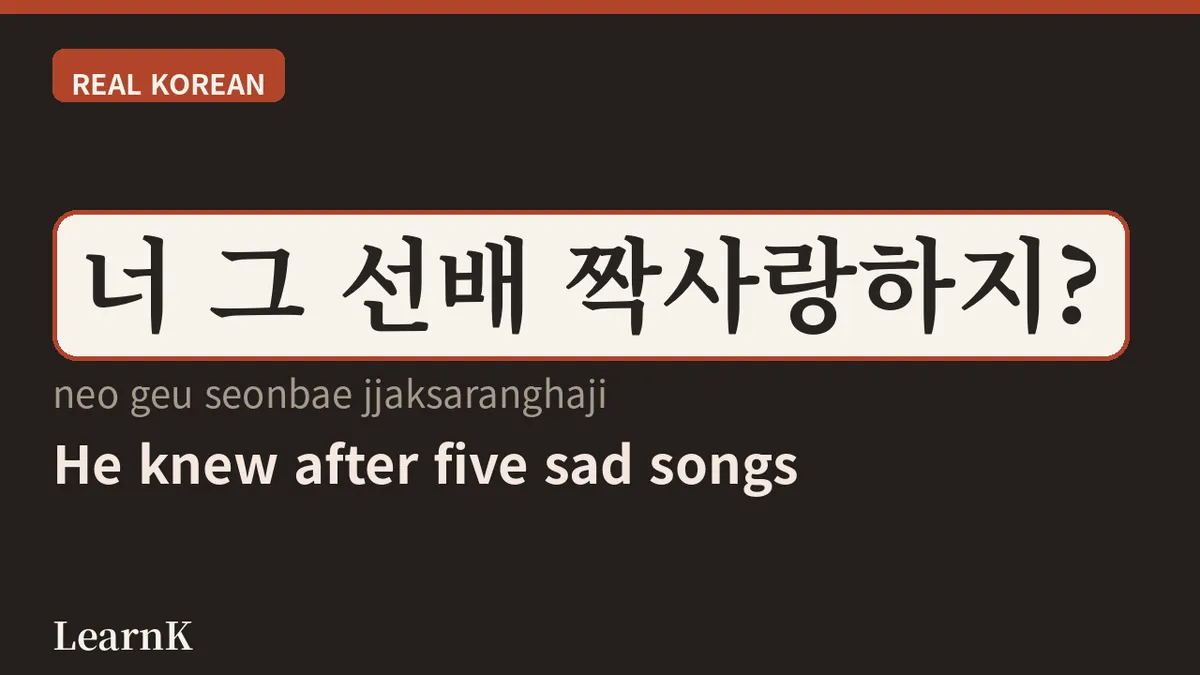
In everyday life, too, 짝사랑 is a word that feels embarrassing yet endearing. When friends teasingly ask, “너 그 사람 짝사랑하지?” (“You’ve got a crush on that person, don’t you?”), it means your feelings for that person have been found out.
Closing Quiz
Which expression best fits in the blank below?
“민준이는 지수를 좋아하지만 지수는 그 마음을 전혀 몰라요. 민준이는 지수를 ______ 하고 있어요.” (“Minjun likes Jisu, but Jisu has no idea how he feels. Minjun is ______ Jisu.”)
① 첫사랑 (cheotsarang) ② 짝사랑 (jjaksarang) ③ 서로 좋아함 (seoro joaham)
The answer is ② 짝사랑 (jjaksarang). After all, it’s a situation where only one person likes the other, and the other has no idea!
Definitions and example sentences are from the National Institute of Korean Language’s Basic Korean Dictionary (krdict.korean.go.kr); that portion of this post, including our translations, is licensed under CC BY-SA 2.0 KR.