The One Little Syllable Heating Up KakaoTalk Chats — Everything About '짤'
Today’s expression is one you’ll bump into dozens of times a day, the moment you turn on your phone. When a friend casually tosses a funny picture into the group KakaoTalk chat and says “Look at this ㅋㅋㅋ,” Koreans call that single picture by just one syllable. Today, let’s learn that very word.
짤
짤 (jjal) refers to an image shared over the internet and messaging apps. In particular, it means a funny picture — or a moving image (GIF) — that conveys emotion in place of words. The closest English equivalents are meme or reaction image. That said, a 짤 doesn’t have to be funny. A screenshot full of information, or a pretty landscape photo, all get called ‘짤’ once they’re passed around in a chat. In other words, pretty much any single image floating around a chat counts as a 짤.
The Story Hidden in One Syllable
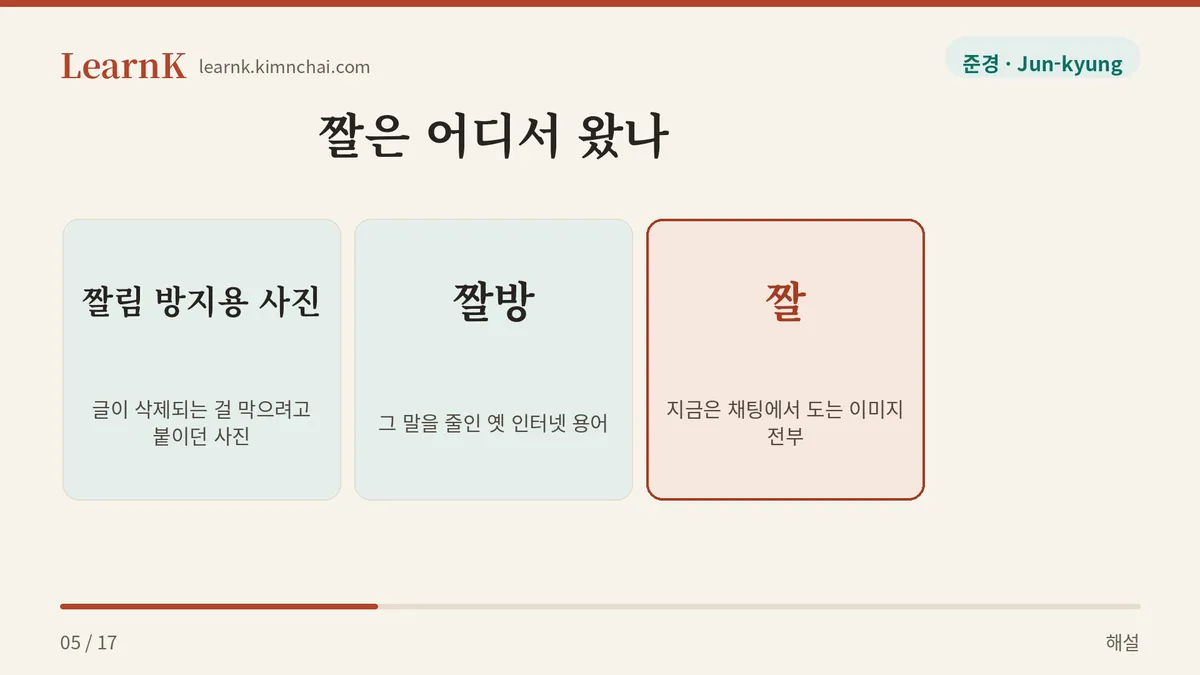
The root of ‘짤’ is 짤리다 (jjallida), meaning ‘잘리다’ — to get cut. On old internet forums, there was a rule that if you posted only text with no picture, the administrator would delete (cut off) your post. So to keep their posts from being deleted, people would attach some random image to each one, and that picture was called a 짤림 방지용 사진 (jjallim bangjiyong sajin) — “a photo to prevent deletion” — shortened to 짤방 (jjalbang). This ‘짤방’ was then shortened once more into today’s ‘짤’. At first it was simply “an image posted to prevent deletion,” but now it has broadened to refer to any picture passed around just for fun. A whole slice of the old internet-forum world is packed into that one syllable.
Meaning and Nuance
짤 is a very casual word. You’d never use it in a formal setting or in official documents — it shows up only in relaxed chats between friends and coworkers. It’s used freely as a noun, as in “짤 하나 저장했어” (I saved a 짤) or “이거 짤로 만들어야겠다” (I should turn this into a 짤). The act of hunting down and collecting new 짤 is even called 짤줍 (jjaljup), short for ‘짤 줍기’ (picking up 짤). When you come across a 짤 you absolutely love, you might say “이거 개웃겨, 짤줍 각” (This is hilarious — definitely a 짤줍 moment). That’s just how deeply the word has worked its way into everyday life.
Seeing It in a Real Conversation
Setting: The subway on the way home from work. Two people sitting side by side are each looking at their phones when Emily suddenly bursts out laughing.
Emily: (킥킥) 야, 이 짤 봐 봐. 고양이가 식빵 굽는 표정이야. (giggling) Hey, look at this jjal. The cat’s making a bread-loaf face.
Jun-kyung: 아 그거 나도 봤어. 어제 단톡방에 누가 올렸더라. Oh, I saw that one too. Someone posted it in the group chat yesterday.
Emily: 나 이거 벌써 저장했어. 나중에 써먹으려고. I already saved it. To use later.
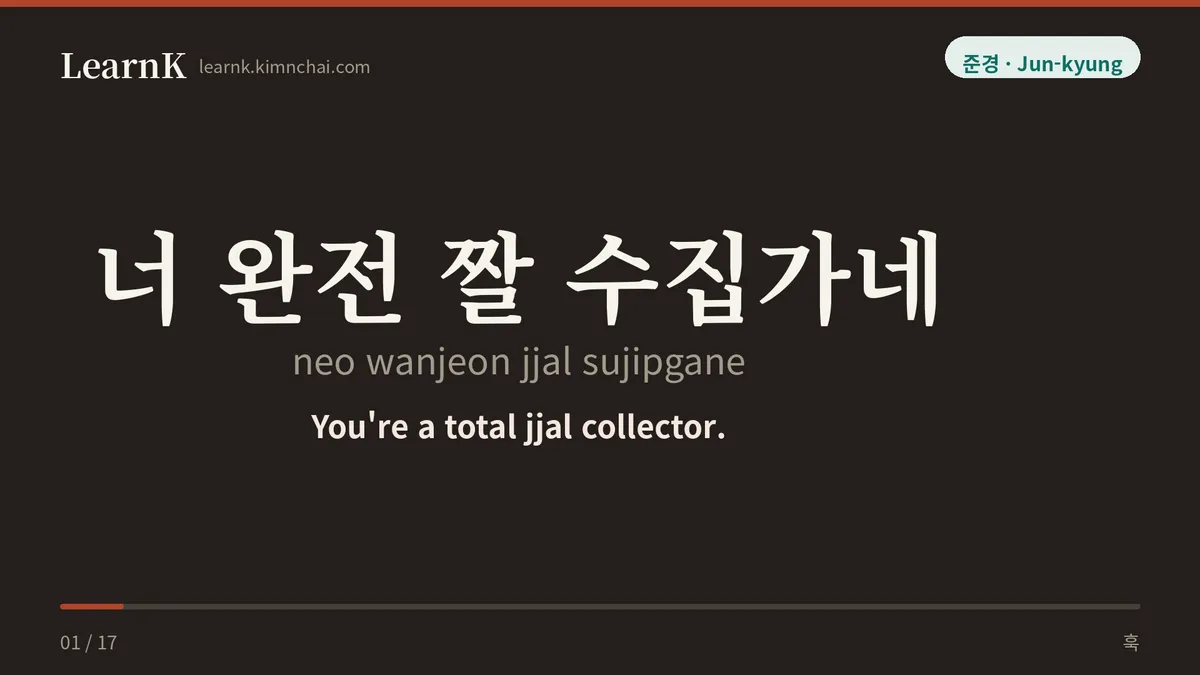
Jun-kyung: 너 완전 짤 수집가네. 폰에 그런 거 몇 개나 있냐? You’re a total jjal collector. How many of those do you even have on your phone?
Emily: 많지. 상황별로 폴더까지 만들어 놨어. 빡칠 때 쓰는 거, 웃길 때 쓰는 거. A lot. I even made folders by situation. Ones for when I’m annoyed, ones for when something’s funny.
Jun-kyung: 와… 프로다 프로. 이따 나한테도 하나 보내 줘. Wow… a real pro. Send me one later too.
Example Sentences by Situation
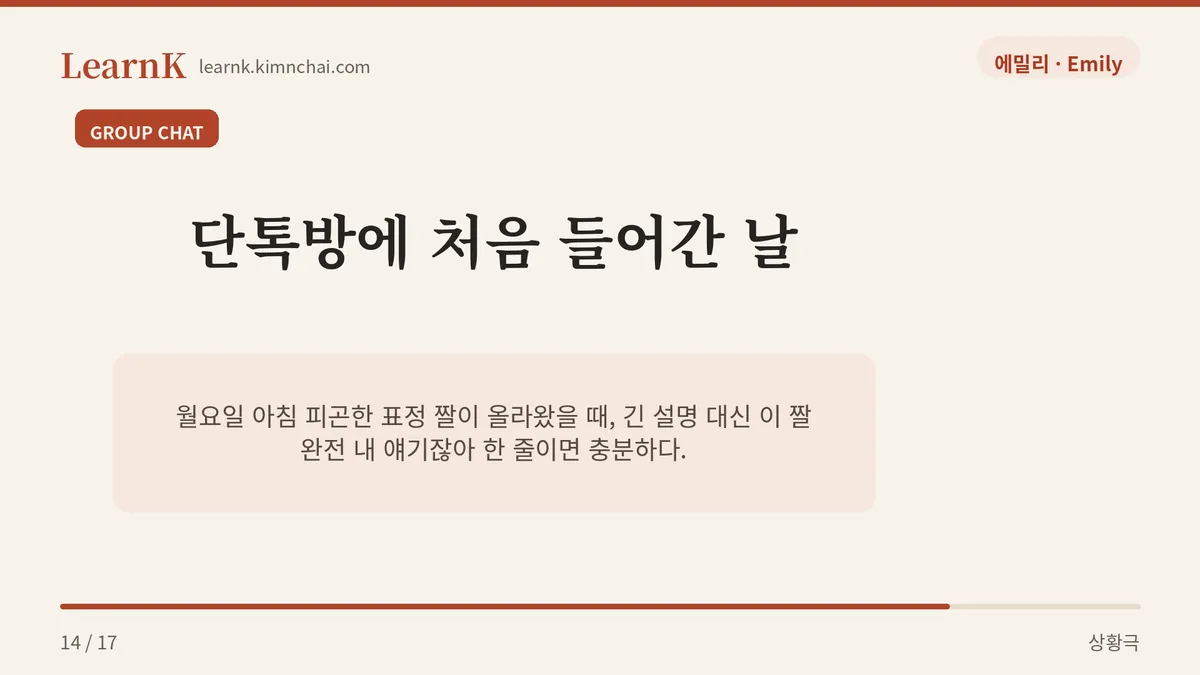
Situation 1 — When you see a photo you totally relate to 이 짤 완전 내 얘기잖아 (i jjal wanjeon nae yaegijana) — This means “This picture is exactly my situation.” You’d use it when you fiercely relate to a 짤, like one of a tired face on a Monday morning.
Situation 2 — When passing a funny 짤 to a friend 이거 짤로 저장해 놔 (igeo jjallo jeojanghae nwa) — This means “Save this picture so you can use it later.” It’s what you say to recommend a photo to a friend when you’ve found one worth keeping around.
Situation 3 — When you find the perfect photo 짤 하나로 상황 정리됐다 (jjal hanaro sanghwang jeongridwaetda) — This means “One picture said it all, no words needed.” You’d use it when a single 짤 explains the mood better than a hundred words could.
Similar Words, Plus Casual vs. Polite Speech
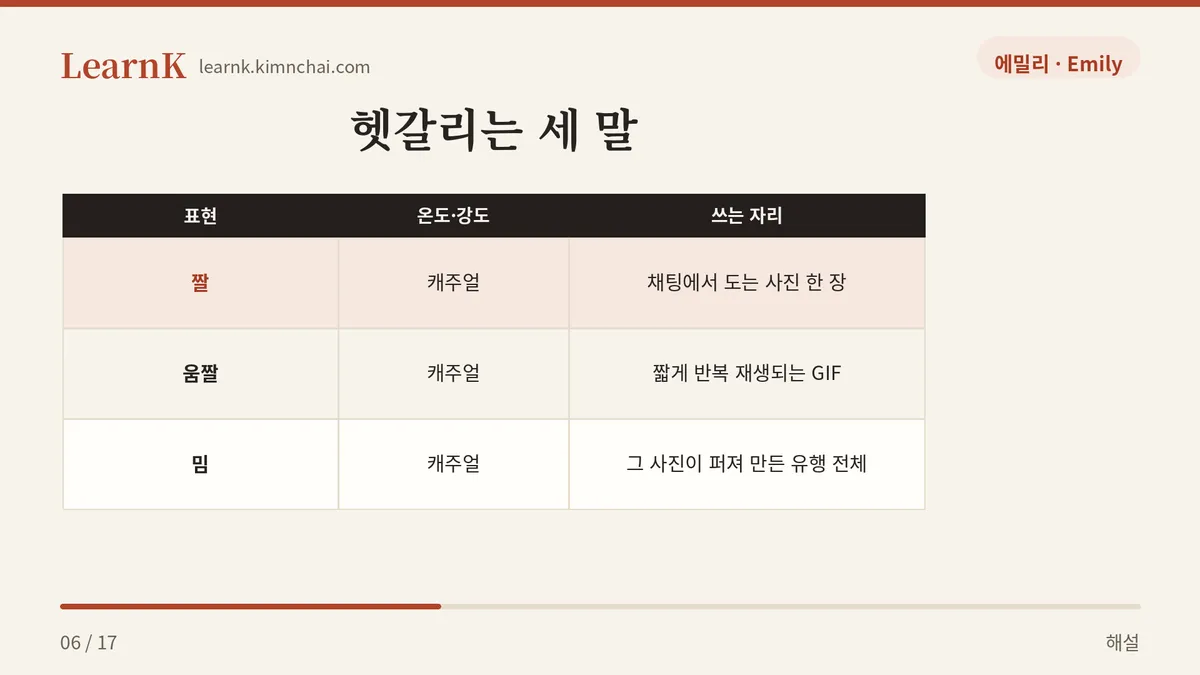
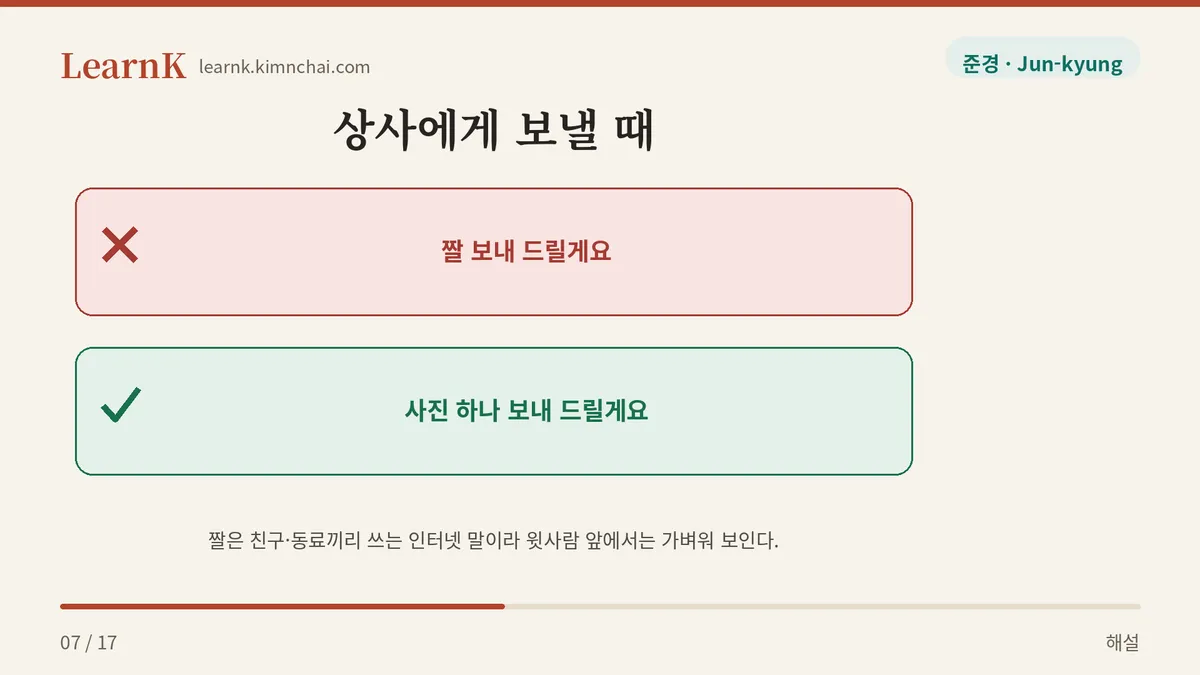
There are a few words that often get confused with 짤. 움짤 (umjjal) means a ‘moving 짤’ — that is, a GIF that loops in a short repeat. 밈 (mim) is simply the English word meme read as it sounds; while 짤 points to ‘a single picture,’ 밈 points to the whole ‘trend’ created as that picture spreads, so it’s a slightly broader concept. Since 짤 is a newly coined word, the line between polite and casual speech isn’t sharp, but with someone older than you, it’s more natural to just swap in the more genteel word ‘사진’ (photo). When talking to your boss, 사진 하나 보내 드릴게요 (sajin hana bonae deurilgeyo) (I’ll send you a photo) is much safer than “짤 보내 드릴게요.”
Cultural Background
짤 grew up alongside Korea’s fast-paced chat culture. In a KakaoTalk group chat, casually tossing out a single 짤 to convey emotion — instead of a long explanation — is seen as far more polished and witty. Whether you’re angry, embarrassed, or celebrating, picking just the right 짤 and sending it instantly softens the mood. That’s why, for Korea’s younger generation, a ‘sense for 짤’ is a kind of social skill. It’s common for a memorable scene from a variety show or drama to get screenshotted and passed around as a 짤, only for that actor to become a hot topic all over again years later thanks to that very 짤.
Closing Quiz
A friend posts a funny cat picture in the group chat and says “이거 저장각” (definitely saving this). What do we call — in a single syllable — that picture your friend is about to ‘save’? (Answer: 짤!)
Definitions and example sentences are from the National Institute of Korean Language’s Basic Korean Dictionary (krdict.korean.go.kr); that portion of this post, including our translations, is licensed under CC BY-SA 2.0 KR.