족발 (jokbal): The Late-Night Spread That Needs No Dishes
족발
족발 (jokbal) means a pig’s foot — or the dish made by braising that foot for hours in a soy-sauce broth. In Korea, once it’s past ten at night and someone says “야식 뭐 시킬까?” (yasik mwo sikilkka?) — “What should we order for a late-night snack?” — the name that jumps out most often after fried chicken is exactly these two syllables. Between the moving boxes on the day you move in, on the meeting-room table after a late shift at the office, on the floor of a studio apartment the day exams end — jokbal is food that gets served without plates and without a dining table, as long as you spread out one sheet of newspaper.
What makes this word fun for learners is that its meaning comes in two layers. The first is literal: a body part, a pig’s foot. That’s the sense you’ll meet at a butcher’s display case, in a recipe, at a market stall. The second is the dish — that foot simmered for hours in a broth with soy sauce, garlic, ginger, and green onion. And when Korean people actually say this word out loud, they almost always mean the second one. If a friend says “어제 족발 먹었어” (eoje jokbal meogeosseo) — “I had jokbal yesterday” — they’re not telling you they chewed on a foot. They’re telling you they dipped glossy brown meat into salted shrimp sauce.
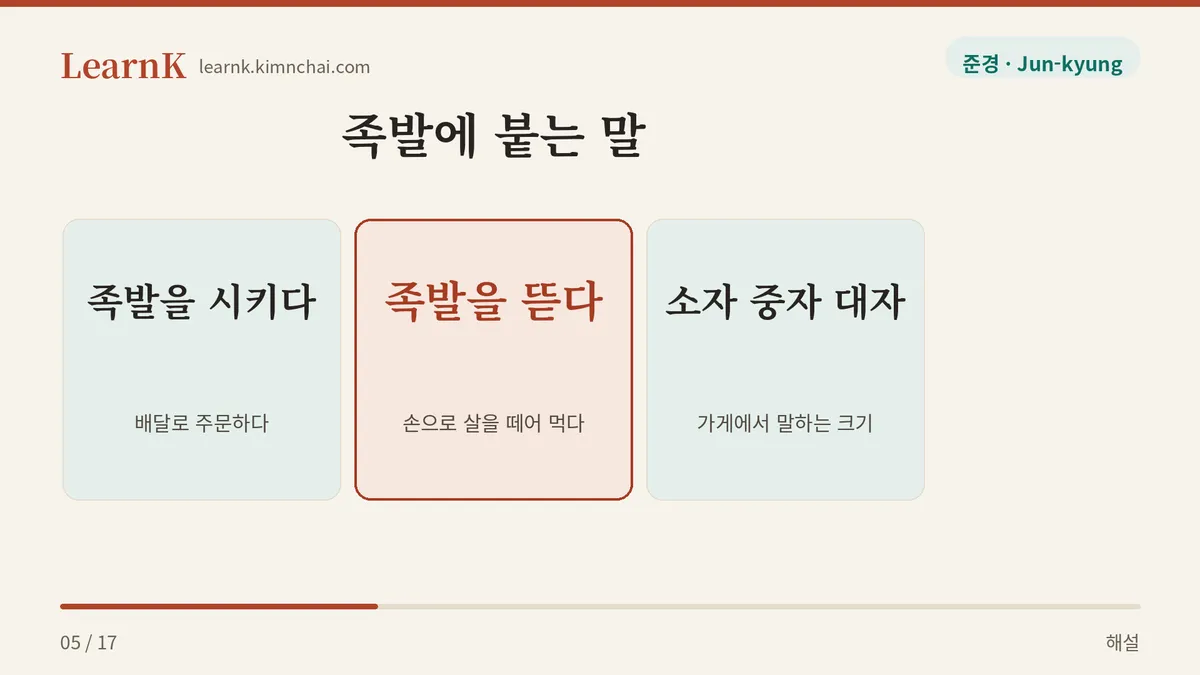
The verbs that travel with it are fixed, too. 족발을 시키다 (jokbareul sikida) means to order it for delivery, and 족발을 뜯다 (jokbareul tteutda) means to hold it in your hands and pull the meat off the bone. That single verb contains the whole picture: this isn’t food you slice quietly with a fork and knife, it’s food you eat with plastic gloves on, stripping meat from bone. The counters are worth learning as well. At a shop you don’t count it in 마리 (mari), the counter for whole animals — you count it by the plate, 접시 (jeopsi), or you name a size: 소자 (soja) small, 중자 (jungja) medium, 대자 (daeja) large.
Checking it in the National Institute of Korean Language dictionary
족발 (jokbal) 「noun」 돼지의 발. 또는 그것을 조린 음식. (dwaejiui bal. ttoneun geugeoseul jorin eumsik. — “A pig’s foot. Or food made by braising it.”) [English] jokbal; braised pigs’ feet — Food made by boiling them down. [Japanese] とんそく【豚足】 — 豚の足。または、それを煮詰めた料理。 [Spanish] jokbal — Pata de cerdo o plato cocido de pata de cerdo. [Chinese] 猪蹄,酱猪蹄 — 猪的脚部;或指用其炖煮而成的食物。 — National Institute of Korean Language, Basic Korean Dictionary (krdict.korean.go.kr)
The dictionary carries no Portuguese definition. For reference, it would come out to something like “jokbal — pé de porco, ou prato feito cozinhando-o lentamente” — but let us be clear that this line is our own rendering, not the dictionary’s translation.
The definition looks like one short line, but notice that both meanings are packed into it. 돼지의 발 (dwaejiui bal), “a pig’s foot,” and 그것을 조린 음식 (geugeoseul jorin eumsik), “food made by braising it,” sit side by side with nothing but a period between them. Below are the real usage examples the dictionary supplies.
손님, 족발은 무엇으로 드릴까요? (sonnim, jokbareun mueoseuro deurilkkayo? — “Sir/Ma’am, what kind of jokbal would you like?”) — National Institute of Korean Language, Basic Korean Dictionary (krdict.korean.go.kr)
This is a shop owner speaking to a customer. The question comes up because a jokbal restaurant makes you choose: front foot or back foot, and small or large. If you hear this sentence in a Korean restaurant, just answer with a size — “대자 하나 주세요” (daeja hana juseyo), “One large, please.”
가게로 들어간 세 남자는 족발과 막걸리를 주문했다. (gagero deureogan se namjaneun jokbalgwa makgeollireul jumunhaetda. — “The three men who went into the shop ordered jokbal and makgeolli.”) — National Institute of Korean Language, Basic Korean Dictionary (krdict.korean.go.kr)
This one sentence shows you exactly what kind of occasion jokbal belongs to. Not one person but three; not rice alongside it but alcohol. Jokbal is fundamentally 안주 (anju) — food a group shares while drinking, torn apart together.
돼지 족발은 약한 불로 한참 삶아야 속살까지 잘 익어서 제맛이다. (dwaeji jokbareun yakhan bullo hanchan salmaya soksalkkaji jal igeoseo jemasida. — “Pig’s feet only taste right when you boil them a long time over low heat, so that even the inner meat cooks through.”) — National Institute of Korean Language, Basic Korean Dictionary (krdict.korean.go.kr)
A sentence about cooking. Note here that people sometimes attach 돼지 (dwaeji), “pig,” in front, as in 돼지 족발 (dwaeji jokbal). And it’s accurate: jokbal has to simmer over low heat for two or three hours before the skin goes soft and the meat lets go of the bone.
족발은 노려서 조금만 먹어도 금방 질린다. (jokbareun noryeoseo jogeumman meogeodo geumbang jillinda. — “Jokbal is gamey, so even a little of it makes you sick of it fast.”) — National Institute of Korean Language, Basic Korean Dictionary (krdict.korean.go.kr)
The word 노리다 (norida) here is an adjective for that particular gamey, greasy smell meat can have. It’s precisely this smell that some shops fight by throwing ginger, soybean paste, and even coffee or medicinal herbs into the pot. In other words, this sentence is the classic way someone who dislikes jokbal explains why.
그녀는 족발에 붙어 있는 살을 발라내어 아이의 입에 넣어 주었다. (geunyeoneun jokbare buteo inneun sareul ballanaeeo aiui ibe neoeo jueotda. — “She picked the meat off the jokbal and put it in the child’s mouth.”) — National Institute of Korean Language, Basic Korean Dictionary (krdict.korean.go.kr)
This scene is only possible because jokbal is food you take apart with your hands. Pulling meat off a bone and placing it in someone else’s mouth is a deeply familiar way of expressing 정 (jeong) — warm attachment — in Korea. It’s an example sentence that shows just how much tenderness can cling to a single food name.
Seeing it in a real conversation
Scene: the first night in a new place. The moving boxes are still stacked in the living room, and the two of them are sitting on the floor, having just opened a delivery app.
Jun-kyung: 그릇 박스가 어디 갔는지 하나도 모르겠다. 그냥 시켜 먹자. I have no idea where the box with the dishes went. Let’s just order in.
Emily: 그럼 족발 어때? 이사한 날엔 그릇 없어도 되는 게 최고야. Then how about jokbal? On moving day, something you don’t need dishes for is the best.
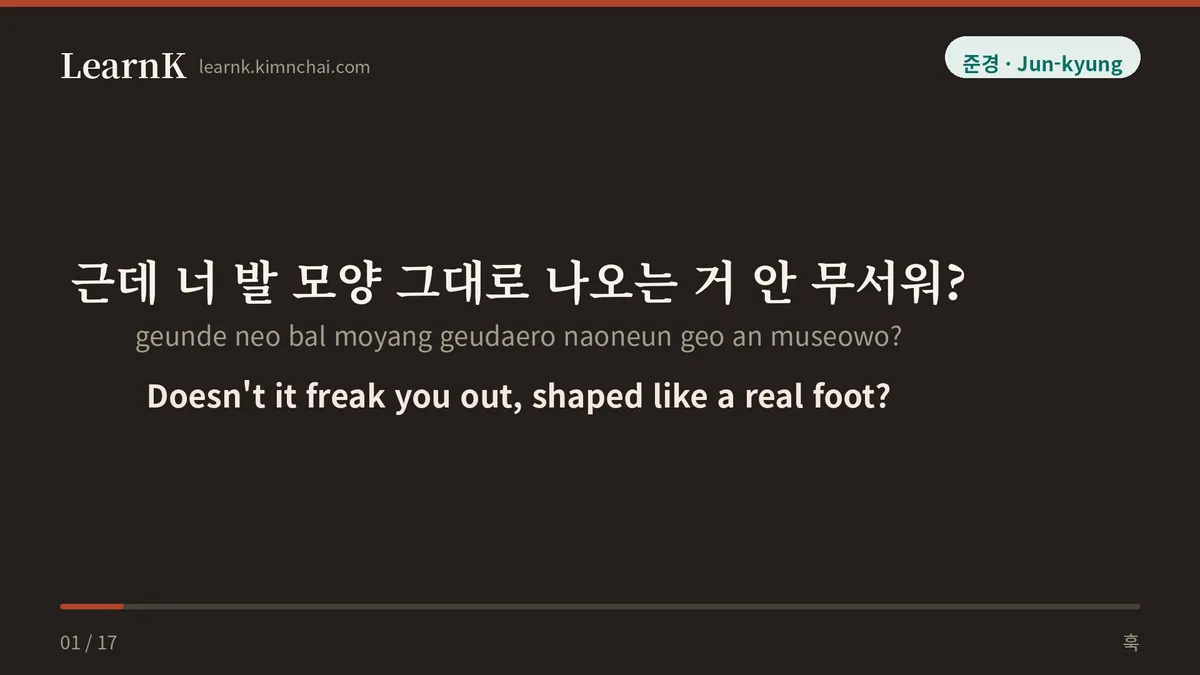
Jun-kyung: 오, 좋다. 근데 너 발 모양 그대로 나오는 거 안 무서워? Oh, nice. But doesn’t it freak you out that it comes out shaped like an actual foot?
Emily: 야, 나 한국 산 지 십오 년이야. 뼈 발라 먹는 거 너보다 잘해. Hey, I’ve lived in Korea for fifteen years. I strip the bone better than you do.
Jun-kyung: 인정. 그럼 족발 대자에 막걸리 한 병? Fair enough. Large jokbal and a bottle of makgeolli, then?
Emily: 콜. 박스 위에 신문지 깔면 그게 상이지, 뭐. Deal. Spread newspaper on a box and there’s your table.
These versions sound unnatural
Since jokbal is the name of an object, it doesn’t shift between polite and casual forms itself — but there are two spots where learners regularly trip.
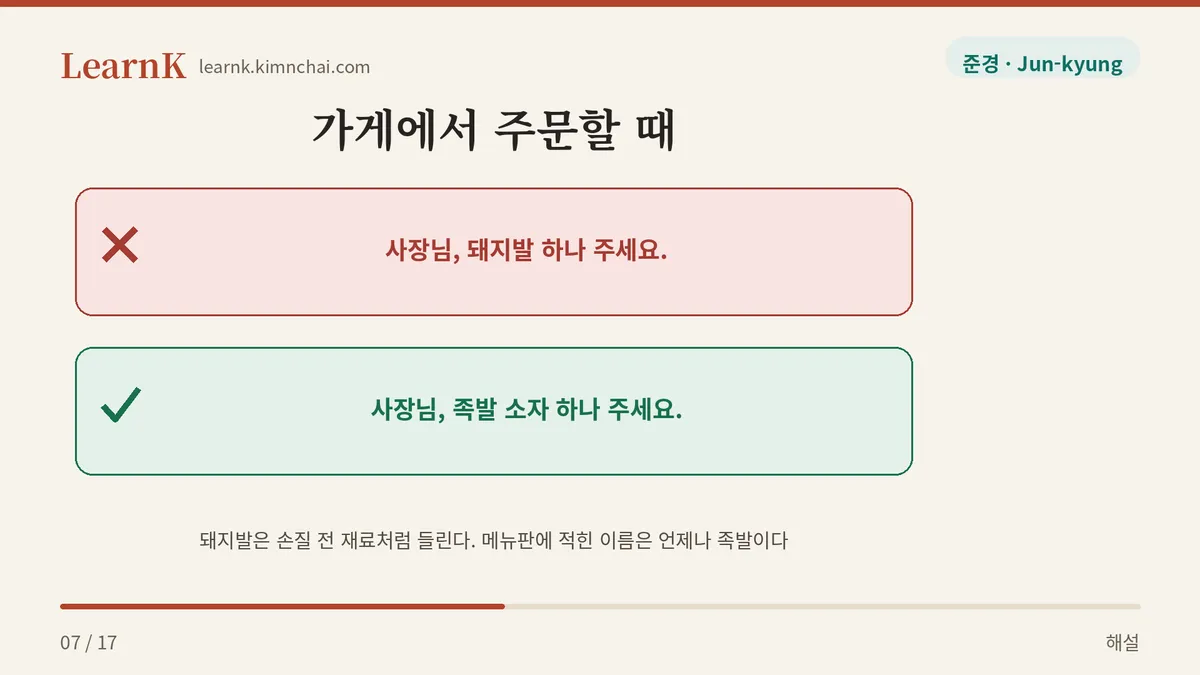
✗ (at a restaurant) 사장님, 돼지발 하나 주세요. (sajangnim, dwaejibal hana juseyo. — “Excuse me, one pig foot, please.”) ✓ (at a restaurant) 사장님, 족발 소자 하나 주세요. (sajangnim, jokbal soja hana juseyo. — “Excuse me, one small jokbal, please.”) → You can put 돼지 in front, as the dictionary’s 돼지 족발 (dwaeji jokbal) shows, but the name of the dish is always 족발. Say 돼지발 (dwaejibal) and it sounds like you’re asking for raw, untrimmed ingredients rather than something on the menu.
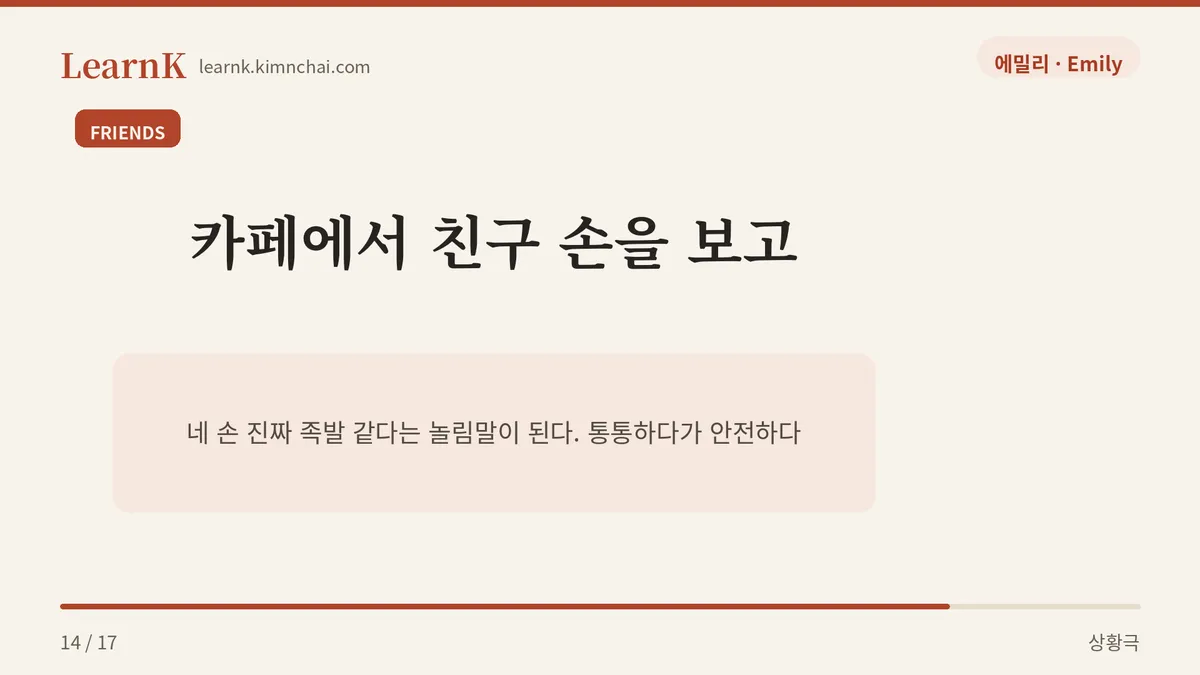
✗ (looking at a friend’s hand) 네 손 진짜 족발 같다. (ne son jinjja jokbal gatda. — “Your hand really looks like jokbal.”) ✓ (looking at a friend’s hand) 네 손 진짜 통통하다. (ne son jinjja tongtonghada. — “Your hands are really chubby.”) → The moment you attach 족발 to a person’s hands or feet, it turns into teasing. Unless you’re very close friends joking around, the other person’s face will drop. And you would never, ever use it toward someone older or senior to you.
Example sentences by situation
1. To a coworker on an evening when overtime is confirmed
At a Korean company, when overtime drags on, the most common form of comfort is food. This is a casual, 반말 (banmal) line you toss out easily.
오늘 야근 확정이래. 족발이나 시켜 먹자. oneul yageun hwakjeongirae. jokbarina sikyeo meokja. (오늘 야근 확정이래. 족발이나 시켜 먹자. / They say we’re definitely working late. Let’s just order jokbal.)
Attaching -이나 (-ina) adds a “nothing fancy, but how about this” feeling, which makes the suggestion low-pressure.
2. When treating your parents
Jokbal is soft to chew and easy to share, so it often lands on the table at gatherings with older family members. Here you switch to 존댓말 (jondaenmal), polite speech.
어머니, 오늘은 제가 살게요. 족발 좋아하시죠? eomeoni, oneureun jega salgeyo. jokbal joahasijyo? (어머니, 오늘은 제가 살게요. 족발 좋아하시죠? / Mom, it’s on me today. You like jokbal, right?)
3. Walking into a shop and ordering
This is precisely the answer to the dictionary’s example, “손님, 족발은 무엇으로 드릴까요?”
여기 족발 소자 하나랑 막걸리 한 병 주세요. yeogi jokbal soja hanarang makgeolli han byeong juseyo. (여기 족발 소자 하나랑 막걸리 한 병 주세요. / One small jokbal and a bottle of makgeolli, please.)
Polite and casual forms, and related expressions
족발 itself is a noun, so its form never changes; politeness is carried by the verb that follows it.
- Casual: 족발 시킬까? (jokbal sikilkka?) — to friends, younger siblings, close coworkers
- Polite: 족발 시킬까요? (jokbal sikilkkayo?) — to seniors, bosses, someone you’ve just met
- Very formal: 족발 하나 부탁드립니다. (jokbal hana butakdeurimnida.) — for phone orders or formal settings
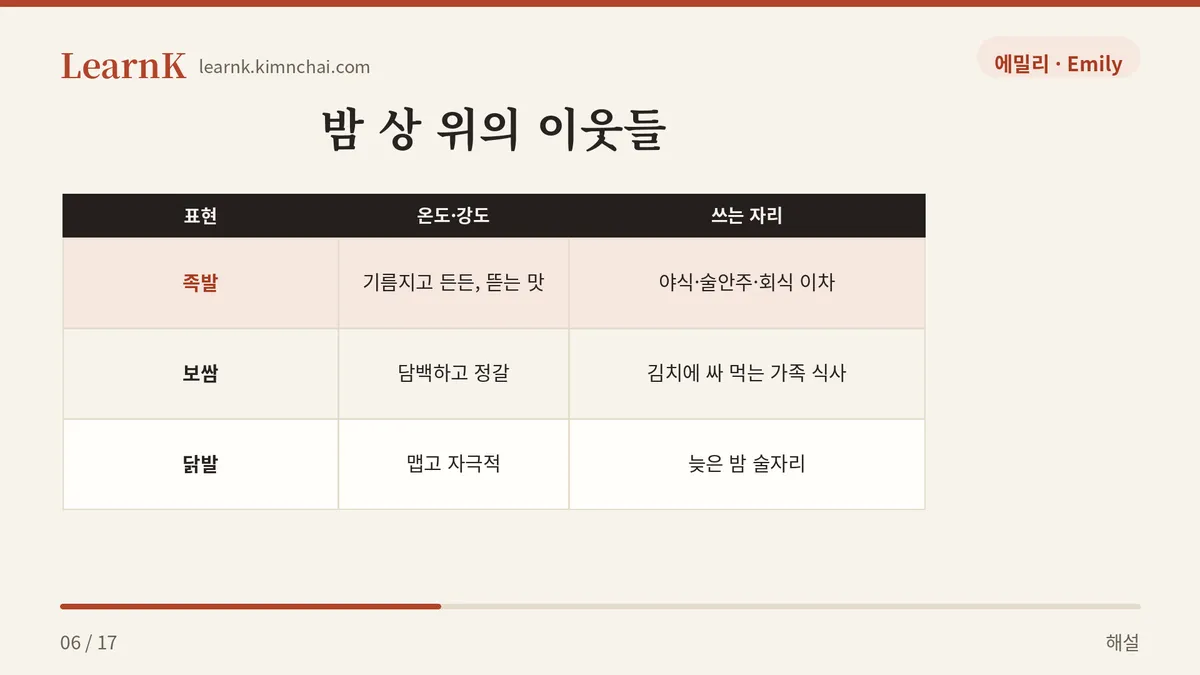
Jokbal’s place becomes clearer when you set it beside the neighboring dishes that share the late-night table.
| Expression | Feel & intensity | Where it’s used |
|---|---|---|
| 족발 (jokbal) | Rich and filling; the pleasure of tearing it apart | Late-night snacks, drinking food, the second round of a work dinner. A dish for sharing in a group |
| 보쌈 (bossam) | Clean and mild, neatly presented | Meat wrapped up with kimchi. Fine for family meals or for guests |
| 순대 (sundae) | Homely and easy | Snack shops and street stalls. Good to eat alone, too |
| 닭발 (dakbal) | Spicy and intense, definitely on the drinking side | Late-night drinking. Not something you order if someone can’t handle heat |
Jokbal and bossam are lumped into a single category on delivery apps, so plenty of people order half-and-half. Learners mix the two up often, so remember: jokbal is feet braised in soy sauce, while bossam is boiled lean pork served with kimchi.
Cultural background — a name that says “foot” twice
The name 족발 is itself a little joke. The 족 in it is the Sino-Korean character 足, which already means “foot.” Then the native Korean word 발 (bal), “foot,” got attached on top — so the name says “foot” twice over. Korean has a fair number of these doubled-up words: once an expression settles into everyday use, the original Chinese-character meaning stops being felt, and a native Korean word with the same meaning gets tacked on. Since nobody uses 족 on its own these days anyway, just memorize 족발 whole, as one word.
The occasions jokbal shows up at are fairly fixed. It’s night, there’s a group, and there’s alcohol. When the first round of a work dinner was grilled meat and everyone moves on to a second place; when overtime pushes past midnight; when you’ve finished something physical like a move or a big cleaning day. It’s an old delivery and eating-out staple — old enough that Seoul has entire streets, like Jangchung-dong, lined with jokbal restaurants.
Watch any Korean drama and you’ll see immediately what emotions this food is attached to. The bag carried in hand on the way to comfort a friend after a breakup; the spread laid out on newspaper on the bare floor of an empty room once the last box is moved; the plate a parent sets down silently outside a child’s door late at night — it’s food that says “I’ll stay with you” without a single line of dialogue. The dictionary’s own example, “살을 발라내어 아이의 입에 넣어 주었다,” has exactly that texture.
The way you eat it has its own rules, too. You put on plastic gloves and tear it apart by hand, dip it in 새우젓 (saeujeot), salted shrimp sauce, and wrap it in lettuce with garlic. Many people will recommend it to you by saying it’s full of collagen and good for your skin — though honestly, that line has more to do with the kindness of the person offering than with the science. When you order it as a late-night snack, finishing with 막국수 (makguksu) or 냉면 (naengmyeon) on the side is a common combination.
Today’s quiz
You’ve walked into a jokbal restaurant and sat down. What’s the most natural way to order?
① 사장님, 돼지발 한 접시 주세요. (sajangnim, dwaejibal han jeopsi juseyo.) ② 사장님, 족발 소자 하나 주세요. (sajangnim, jokbal soja hana juseyo.) ③ 사장님, 족발 한 마리 주세요. (sajangnim, jokbal han mari juseyo.)
Answer: ②
The 돼지발 in ① sounds like the raw, untrimmed ingredient rather than the name of a dish. The name printed on the menu is always 족발. The 마리 in ③ is the counter for whole live animals, which doesn’t fit a dish made of feet. Jokbal is counted by the plate, or ordered at a shop by naming a size: 소자, 중자, 대자. Answer this way and you’ve given the perfect reply to the dictionary’s example, “손님, 족발은 무엇으로 드릴까요?”
Definitions and example sentences are from the National Institute of Korean Language’s Basic Korean Dictionary (krdict.korean.go.kr); that portion of this post, including our translations, is licensed under CC BY-SA 2.0 KR.