조연 (joyeon) — The People You Remember Longer Than the Lead
조연 (joyeon)
조연 (joyeon) means the role of helping the main character carry the story forward in a play or a film — or the actor who takes on that role. If you watch enough Korean dramas, this moment always arrives. The story of the two leads unfolds exactly as you predicted, and yet the real reason you can’t wait for the next episode is the gruff department head at the lead’s company, or the auntie selling side dishes at the market. She gets fewer than ten lines in a whole episode, and those ten lines are the ones that stay with you longest. In Korean, that kind of part — and the actor who plays it — is called 조연 (joyeon).
Korean learners usually run into this word for the first time in subtitles or fan communities. 주연 (juyeon) is the actor playing the lead; 조연 (joyeon) is the actor filling in the space beside them. You can get that far from a dictionary alone. The problem is temperature. The English supporting actor is a fairly dry classification term, while the Korean 조연 (joyeon) carries something a little warmer. Korean viewers pour unusual affection on supporting actors — so much so that there’s a phrase built purely for praise: 명품 조연 (myeongpum joyeon). The 명품 (myeongpum) there is the same 명품 as in luxury brands. Calling an actor 명품 조연 (myeongpum joyeon) is comparing a great supporting performance to an expensive designer piece.
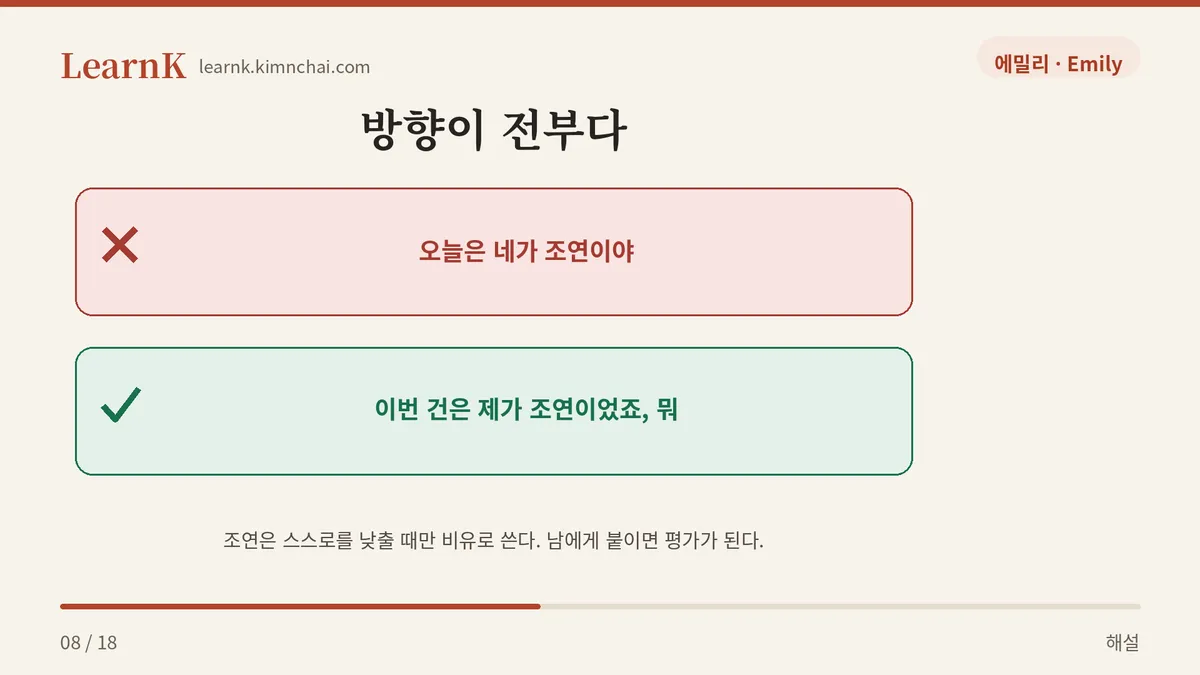
At the same time, this is a word to handle carefully when you point it at an actual person. It’s a neutral term for how much weight a role carries, but the moment you say to a living human 너는 조연이야 (neoneun joyeoniya), it slides over into you are not the center. That’s why, used as a metaphor, the word almost always points back at the speaker. People say 오늘은 제가 조연이죠 뭐 (oneureun jega joyeonijyo mwo), but they rarely say 오늘은 네가 조연이야 (oneureun nega joyeoniya).
Checking It in the National Institute of Korean Language Dictionary
조연 (joyeon) 「noun」 In theater or film, the act of playing a role that helps the main character develop the story; or an actor who takes on such a role. — National Institute of Korean Language, Basic Korean Dictionary (krdict.korean.go.kr)
Here are the multilingual definitions the dictionary provides as well.
[English] supporting role; supporting actor; supporting actress — In theater or film, the act of playing a supporting role to the lead character in the unfolding story, or an actor/actress playing such a role. [Japanese] じょえん【助演】。わきやく【脇役・傍役】 — 演劇・映画などで、主役を助けて劇を展開していく役割をすること。また、その人。 [Spanish] actor secundario, actor de reparto — En teatro o película, acto de ejercer el papel secundario acompañando a los protagonistas a desarrollar la historia. O actor que ejerce ese rol. [Chinese] 配角 — 在话剧或电影里,起到辅助主角展开故事的作用;或指担当那样角色的演员。 — National Institute of Korean Language, Basic Korean Dictionary (krdict.korean.go.kr)
The dictionary does not carry a Portuguese definition. For reference, our own rendering would be something like ator coadjuvante, papel coadjuvante — but we should note that this line is our translation, not a dictionary quotation.
There’s one thing worth flagging here. If you search the dictionary for example sentences under 조연 (joyeon), every sentence that actually comes back contains 기조연설 (gijo yeonseol), “keynote speech.” The letters 조연 happen to sit inside 기조연설, so they get pulled up together. It’s exactly the kind of spot where a learner gets confused, so we’re reproducing the dictionary’s sentences exactly as given and adding an explanation.
기조연설을 듣다. (gijo yeonseoreul deutda.) — To listen to a keynote speech. 지구 온난화 연구 분야의 유명 학자가 기조연설을 통해 이번 학회의 주제를 밝혔다. (jigu onnanhwa yeongu bunyaui yumyeong hakjaga gijo yeonseoreul tonghae ibeon hakhoeui jujereul balkyeotda.) — A famous scholar in the field of global warming research announced the theme of this conference in a keynote speech. 나는 다음 달에 있을 국제 학술 대회에서 기조연설을 해 달라는 부탁을 받았다. (naneun daeum dare isseul gukje haksul daehoeeseo gijo yeonseoreul hae dallaneun butageul badatda.) — I was asked to give the keynote speech at next month’s international academic conference. 내일 방송 토론회에서 있을 후보자들의 기조연설을 들어 보렴. (naeil bangsong toronhoeeseo isseul hubojadeurui gijo yeonseoreul deureo boryeom.) — Give the candidates’ keynote speeches at tomorrow’s televised debate a listen. — National Institute of Korean Language, Basic Korean Dictionary (krdict.korean.go.kr)
- 기조연설을 듣다 (gijo yeonseoreul deutda) — a scene of sitting in the audience at an event. You’re taking in the opening item of a conference or a competition.
- 지구 온난화 연구 분야의 유명 학자가 기조연설을 통해 이번 학회의 주제를 밝혔다 — the first morning of an academic conference, where the most renowned researcher steps up and declares what that year’s meeting will be about.
- 나는 다음 달에 있을 국제 학술 대회에서 기조연설을 해 달라는 부탁을 받았다 — a sentence from the person who received the invitation. The tone is half boast, half burden.
- 내일 방송 토론회에서 있을 후보자들의 기조연설을 들어 보렴 — an evening during election season, a parent suggesting something to their child. The ending 보렴 (boryeom) is what reveals that relationship.
기조연설 (gijo yeonseol) is 기조 (gijo) — the underlying direction, the keynote — plus 연설 (yeonseol), “speech.” It is not 기 (gi) plus 조연 (joyeon). The two words have no relationship at all, in meaning or in etymology.
Seeing It in Real Conversation
Scene: The film has ended and the closing credits are rolling. Only two people are still sitting in the theater.
Jun-kyung: 야, 잠깐만. 나 저 형사 아저씨 이름만 확인하고 가자. Hey, hold on. Let me just check that detective guy’s name before we go.
Emily: 아 그 아저씨! 완전 조연인데 주인공보다 기억에 남더라. Oh, that guy! He was totally a supporting role, but I remember him more than the lead.
Jun-kyung: 그치? 대사 다 합쳐도 오 분도 안 될걸. Right? All his lines put together probably don’t even add up to five minutes.
Emily: 근데 그 오 분이 영화를 살렸잖아. 이런 걸 명품 조연이라고 하는 거지? But those five minutes carried the whole movie. This is what you call a myeongpum joyeon, right?
Jun-kyung: 어, 딱 그거야. 저런 배우가 한 명 있어야 이야기가 굴러가거든. Yeah, exactly that. You need one actor like him for the story to actually move.
Emily: 아 저기 저기, 세 번째 줄! 나 이 사람 나오는 거 다 찾아볼래. Oh there, there, third line! I’m going to look up everything he’s in.
Saying It This Way Sounds Off
✗ (to a senior actor) 선배님, 이번 작품에서 조연 맡으셨죠? (seonbaenim, ibeon jakpumeseo joyeon mateusyeotjyo?) ✓ (to a senior actor) 선배님, 이번 작품에서 맡으신 역할 정말 좋았어요. (seonbaenim, ibeon jakpumeseo mateusin yeokhal jeongmal joasseoyo.) → The first sentence isn’t wrong. It’s just that you’re bringing up the size of someone’s part while standing right in front of them, so it lands like a confirmation of you’re not the lead, are you? With the person themselves, it’s safer to go in through the role or the acting.
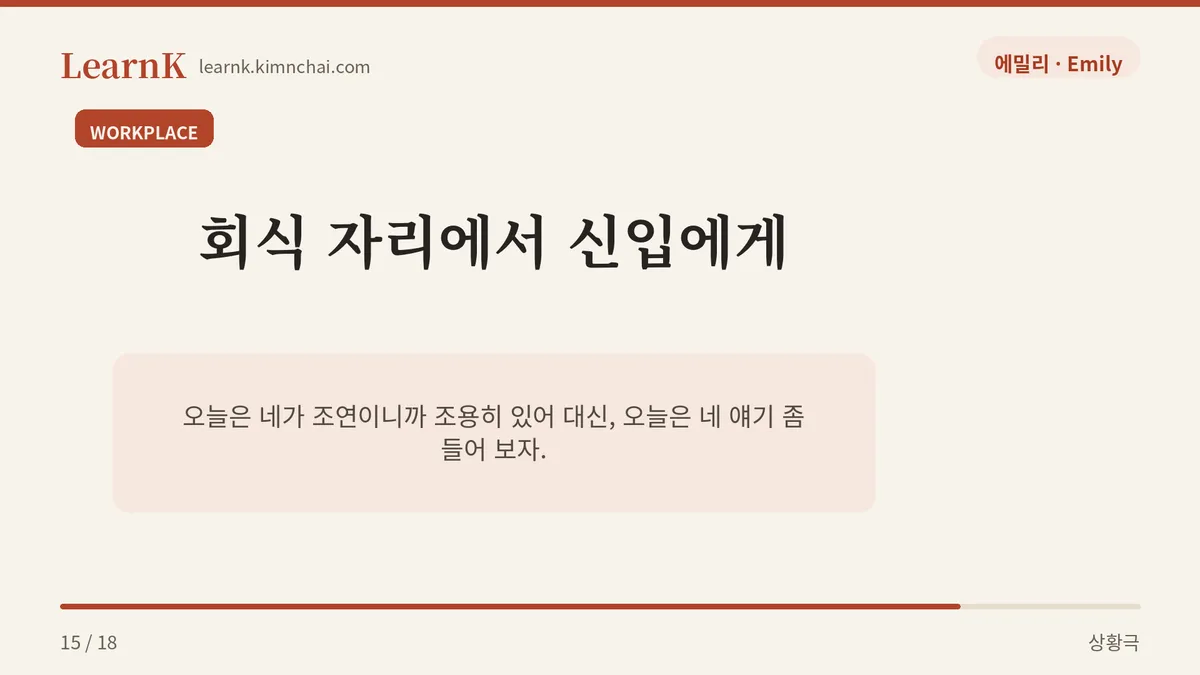
✗ (to a new hire at a company dinner) 오늘은 네가 조연이니까 조용히 있어. (oneureun nega joyeoninikka joyonghi isseo.) ✓ (to a new hire at a company dinner) 오늘은 네 얘기 좀 들어 보자. (oneureun ne yaegi jom deureo boja.) → When 조연 (joyeon) is used as a metaphor, it’s normally reserved for lowering yourself. Point it at someone else and it turns into you don’t matter. 저는 오늘 조연이죠 뭐 (jeoneun oneul joyeonijyo mwo) is modesty; 너는 조연이야 (neoneun joyeoniya) is an insult.
Example Sentences by Situation
1. Recommending a drama to a friend while picking what to watch this weekend
이 드라마는 조연들이 다 살아 있어. (i deuramaneun joyeondeuri da sara isseo.) The supporting characters in this drama are all alive.
살아 있다 (sara itda), “to be alive,” is a common way of saying a character feels vivid. It’s praise for a work where the leads aren’t the only ones shining while everyone else drifts by like scenery — where the people standing off to the side have their own circumstances and their own way of talking. Among Korean drama fans, this is close to the decisive line when recommending a show.
2. Calling your parents on the day roles were cast in your university theater club
저는 이번에 조연을 맡았어요. (jeoneun ibeone joyeoneul mataseoyo.) I got a supporting role this time.
The most basic form pairs the word with the verb 맡다 (matda), “to take on (a role).” 조연을 하다 (joyeoneul hada) is also used, but 맡다 sounds a little more formal and settled. If you don’t want to come across as disappointed, adding something like 그래도 대사 많아요 (geuraedo daesa manayo), “but I’ve got a lot of lines,” afterward feels natural.
3. When you’re praised after supporting a colleague’s project from behind the scenes
이번 건은 제가 조연이었죠, 뭐. (ibeon geoneun jega joyeonieotjyo, mwo.) I was just the supporting role on this one.
Even in an office that has nothing to do with acting, this is how the word gets used. The 뭐 (mwo) at the end of the sentence is a device for softening the modesty. It hands the credit over to the other person while quietly leaving behind the fact that you did do something — a very Korean piece of balancing.
Formal Speech, Casual Speech, and Related Expressions
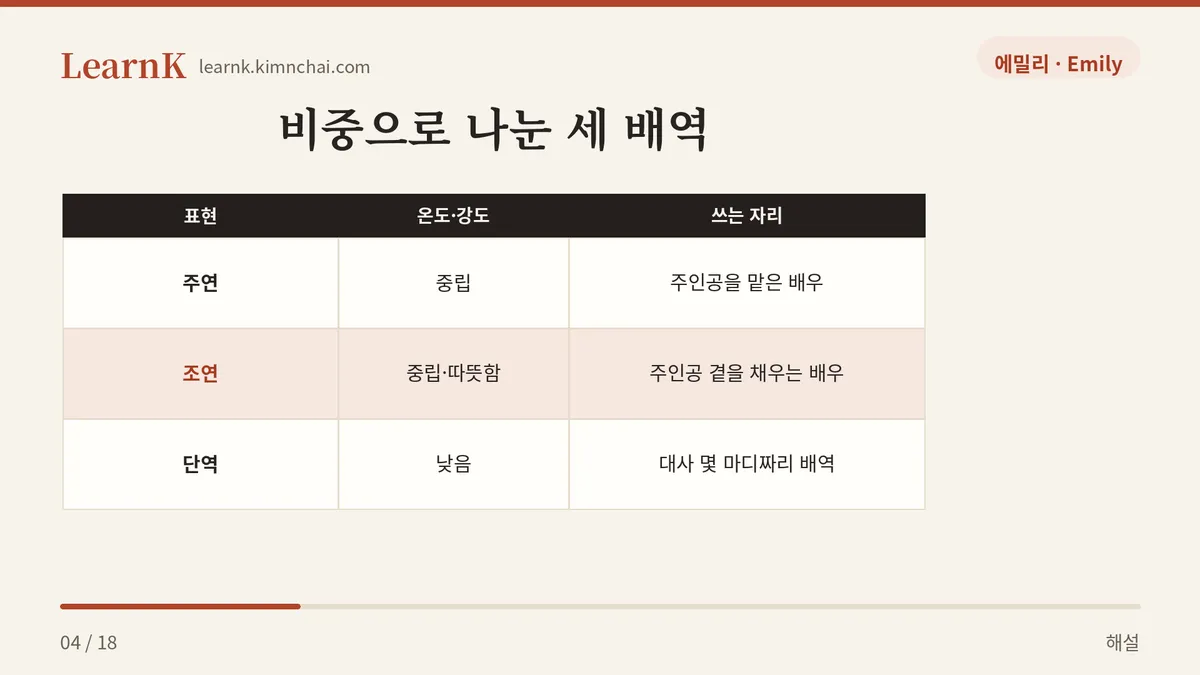
조연 (joyeon) is a noun, so the word itself carries no politeness level. That’s decided by the predicate attached to it. To a friend: 쟤 이번에 조연이야 (jyae ibeone joyeoniya). To an elder: 이번에 조연입니다 (ibeone joyeonimnida). For the soft middle ground: 조연이에요 (joyeonieyo). And when you want to ask about the size of someone’s part, 어떤 역할 맡으셨어요? (eotteon yeokhal mateusyeosseoyo?) is far more natural than 조연이세요? (joyeoniseyo?).
| Expression | Temperature & Intensity | Where It’s Used |
|---|---|---|
| 조연 (joyeon) | Neutral. A classifying term for how much weight a role carries | Anywhere you’re discussing a work. Careful in front of the person themselves |
| 주연 (juyeon) | Neutral. The counterpart to 조연 | Casting articles, awards ceremonies, posters |
| 단역 (danyeok) | Low. A part worth a few lines | When marking off a role even smaller than 조연 |
| 명품 조연 (myeongpum joyeon) | Warm praise | Headlines, fan communities, reviews |
| 신 스틸러 (sin seutilleo) | Excitement and admiration | Social media and younger speakers. It means “one who steals the scene” |
Cultural Background — The People on the Third Line of the Credits
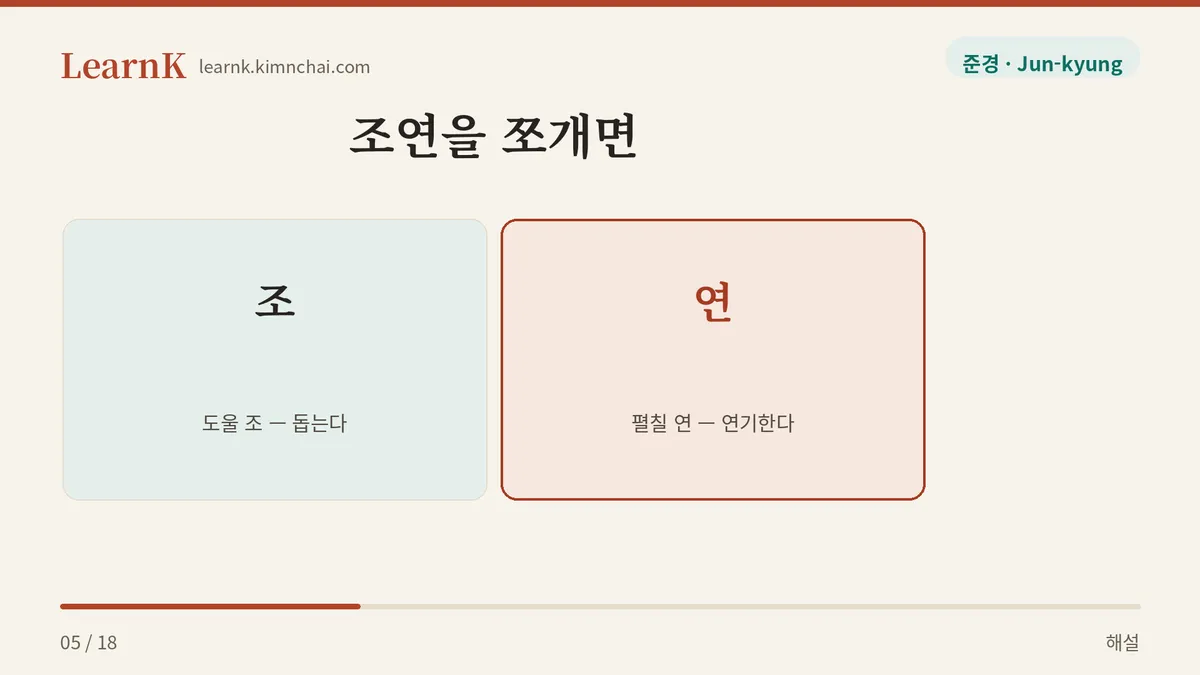
조연 (joyeon) is a Sino-Korean word: 도울 조 (助), “to help,” joined to 펼칠 연 (演), “to unfold, to perform.” Read literally, it means to help the acting along. The 주 (主) in 주연 (juyeon) means master, or center — so the two words were built as a pair from the very beginning. The dictionary lists じょえん【助演】 in its Japanese definition for the same reason: the two languages share the same characters.
What’s interesting is how unusually flat that pair has become in Korea. Major awards ceremonies like the Baeksang Arts Awards and the Blue Dragon Film Awards have separate best supporting actor and actress categories, and it’s not rare for one of those acceptance speeches to be the most talked-about thing of the entire night. Fans sit through the closing credits to the very end trying to find the name of an actor whose face everyone knows and whose name nobody does. 명품 조연 (myeongpum joyeon) came out of that habit, and right alongside it sits 신 스틸러 (sin seutilleo), coined by importing the English scene stealer.
Move into everyday conversation and this word becomes a tool of modesty. At a wedding, a friend of the couple says 오늘의 주인공은 저 둘이고 저희는 조연이죠 (oneurui juingongeun jeo durigo jeohuineun joyeonijyo), “the stars today are those two, and we’re the supporting cast.” At work, someone who has just finished a project says 제 역할은 조연이었어요 (je yeokhareun joyeonieosseoyo), “my part in it was a supporting one.” This way of pulling yourself back one step is a very common form of politeness in Korean conversation. What matters, though, is the direction. 조연 (joyeon) becomes modesty when you attach it to yourself, and turns into a verdict the moment you attach it to someone else. Keep that one rule and 조연 is a very easy word to use.
Today’s Quiz
You’re about to greet a senior actor you’re meeting for the first time on a drama set. Which of the following sounds most natural?
- 선배님, 이번에 조연 맡으셨죠? 잘 부탁드립니다. (seonbaenim, ibeone joyeon mateusyeotjyo? jal butakdeurimnida.)
- 선배님, 이번 작품에서 맡으신 역할 정말 기대하고 있었습니다. (seonbaenim, ibeon jakpumeseo mateusin yeokhal jeongmal gidaehago isseotseumnida.)
- 선배님은 조연이시니까 편하게 하시면 돼요. (seonbaenimeun joyeonisinikka pyeonhage hasimyeon dwaeyo.)
The answer is number 2. Number 1 has nothing grammatically wrong with it, but confirming the size of someone’s part in your very first greeting gives the impression that you’re knocking them down a peg. Number 3 is far ruder still, since it amounts to offering to lighten their load on the grounds that they’re a supporting player. 조연 (joyeon) is a word for talking about a production — not a name tag you pin on someone standing in front of you. With the person themselves, always open with the role and the acting.
Definitions and example sentences are from the National Institute of Korean Language’s Basic Korean Dictionary (krdict.korean.go.kr); that portion of this post, including our translations, is licensed under CC BY-SA 2.0 KR.