꿀잼 (kkuljaem): 'Fun as Sweet as Honey' — Korean's Ultimate Cry of Delight
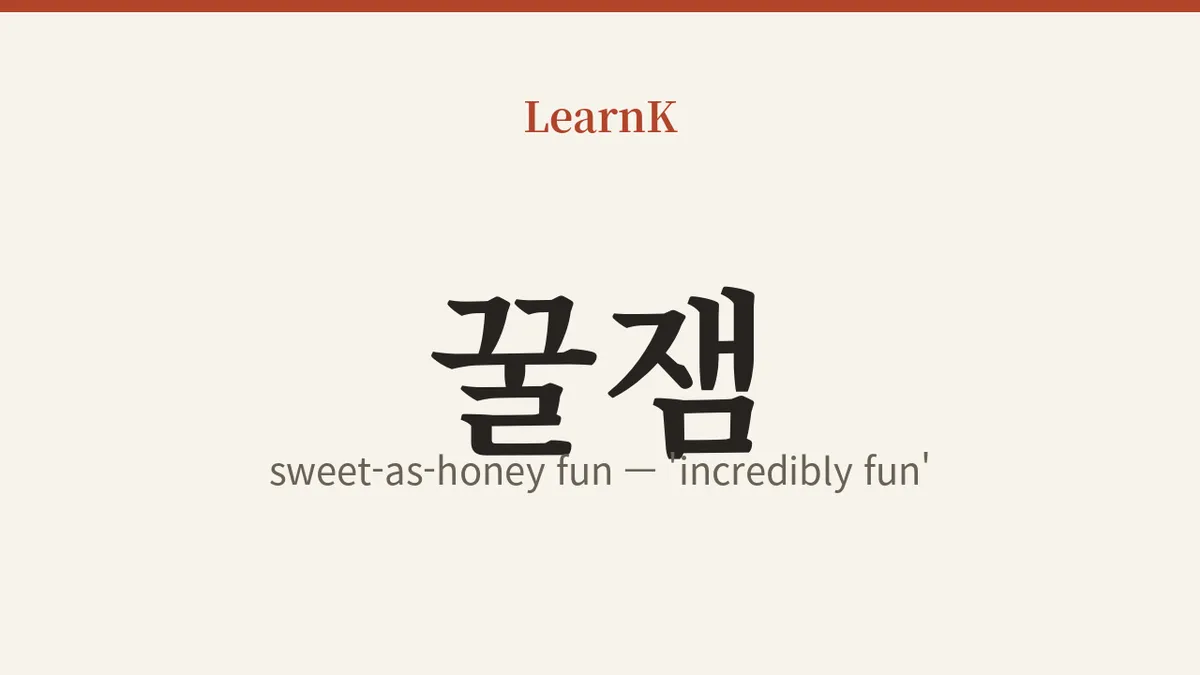
Have you ever pulled an all-nighter binge-watching a Korean drama? Or gotten a game recommendation from a friend and fallen so deep into it that you lost all track of time? In moments like those, there’s one word Koreans always have on the tip of their tongue: 꿀잼 (kkuljaem). Today, let’s take a deep dive into this expression that pops up everywhere, from social media comments to variety-show subtitles.
꿀잼
꿀잼 (kkuljaem) is a coined word made by combining two words. It joins 꿀 (kkul, 꿀=honey) with 잼 (jaem), the first part of 재미 (jaemi, 재미=fun). Translated literally, it means ‘fun as sweet as honey’ — in other words, ‘incredibly fun.’ In Korean, 꿀 (honey) is used almost like a prefix to emphasize ‘something really good,’ which is where words like 꿀팁 (kkultip, a really useful tip) and 꿀잠 (kkuljam, a wonderfully sweet sleep) come from too.
It’s helpful to learn the opposite as well. When something isn’t fun at all, you say 노잼 (nojaem). It’s a blend of the English ‘no’ and the 잼 (jaem) from 재미. So Koreans can sum up a movie in a single word after watching it: “꿀잼?” “아니, 노잼.” (“Fun?” “Nope, boring.”) Just knowing these two words is enough to hold a conversation.
Checking the National Institute of Korean Language Dictionary
Let’s use a source from a national institution to confirm whether this expression is really a proper word listed in the dictionary.
꿀잼 (noun): (figuratively) A word used to describe something very fun. [en] fun fun; blast — (figurative) A word used to describe something very fun. [zh] 超有趣,非常好玩 — (喻义)形容某件事情极为有趣。 — National Institute of Korean Language, Basic Korean Dictionary (krdict.korean.go.kr)
Note that the definition includes the phrase ‘figuratively.’ This means honey isn’t literally sweet here — rather, it’s a metaphor that likens ‘fun’ to that sweetness. Now let’s look at the actual example sentences the dictionary provides.
내가 요즘 즐겨 보는 텔레비전 프로그램은 정말 꿀잼이다. — National Institute of Korean Language, Basic Korean Dictionary (krdict.korean.go.kr)
This is a situation where someone is introducing a show they enjoy and emphasizing, ‘This is really fun.’ Adding ‘-이다’ as in 꿀잼이다 (kkuljaemida) turns it into a predicate.
조금 보다가 말았어. 이 드라마의 원작 소설이 더 꿀잼이야. — National Institute of Korean Language, Basic Korean Dictionary (krdict.korean.go.kr)
Here the speaker is comparing, saying the original novel is more fun than the drama. It also pairs nicely with adverbs of degree, as in 더 꿀잼 (deo kkuljaem, 더=more).
지수와 나는 꿀잼이라고 소문난 게임을 하기로 했다. — National Institute of Korean Language, Basic Korean Dictionary (krdict.korean.go.kr)
Here it’s used as a modifier: 꿀잼이라고 소문난 (kkuljaemirago somunnan), meaning ‘rumored to be fun.’ It can also come before nouns like games, movies, or dramas to modify them, as in 꿀잼 영화 (kkuljaem yeonghwa, a fun movie) and 꿀잼 드라마 (kkuljaem deurama, a fun drama).
Example Sentences by Situation (Original)
Situation 1 — Recommending content to a friend
어제 그 웹툰 봤어? 진짜 꿀잼이야, 꼭 봐! (eoje geu weptun bwasseo? jinjja kkuljaemiya, kkok bwa!) “Did you see that webtoon yesterday? It’s seriously so fun — you have to watch it!”
Situation 2 — Sharing your thoughts on a movie you just watched
기대 안 했는데 완전 꿀잼이었어. 두 시간이 순삭됐어. (gidae an haetneunde wanjeon kkuljaemieosseo. du sigani sunsakdwaesseo.) “I wasn’t expecting much, but it was a total blast. Two hours just flew by.”
Situation 3 — Looking back on a trip or an experience
이번 부산 여행 진짜 꿀잼이었다. 다음에 또 가자! (ibeon busan yeohaeng jinjja kkuljaemieotda. daeume tto gaja!) “This Busan trip was really fun. Let’s go again next time!”
As you can see, 꿀잼 can be used not just for content but broadly for ‘anything that was fun’ — trips, gatherings, experiences, and more.
Seeing It in a Real Conversation
Scene: The entrance of Jun-kyung’s house. Emily has come to return the Nintendo game she borrowed last week.
Emily: 자, 게임 돌려주러 왔어. 나 이거 때문에 주말이 순삭됐잖아. Here, I came to return the game. This thing made my whole weekend just vanish.
Jun-kyung: 거봐, 내가 꿀잼이랬지? 소문날 만하지? See? I told you it’s a blast. Lives up to the hype, right?
Emily: 인정. 처음엔 노잼인 줄 알았는데 두 시간 지나니까 못 멈추겠더라고. Agreed. At first I thought it’d be a dud, but two hours in I couldn’t stop.
Jun-kyung: 그니까. 다음 편은 더 꿀잼이야. 그것도 빌려줄까? Right? The next one’s even more fun. Want to borrow that one too?
Emily: 오 진짜? 완전 좋지. 근데 이번 주 야근이라 또 주말에 밤새게 생겼네. Oh really? Absolutely. But I’ve got overtime this week… looks like another all-nighter this weekend.
Jun-kyung: 하하, 몸 상한다. 그래도 이건 밤샐 값어치 있어, 진짜. Haha, take care of yourself. But this one’s worth the all-nighter, seriously.
Comparing Formal/Casual Speech and Similar Expressions
Since 꿀잼 was born as internet slang, it’s basically reserved for casual, informal (반말) situations. Feel free to use it with friends, on social media, and in comments, but it doesn’t suit a boss at work or an adult you’re meeting for the first time. When you need to be formal, switch it out like this:
- Casual/slang: 꿀잼이야 (kkuljaemiya)
- Polite expressions: 정말 재미있어요 (jeongmal jaemiisseoyo) / 아주 흥미로웠습니다 (aju heungmiroweotseumnida)
A similar intensified expression is 개꿀잼 (gaekkuljaem). The prefix ‘개-’ pushes the degree to the extreme, giving a nuance of ‘insanely awesome fun,’ but it’s rougher, so it’s only used among close friends. Conversely, when something is truly boring, you can use the 노잼 (nojaem) mentioned earlier.
Cultural Background — Why ‘Honey’?
In Korean variety shows and dramas, the word ‘꿀잼’ flashes across the screen in big letters at every funny moment. It’s a kind of signal that points out in advance the fun the viewer is about to feel. It’s also used to describe a character who’s totally absorbed in something.
이거 완전 꿀잼인데? — Drama Start-Up (tvN, 2020)
It’s the kind of phrasing that would come out naturally in a scene where young characters find something new exciting. In this way, 꿀잼 may not appear in stiff textbooks, but it’s a key word for understanding the everyday conversations of young Koreans and their online culture.
Closing Quiz
You watched a drama a friend recommended and got so hooked that you stayed up all night. The next day, you want to share your thoughts with that friend. Which of these sounds the most natural?
- 그 드라마 완전 노잼이야. (That drama was totally boring.)
- 그 드라마 완전 꿀잼이야, 밤새 봤어! (That drama was such a blast — I watched it all night!)
- 그 드라마 아주 흥미로웠습니다. (That drama was very intriguing.)
The answer is number 2. In a casual (반말) situation between friends, 꿀잼 is perfect for conveying the excitement of ‘that was really fun.’ (Number 3 is correct in meaning, but it’s far too formal to use with a friend.)
Definitions and example sentences are from the National Institute of Korean Language’s Basic Korean Dictionary (krdict.korean.go.kr); that portion of this post, including our translations, is licensed under CC BY-SA 2.0 KR.