The Star of the Drinking Table, ‘안주’ — One Word That Captures Korean Drinking Culture
You’ve probably seen it plenty of times in Korean dramas: characters sitting at a pojangmacha (street food tent) or a bar, tipping back glasses of soju. And on the table you’ll spot food like 김치 (kimchi), 계란말이 (gyeranmari, rolled omelet), and 마른오징어 (mareun-ojingeo, dried squid). What do Koreans call this food? That’s today’s expression: 안주 (anju).
안주
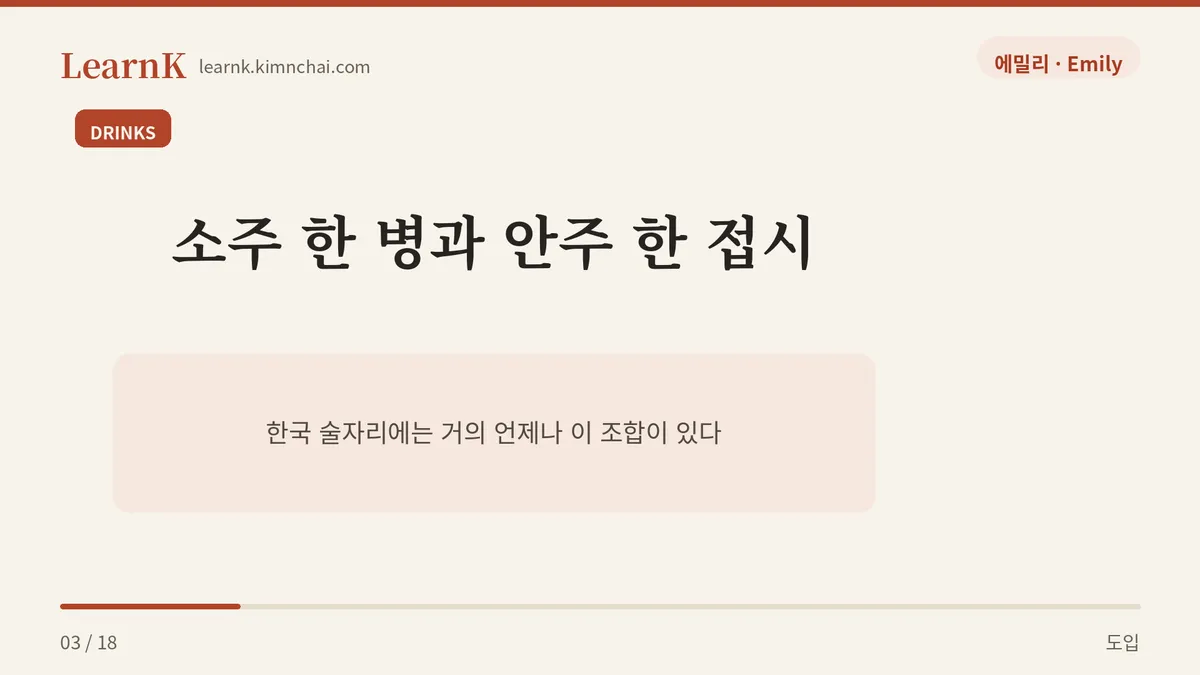
안주 (anju) means food you eat alongside your drinks. Unlike the Western “drinking without food” culture, in Korea alcohol almost always comes with 안주 (anju). There’s a deep-rooted belief captured in the phrase ‘술만 마시면 속 버린다 (sul-man masimyeon sok beorinda)’—“if you only drink, you’ll wreck your stomach.” So 안주 (anju) isn’t just food; it’s the heart of Korean drinking culture, where people drink and share stories together.
Checking the National Institute of Korean Language Dictionary
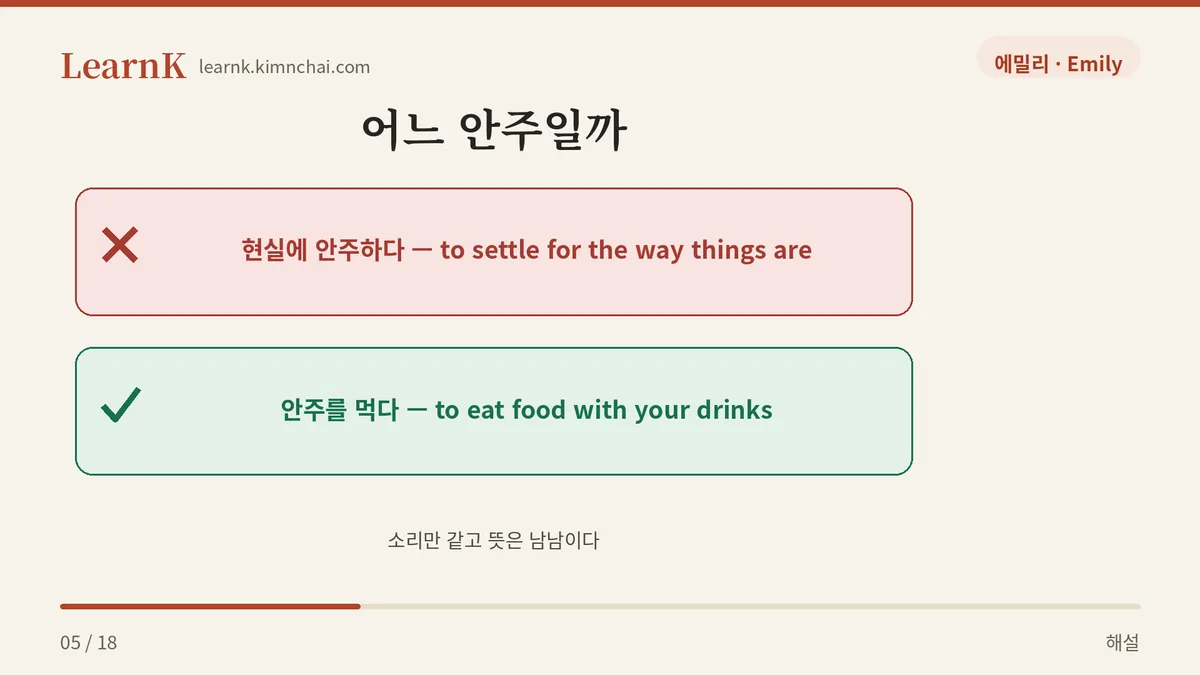
First, one thing to clear up. If you search the National Institute of Korean Language dictionary for the word that sounds like 안주, the first result you’ll get is a homonym (同音異義語, homophone with a different meaning): 안주 (安住), meaning “a settled, peaceful life,” as shown below.
안주 「noun」
- Settling down in one place and living comfortably. [en] living in peace [es] asentamiento, vida tranquila [zh] 安居乐业,定居
- Being satisfied with your current situation or circumstances. [en] satisfaction; settling for [es] complacencia [zh] 安于现状 — National Institute of Korean Language, Basic Korean Dictionary (krdict.korean.go.kr)
This 안주 (安住) shows up in phrases like ‘현실에 안주하지 마라 (hyeonsire anjuhaji mara)’—“don’t settle for the way things are; go out and challenge yourself”—and it has nothing to do with the food 안주 (anju) we’re learning today. They just sound the same but are total strangers. The drinking-snack 안주 (anju) we’re learning, on the other hand, comes vividly to life in the real example sentences below.
그래, 너도 강소주만 마시지 말고 옆에 있는 안주도 좀 먹어. (Come on, don’t just drink your soju straight—have some of the 안주 next to you, too.) — National Institute of Korean Language, Basic Korean Dictionary (krdict.korean.go.kr)
강소주 (gangsoju) is soju drunk plain, with no 안주 (anju). This is a caring, affectionate way of urging someone to “have some 안주, too.”
나는 안주도 없이 강소주를 벌컥벌컥 들이켰더니 속이 쓰렸다. (I gulped down straight soju with no 안주, and my stomach was burning.) — National Institute of Korean Language, Basic Korean Dictionary (krdict.korean.go.kr)
A situation where someone downs strong liquor too fast with no 안주 (anju) and ends up with a burning stomach. It’s a perfect example of why Koreans always make sure to have 안주.
우리는 건포도를 안주 삼아 맥주를 마셨다. (We drank beer with raisins as our 안주.) — National Institute of Korean Language, Basic Korean Dictionary (krdict.korean.go.kr)
‘안주 삼다 (anju samda)’ is an expression meaning “to use something as 안주.” It doesn’t have to be a fancy dish—even a few raisins make a fine 안주.
(Note: the dictionary has no Portuguese translation for the definition above, so we’ve added one ourselves — 안주 (安住): “vida tranquila e estável em um só lugar.”)
Example Sentences by Situation
1. When choosing from the menu at a bar 안주 뭐 시킬까? (anju mwo sikilkka?) — “What 안주 should we order?” It’s the very first thing that comes up the moment you sit down with a friend.
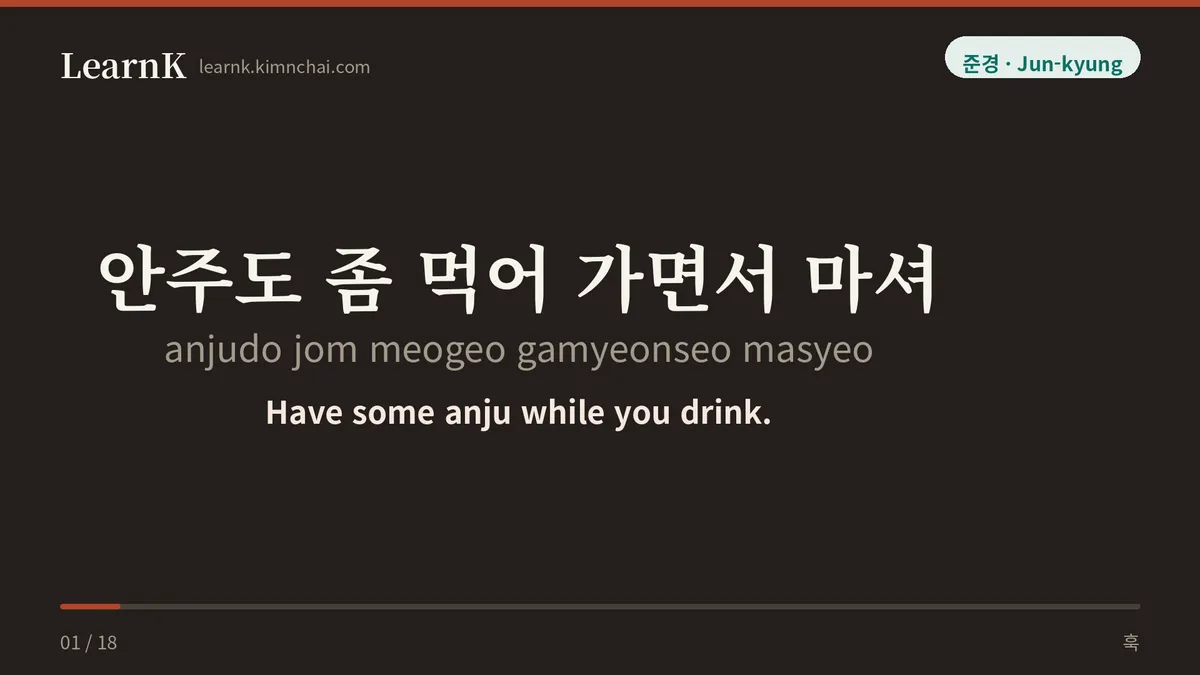
2. When looking out for a friend who’s only drinking 안주도 좀 먹어 가면서 마셔. (anjudo jom meogeo gamyeonseo masyeo.) — A caring remark you offer to a friend who’s pouring drinks into an empty stomach.
3. When you want to keep it light 오늘은 마른안주에 맥주 한잔하자. (oneureun mareun-anjue maekju hanjanhaja.) — 마른안주 (mareun-anju) is dry snack food like squid or peanuts, with no moisture to it.
Formal vs. Casual Speech and Related Expressions
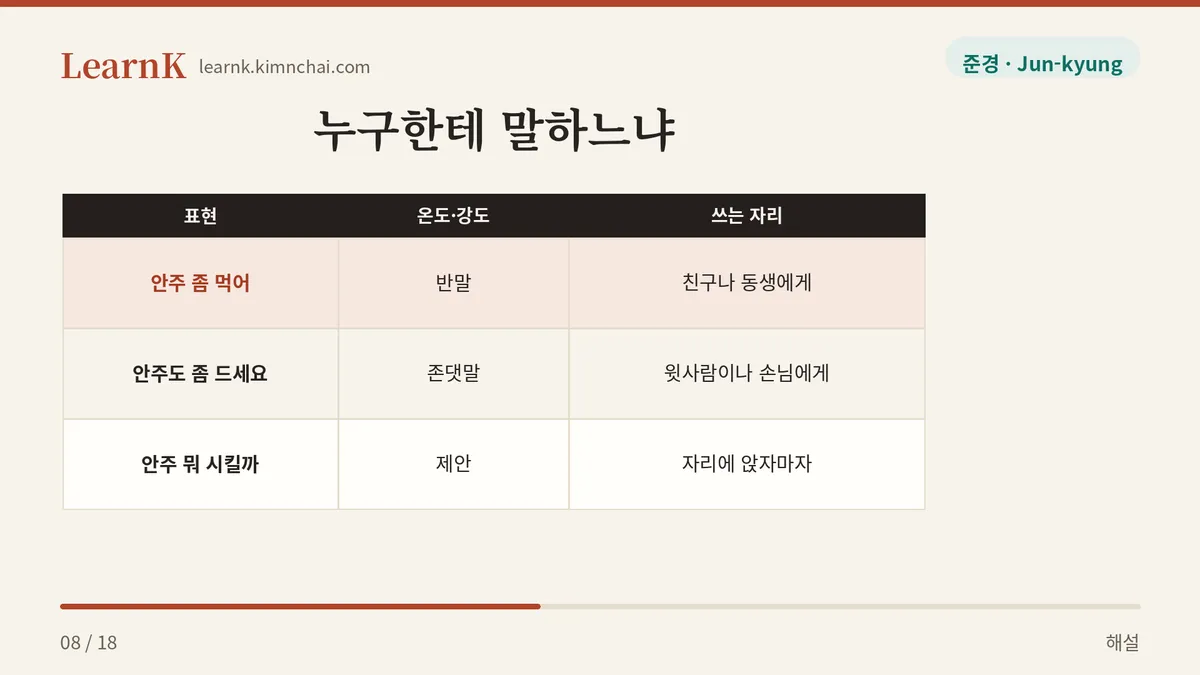
- Casual: 안주 좀 먹어. (anju jom meogeo.)
- Formal: 안주도 좀 드세요. (anjudo jom deuseyo.)
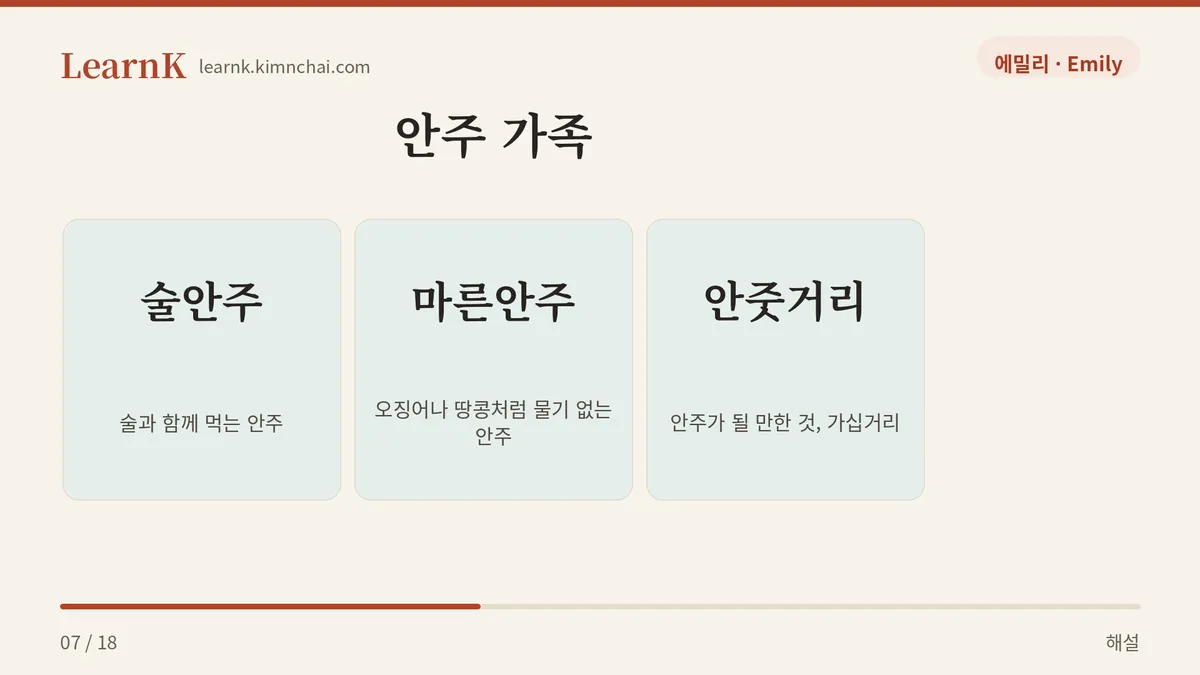
Want to learn some related expressions too? 술안주 (sul-anju) emphasizes that the 안주 goes with alcohol, 마른안주 (mareun-anju) means dry snacks, and 안줏거리 (anjukkeori) means “something that can serve as 안주.” As a side note, ‘안줏거리’ is also used figuratively to mean “fodder for gossip.”
Cultural Background
Picture a pojangmacha scene from a Korean drama. The main character, after a rough day, pours out their heart in front of a bottle of soju and a steaming bowl of 어묵탕 (eomuktang, fish cake soup). Here, 안주 isn’t so much food to fill your stomach as it is a “stage” where conversation and comfort are exchanged. At a company dinner, saying ‘안주 좀 더 시킬까요? (anju jom deo sikilkkayo?)’—“Should we order some more 안주?”—can also mean “let’s keep talking.” So once you understand 안주, you start to see Korea’s culture of 정 (jeong, warm affection).
Closing Quiz
Your friend is downing soju with no 안주 at all. Say something in a single sentence to show you’re worried about them. (Hint: use ‘안주’ and ‘먹다’!)
Definitions and example sentences are from the National Institute of Korean Language’s Basic Korean Dictionary (krdict.korean.go.kr); that portion of this post, including our translations, is licensed under CC BY-SA 2.0 KR.