치킨 (chikin) — In Korea, 닭 (dak) and 치킨 (chikin) Are Two Different Foods
치킨 (chikin)
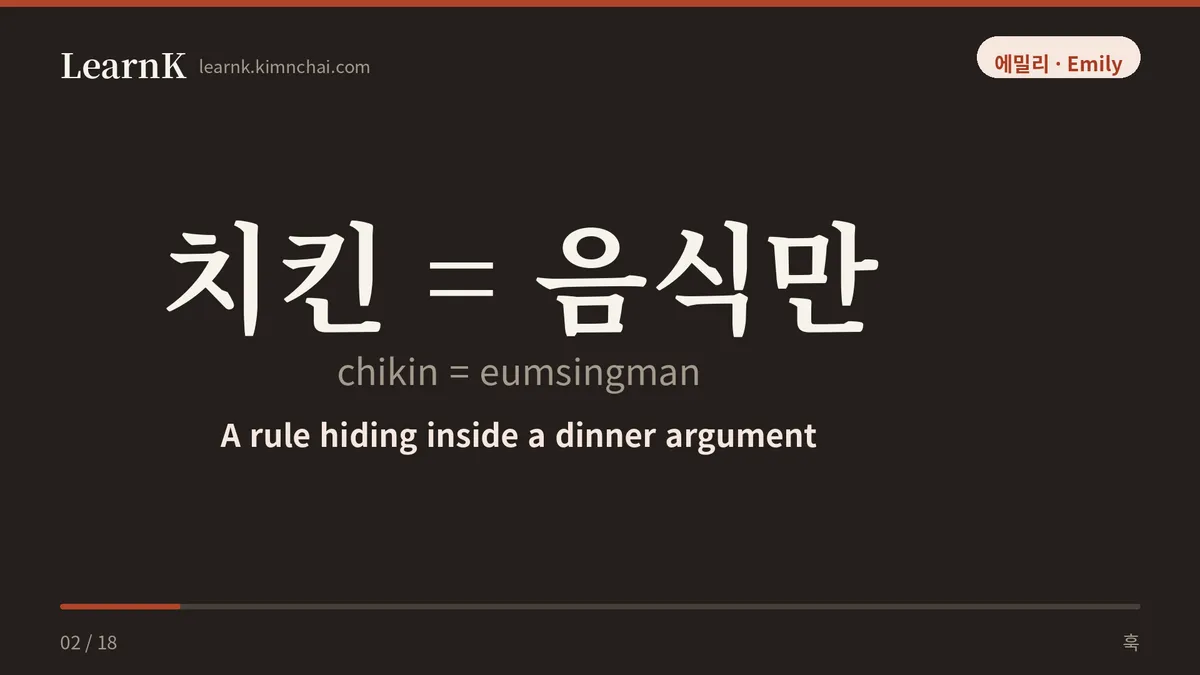
치킨 (chikin) means a dish of chopped-up chicken coated in flour or the like and then deep-fried or roasted. It looks like English chicken borrowed straight over, but the meaning narrowed sharply on the way into Korean. Eight o’clock on a Friday evening: the savory smell of hot oil drifting down an apartment hallway, a helmeted delivery driver stepping out of the elevator — when a Korean says 치킨, that one scene is exactly what comes to mind.
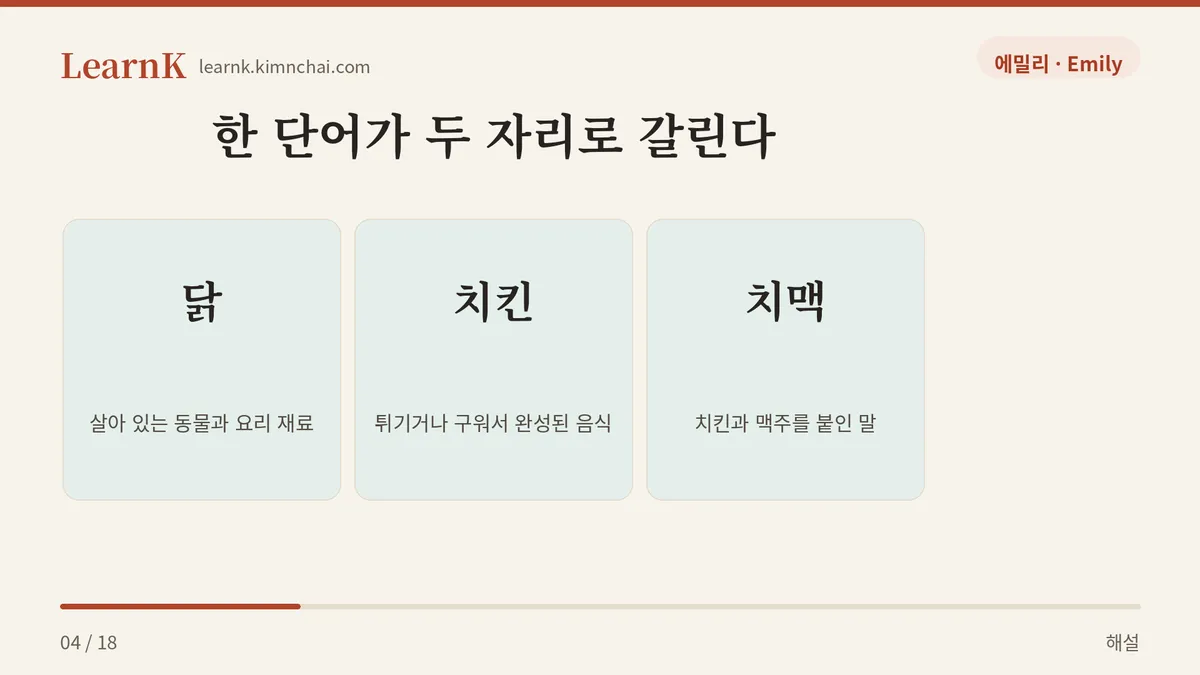
And that’s where learners hit their first wall. English chicken covers the live bird crowing in the yard, the raw meat at the supermarket counter, and the pieces of meat in 삼계탕 (samgyetang, ginseng chicken soup) all at once. Korean 치킨 (chikin), however, refers only to the finished dish — fried or roasted. The ingredient and the animal are handled by 닭 (dak). Get this one boundary firmly in place and your Korean sentences suddenly start sounding natural.
The nuance is light and bright. It isn’t a formal word, so you can bring it up in front of someone older without any awkwardness — you just adjust the sentence ending to fit the listener: 치킨 드세요 (chikin deuseyo) / 치킨 먹어 (chikin meogeo). In fact, what this word really does is act less like the name of a food and more like a signal. The single line 치킨 시킬까? (chikin sikilkka?) is a proposal: let’s take it easy tonight, let’s stay together a little longer. Which is why it comes out less often when people are hungry than when their hearts loosen up a little.
Checking it in the National Institute of Korean Language dictionary
The National Institute of Korean Language’s Basic Korean Dictionary defines the word like this.
치킨 (chikin) 「noun」 토막을 낸 닭에 밀가루 등을 묻혀 기름에 튀기거나 구운 음식. [en] fried chicken — A dish made by coating chopped chicken with flour, and frying or baking it. [ja] フライドチキン。とりのからあげ【鶏のから揚げ】 — 適当に切った鶏肉に小麦粉などの衣をまぶして、食用油で揚げたり焼いたりした食べ物。 [es] pollo frito, pollo a la brasa — Trozos de pollo rebozados en harina y fritos o cocidos a la brasa. [zh] 炸鸡 — 将切成块的鸡肉裹上面粉,放入油锅里炸或烤的食物。 — National Institute of Korean Language, Basic Korean Dictionary (krdict.korean.go.kr)
Notice the two conditions in the definition: 토막을 낸 닭 (tomageul naen dak, chopped-up chicken) and 튀기거나 구운 (twigigeona guun, fried or roasted). The pre-cooking state simply cannot get inside this word. As a side note, the dictionary carries no Portuguese definition, so the rendering below is our own translation and is not part of the dictionary entry — frango frito: pedaços de frango empanados com farinha, fritos ou assados.
Now let’s go through the dictionary’s actual usage examples one by one.
지수는 맥주에 치킨을 곁들여 먹으면서 축구 경기를 보았다. (Jisuneun maekjue chikineul gyeotdeuryeo meogeumyeonseo chukgu gyeonggireul boatda.) Jisu watched the soccer match while eating chicken alongside her beer. — National Institute of Korean Language, Basic Korean Dictionary (krdict.korean.go.kr)
This is the most typical place chicken shows up: beer and a live soccer broadcast. In Korea these three travel almost as a set, and on days when the national team plays, orders pile up at chicken shops until delivery takes two hours.
너는 치킨 먹을 때 어떤 부위를 제일 좋아해? (Neoneun chikin meogeul ttae eotteon buwireul jeil joahae?) Which part do you like best when you eat chicken? — National Institute of Korean Language, Basic Korean Dictionary (krdict.korean.go.kr)
A casual 반말 (banmal, informal speech) question between close friends. In Korea this may look like a light question about preferences, but it’s also a practical negotiation over whether or not you’ll be giving up a drumstick. People have firm allegiances to 닭다리 (dakdari, drumsticks), 날개 (nalgae, wings), and 퍽퍽살 (peokpeoksal, the dry white breast meat).
우리집 앞에서 치킨을 들고 서 있는 지수의 모습에 서운한 마음이 눈 녹듯 녹아버렸어. 지수가 많이 미안했다고 하더라고. (Urijip apeseo chikineul deulgo seo inneun Jisuui moseube seounhan maeumi nun nokdeut nogabeoryeosseo. Jisuga mani mianhaetdago hadeorago.) The sight of Jisu standing in front of my house holding chicken melted my hurt feelings away like snow. She said she was really sorry. — National Institute of Korean Language, Basic Korean Dictionary (krdict.korean.go.kr)
This example shows nicely that chicken isn’t just food. When saying sorry out loud feels too embarrassing, Koreans show up holding chicken. One paper bag stands in for “I’m sorry.”
피자를 주문하든가 치킨을 주문하든가 하나를 주문하세요. (Pijareul jumunhadeunga chikineul jumunhadeunga hanareul jumunhaseyo.) Order pizza or order chicken — pick one and order it. — National Institute of Korean Language, Basic Korean Dictionary (krdict.korean.go.kr)
The two great mountain ranges of delivery food, side by side. Whenever a group gets together, “pizza or chicken?” is an almost ceremonial debate — and it usually ends with ordering both.
닭다리로만 구성된 치킨이 인기를 끌고 있다. (Dakdariroman guseongdoen chikini ingireul kkeulgo itda.) Chicken made up entirely of drumsticks is gaining popularity. — National Institute of Korean Language, Basic Korean Dictionary (krdict.korean.go.kr)
What matters here is that 닭다리 and 치킨 appear in the same sentence. When you’re talking about the ingredient or a cut, 닭 (dak) attaches — 닭다리 (dakdari, drumstick), 닭가슴살 (dakgaseumsal, chicken breast) — and when you name the finished dish as a whole, it becomes 치킨. The division of labor between the two words is right there in this sentence.
See it in a real conversation
Setting: Han River Park on a Friday evening. A picnic mat is spread out, and they’re waiting on food ordered through a delivery app.
Jun-kyung: 기사님이 3번 출구 앞이래. 나 뛰어갔다 올게. The driver says he’s at Exit 3. I’ll run over and grab it.
Emily: 같이 가! 나 치킨 식은 거 진짜 못 먹어. I’ll come too! I really can’t eat cold chicken.
Jun-kyung: 근데 반반 시키자니까 왜 굳이 후라이드만 했어? By the way, I said let’s get half-and-half — why’d you insist on plain fried?
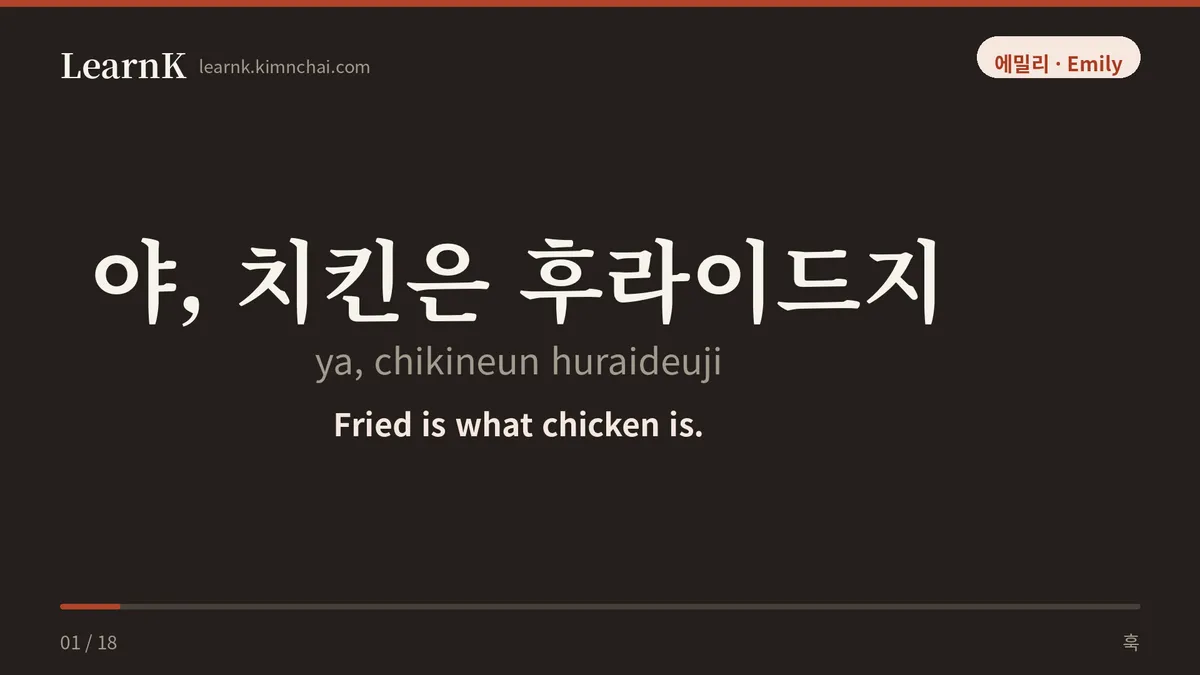
Emily: 야, 치킨은 후라이드지. 양념은 세 조각 넘으면 물려. Come on, fried is what chicken is. Sauced gets cloying past three pieces.
Jun-kyung: 하여간 너 한국 사람 다 됐다. 맥주는 내가 사 올게. Honestly, you’ve turned completely Korean. I’ll go buy the beer.
Emily: 좋아, 그럼 진짜 치맥이네. 치킨 오기 전에 자리 맡아 놓을게. Nice, then it’s proper chimaek. I’ll hold our spot before the chicken gets here.
Said this way, it sounds off
치킨 is the name of a thing, so it isn’t a word you adjust depending on who you’re talking to. Instead, let’s look at the two misunderstandings almost every learner runs into.
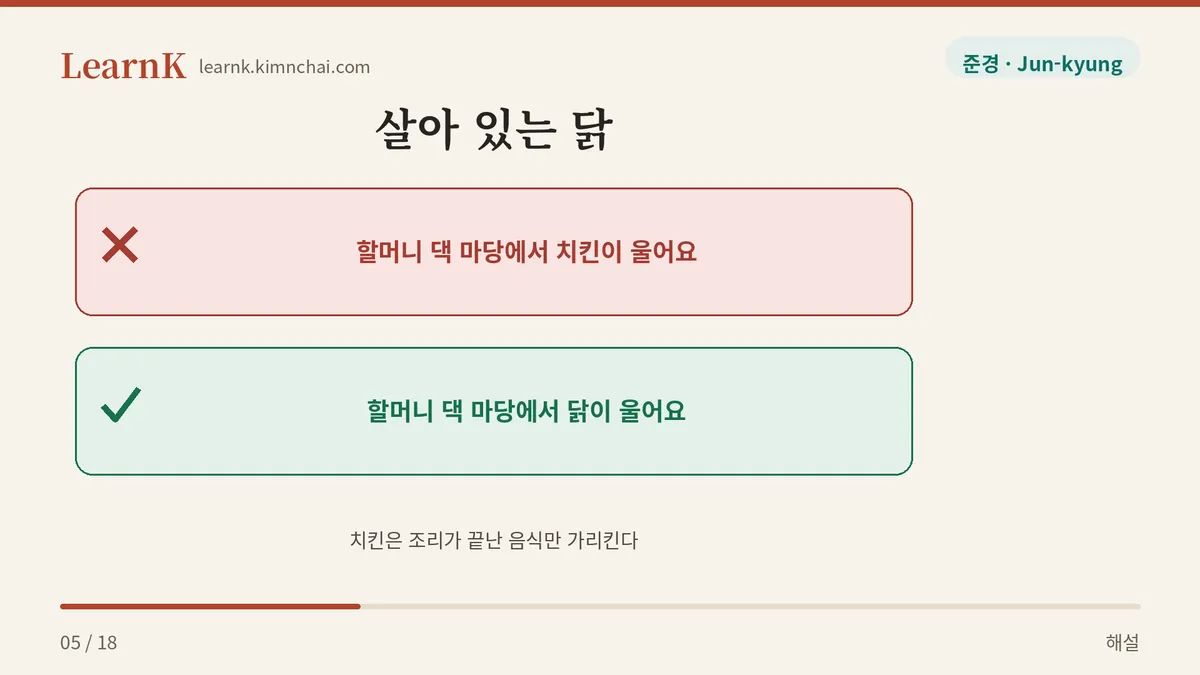
✗ 할머니 댁 마당에서 치킨이 울어요. (halmeoni daek madangeseo chikini ureoyo.) ✓ 할머니 댁 마당에서 닭이 울어요. (halmeoni daek madangeseo dagi ureoyo.) A chicken is crowing in Grandma’s yard. → A living animal is never 치킨. Since 치킨 refers only to fully cooked food, saying it this way conjures up a scene of a deep-fried chicken crowing in the yard.
✗ 감기에 걸려서 엄마가 치킨죽을 끓여 주셨어요. (gamgie geollyeoseo eommaga chikinjugeul kkeuryeo jusyeosseoyo.) ✓ 감기에 걸려서 엄마가 닭죽을 끓여 주셨어요. (gamgie geollyeoseo eommaga dakjugeul kkeuryeo jusyeosseoyo.) I caught a cold, so my mom made me chicken porridge. → You also use 닭 when naming the ingredient in soups and braises. Traditional dishes take 닭, as in 닭죽 (dakjuk, chicken porridge), 닭볶음탕 (dakbokkeumtang, spicy braised chicken), and 닭갈비 (dakgalbi, stir-fried spicy chicken). Names containing 치킨 generally start from something fried — 치킨 샐러드 (chikin saelleodeu, chicken salad), 치킨 버거 (chikin beogeo, chicken burger).
Example sentences by situation
1. When the work dinner ends early and you’re not ready to go home (workplace, 존댓말 polite speech)
아직 아홉 시밖에 안 됐는데, 야식으로 치킨 어때요? 제가 시킬게요. (ajik ahop sibakke an dwaenneunde, yasigeuro chikin eottaeyo? jega sikilgeyo.) It’s only nine — how about chicken for a late-night snack? I’ll order it. Here 치킨 works as the wrapping paper that softens a proposal of “let’s stay together a bit longer.”
2. Rewarding yourself after a hard day (talking to yourself, 반말 informal speech)
오늘 발표 무사히 끝났으니까 나한테 치킨 한 마리 사 줘야겠다. (oneul balpyo musahi kkeunnasseunikka nahante chikin han mari sa jwoyagetda.) The presentation went fine, so I should treat myself to a whole chicken. Chicken is counted with 마리 (mari): 한 마리 (han mari, one), 두 마리 (du mari, two) — the default unit is the whole bird, not the piece.
3. Looking after a guest at your housewarming (to someone older, 존댓말 polite speech)
치킨 좀 더 드세요. 다리는 아직 손도 안 댔어요. (chikin jom deo deuseyo. darineun ajik son do an daesseoyo.) Please have some more chicken. Nobody’s touched the drumsticks yet. The word itself stays as is; only the verb is raised to 드세요 (deuseyo). 치킨 has no separate honorific form.
Politeness levels and similar expressions
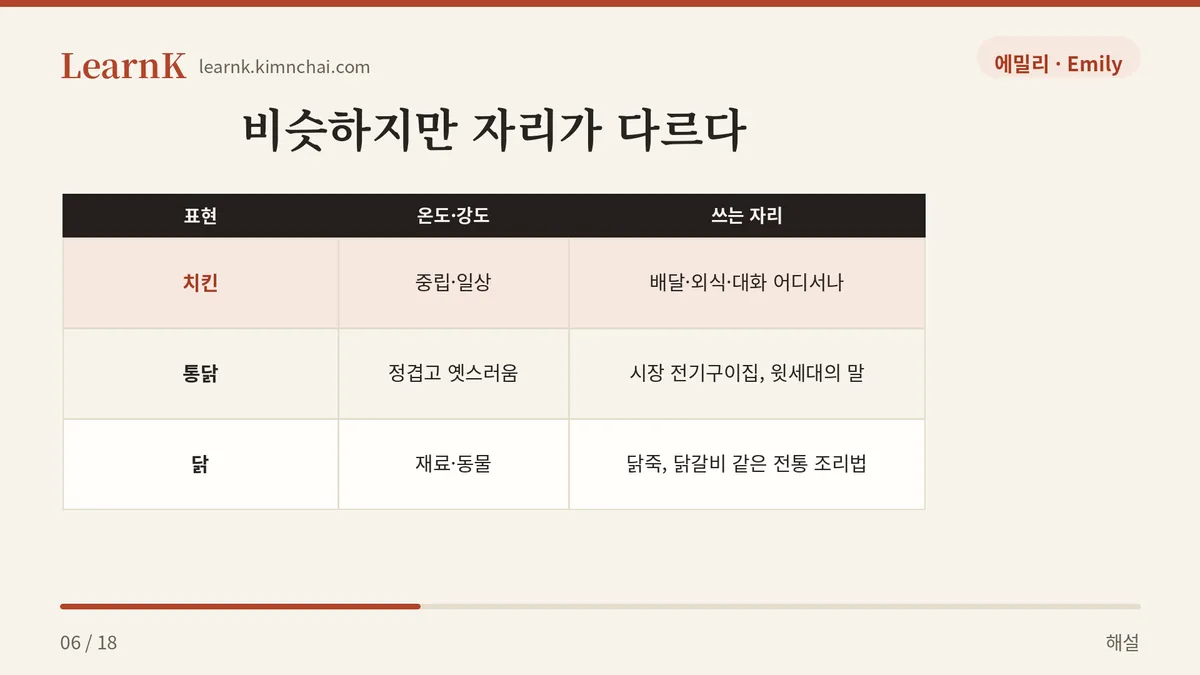
| Expression | Warmth / intensity | Where it’s used |
|---|---|---|
| 치킨 (chikin) | Neutral, everyday | Anywhere — delivery, eating out, conversation |
| 통닭 (tongdak) | Homey, old-fashioned | Rotisserie stalls at markets, old-school whole-chicken shops. Favored by older generations |
| 닭 (dak) | The ingredient or animal itself | Cooking ingredients, live chickens. Not used for fried dishes |
| 치맥 (chimaek) | Light and lively | Among peers, on social media. Not for formal occasions |
Because 치킨 is a noun, informal and polite speech aren’t distinguished in the word itself. The distinction lives in the verb you pair it with. To a friend, 치킨 시키자 (chikin sikija); to someone older, 치킨 주문할까요? (chikin jumunhalkkayo?). Note that 시키다 (sikida) is the everyday word for calling in a delivery, while 주문하다 (jumunhada) sounds a bit more proper.
Cultural background — the national dish of Friday night
The word formation is clear enough. 치킨 is a loanword taken directly from English chicken, but on arriving in Korea its meaning narrowed to “fried chicken dish.” Because the sturdy native word 닭 was already handling the animal and the ingredient, the new word got pushed into the empty slot — the Western-style fried dish. It’s a textbook case of a loanword ending up with a narrower meaning than the original. 치맥 (chimaek), likewise, is a blend of the first syllables of 치킨 and 맥주 (maekju, beer).
In order of appearance, the electric-rotisserie 통닭 of 1960s–70s markets and Myeongdong came first; then in the 1980s, flour-battered 프라이드치킨 (peuraideuchikin, fried chicken) and 양념치킨 (yangnyeomchikin, sauced chicken) arrived and created the landscape we know today. Through the 2002 World Cup, “chicken on game day” became fixed, and to this day, when the pro baseball season rolls around, chicken boxes line up across the stadium stands.
TV dramas played their part too. In SBS’s My Love from the Star, which aired in 2014, a single line the heroine tosses out while looking out the window on a snowy day set off a chimaek craze across much of Asia.
눈 오는 날에는 치맥인데. (nun oneun nareneun chimaeginde.) On a snowy day, it’s supposed to be chimaek. — from the drama My Love from the Star (SBS, 2014)
After that line, Korean-style chicken shops multiplied rapidly across China and Southeast Asia. Korea has dozens of chicken brands and several chicken shops in every neighborhood, and the joke that “Korea has more chicken shops than convenience stores” has been going around for a long time. It’s a line that also carries the hard reality of small-business ownership. So when a Korean friend asks 치킨 시킬까? (chikin sikilkka?), that isn’t a conversation about the dinner menu — it’s closer to an invitation to spend the evening together.
Today’s quiz
Which of the following sentences sounds natural in Korean?
① 할머니 댁 치킨이 알을 낳았어요. (halmeoni daek chikini areul naasseoyo.) ② 감기에 걸려서 치킨죽을 먹었어요. (gamgie geollyeoseo chikinjugeul meogeosseoyo.) ③ 오늘 저녁에 치킨 시켜 먹을까? (oneul jeonyeoge chikin sikyeo meogeulkka?)
Show the answer
Answer: ③ 오늘 저녁에 치킨 시켜 먹을까? (Should we order chicken for dinner tonight?)
① is about a live chicken, so it should be 닭이 알을 낳았어요 (dagi areul naasseoyo), and ② is a traditional dish, so 닭죽 (dakjuk) is correct. Just remember that 치킨 is used only for food that has been finished by frying or roasting, and you can sort out all three at once.
Definitions and example sentences are from the National Institute of Korean Language’s Basic Korean Dictionary (krdict.korean.go.kr); that portion of this post, including our translations, is licensed under CC BY-SA 2.0 KR.