팬덤 (paendeom) — When Affection Gathers and Earns a Name
팬덤
The moment a friend who lost out on concert tickets sighs and says “이 정도 팬덤이면 당연하지 (i jeongdo paendeomimyeon dangyeonhaji)” — “With a fandom this big, of course I didn’t get one” — you can feel the weight of this word. 팬덤 (paendeom) means a group of people who are passionate about a famous person such as an athlete, actor, or singer. It doesn’t point to one person’s feelings, but to the state where many such feelings have gathered into a single mass.
That’s why 팬덤 is even counted differently. 팬이 많다 (paeni manta), “there are a lot of fans,” is a story about the number of people. But 팬덤이 크다 (paendeomi keuda), “the fandom is big,” is a story about the power that comes out when that crowd moves together. An album selling hundreds of thousands of copies in a few days, an entire subway station’s ad space filled up for a birthday, a ticketing window closing in three seconds — faced with results like those, Koreans say 팬덤이 세다 (paendeomi seda), “the fandom is strong.”
The words that attach to it are fairly fixed, too. The verbs that come with it are 형성하다 (hyeongseonghada) (to form), 보유하다 (boyuhada) (to have, to hold), and 가입하다 (gaipada) (to join); when describing its state, words like 크다 (keuda) (big), 단단하다 (dandanhada) (solid), and 탄탄하다 (tantanhada) (sturdy) show up. The interesting part is the temperature. The word 팬덤 itself isn’t as hot as you might expect — it’s actually an analytical word, one that steps back a pace and observes the phenomenon. When enthusiastic people talk about their own feelings, they say “나 팬이야 (na paenya)”, “I’m a fan” — not “나 팬덤이야 (na paendeomiya)”.
These days it reaches beyond entertainers. People attach 팬덤 to politicians, YouTubers, games, and brands as well. Just keep in mind that when it stretches this far, a critical undertone often creeps in — as in “저 사람은 팬덤이 받쳐 주니까 (jeo sarameun paendeomi batchyeo junikka)”, “well, that person has a fandom propping them up.”
Checking It in the National Institute of Korean Language Dictionary
팬덤 「noun」 A group of people who are passionate about celebrities such as athletes, actors, and singers. — National Institute of Korean Language, Basic Korean Dictionary (krdict.korean.go.kr)
Every word the dictionary chose is precise. 열광적으로 (yeolgwangjeogeuro), “fervently,” pins down the intensity of the emotion, and 모인 집단 (moin jipdan), “a gathered group,” nails down the fact that this word points to a crowd, not an individual. And you can confirm here that the targets aren’t only singers — athletes and actors are included too.
The definitions in each language are listed like this.
[en] fandom — A group of people who are passionate about celebrities such as athletes, actors, and singers. [ja] ファンダム — スポーツ選手や俳優、歌手などの有名人を熱狂的に好きな人たちが集まった集団。 [es] fandom — Grupo de seguidores o fans de un deportista, actor, cantante u otra celebridad. [zh] 粉丝圈 — 狂热地喜欢运动员、演员、歌手等名人的团体。 — National Institute of Korean Language, Basic Korean Dictionary (krdict.korean.go.kr)
A Portuguese definition isn’t registered in the dictionary. So we should note that the line below is not a dictionary quotation but our own translation — [pt] fandom — Grupo de pessoas que admiram apaixonadamente uma celebridade, como atletas, atores ou cantores.
Now let’s look at the real usage examples the dictionary includes alongside it.
응. 그 공연 이후에 팬이 된 사람이 꽤 많은 것 같아. 벌써 팬덤도 만들었더라고. — National Institute of Korean Language, Basic Korean Dictionary (krdict.korean.go.kr)
“Yeah. Quite a few people seem to have become fans after that performance. They’ve already formed a fandom.” This is friends talking in casual speech. The first sentence counts individuals — 팬이 된 사람 (paeni doen saram), “people who became fans” — and then the second moves on to 팬덤도 만들었더라고 (paendeomdo mandeureotdeorago), “they even made a fandom.” That shift from individuals gathering into a group happens within a single breath, which makes this the example that best shows the character of the word.
이 가수는 데뷔하기 전부터 강력한 팬덤을 보유하고 있었다. — National Institute of Korean Language, Basic Korean Dictionary (krdict.korean.go.kr)
“This singer had a powerful fandom even before debuting.” This is the kind of sentence you’d find in an article or a profile. Notice the stiff verb 보유하다 (boyuhada), “to hold, to possess,” attached to it. Sometimes a fandom is treated not as emotion but as an asset, and this sentence is exactly that usage. It’s commonly written this way when describing a singer who came out of an audition program.
지나친 팬덤 문화는 배타적인 태도로 변질될 가능성도 있다. — National Institute of Korean Language, Basic Korean Dictionary (krdict.korean.go.kr)
“Excessive fandom culture can also degenerate into an exclusionary attitude.” The fact that the dictionary included this example at all is telling. It means 팬덤 isn’t always a bright word. The clearer “our side” becomes, the more an “outside” comes into being — and when the word 팬덤 appears in Korean news, this worry is voiced along with it more often than not.
팬덤을 형성하다. / 팬덤을 만들다. / 팬덤에 가입하다. / 팬덤 현상. / 팬덤 문화. — National Institute of Korean Language, Basic Korean Dictionary (krdict.korean.go.kr)
These are the representative collocations (words frequently used together) that the dictionary has gathered: to form a fandom / to make a fandom / to join a fandom / the fandom phenomenon / fandom culture. 팬덤을 형성하다 (paendeomeul hyeongseonghada) belongs to written language; 팬덤에 가입하다 (paendeome gaipada) is the concrete act of paying to enter an official fan club; and 팬덤 문화 (paendeom munhwa) covers a whole way of life, from merch to cheering to charity donations. Memorize just these five as chunks and you can build half the sentences that contain 팬덤.
Seeing It in a Real Conversation
Situation: Saturday afternoon, in front of Exit 6 of the subway station. Emily has come out to pick up a photocard from a secondhand trade, and Jun-kyung tagged along because he was bored.
Jun-kyung: 야, 카드 한 장 받겠다고 이 더위에 나온 거야? Hey, you came out in this heat just to get one photocard?
Emily: 응. 이거 팬덤 안에서도 구하기 진짜 어려운 거거든. 운 좋은 거지. Yeah. This one’s really hard to get even inside the fandom. I got lucky.
Jun-kyung: 근데 모르는 사람이랑 이렇게 만나도 괜찮아? But is it okay to meet a stranger like this?
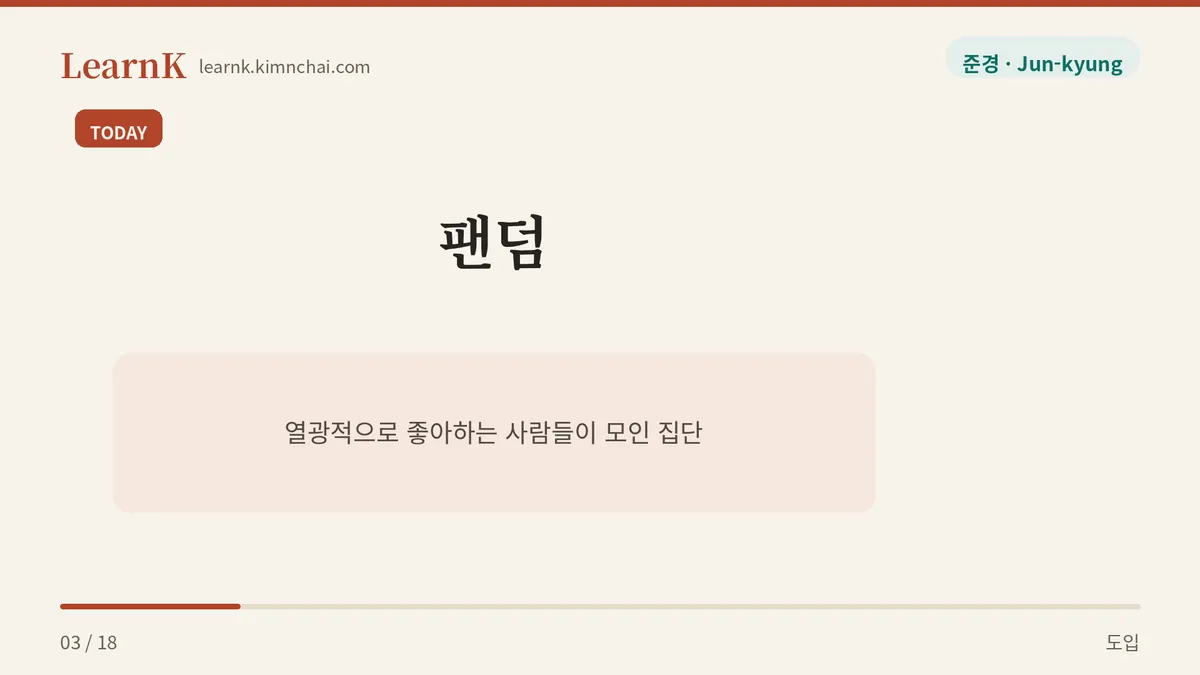
Emily: 괜찮아. 같은 팬덤이면 대충 통해. 사기 치면 소문 다 나거든. It’s fine. If we’re in the same fandom, we sort of get each other. If someone scams you, word gets around.
Jun-kyung: 아… 그건 좀 무섭기도 하네. Ah… that’s a little scary too, actually.
Emily: 그치. 팬덤 문화가 든든하기도 하고 무섭기도 하고, 딱 그래. Right. Fandom culture is reassuring and scary at the same time — that’s exactly it.
This Sounds Awkward
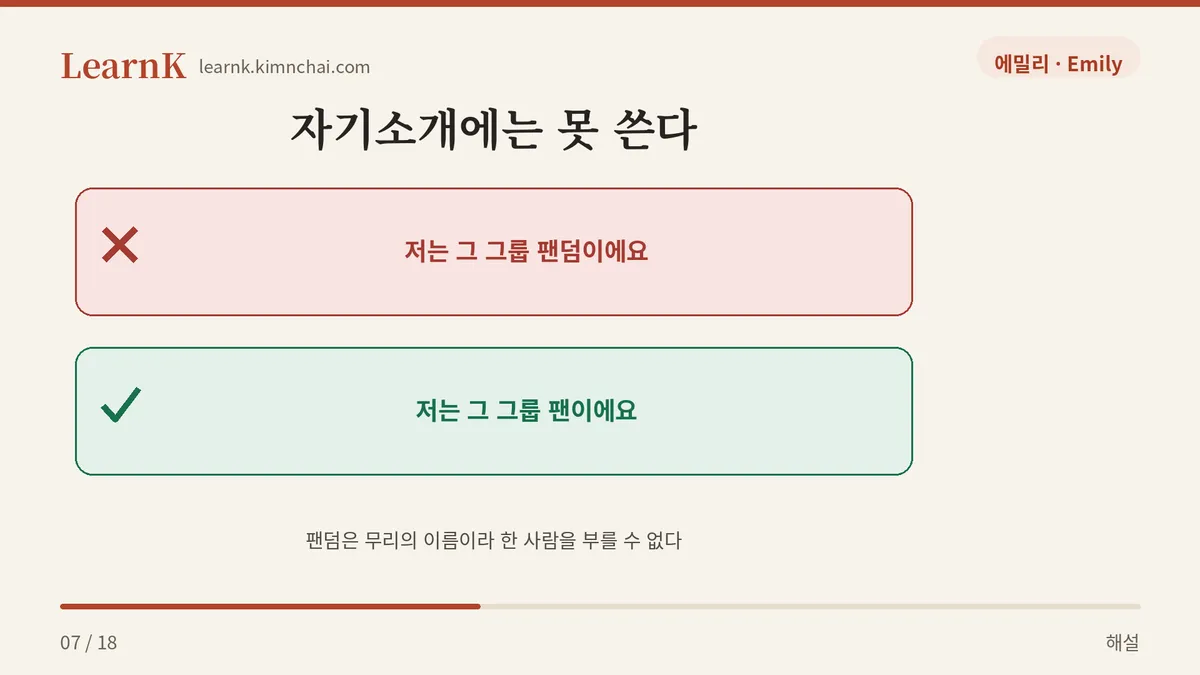
✗ 저는 그 그룹 팬덤이에요. ✓ 저는 그 그룹 팬이에요. / 저 그 그룹 팬덤에 있어요. → “I’m that group’s fandom” vs. “I’m a fan of that group” / “I’m in that group’s fandom.” 팬덤 is the name for a group of people gathered together, not a label for one person. When introducing yourself, say 팬 (paen); if you really want to mention the group, use a form that places you inside it, like 팬덤에 있다 (paendeome itda) or 팬덤에 속해 있다 (paendeome sokhae itda), “to be in / to belong to the fandom.”
✗ (부장님께) 부장님, 사내에 팬덤이 대단하시던데요. ✓ (부장님께) 부장님, 사내에 따르는 분들이 참 많으시더라고요. → (To your department head) “Sir, your fandom in this company is impressive” vs. “Sir, there really are a lot of people in the company who look up to you.” The grammar is fine, but the setting is wrong. 팬덤 is fundamentally a word aimed at stars, so using it toward a senior at work sounds like a joke that teases while pretending to flatter. With bosses, teachers, and elders, 따르는 사람이 많다 (ttareuneun sarami manta), “many people follow/look up to you,” or 신망이 두텁다 (sinmangi duteopda), “to be held in deep trust,” is the safe choice.
Example Sentences by Situation
1. Right after an audition program airs, texting with a friend
This is what you say about a contestant whose reception flipped completely after one stage the night before.
어제 무대 하나로 팬덤이 확 커졌더라 (paendeomi hwak keojyeotdeora). One stage yesterday and the fandom got way bigger.
커지다 (keojida), “to grow bigger,” is one of the verbs that attaches best to 팬덤. It means the number of people went up, and at the same time that the power grew stronger.
2. After failing to get concert tickets
This is the sentence that comes out — half frustration, half acceptance — when the booking window closes the instant it opens.
팬덤이 크면 티켓 경쟁도 그만큼 세지 (paendeomi keumyeon tiket gyeongjaengdo geumankeum seji). If the fandom is big, the ticket competition gets just as fierce.
Korea’s concert culture, where affection turns straight into competition, is packed into this one sentence.
3. Reading an article about overseas activities, in a slightly serious mood
This is the analytical temperature mentioned earlier, the usage you find in news and reviews.
이 그룹은 국내보다 해외 팬덤이 더 단단하다 (paendeomi deo dandanhada). This group’s fandom is more solid overseas than at home.
If 크다 (keuda) is about scale, then 단단하다 (dandanhada) and 탄탄하다 (tantanhada) mean it doesn’t scatter easily. You use these expressions to talk about the fans who remain even after the trend has passed.
Formal and Casual Speech, and Similar Expressions
팬덤 is a noun, so you only need to change the sentence ending. Casually it’s 팬덤이 크더라 (paendeomi keodeora); politely it’s 팬덤이 큽니다 (paendeomi keumnida) or 팬덤이 커요 (paendeomi keoyo). The word itself carries no level of formality, so it goes straight into news articles and chats with friends alike.
Let’s line up the neighboring words that are easy to mix up.
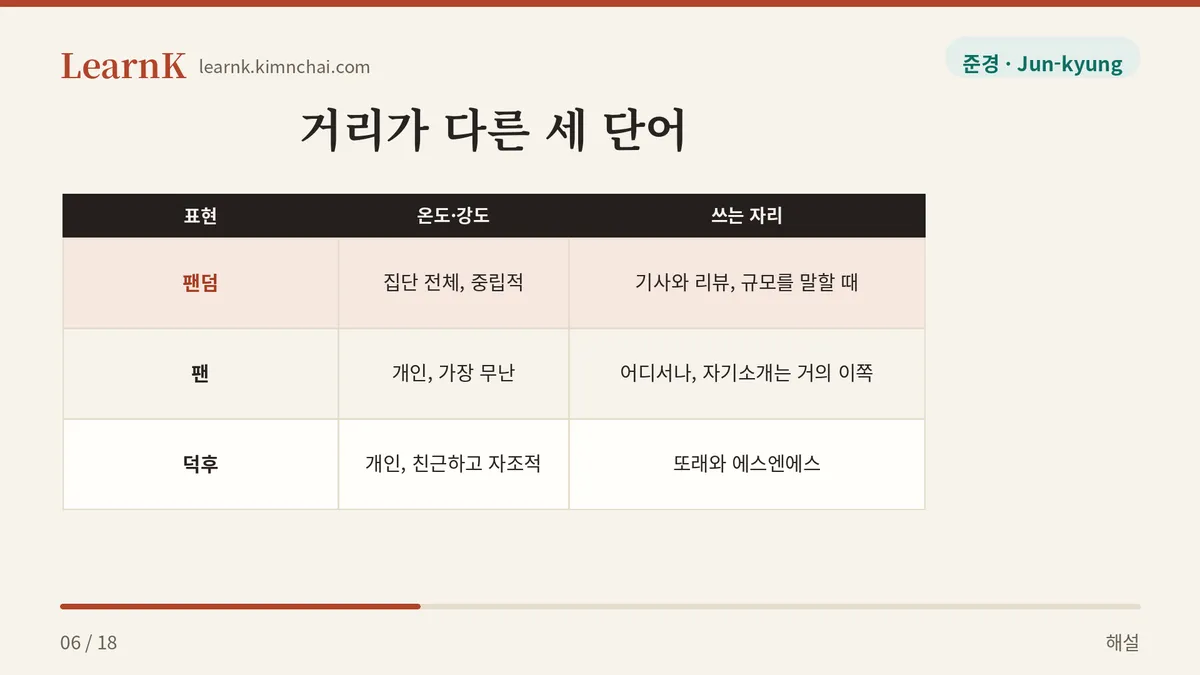
| Expression | Temperature / Intensity | Where it’s used |
|---|---|---|
| 팬덤 (paendeom) | The group as a whole. Neutral and analytical | Articles and reviews; among fans when discussing scale or mood |
| 팬 (paen) | An individual. The safest option | Anywhere. Almost always the one for self-introductions |
| 덕후 (deokhu) | An individual. Friendly and self-deprecating | With peers and on social media. Be careful in front of superiors |
“저 그 배우 팬이에요 (jeo geu baeu paenieyo)”, “I’m a fan of that actor,” is safe anywhere; “저 완전 덕후예요 (jeo wanjeon deokhuyeyo)”, “I’m a total geek about it,” is something you say with a laugh in front of friends; and “팬덤이 대단하죠 (paendeomi daedanhajyo)”, “the fandom is something else, isn’t it,” is said while looking at that crowd from the outside. All three sentences point from a different distance.
Cultural Background — The Moment It Gets a Name
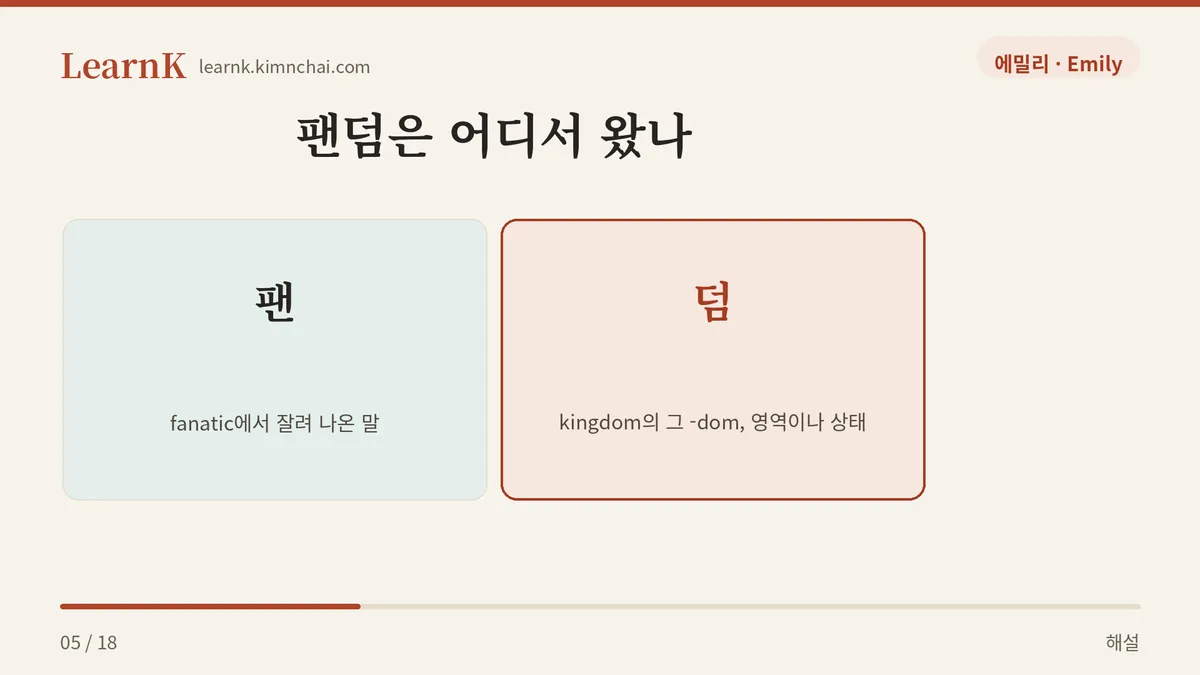
팬덤 is the English word fandom brought over as is. Fan is a clipping of fanatic, and the -dom on the end is the same -dom as in kingdom and freedom — meaning a domain or a state. So taken literally, it’s “the domain of the fervent.” The fact that the word is built like the name of a country fits Korean fandom culture oddly well.
The reason fandom looks special in Korea is that these crowds have actual names. Every group has an official fandom name, a color, and a light stick to hold. That scene where the venue goes dark and then tens of thousands of lights switch on in the same color — that scene makes the abstract word 팬덤 visible. The moment a name and a color appear, scattered affection becomes belonging.
The way they operate is organized, too. They stream the music together during release week, pool money to put up subway ads for birthdays, donate in an idol’s name, and send food trucks to filming sites. The word that bundles all of this together — and it’s in the dictionary as well — is 팬덤 문화 (paendeom munhwa). And this culture didn’t suddenly appear within the last 20 or 30 years. The drama Reply 1997 (tvN, 2012) portrayed a high schooler in 1990s Busan spending an entire day on one singer she loved, showing that even back in the dial-up BBS era, people were already gathering, naming themselves, and arguing.
That said, as the dictionary example quietly warned, the power to band together also creates an outside. When you run into the word 팬덤 in Korean news, sometimes it’s praise and sometimes it’s concern. That’s why you should check the context one more time before using this word.
Today’s Quiz
A friend says, “나 요즘 그 배우한테 완전 빠졌어” (“I’m totally hooked on that actor lately”). Which is the most natural thing to say next?
- 오, 너 이제 그 배우 팬덤이네. (Oh, you’re that actor’s fandom now.)
- 오, 그 배우 팬덤 진짜 크던데. (Oh, that actor’s fandom is seriously big.)
- 오, 너 팬덤 하나 만들었구나. (Oh, so you’ve made yourself a fandom.)
The answer is number 2. 팬덤 refers to a group, so you can’t say 팬덤이네 (paendeomine) about a single friend — that makes number 1 awkward (팬이네 (paenine), “you’re a fan,” or 덕후 다 됐네 (deokhu da dwaenne), “you’ve become a full-on geek,” would be right). The phrase 팬덤을 만들다 (paendeomeul mandeulda) in number 3 is a perfectly normal expression that’s even in the dictionary, but it would mean this person who just started liking the actor single-handedly built a crowd, which doesn’t match the situation. Talking about the scale of a crowd that already exists, as in number 2 — that’s where this word belongs.
Definitions and example sentences are from the National Institute of Korean Language’s Basic Korean Dictionary (krdict.korean.go.kr); that portion of this post, including our translations, is licensed under CC BY-SA 2.0 KR.