Today's Korean: 김치 (kimchi) — the Food You Don't Make, You 담그다 (damgeuda)
김치 (gimchi)
김치 (gimchi) means a food made by salting vegetables such as napa cabbage or radish, tossing them with seasoning, and letting them ferment. It is the first word most Korean learners memorize, and also the word they go on using with a misunderstanding attached for the longest. The reason is simple: 김치 is not the name of one dish printed on a menu. It is a word that occupies an entire shelf of a Korean refrigerator and the rhythm of a whole year of running a household. Once November comes around, the news reports the price of cabbage, and phone calls go back and forth between families about how many heads to put up this year. To use this word properly, you have to know not just what it means but the places where it gets said.
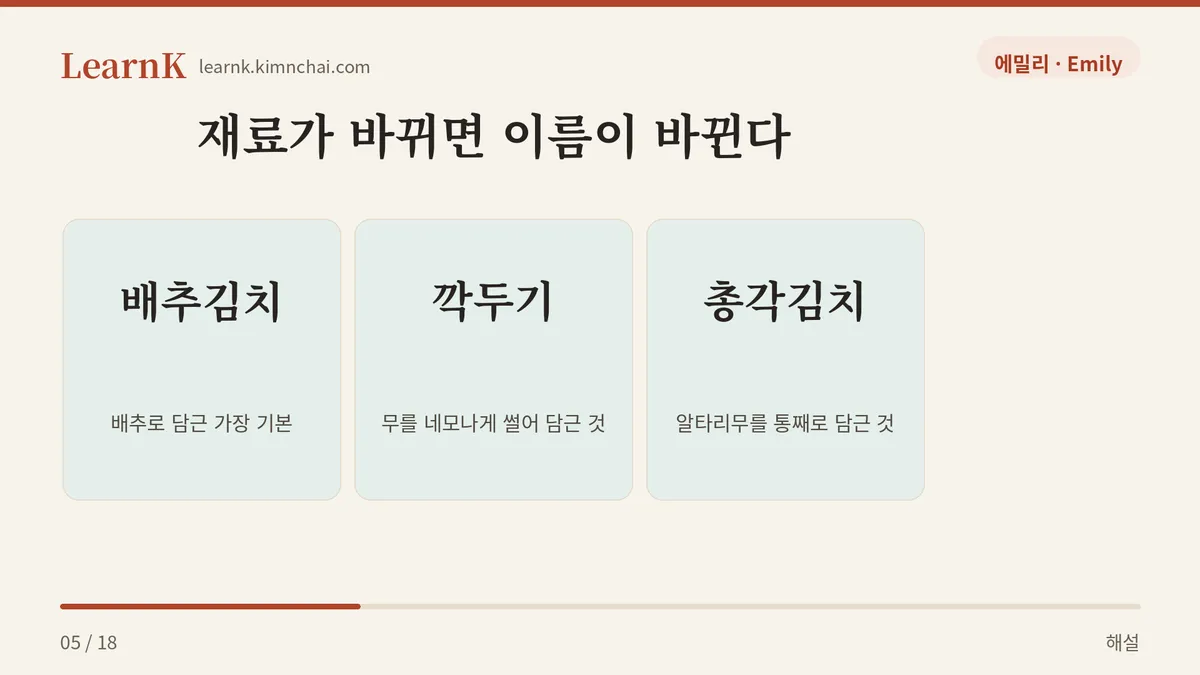
The first thing to know is that 김치 works more like an umbrella term for a whole category. 배추김치 (baechu-gimchi), 깍두기 (kkakdugi), 총각김치 (chonggak-gimchi), 갓김치 (gatgimchi), 파김치 (pagimchi), 오이소박이 (oisobagi) — change the ingredient and the name changes, but every one of them is 김치. So when a Korean asks 집에 김치 있어? (jibe gimchi isseo?), they are not asking about one specific side dish. They are asking whether you have any of that salted-and-fermented kind of side dish in the house.
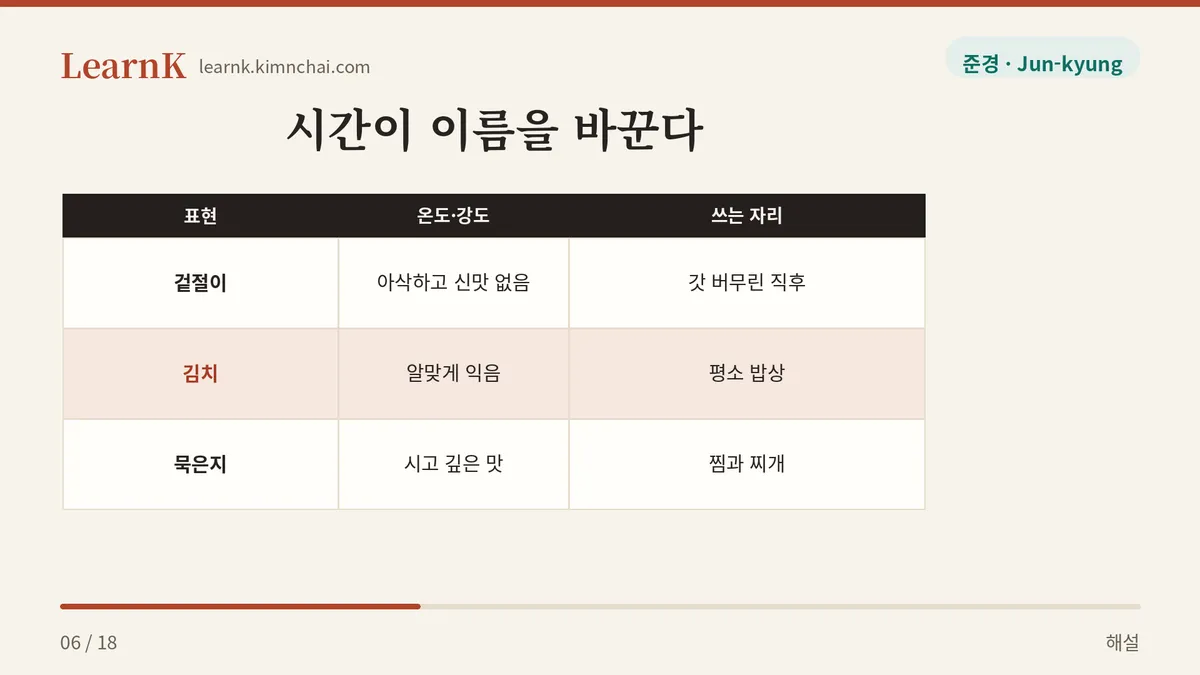
Second, the word 김치 has time built into it. Freshly tossed and not yet fermented, it is 겉절이 (geotjeori). Fermented to just the right point, it is simply 김치. Aged a long time until it turns sour, it is 묵은지 (mugeunji) or 신김치 (singimchi). That is why 김치가 맛있다 (gimchi-ga masitda) and 김치가 잘 익었다 (gimchi-ga jal igeotda) are two different compliments. The first one is about flavor; the second one says the fermentation has arrived at exactly the right spot.
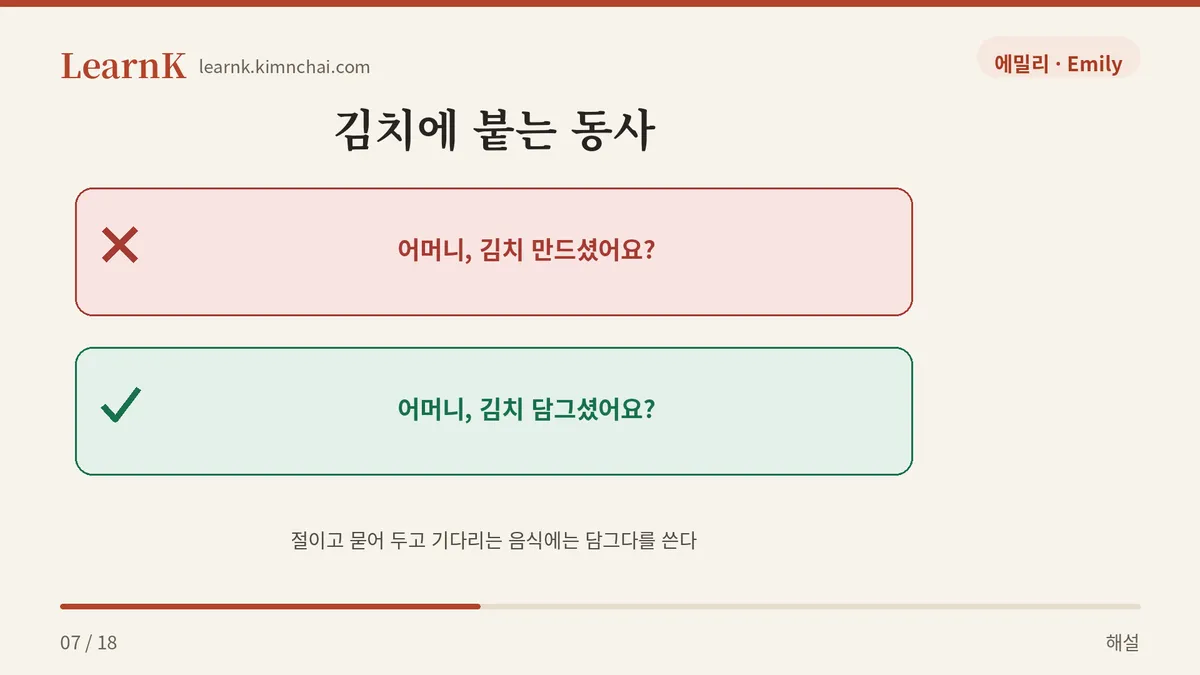
The third point is where learners slip most often: you do not 만들다 (mandeulda, to make) 김치 — you 담그다 (damgeuda) it. Swapping in that one verb makes your sentence sound far more Korean.
Checking It in the National Institute of Korean Language Dictionary
First, let us look at exactly how the national institute’s dictionary unpacks this word.
김치 (gimchi) 「noun」 배추나 무 등의 채소를 소금에 절인 후 양념에 버무려 발효시켜서 만든 음식. A food made by salting vegetables such as napa cabbage or radish, then mixing them with seasoning and letting them ferment. — National Institute of Korean Language, Basic Korean Dictionary (krdict.korean.go.kr)
The same dictionary carries definitions in several other languages, which we reproduce here too. It is interesting how the focus shifts a little from language to language.
- [en] kimchi — A staple of the Korean diet made by salting vegetables such as kimchi cabbages, white radishes, etc., and seasoning and fermenting them.
- [ja] キムチ — 白菜や大根などの野菜を塩に漬けた後、薬味を混ぜて発酵させて作った食べ物。
- [es] kimchi — Alimento que se prepara salando legumbre como el col o nabo que luego se mezcla con condimentos y se deja para la fermentación.
- [zh] 辛奇 — 把白菜或萝卜等蔬菜用盐腌过后拌上作料,经过发酵而成的食物。 — National Institute of Korean Language, Basic Korean Dictionary (krdict.korean.go.kr)
It is worth noticing that only the English definition puts a staple of the Korean diet right up front. As for why the Chinese headword is 辛奇 rather than 泡菜 (paocai), we come back to that in the cultural background below.
※ The Portuguese definition is not carried in this dictionary, so we translated it ourselves (our own translation): kimchi — prato feito de vegetais como acelga ou nabo, primeiro salgados e depois temperados e fermentados.
Now let us look at the actual usage examples in the dictionary. The examples show where this word lives far better than the definition does.
그 상인은 올 겨울에는 배추 가격 인상으로 김치 가격도 상승할 것 같다고 했다. (geu sangin-eun ol gyeoul-eneun baechu gagyeok insang-euro gimchi gagyeok-do sangseunghal geot gatdago haetda.) The merchant said that with the rise in cabbage prices, kimchi prices are likely to go up this winter too. — National Institute of Korean Language, Basic Korean Dictionary (krdict.korean.go.kr)
→ When cabbage prices go up, kimchi prices go up: a sentence that repeats itself every single year in markets and on the news. This example shows that kimchi is treated less as a matter of personal taste than as something close to a consumer price index.
나는 밀가루와 김치를 가지고 김치전을 만들었다. (naneun milgaru-wa gimchi-reul gajigo gimchijeon-eul mandeureotda.) I made kimchi pancakes with flour and kimchi. — National Institute of Korean Language, Basic Korean Dictionary (krdict.korean.go.kr)
→ Here you can see that kimchi is a finished side dish and, at the same time, an ingredient for other dishes. 김치전 (gimchijeon), 김치찌개 (gimchijjigae) and 김치볶음밥 (gimchi-bokkeumbap) all grew out of the practical wisdom of using up kimchi that has turned sour.
외국에 나가서 며칠만 있어 보면, 제일 먼저 김치 생각이 간절히 난다. (oegug-e nagaseo myeochil-man isseo bomyeon, jeil meonjeo gimchi saenggag-i ganjeolhi nanda.) Spend even a few days abroad and the first thing you find yourself desperately craving is kimchi. — National Institute of Korean Language, Basic Korean Dictionary (krdict.korean.go.kr)
→ When Koreans talk about homesickness, kimchi is the one they send out first. 김치 생각이 나다 (gimchi saenggagi nada) is used almost like a set phrase, and it doubles as a roundabout way of saying you miss home.
어머니는 직접 배추를 조금씩 갈아 김치를 담그신다. (eomeoni-neun jikjeop baechu-reul jogeumssik gara gimchi-reul damgeusinda.) My mother prepares the cabbage herself, a little at a time, and makes the kimchi. — National Institute of Korean Language, Basic Korean Dictionary (krdict.korean.go.kr)
→ And there it is, that verb: 담그다. Notice as well that the subject honorific -시- has been attached, turning it into 담그신다 (damgeusinda). The noun 김치 has no honorific form of its own; the honorific work is always carried by the verb.
나는 새로 담근 김치가 입에 감겨서 계속 그것만 먹는다. (naneun saero damgeun gimchi-ga ib-e gamgyeoseo gyesok geugeot-man meongneunda.) The freshly made kimchi is so good on the tongue that I keep eating nothing but that. — National Institute of Korean Language, Basic Korean Dictionary (krdict.korean.go.kr)
→ 새로 담근 김치 (saero damgeun gimchi), freshly made kimchi, is close to the 겉절이 stage. 입에 감기다 (ibe gamgida) is an idiom meaning a flavor wraps itself around your mouth so you keep reaching for more — a phrase that goes perfectly with talk of kimchi.
Seeing It in a Real Conversation
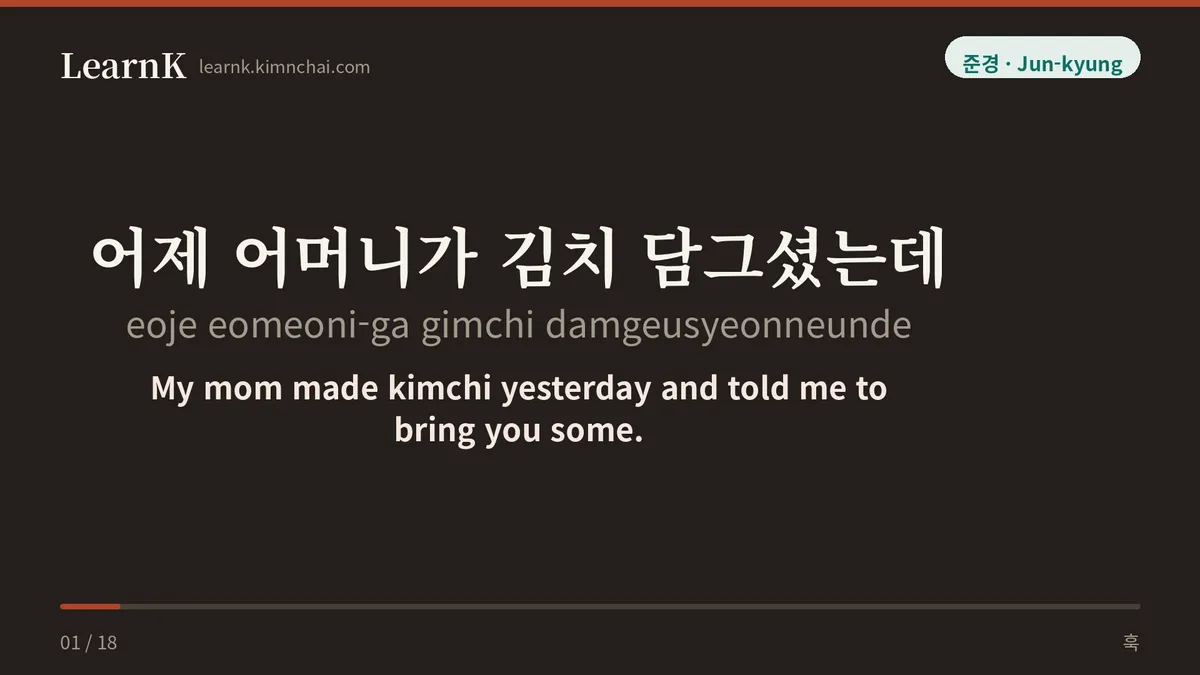
Situation: Saturday morning in late November, in the parking lot in front of Jun-kyung’s apartment building. Jun-kyung, who finished the 김장 (gimjang) yesterday, has come down carrying a huge kimchi container.
Jun-kyung: 이거 받아. 어제 어머니가 김치 담그셨는데 너 갖다주라고 하셨어. Take this. My mom made kimchi yesterday and told me to bring you some.
Emily: 헐, 이 통을 다? 나 혼자 사는데 이걸 언제 다 먹어. Whoa, this whole container? I live alone — when am I ever going to finish this?
Jun-kyung: 지금은 겉절이니까 그냥 먹고, 좀 있다 시어지면 찌개 끓여. 그게 더 맛있어. Right now it’s fresh, so just eat it as is. Once it turns sour, make a stew with it — that’s even better.
Emily: 아 맞다, 신 김치로 끓여야 국물이 진하지. 어머니한테 잘 먹겠다고 전해 줘. Oh right, sour kimchi is what makes the broth rich. Tell your mom thank you for me.
Jun-kyung: 응, 통은 다음에 만날 때 돌려주고. 우리 엄마 통 되게 따져. Sure. Just give the container back next time we meet — my mom is really particular about her containers.
Emily: 알겠어. 김치보다 통을 더 잘 지킬게. Got it. I’ll guard the container even better than the kimchi.
That last line sounds like a joke, but it is a real thing. Lending out a kimchi container and getting it back is a fairly serious piece of household procedure in Korea.
These Sound Off to Korean Ears
✗ 어머니, 김치 만드셨어요? (eomeoni, gimchi mandeusyeosseoyo?) ✓ 어머니, 김치 담그셨어요? (eomeoni, gimchi damgeusyeosseoyo?) → The grammar is not wrong, but Koreans almost never use 만들다 with kimchi. For food that gets salted, packed away, and left to wait, the verb is 담그다. The same goes for 간장 (ganjang, soy sauce), 된장 (doenjang, soybean paste) and 술 (sul, alcohol). Using 만들다 makes it sound like the kimchi was stamped out in a factory rather than put up at home.
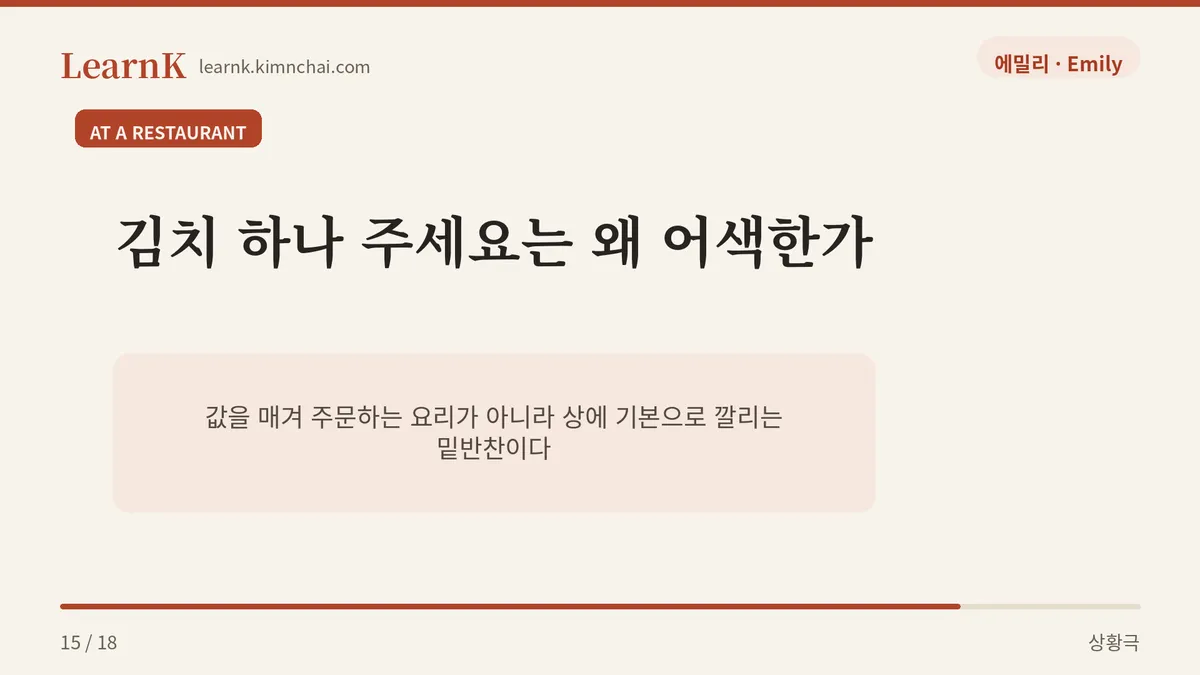
✗ (at a restaurant) 저기요, 김치 하나 주세요. (jeogiyo, gimchi hana juseyo.) ✓ (at a restaurant) 저기요, 김치 좀 더 주세요. (jeogiyo, gimchi jom deo juseyo.) → Kimchi is not a priced dish you order; it is a basic side dish that comes with the table by default. Ordering it by the piece — one, two — sounds like asking for something that is not on the menu, and the server will pause for a second. When you want more, 좀 더 주세요 is the right form, and there is usually no extra charge.
Example Sentences by Situation
Situation 1 — You drop by a friend who has just started living on their own, and the fridge is completely bare.
반찬 없으면 김치라도 꺼내 먹어. (banchan eopseumyeon gimchi-rado kkeonae meogeo.) If you’ve got no side dishes, at least take out some kimchi and eat that.
The particle -라도 means it is not the best option, but at least this one. That single syllable carries the whole sense that kimchi is the bare minimum line of defense on a Korean table.
Situation 2 — At a 백반 (baekban) place you are trying for the first time, the side dishes are unusually good.
여기 김치 직접 담그시나 봐요. (yeogi gimchi jikjeop damgeusina bwayo.) You must make the kimchi here yourselves.
This is the highest compliment you can pay a restaurant owner, because it means they do not buy it in but put it up with their own hands. Here too, 담그시나 봐요 sounds far more natural than 만드시나 봐요.
Situation 3 — Pulling an old container out of the very back of the kimchi fridge.
이 김치 너무 익었다. 찌개나 끓이자. (i gimchi neomu igeotda. jjigae-na kkeurija.) This kimchi is way too ripe. Let’s just make a stew.
익다 (ikda) means the fermentation has come along, not that the food has gone bad. Over-ripe kimchi does not get thrown out — it gets promoted to cooking ingredient. Do not confuse it with 상하다 (sanghada), which really does mean it belongs in the bin.
Honorific and Casual Speech, and Neighboring Words
김치 is the name of a thing, so it has no separate honorific and casual forms. The honorific work is always carried by the verb that goes with it: 담그다 becomes 담그시다, 먹다 becomes 드시다. So you get sentences like 어머니가 김치를 담그신다 (eomeoni-ga gimchi-reul damgeusinda) and 할머니, 김치 좀 드세요 (halmeoni, gimchi jom deuseyo).
What learners do trip over is the border between 김치 and the words next door to it.
| Expression | Nuance / range | Where it is used |
|---|---|---|
| 김치 (gimchi) | The umbrella term covering every salted, fermented side dish of this kind | Anywhere, whenever the specific type does not matter |
| 겉절이 (geotjeori) | Freshly tossed, not yet fermented. Crisp, with no sourness | Right after 김장; at a restaurant, 겉절이 주세요 |
| 묵은지 (mugeunji) | Aged over a year, sour and deep in flavor | When talking about braises and stews; treated as a delicacy |
| 김장 (gimjang) | Not a food but the event of making kimchi in bulk in late autumn | November–December; spoken of like a family occasion |
Be especially careful with that last row. 김장 먹었어요 sounds off; 김장 했어요 / 김장 도와드렸어요 (gimjang haesseoyo / gimjang dowadeuryeosseoyo) is correct. 김장 is not something you eat, it is something you do.
Cultural Background — Putting It Up, Sharing It Out, and Getting the Container Back
Start with the etymology. The most widely accepted account is that 김치 comes from the Sino-Korean word 침채 (沈菜, chimchae, vegetables steeped in water), which passed through the older form 딤채 (dimchae) before settling into 김치. When a brand of dedicated kimchi refrigerator appeared in the 1990s, the name 딤채 came straight from that old word. In other words, the verb 담그다 is lodged right there in the root of the noun.
김장 is the annual event where the whole family, and sometimes the neighbors too, gather in late autumn and spend the entire day salting cabbage and working the filling in. It was inscribed on UNESCO’s list of Intangible Cultural Heritage of Humanity in 2013, and the important detail is that what was inscribed is not kimchi the food but kimjang, the making and sharing of kimchi. An international body recognized that the heart of it is not what you eat but who you share it with. That is why, the day after 김장, people like Jun-kyung in the conversation above go around carrying containers, and why returning the empty container becomes the excuse for the next time you meet.
It is no accident that Korean dramas keep showing 김장 scenes. It is one of the few situations where an entire family sits together for hours with their hands busy, which makes it the perfect setting for buried conflicts to erupt — or, just as often, to quietly get patched up. The words that pass between the salted cabbage leaves carry more than the lines themselves do.
Finally, the reason the dictionary’s Chinese headword is 辛奇 (xinqi) rather than 泡菜 (paocai): in 2021 the Korean government settled on 辛奇 as the official Chinese spelling of kimchi. The characters were chosen to sound close to 김치 while meaning something like spicy and singular.
One bonus. In Korea, people shout 김치~ (gimchi) instead of cheese when taking a photo, because that final vowel pulls the corners of the mouth up. If you hear it when you find yourself in front of a camera in Korea, just smile.
Today’s Quiz
Which of these is the most natural Korean for the scene of a mother salting cabbage and making kimchi?
- 어머니는 김치를 만드신다. (eomeoni-neun gimchi-reul mandeusinda.)
- 어머니는 김치를 담그신다. (eomeoni-neun gimchi-reul damgeusinda.)
- 어머니는 김치를 요리하신다. (eomeoni-neun gimchi-reul yorihasinda.)
Show the answer
The answer is 2, 어머니는 김치를 담그신다 (eomeoni-neun gimchi-reul damgeusinda).
Number 1 is not grammatically wrong, but it gives off a factory-production feel, and the 요리하다 in number 3 is used for cooking with heat, so it does not fit fermented food. Just remember that food which is salted, packed away, and left to wait takes 담그다, and you have already pocketed half of today’s lesson.
Definitions and example sentences are from the National Institute of Korean Language’s Basic Korean Dictionary (krdict.korean.go.kr); that portion of this post, including our translations, is licensed under CC BY-SA 2.0 KR.