막걸리 (makgeolli): Korea's Beloved National Drink, Enjoyed with 파전 (pajeon) on a Rainy Day
On a day when the rain drizzles down, there are two words that automatically pop into Korean people’s minds: 파전 (pajeon) and 막걸리 (makgeolli). If you watch Korean dramas, you’ve probably seen a scene at least once where characters pour a milky-white drink from a yellow kettle, splashing it generously into bowls. Today’s expression is exactly that white drink — Korea’s signature traditional liquor, 막걸리 (makgeolli).
막걸리
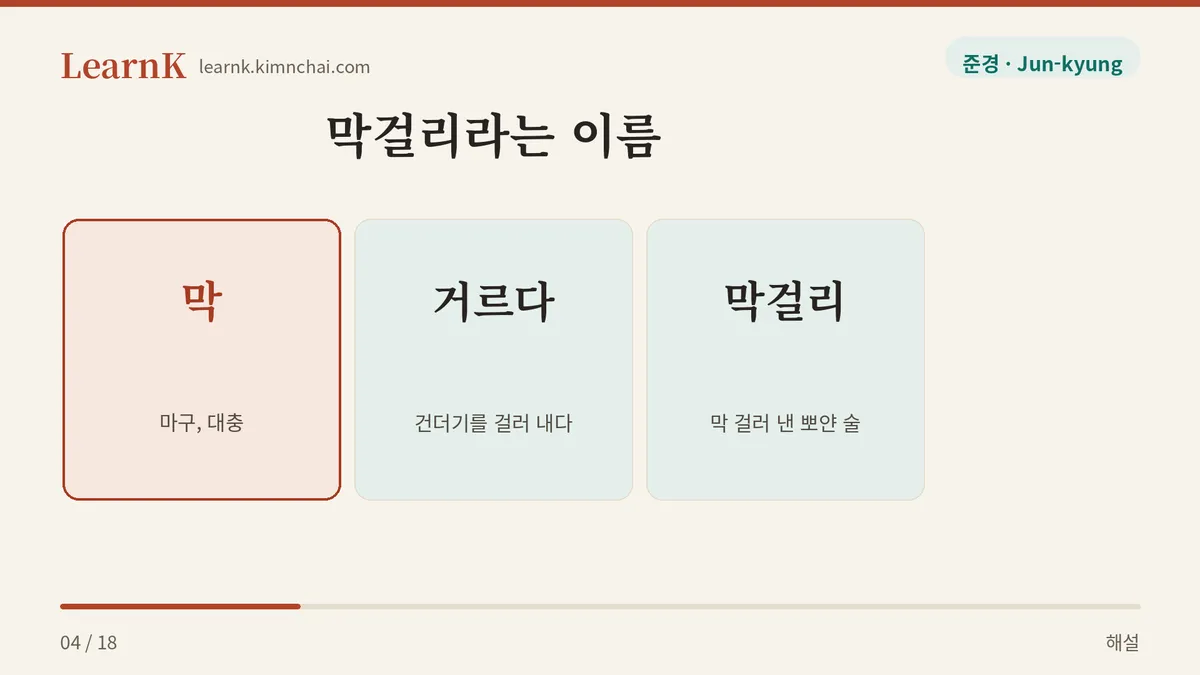
막걸리 (makgeolli) is a uniquely Korean liquor brewed from rice, with a slightly rough, tangy taste and a milky color. There’s a meaning hidden in the name: one theory says it combines ‘막’ (meaning ‘roughly, carelessly’) and ‘거르다’ (to strain/filter). In other words, it’s liquor that was 막 걸러 낸 (mak georeo naen) — strained roughly rather than finely refined. That’s why, unlike 소주 (soju) or 청주 (cheongju), it isn’t clear; the cloudy sediment of the rice grains stays alive in it, giving it a milk-white color.
Here’s one nuance worth knowing. Because 막걸리 has a low alcohol content of around 6% and is cheap, it long carried a strong image as ‘a common person’s drink, something enjoyed by elderly farmers.’ But these days, with all kinds of fruit-flavored 막걸리 hitting the market, it has transformed into a ‘hip traditional liquor’ beloved by younger generations and foreign tourists alike.
Checking with the National Institute of Korean Language Dictionary
The National Institute of Korean Language’s Basic Korean Dictionary defines 막걸리 like this.
막걸리 (noun): A uniquely Korean white alcoholic drink made from rice, with a slightly thick, tangy taste. [en] makgeolli; unrefined rice wine — A unique Korean white alcoholic drink made from rice, which tastes a little thick. [ja] マッコリ — ねっとりと後味が残る、米を主原料とする韓国の白い伝統酒。 — National Institute of Korean Language, Basic Korean Dictionary (krdict.korean.go.kr)
If we also look at the real usage examples the dictionary provides, the feel of the word becomes much clearer.
비 오는 날에는 파전에 막걸리를 곁들여 먹는 게 최고지. — National Institute of Korean Language, Basic Korean Dictionary (krdict.korean.go.kr)
This sentence shows that the ‘pajeon and makgeolli on a rainy day’ formula we mentioned earlier is so ingrained for Koreans that it’s practically a 국룰 (gukrul, an unwritten rule) — enough to appear even in a dictionary example.
막걸리는 나이 많은 사람들이 마신다는 고정 관념을 깨고 최근에는 젊은 사람들도 즐겨 마신다. — National Institute of Korean Language, Basic Korean Dictionary (krdict.korean.go.kr)
This example pinpoints exactly the change in 막걸리’s image. It captures the shift from ‘a common person’s drink’ to ‘a trendy traditional liquor.’
쌀을 원료로 만든 막걸리는 한국의 대표적인 곡주이다. — National Institute of Korean Language, Basic Korean Dictionary (krdict.korean.go.kr)
곡주 (gokju) means liquor brewed from grain. It’s an explanatory sentence that tells us why 막걸리 is inseparable from rice-farming culture.
두 남자는 걸쭉한 막걸리를 말없이 마시기 시작했다. — National Institute of Korean Language, Basic Korean Dictionary (krdict.korean.go.kr)
Here, 걸쭉하다 (geoljukhada) means that a liquid is thick rather than watery. It’s a word often used to describe the tangy, thick texture of 막걸리, so memorize it along the way.
Practical Example Sentences by Situation
Shall we learn how it’s used in real conversations through three example sentences we made ourselves?
-
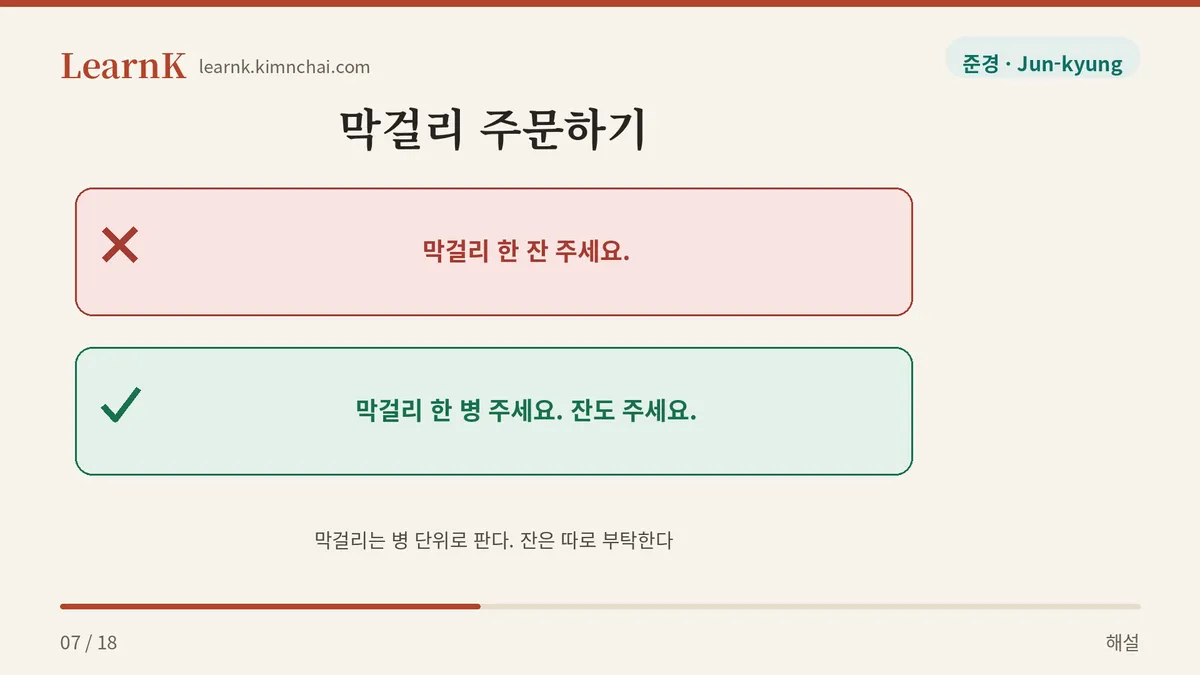
When ordering at a restaurant 막걸리 한 병 주세요. (makgeolli han byeong juseyo.) — ‘One bottle of makgeolli, please.’ Since it’s sold by the bottle, we use the expression 한 병 (han byeong) (‘one bottle’). If you need a bowl or a glass, you can add 잔도 주세요 (jando juseyo) (‘a glass too, please’).
-
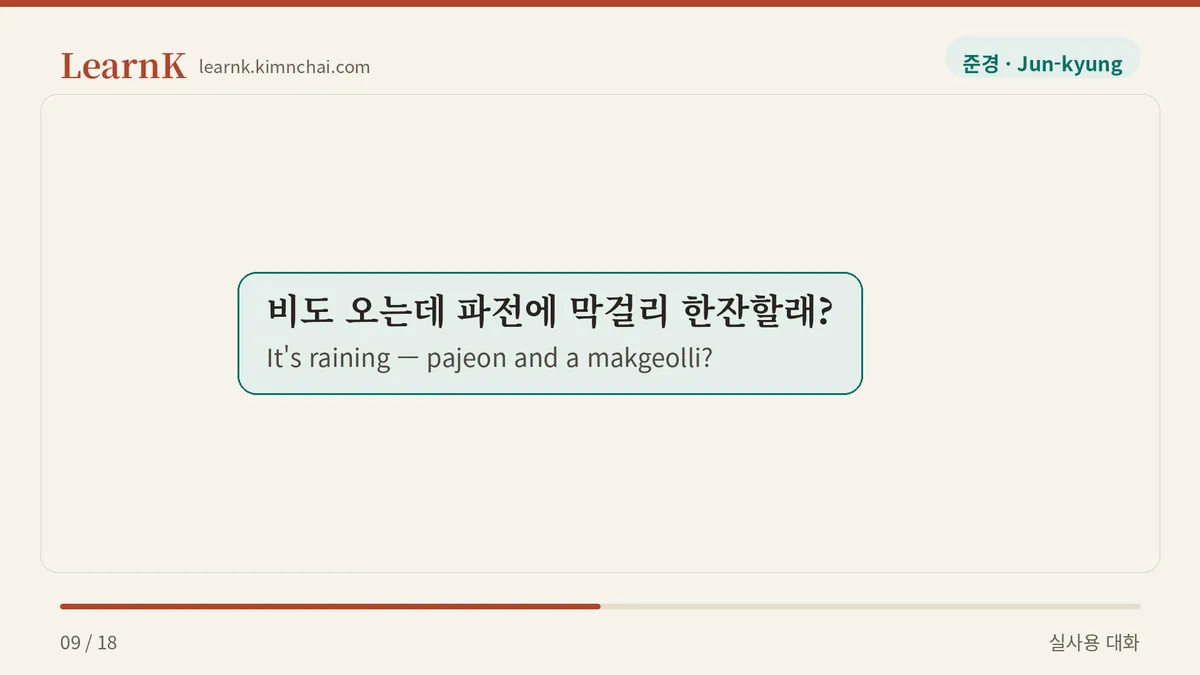
When inviting a friend along with some food 비도 오는데 파전에 막걸리 한잔할래? (bido oneunde pajeone makgeolli hanjanhallae?) — ‘It’s raining, so how about pajeon and a drink of makgeolli?’ 한잔하다 (hanjanhada) is an affectionate expression meaning ‘to have a light drink.’
-
When describing the taste 이 막걸리는 달지 않고 걸쭉해서 제 입맛에 딱 맞아요. (i makgeollineun dalji anko geoljukhaeseo je immase ttak majayo.) — ‘This makgeolli isn’t sweet and is nice and thick, so it’s just right for my taste.’ These days there’s plenty of very sweet makgeolli too, so it’s good to describe your preference this specifically.
Comparing Formal/Informal Speech and Similar Expressions
Even the same suggestion changes tone depending on whom you’re speaking to.
- Formal (존댓말): 막걸리 한잔하시겠어요? (makgeolli hanjanhasigesseoyo?) — to someone older or someone you’ve just met.
- Informal (반말): 막걸리 한잔할래? (makgeolli hanjanhallae?) — to a friend or someone close to you.
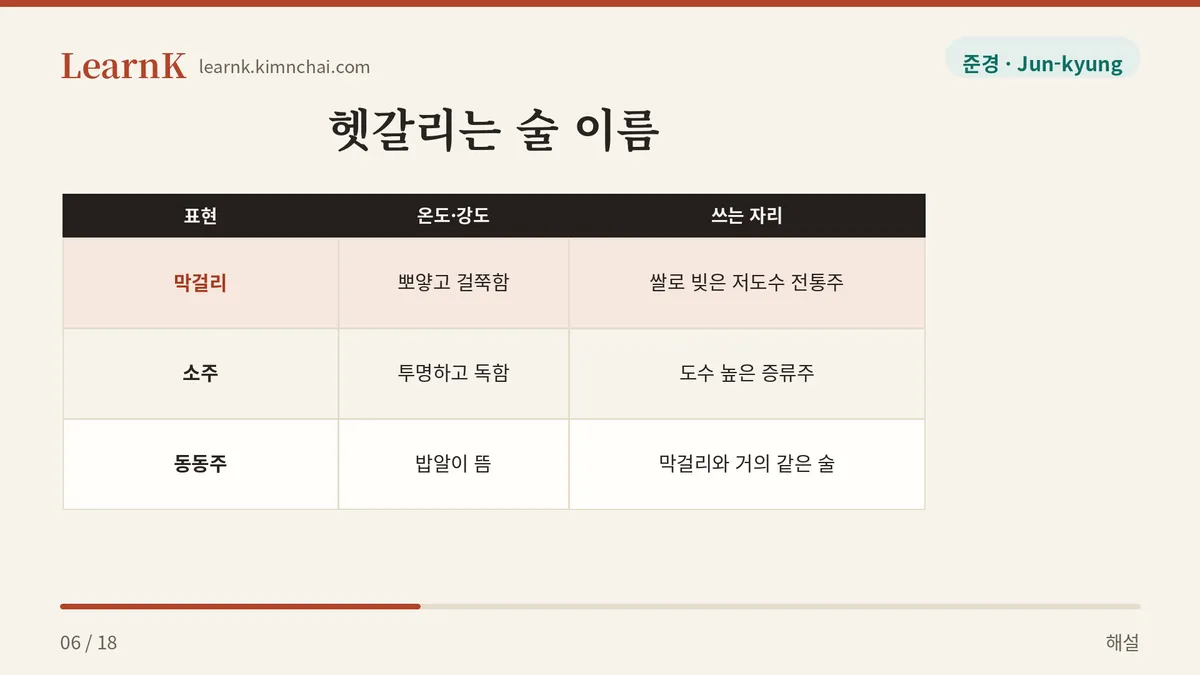
It’s also good to distinguish between the names of similar drinks. 소주 (soju) is a clear, high-proof distilled liquor, while 동동주 (dongdongju) is almost the same as 막걸리 but is characterized by grains of rice floating on top. Also learn the old-fashioned word for 막걸리: 탁주 (takju, 濁酒), a Sino-Korean word meaning ‘cloudy liquor.‘
Cultural Background
In Korean films and dramas, 막걸리 is more than just a drink. In scenes where farmers who’ve finished a hard day sit on the ridges between rice paddies and share it, or where a father and son who haven’t seen each other in ages silently clink their bowls, 막걸리 often appears as a symbol of 정 (jeong) and comfort. For example, in the many period dramas depicting the lives of ordinary people, instead of explaining their hardships at length, the characters quietly hand over a bowl of 막걸리 and console one another. That’s why, for Koreans, 막걸리 carries the warm image of ‘a drink you share together.‘
Closing Quiz
What’s the most natural word to fill in the blank below?
비도 오는데 파전에 ____ 한잔할래?
① 소주 (soju) ② 막걸리 (makgeolli) ③ 커피 (keopi)
The answer is ② 막걸리 (makgeolli). When it comes to the drink you pair with pajeon on a rainy day, makgeolli is, without a doubt, the 국룰 (gukrul)!
Definitions and example sentences are from the National Institute of Korean Language’s Basic Korean Dictionary (krdict.korean.go.kr); that portion of this post, including our translations, is licensed under CC BY-SA 2.0 KR.