The Taste You Sneak at Night — Today's Korean Word: '야식 (yasik)'
It’s 11 p.m. You’ve wrapped up your day and are lying in bed when — from somewhere — the smell of ramyeon comes drifting in. You try to hold back, but your stomach lets out a “꼬르륵 (kkoreureuk)” growl, and in the end you head to the kitchen and put a pot of water on the stove. The food we eat in exactly this moment is called 야식 (yasik) in Korean. If you watch Korean dramas, you’ll often see characters ordering chicken late at night or boiling up some ramyeon — and the word that never fails to show up in those scenes is 야식. Today, let’s dig deep into this delicious word that every fan of Korean culture absolutely needs to know.
야식
야식 (yasik) is a combination of the Chinese characters ‘밤 야 (夜, “night”)’ and ‘먹을 식 (食, “eat”)’, so it literally means “food eaten at night.” It refers to the extra food you eat late at night when you get a little peckish after finishing dinner (저녁, jeonyeok). Rather than a proper meal, it’s closer to “a fun little snack you have one more time.”
The interesting thing is that the word 야식 carries a nuance that goes beyond the plain facts. Most Korean people know that 야식 isn’t good for their health. And yet they can’t give it up. So 야식 comes wrapped in a feeling of “the delightful guilt of eating something you enjoy, even though you know it’s bad for you.” That subtle expression on someone’s face when they say “오늘도 야식을 먹고 말았어 (oneuldo yasigeul meokgo marasseo)” — “I ended up eating 야식 again today” — can you picture it?
Checking the National Institute of Korean Language Dictionary
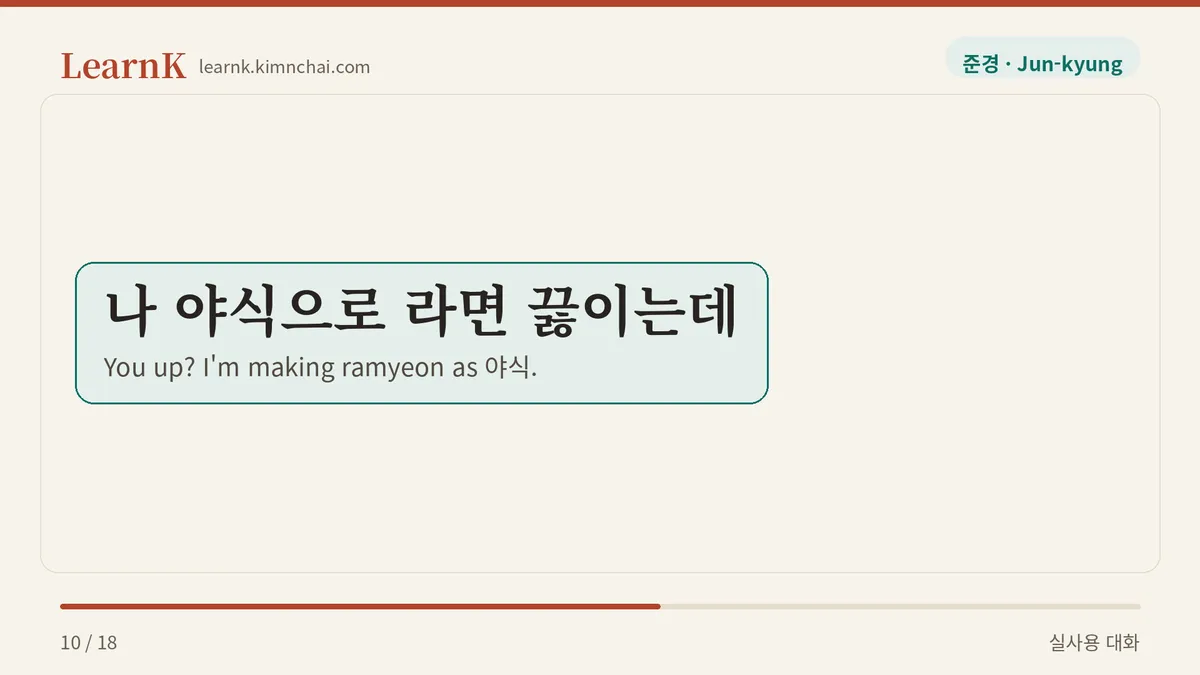
The Basic Korean Dictionary, published by the National Institute of Korean Language — a national institution of the Republic of Korea — defines 야식 like this:
야식 (noun): Food eaten at night. [en] late-night meal; midnight snack — Food that one eats at night. [es] tentempié nocturno, comida nocturna [zh] 夜宵 — 深夜吃的食物。 — National Institute of Korean Language, Basic Korean Dictionary (krdict.korean.go.kr)
(Note: The Portuguese translation is not included in the dictionary, so we’ve rendered it ourselves as roughly ‘refeição noturna / lanche da madrugada.’ This translation is our own, not dictionary material.)
Shall we also take a look at the actual usage examples the dictionary provides? We quote them exactly as they appear in the original.
공부를 하다 출출해진 승규는 야식으로 냄비에 라면을 끓여 먹었다. — National Institute of Korean Language, Basic Korean Dictionary (krdict.korean.go.kr)
This is a scene where Seung-gyu, having gotten hungry while studying late at night, boils up a pot of ramyeon as 야식. It shows just how naturally ‘출출하다 (chulchulhada, to be a little hungry)’ pairs with 야식.
밤마다 야식을 챙겨 먹었더니 몸무게가 바싹바싹 늘었다. — National Institute of Korean Language, Basic Korean Dictionary (krdict.korean.go.kr)
This means that as a result of eating 야식 every single night, the person’s weight steadily piled on. It’s an example sentence that captures both the “pleasure” and the “price” of 야식 at once.
운동도 해야 하고 늦은 시간에 야식을 먹지 않아야 해. — National Institute of Korean Language, Basic Korean Dictionary (krdict.korean.go.kr)
This is a situation where someone is resolving to themselves that, for their health, they should resist 야식. It’s a classic line from someone who has made up their mind to go on a diet.
야식은 몸에 나쁘지요. — National Institute of Korean Language, Basic Korean Dictionary (krdict.korean.go.kr)
This is a sentence that matter-of-factly states a piece of common knowledge about 야식. The ending ‘-지요 (-jiyo)’ is used to gently confirm a fact that the listener is likely to know too.
Example Sentences by Situation
Now it’s your turn to try. Read them while imagining each situation.
- To a friend (casual speech): “우리 오늘 밤에 야식으로 치킨 시킬까? (uri oneul bame yasigeuro chikin sikilkka?)” — This is you suggesting to a friend, late at night, that you order some delivery food together.
- To family (polite speech): “엄마, 야식 드실래요? 제가 라면 끓일게요. (eomma, yasik deusillaeyo?)” — This is a situation where you’re warmly offering some 야식 to your mother, who’s feeling a bit peckish at night.
- To yourself, mid-diet (talking to yourself): “안 돼, 야식은 참아야 해. (an dwae, yasigeun chamaya hae.)” — This is the heart of all of us as we battle temptation.
Polite/Casual Speech and Similar Expressions
Since 야식 is a noun, the word itself is used the same way regardless of politeness level. What changes instead is the verb that comes with it.
- Casual: “야식 먹자! (yasik meokja!)”
- Polite: “야식 드시겠어요? (yasik deusigesseoyo?)” — Here you use ‘드시다 (deusida),’ the honorific form of ‘먹다 (to eat).’
A similar word is 밤참 (bamcham). Its meaning is almost the same, but it has a slightly more old-fashioned, homey feel, so in everyday conversation and on delivery apps these days, 야식 is used far more often.
Cultural Background — 야식 Is Korea’s Nighttime Culture
Korea has a highly developed delivery culture that stays open until late at night, so 야식 is more than just food — it’s a whole “culture.” For students studying during exam season, office workers pulling late shifts, and people binge-watching dramas all night long, 야식 is a small reward at the end of the day. The signature menu items include chicken, ramyeon, jokbal (pig’s trotters), and tteokbokki. In dramas, too, there are frequent scenes where the main character, after a hard day, eats 야식 at a late-night 포장마차 (pojangmacha, street food stall) or at their own kitchen table and pours out what’s on their mind — scenes like these convey the emotion of “comfort after exhaustion.” Sharing 야식 with someone also means you’re that close to each other.
Closing Quiz
A friend who’s been studying late at night says they’re hungry. To ask “우리 ○○ 먹을까? (uri ○○ meogeulkka?)” — “Shall we eat ○○?” — what word should go in the blank? And when offering that food to an elder, what honorific word should you use instead of ‘먹다 (to eat)’? Leave your answers in the comments!
Definitions and example sentences are from the National Institute of Korean Language’s Basic Korean Dictionary (krdict.korean.go.kr); that portion of this post, including our translations, is licensed under CC BY-SA 2.0 KR.