만두 (mandu) — From the Seollal Breakfast Table to Winter Market Steamers, Korea's Plate of Dumplings
만두 (mandu)
만두 (mandu) means a food made by rolling wheat dough into a thin wrapper and folding it around a filling of minced meat or vegetables. In Korea, the word doesn’t point to just one specific dish. There’s mandu in the steamer billowing clouds of steam at a winter market stall, on the little plate that comes alongside your jjajangmyeon at a Chinese-Korean restaurant, and on the bottom shelf of the freezer in every студент — sorry, in every one-room apartment freezer in the country. That’s why it’s one of the first food words Korean learners memorize, and at the same time one of the most frequently misunderstood.
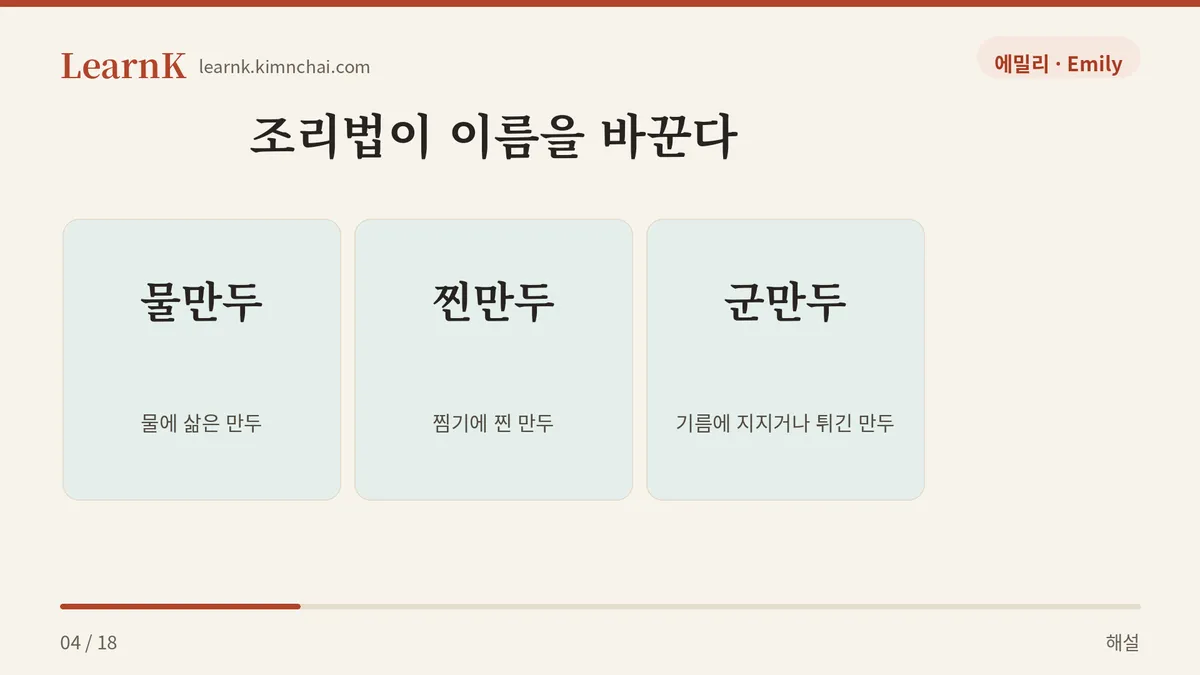
Mandu splits into different names depending on how it’s cooked. Boiled in water, it’s 물만두 (mulmandu); steamed, it’s 찐만두 (jjinmandu); pan-fried or deep-fried, it’s 군만두 (gunmandu). It splits by filling too — 고기만두 (gogimandu) and 김치만두 (gimchimandu) — and if it’s the size of your fist, it becomes 왕만두 (wangmandu). In other words, 만두 (mandu) is the umbrella term, and everything else is a name that hangs underneath it. Ask a Korean person what they ate today, and if they answer just “만두,” they’ll naturally get a follow-up question: what kind?
It also helps to know which verb it pairs with. Mandu goes with 빚다 (bitda) far more often than with 만들다 (mandeulda, “to make”). 만두를 빚다 (mandureul bitda) refers to the whole motion of folding the wrapper by hand and pressing the edges to shape it. Just as you shape pottery and shape songpyeon, you shape mandu. That one word contains how Koreans relate to mandu — yes, it’s something you can buy, but originally it was something a group of people sat around a table and made with their hands.
Checking the National Institute of Korean Language dictionary
Here is the definition from the National Institute of Korean Language’s Basic Korean Dictionary.
만두 (mandu) 「명사」 (noun) 밀가루를 반죽하여 얇게 민 후 그 위에 다진 고기나 야채 등 여러 가지 음식을 넣고 빚은 음식. A food made by kneading flour, rolling it out thin, then placing minced meat, vegetables, and various other fillings on it and folding it closed.
[en] mandu — Dumplings, made by kneading and pressing flour and wrapping minced meat, vegetables, etc., with the dough. [ja] ギョーザ【餃子】。パオズ【包子】 — 小麦粉で作った薄い皮の中にひき肉や野菜などの色々な具を詰めて作った料理。 [es] empanada coreana, bollo coreano — Empanada hecha de masa de harina fina, rellenándola con carne picada y verduras. [zh] 饺子 — 将和好的面团擀成薄片,放上剁碎的肉末或蔬菜等各种馅料后包起来的食物。 — National Institute of Korean Language, Basic Korean Dictionary (krdict.korean.go.kr)
The dictionary doesn’t carry a Portuguese translation, so the following is our own rendering (not a dictionary quotation): pastel coreano recheado (mandu) — massa fina de trigo recheada com carne moída, legumes e outros ingredientes.
The part worth a closer look is the Chinese equivalent. The dictionary renders 만두 as 饺子 (jiaozi). Even though the two words come from the same Chinese characters, it does not render it as 馒头. We’ll pick up the reason in the awkward-usage section and the cultural background below.
There’s one more thing to flag. The example sentences that come up when you search 만두 in the dictionary aren’t actually examples of the food at all. They merely happen to contain the three syllables 만-두 inside completely different words: 그만두다 (geumanduda) and 가만두다 (gamanduda). Here they are, exactly as they appear, nothing invented.
아버지는 회사에서 삼십 년 가까이 일하고 지난해에 회사를 그만두었다. (abeojineun hoesaeseo samsip nyeon gakkai ilhago jinanhaee hoesareul geumandueotda.) My father worked at his company for nearly thirty years and quit last year.
어머니는 다니던 직장을 그만두시고 집에서 가정일만 맡아서 하신다. (eomeonineun danideon jikjangeul geumandusigo jibeseo gajeongilman mataseo hasinda.) My mother left the job she’d been working and now takes care of the household full time.
나는 동생이 화가 난 것 같아서 그냥 가만두었다. (naneun dongsaengi hwaga nan geot gataseo geunyang gamandueotda.) My younger sibling seemed angry, so I just left them alone.
동생은 강아지를 가만두지 않고 계속 귀찮게 굴었다. (dongsaengeun gangajireul gamanduji anko gyesok gwichanke gureotda.) My younger sibling wouldn’t leave the puppy alone and kept pestering it.
정말? 어떤 녀석인지 가만두지 않을 거야. (jeongmal? eotteon nyeoseoginji gamanduji aneul geoya.) Really? Whoever the guy is, I’m not letting him off. — National Institute of Korean Language, Basic Korean Dictionary (krdict.korean.go.kr)
Let’s look at what’s happening in each one. The first sentence calmly reports that a father, near retirement age, left the workplace he’d been at for years. The second explains how a mother wrapped up her working life and took on the housework — both use 그만두다 (geumanduda), meaning “to stop doing something you’d been doing.” The third means the speaker left an angry sibling alone instead of poking at them; the fourth means the opposite — the sibling would not leave the puppy alone and kept bothering it. The fifth is someone thoroughly furious, vowing not to let the other person off, so its temperature is completely different from the first two.
Not one of the five sentences contains anything edible. This is exactly the trap Korean learners actually stumble into, and it’s why you shouldn’t take dictionary search results at face value.
A real conversation
Scene: the evening before the Seollal holiday, in Jun-kyung’s kitchen. Mandu wrappers and filling are spread across the table, and the two of them are sitting across from each other, folding.
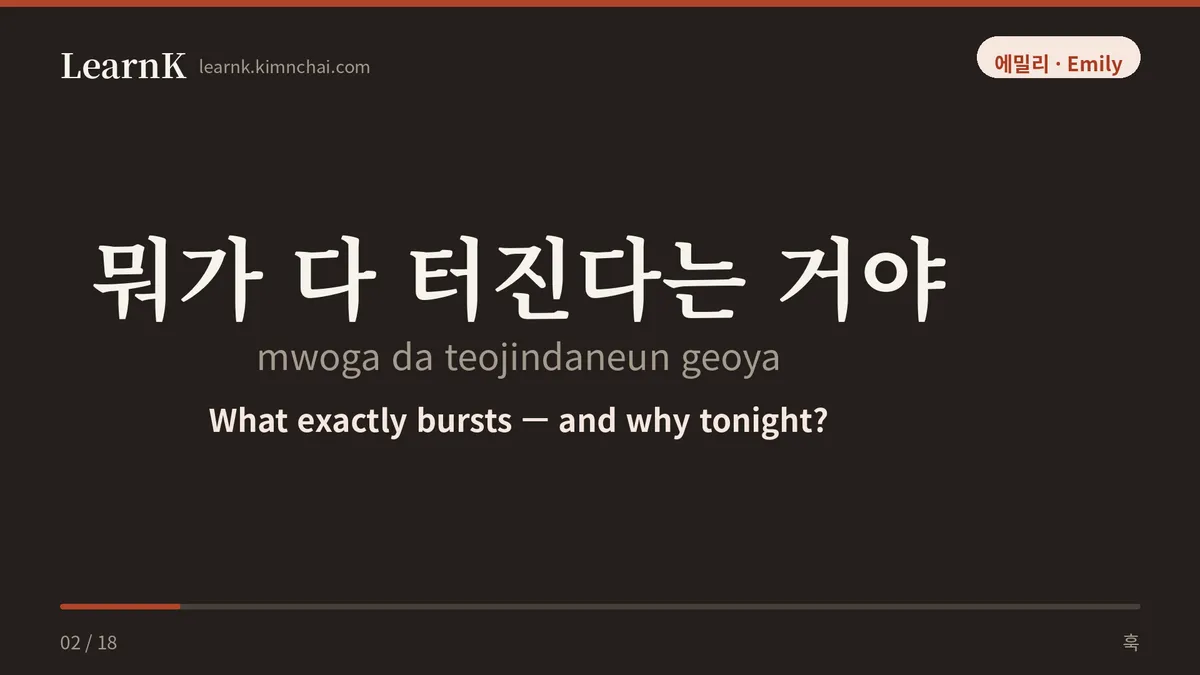
준경: 야, 가장자리에 물 안 묻히고 그냥 붙이면 삶을 때 다 터져. Hey, if you press the edges without wetting them, they all burst when you boil them.
에밀리: 아 진짜? 어쩐지 아까 삶은 만두 세 개가 다 벌어지더라. Oh really? No wonder three of the mandu I boiled earlier all split open.
준경: 그니까. 소도 욕심내지 마. 많이 넣으면 백퍼 터져. Right. And don’t get greedy with the filling. Stuff too much in and it’s guaranteed to burst.
에밀리: 근데 이거 언제 다 빚어? 나 벌써 손목 나갔는데. But when are we going to finish all this? My wrist is already done for.
준경: 내일 아침에 만둣국 끓이려면 이 판은 채워야 돼. 어머니가 딱 세 판 말씀하셨어. We have to fill this tray to make mandutguk tomorrow morning. Mom said exactly three trays.
에밀리: 알겠어… 대신 지금 찐 것 몇 개만 먼저 먹자. 만두는 빚으면서 집어 먹는 게 제일 맛있잖아. Fine… but let’s eat a few of the steamed ones first. Mandu tastes best when you snack on them while making them.
This sounds awkward
✗ (standing in front of a shop selling mantou while traveling in China) 여기 만두 파네! 김치만두 있어요? (yeogi mandu pane! gimchimandu isseoyo?) — “They sell mandu here! Do you have kimchi mandu?” ✓ (at a Korean snack shop) 여기 김치만두 있어요? (yeogi gimchimandu isseoyo?) — “Do you have kimchi mandu here?” → Korean 만두 (mandu) and Chinese 馒头 (mantou) are Sino-Korean cousins from the same characters, but the foods they point to today are different. Modern Chinese mantou is closer to a plain steamed bun with no filling; the filled ones are called jiaozi (饺子) or baozi (包子). That’s exactly why the dictionary gives 饺子 as the Chinese equivalent of 만두.
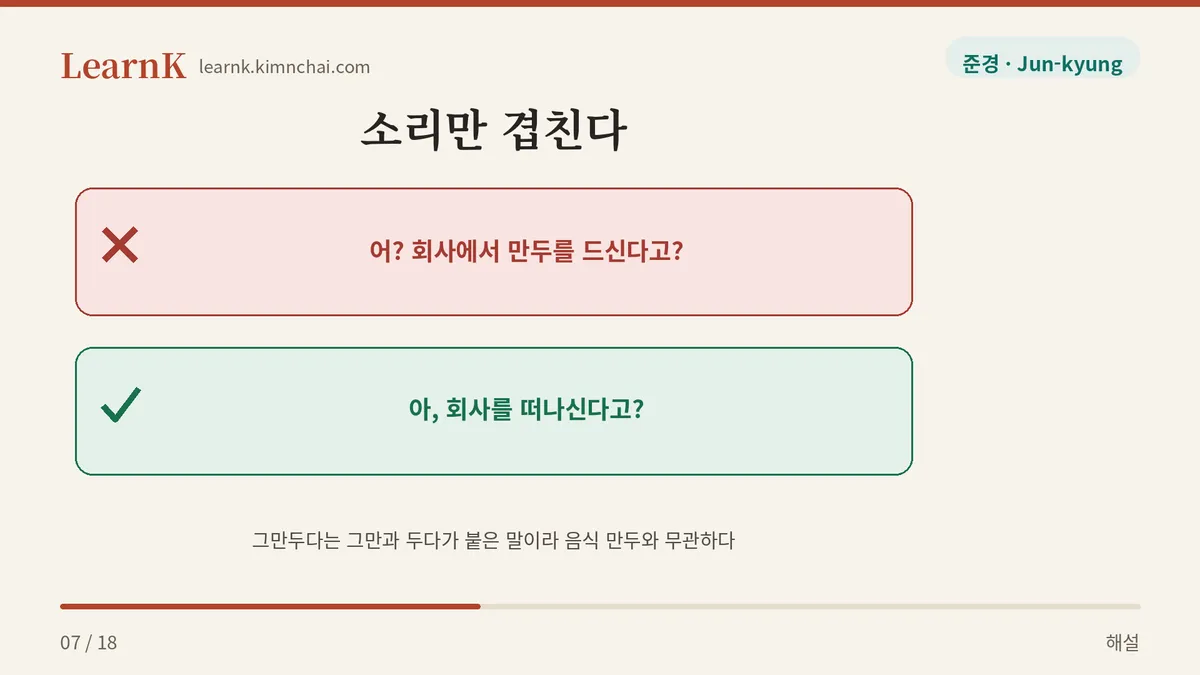
✗ 부장님이 회사를 그만두신대. — 어? 회사에서 만두를 드신다고? (bujangnimi hoesareul geumandusindae. — eo? hoesaeseo mandureul deusindago?) — “I hear the manager is quitting the company.” — “Huh? He’s eating mandu at the office?” ✓ 부장님이 회사를 그만두신대. — 아, 회사를 떠나신다고? (bujangnimi hoesareul geumandusindae. — a, hoesareul tteonasindago?) — “I hear the manager is quitting the company.” — “Ah, he’s leaving the company?” → The 만두 buried inside 그만두다 (geumanduda) and 가만두다 (gamanduda) has nothing to do with food. They break down as 그만 + 두다 and 가만 + 두다 respectively — the syllables just happen to overlap. 그만두다 in particular is used for weighty things like resigning or quitting, so bringing up food here throws the mood badly off.
Example sentences by situation
1. Ordering at a snack shop — when the menu lists several kinds of mandu, you have to name the cooking method or the filling to finish your order.
여기 김치만두 한 접시랑 만둣국 하나 주세요. (yeogi gimchimandu han jeopsirang mandutguk hana juseyo.) A plate of kimchi mandu and one mandutguk, please.
2. Standing in front of the fridge wondering about dinner — there’s always a bag of mandu somewhere in a Korean solo-dweller’s freezer. It’s the default setting for days you can’t be bothered to cook.
냉동실에 만두밖에 없는데, 그거라도 쪄 먹을까? (naengdongsire mandubakke eomneunde, geugeorado jjyeo meogeulkka?) There’s nothing but mandu in the freezer — should we just steam those?
3. On the phone before a holiday — it takes a lot of work, so plenty of households buy them now.
올해는 만두 안 빚고 그냥 사서 하기로 했어. (olhaeneun mandu an bitgo geunyang saseo hagiro haesseo.) This year we decided not to make the mandu by hand and just buy them.
Formal vs. casual speech, and similar expressions
만두 (mandu) is the name of an object, so the word itself carries no honorific or humble level. Politeness shows up in the verb you use with it. With a friend: 만두 먹을래? (mandu meogeullae?). With someone older or senior: 만두 좀 드시겠어요? (mandu jom deusigesseoyo?) — just swap 먹다 (meokda) for 드시다 (deusida).
What’s easier to mix up is the family of mandu names. Each has a slightly different feel and setting.
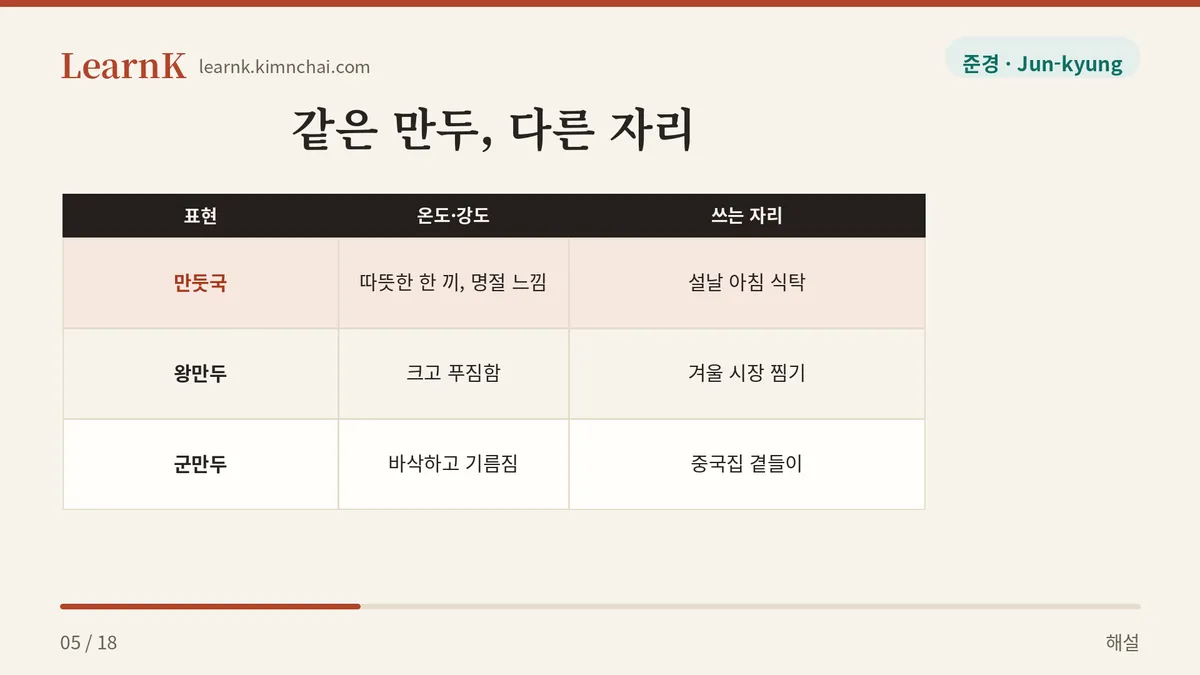
| Expression | Tone & intensity | Where it’s used |
|---|---|---|
| 만두 (mandu) | neutral umbrella term | anywhere — menus, home, the market |
| 만둣국 (mandutguk) | a warm full meal, holiday feeling | the Seollal breakfast table, Korean restaurants |
| 왕만두 (wangmandu) | big and hearty, winter street food | market steamers, convenience stores |
| 군만두 (gunmandu) | crispy and oily, side-dish feel | Chinese-Korean restaurants, drinking snacks |
| 교자 (gyoja) | thin-skinned Japanese style, imported feel | izakayas, frozen-food product names |
Even though they’re all mandu, 왕만두 (wangmandu) first calls up the image of blowing on something hot on a winter street, while 군만두 (gunmandu) first calls up the plate sitting next to a bowl of jjajangmyeon. The word summons not just the food but the place the food sits.
Cultural background — mandutguk on Seollal morning
The word 만두 (mandu) comes from the Chinese characters 饅頭. The word crossed over from China, but after that the foods the two countries point to diverged. In Korea, everything folded around a filling stayed 만두; in China, the fillingless steamed bun became mantou. Two languages inherited the same characters and ended up drawing different pictures.
The day mandu takes center stage is Seollal, Lunar New Year. What appears on the Seollal morning table differs by region: in the south, tteokguk (rice cake soup), while households with roots in the north — Hwanghae-do, Pyeongan-do — often cook mandutguk instead. That’s why 떡만둣국 (tteokmandutguk), which combines the two, is also common. The scene of the whole family gathered around the table folding mandu on the eve of Seollal is a staple of holiday episodes in Korean dramas. When the camera moves into the kitchen, the adults fold mandu while bringing up all the things they haven’t had a chance to say, and nagging and worry and laughter get mixed in between. Time spent folding mandu is cooking time and, at the same time, time the family sits face to face for a long stretch — which makes it the best possible place for a drama to hang a conversation on.
So 만두를 빚다 (mandureul bitda) carries more than a story about food. Supermarket frozen mandu has gotten so good that fewer households fold their own now, and precisely because of that, hand-folded mandu reads as a sign of care. If you visit a Korean friend’s home and hand-folded mandu comes out on the table, that means you’re being welcomed rather warmly.
Today’s quiz
Which word fits most naturally in the blank?
내일이 설날이니까 오늘 저녁에 온 가족이 모여서 만두를 ____. (naeiri seollarinikka oneul jeonyeoge on gajogi moyeoseo mandureul ____.) Tomorrow is Seollal, so tonight the whole family gathers and ____ mandu. ① 만들어요 (mandeureoyo) ② 빚어요 (bijeoyo) ③ 지어요 (jieoyo)
The answer is ② 빚어요 (bijeoyo). Option ① 만들어요 (mandeureoyo) isn’t grammatically wrong, but for the specific motion of folding the wrapper by hand and shaping it, 빚다 (bitda) is far more natural. Koreans say they 빚다 songpyeon and pottery too. Option ③ 짓다 (jitda) is used for rice, houses, names, and clothes, so it doesn’t suit mandu.
Definitions and example sentences are from the National Institute of Korean Language’s Basic Korean Dictionary (krdict.korean.go.kr); that portion of this post, including our translations, is licensed under CC BY-SA 2.0 KR.