민망하다 (minmanghada) — When You've Done Nothing Wrong but Your Face Still Burns
민망하다 (minmanghada)
민망하다 (minmanghada) means feeling too embarrassed to face someone or to look at something. You haven’t done anything genuinely wrong, but your face goes hot and you have no idea where to put your eyes — it’s that few-seconds-long feeling.
The elevator doors are sliding shut just as you lock eyes with the person sprinting toward you from down the hall. Your junior colleague gets to the register first after all, despite everything. Someone you haven’t seen in years calls your name warmly and you cannot summon theirs. In moments like these, Koreans let out a quiet “아, 민망해 (a, minmanghae).”
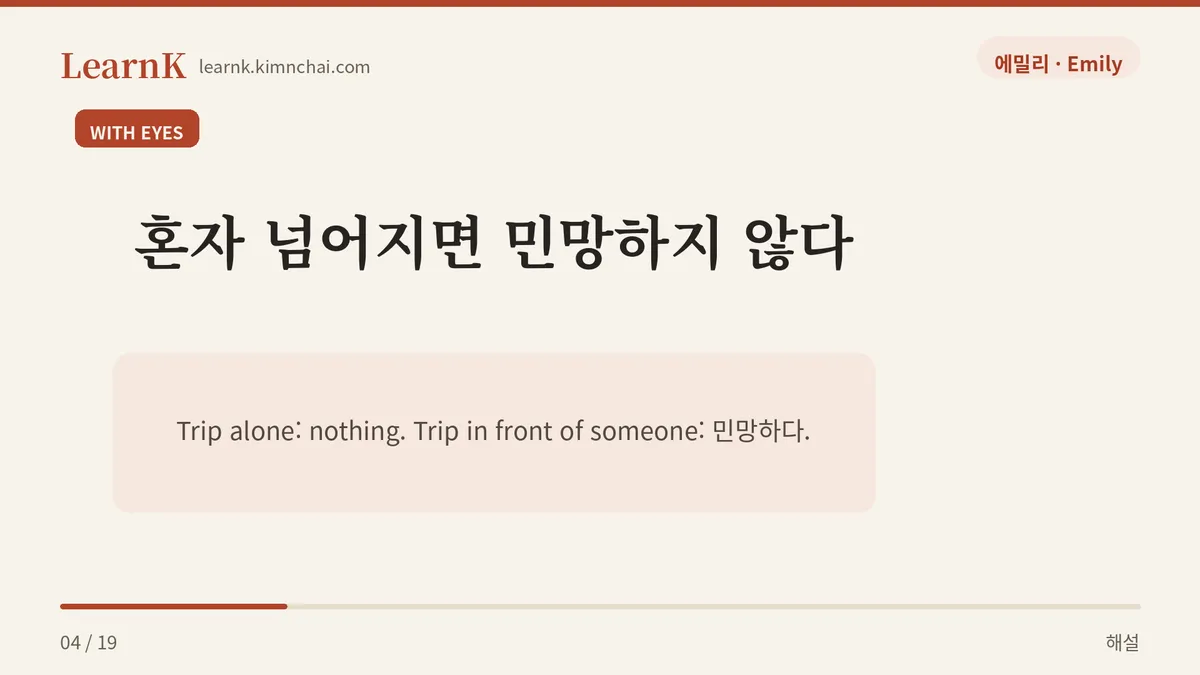
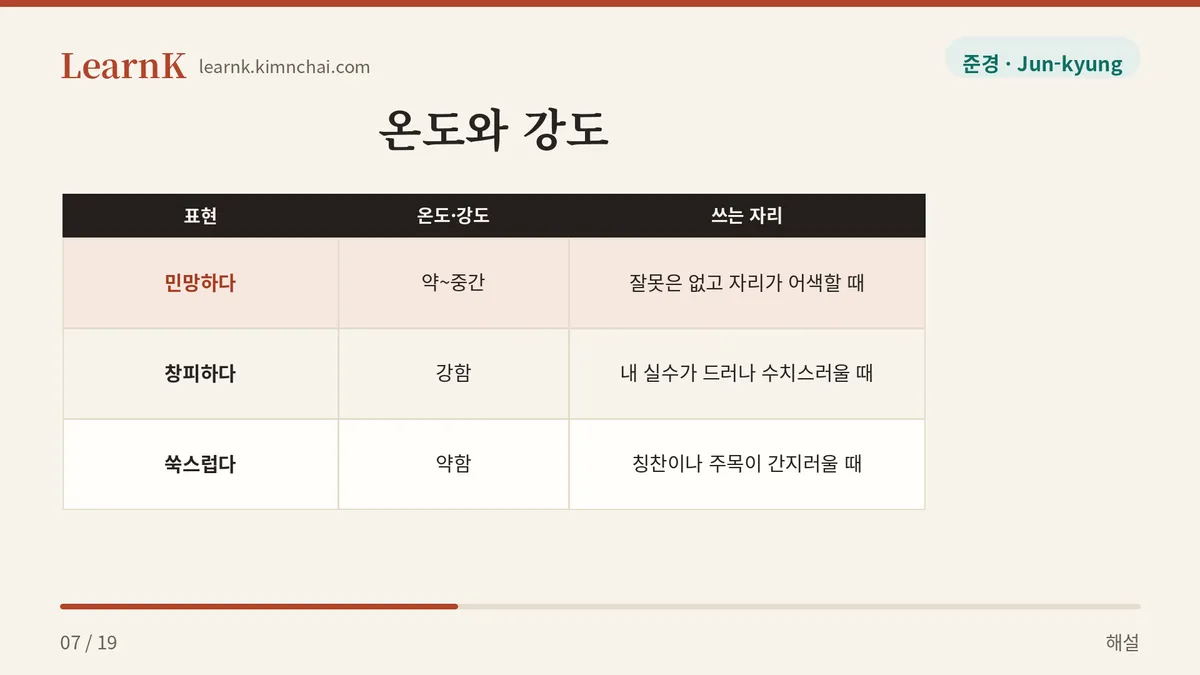
민망하다 (minmanghada) always involves someone watching. If you trip in your room alone, it isn’t 민망하다. It only becomes 민망하다 the moment somebody sees you fall. This is exactly where it parts ways with its neighbors. 창피하다 (changpihada) is the shame of having your mistake or shortcoming exposed, and it’s far more intense. 부끄럽다 (bukkeureopda) can carry moral weight. 민망하다 (minmanghada) is lighter than both, and above all, it happens even when you’ve done nothing wrong. The situation is simply awkward.
And this word has a second face. You also say 민망하다 (minmanghada) when someone else’s situation is so pitiable that it makes you uncomfortable. The feeling of watching an underprepared person take the stage and sing; the feeling of facing someone who bought you a gift far beyond their means. That’s why “보기에 민망하다 (bogie minmanghada)” can be read in two directions — either I’m embarrassed to be watching this, or I feel sorry for that person.
Checking It in the National Institute of Korean Language Dictionary
민망하다 (minmanghada) 「Adjective」 ① 딱하고 안타깝다. (ttakhago antakkapda) — Pitiable and heartbreaking. [en] pitiful; pathetic — Feeling sorry and pity for something or someone. [ja] いたわしい【労しい】 — 気の毒で残念だ。 [es] lastimoso, penoso — Que da lástima y pena. [zh] 怜悯,不是滋味 — 可怜而惋惜。 — National Institute of Korean Language, Basic Korean Dictionary (krdict.korean.go.kr)
민망하다 (minmanghada) 「Adjective」 ② 사람을 대하거나 보기가 부끄럽다. (sarameul daehageona bogiga bukkeureopda) — Feeling embarrassed to face or look at someone. [en] awkward; embarrassed — Feeling ashamed or shy to look at or face someone. [ja] きまりがわるい【決まりが悪い】。こはずかしい【小恥ずかしい】 — 顔を合わせたり見たりすることが恥ずかしい。 [es] avergonzado, incómodo — Que siente vergüenza o incomodidad ante otras personas. [zh] 过意不去,脸上挂不住 — 见人或待人时不好意思。 — National Institute of Korean Language, Basic Korean Dictionary (krdict.korean.go.kr)
This dictionary doesn’t include a Portuguese translation. For reference, sense ② lands somewhere close to constrangido, sem graça — that’s our own rendering, not dictionary material.
Let’s also look at the dictionary’s actual example sentences as they stand. They’re short, but they contain everything you need to know about where this word shows up.
그러게. 정말 보기에 민망하다. (geureoge. jeongmal bogie minmanghada) — Right? It’s genuinely hard to watch. — National Institute of Korean Language, Basic Korean Dictionary (krdict.korean.go.kr)
This sentence follows up on what someone else just said, agreeing with 그러게 (geureoge), “right?” Two people are looking at the same scene and have reached a shared conclusion: it’s hard to know where to look. 민망함 (minmangham) gets sharper when two people confirm it together like this.
옷이 민망하다. (osi minmanghada) — That outfit is embarrassing. — National Institute of Korean Language, Basic Korean Dictionary (krdict.korean.go.kr)
You use this when clothes are so short or so tight that neither the wearer nor the onlooker is comfortable. This example shows that the subject doesn’t have to be a person — an object works too.
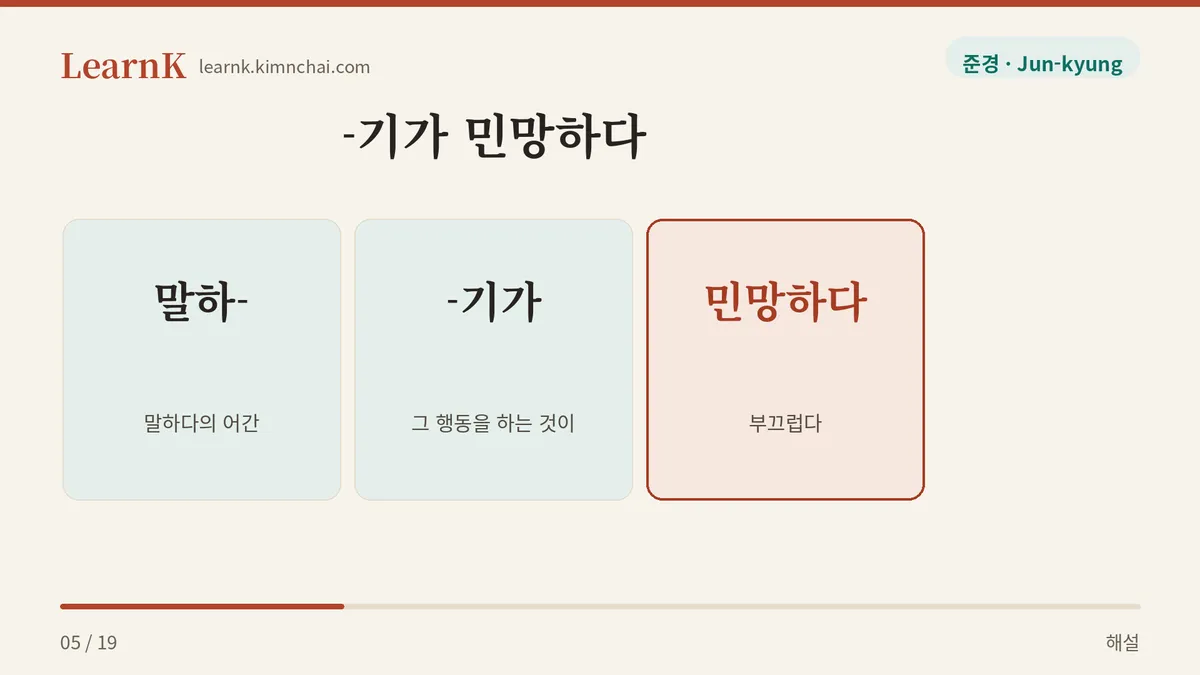
보기가 민망하다. (bogiga minmanghada) — It’s embarrassing to look at. — National Institute of Korean Language, Basic Korean Dictionary (krdict.korean.go.kr)
This is the “-기가 민망하다 (-giga minmanghada)” pattern. Attach it to a verb to build “I’m too embarrassed to do that.” It’s the frame you’ll hear most often in real conversation, so it’s worth memorizing whole.
말하기가 민망하다. (malhagiga minmanghada) — It’s embarrassing to say out loud. — National Institute of Korean Language, Basic Korean Dictionary (krdict.korean.go.kr)
This comes out in front of topics you’d rather not put into words — a test score, a salary, a certification you’ve been putting off for years.
그러게. 애들하고 보기에 좀 민망하다. (geureoge. aedeulhago bogie jom minmanghada) — Right? It’s a little awkward to watch with the kids around. — National Institute of Korean Language, Basic Korean Dictionary (krdict.korean.go.kr)
The moment 애들하고 (aedeulhago), “with the kids,” gets added, the meaning snaps into focus. On your own you’d have let the scene pass without a thought, but watching it alongside a child makes it uncomfortable. That’s proof that 민망함 (minmangham) is a feeling that appears and disappears depending on who you’re with.
Seeing It in Real Conversation
Situation: Saturday afternoon, the parking lot in front of an apartment complex. Emily has come to look at the desk Jun-kyung has decided to sell secondhand.
Jun-kyung: 왔어? 저기 저건데… 사진보다 상태가 좀 그렇지? You’re here? That’s it over there… it looks worse than in the photo, doesn’t it?
Emily: 어? 괜찮은데. 다리도 튼튼하고. Huh? Looks fine to me. The legs are sturdy, too.
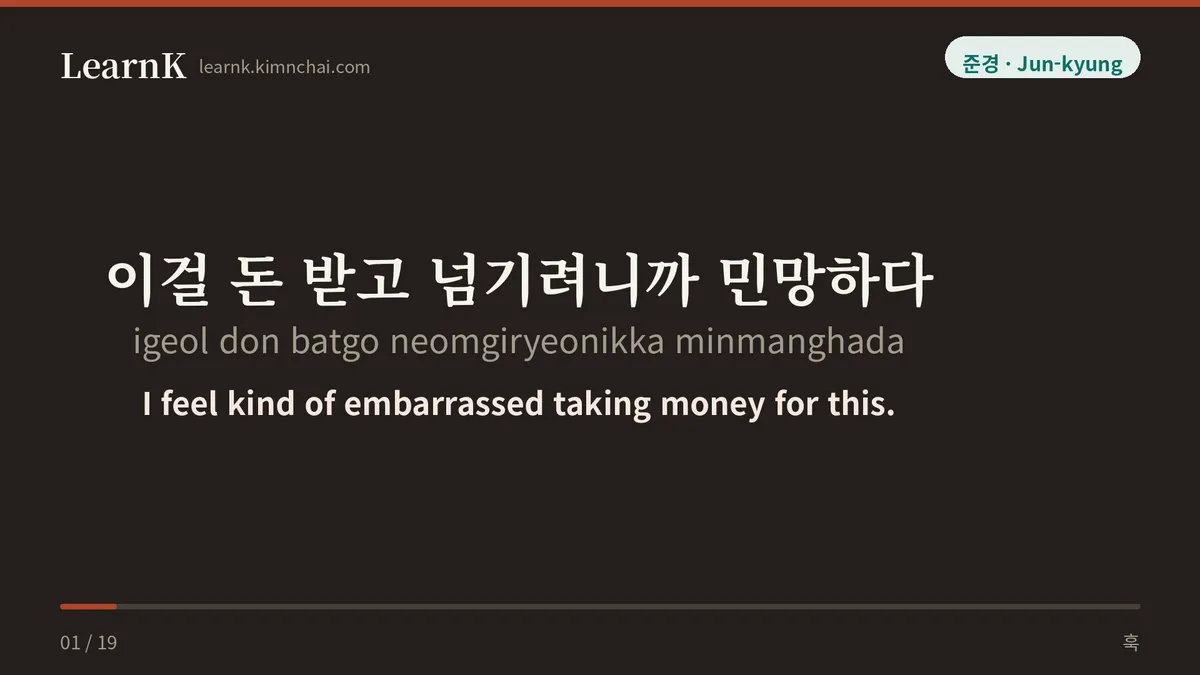
Jun-kyung: 아니야, 상판에 커피 자국 봐. 이걸 돈 받고 넘기려니까 좀 민망하다. No, look at the coffee stain on the top. I feel kind of embarrassed taking money for this.
Emily: 야, 무슨. 그냥 받으면 내가 더 민망하지. Come on. I’d feel way more awkward taking it for free.
Jun-kyung: 그럼 반값만 받을게. 그 이상은 진짜 받기 민망해서 안 되겠어. Then I’ll take half. Any more than that and I’d honestly be too embarrassed to accept.
Emily: 알았어. 대신 이따 커피는 내가 산다. Fine. But I’m buying the coffee later.
This Is Where It Sounds Off
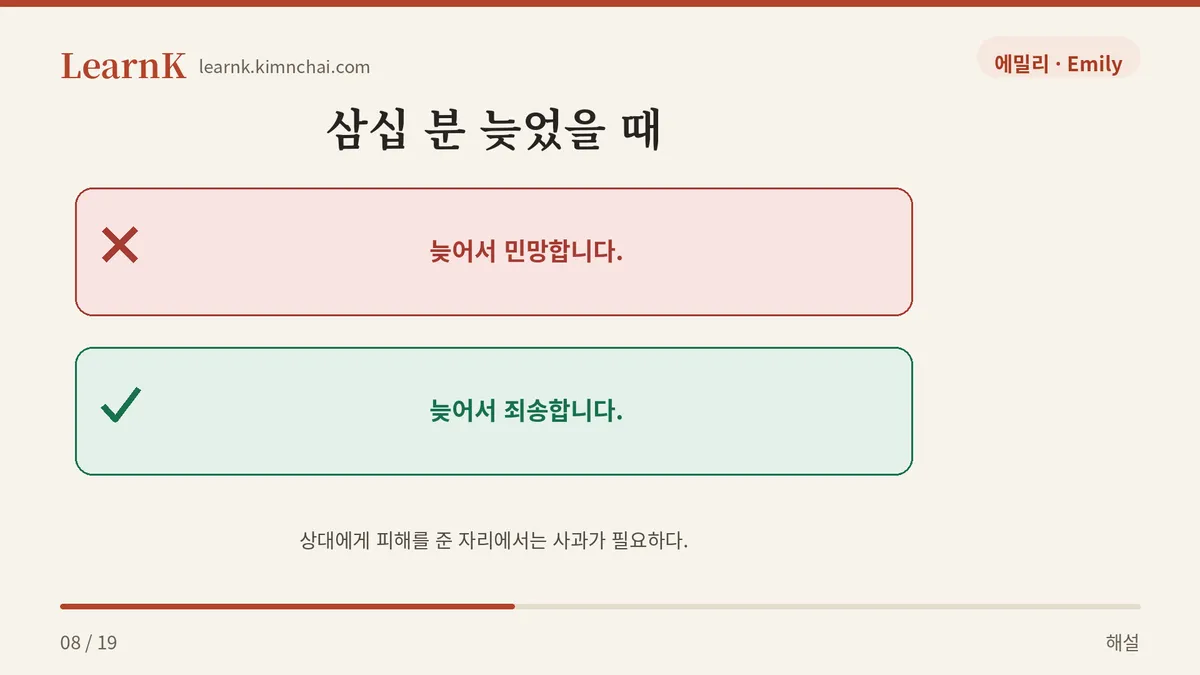
✗ (After showing up 30 minutes late and keeping the whole team waiting) 늦어서 민망합니다. (neujeoseo minmanghamnida) ✓ (After showing up 30 minutes late and keeping the whole team waiting) 늦어서 죄송합니다. (neujeoseo joesonghamnida) → 민망하다 (minmanghada) points at your own bruised dignity. Use it in a situation where you’ve caused someone real inconvenience and it comes across as “right now I’m worried about how I look” — which doesn’t function as an apology.
✗ (Looking a senior colleague straight in the face) 선배, 그 옷 진짜 보기 민망해요. (seonbae, geu ot jinjja bogi minmanghaeyo) ✓ (Quietly, to the friend beside you) 야, 저 옷 좀 민망하지 않냐? (ya, jeo ot jom minmanghaji annya) → “보기 민망하다 (bogi minmanghada)” is a judgment about how someone else looks. Say it straight to that person’s face and it stops being advice and becomes a put-down. This is a phrase you murmur sideways, not one you throw head-on.
Example Sentences by Situation
① Right after turning your camera on in a video call Only once the camera was on did you notice the laundry hanging in the background. Turning it off now would only draw more attention, but leaving it up keeps nagging at you. 지금 끄기도 민망하고 그냥 두기도 민망하네요. (jigeum kkeugido minmanghago geunyang dugido minmanghaneyo) Turning it off now would be awkward, and leaving it is awkward too.
② When a junior colleague pays before you can You’d clearly said the meal was on you, but your junior slipped off “to the restroom” and settled the bill. You’re grateful, but you’re not comfortable just letting it stand. 후배한테 얻어먹기 민망해서 커피는 제가 샀어요. (hubaehante eodeomeokgi minmanghaeseo keopineun jega sasseoyo) I felt too awkward letting a junior colleague pay, so I bought the coffee.
③ When someone unprepared takes the stage — dictionary sense ① At the company dinner talent show, the department head got shoved toward the mic. He missed the lyrics and the beat entirely. It wasn’t funny so much as uncomfortable. 보고 있기 민망해서 그냥 잔만 내려다봤어. (bogo itgi minmanghaeseo geunyang janman naeryeodabwasseo) It was too painful to watch, so I just stared at my glass.
Polite and Casual Forms, and Related Expressions
It’s an adjective, so the conjugation is regular. Casual is 민망해 (minmanghae), the everyday polite 해요 form is 민망해요 (minmanghaeyo), and the formal form is 민망합니다 (minmanghamnida). To modify a noun, use 민망한 (minmanghan) — as in 민망한 순간 (minmanghan sungan), “an awkward moment.”
One thing to watch out for. Korean emotion adjectives are used as-is only in the first person. To describe someone else’s feelings, you have to switch to 민망해하다 (minmanghaehada). “준경이가 민망해했어 (Jun-kyung-iga minmanghaehaesseo)” sounds natural, while “준경이가 민망했어 (Jun-kyung-iga minmanghaesseo)” sounds off.
| Expression | Temperature / Intensity | Where it’s used |
|---|---|---|
| 민망하다 (minmanghada) | Mild to moderate. No wrongdoing — the situation is just awkward | Everyday use across the board; works fine in polite speech |
| 창피하다 (changpihada) | Strong. The shame of an exposed mistake | Among close friends; too heavy for formal settings |
| 쑥스럽다 (ssukseureopda) | Mild. Praise or attention makes you squirm | Being complimented, confessing feelings |
| 겸연쩍다 (gyeomyeonjjeokda) | Moderate. Awkward and sheepish; literary in tone | Writing, older speakers |
| 안쓰럽다 (ansseureopda) | Pity directed outward at someone else | Overlaps with sense ① of 민망하다 |
Cultural Background — Where Eyes Are Watching
민망하다 (minmanghada) is a Sino-Korean word. The dictionary lists it as 憫惘하다, where 憫 means to regard something with pity and 惘 means to be dazed and at a loss. The two branches the dictionary separates out — pitiable and heartbreaking (①), and too embarrassed to know what to do (②) — are divided cleanly between those two characters.
There’s a reason Korean has such a dense vocabulary for this particular kind of embarrassment. It comes from a constant awareness of how your position looks within a relationship right now — the sense usually called 체면 (chemyeon), “face,” or 눈치 (nunchi), “social radar.” 민망함 (minmangham) is the signal that this sense has briefly slipped out of alignment. It’s not that you did something bad; it’s more like a notification that, in this particular moment, your position relative to the other person has gotten momentarily awkward.
In K-dramas, the scene where this emotion runs thickest is usually the holiday dinner table. An elder brings up marriage or a job, the younger person stares into their rice bowl instead of answering, and a few seconds of silence pass over the table. Nobody has done anything wrong, yet everyone is uncomfortable — those few seconds are 민망함 (minmangham).
So here’s one thing I’d recommend to learners. In Korea, 민망함 isn’t an emotion to hide so much as one to say out loud and share. When a moment turns awkward, being the first to say “아, 좀 민망하네요 (a, jom minmanghaneyo)” actually breaks the tension. The instant you name the feeling and put it on the table, everyone in the room ends up laughing together.
Today’s Quiz
A friend has shown up with a birthday gift that sails well past your sense of a reasonable budget. You’re grateful, but you’re not comfortable just accepting it. Which word best fills the blank?
이렇게 비싼 걸 받기 ( ) 어쩔 줄 모르겠어. (ireoke bissan geol batgi ( ) eojjeol jul moreugesseo) I’m so ___ about accepting something this expensive that I don’t know what to do.
① 창피해서 (changpihaeseo) ② 민망해서 (minmanghaeseo) ③ 쑥스러워서 (ssukseureowoseo)
Answer: ② You haven’t done a single thing wrong, but the other person’s generosity is so excessive that it’s uncomfortable to meet their eyes. That’s precisely the territory of 민망하다 (minmanghada). ① is a much stronger word used when your own mistake has been exposed, so it’s overkill here, and ③ is for when praise or attention makes you squirm — a different flavor entirely from this feeling of being indebted to someone.
Definitions and example sentences are from the National Institute of Korean Language’s Basic Korean Dictionary (krdict.korean.go.kr); that portion of this post, including our translations, is licensed under CC BY-SA 2.0 KR.