명동 (Myeongdong) — Seoul's Busiest Three Syllables, and How to Use Them Right
명동 (Myeongdong)
명동 (Myeongdong) is the name of a neighborhood in Jung-gu, central Seoul — a place so densely packed with department stores, cosmetics shops, and restaurants that it has become the city’s flagship downtown quarter, and the one tourists visit most. It appears in almost every travel unit of every Korean textbook, and it’s where a lot of people head the moment they drop their bags at the hotel on their first day in Seoul. And yet, the second learners try to put it into a real sentence, they hesitate — is it the name of a market? A department store? A subway station? Today we’ll look at 명동 (Myeongdong) all the way down to where Korean speakers actually pull out these three syllables, and with what tone.
명동 (Myeongdong) is a proper noun with no emotional charge. It isn’t something you say in anger or say sweetly — it’s just a place name. Even so, the word almost automatically drags along two mental images that nearly every Korean shares. The first is people. Myeongdong on a weekend afternoon is a place where you walk staring at the back of the head in front of you, so if you say 명동 갔다 왔어 (Myeongdong gatda wasseo) — “I went to Myeongdong” — the reply 사람 많았지? (Saram manhatji?) — “It was packed, right?” — comes back almost as a reflex. The second is spending. Cosmetics road shops, street-food stalls, duty-free stores, and currency exchange booths are all crammed into the same few alleys, so 명동에서 샀어 (Myeongdongeseo sasseo) — “I bought it in Myeongdong” — usually means clothes, cosmetics, or souvenirs. So 명동 (Myeongdong) is an administrative district name on a map and, at the same time, functions almost like a common noun meaning “crowded shopping street.” Once you can see those two layers, the examples below read much more clearly.
Checking It in the National Institute of Korean Language Dictionary
The National Institute of Korean Language’s Basic Korean Dictionary defines the word like this.
명동 (Myeongdong) 「noun」 A dong (neighborhood) in Jung-gu, Seoul. It has many service facilities such as department stores, restaurants, and theaters, and is a well-known Seoul attraction that draws large numbers of tourists. — National Institute of Korean Language, Basic Korean Dictionary (krdict.korean.go.kr)
The dictionary also provides the same definition in several other languages.
[en] Myeongdong — A region, ‘dong’ in Jung-gu, Seoul; there are many service facilities such as department stores, music stores, and theaters, and it is a popular tourist attraction in Seoul. [ja] ミョンドン【明洞】 — ソウル特別市中区にある洞。デパート、飲食店、劇場などサービス施設が多く、観光客が多く訪れるソウルの名所である。 [es] Myeongdong — Una de las unidades administrativa en Jung-gu, Seúl. Tiene muchas instalaciones de servicios como grandes almacenes, restaurantes y teatros, y es una atracción turística popular en Seúl. [zh] 明洞 — 位于首尔特别市中区的一个区域,有众多百货店、餐厅、剧场等服务设施,是吸引众多游客的首尔著名景点。 — National Institute of Korean Language, Basic Korean Dictionary (krdict.korean.go.kr)
A Portuguese definition isn’t included in the dictionary, so the one below is our own rendering (not a dictionary quotation). Myeongdong — Um bairro (‘dong’) em Jung-gu, Seul; concentra lojas de departamentos, restaurantes e teatros, e é um dos pontos turísticos mais visitados da cidade.
Now let’s walk through the real usage examples the same dictionary lists, one at a time.
명동 거리. (Myeongdong geori.) Myeongdong Street. — National Institute of Korean Language, Basic Korean Dictionary (krdict.korean.go.kr)
This is the most basic form. Attaching 거리 (geori, street) after 명동 points not to the administrative district but to the whole walkable shopping strip. You’ll run into this form constantly on tourist signboards and maps.
명동은 언제나 사람들이 복작거리는 것 같아요. (Myeongdongeun eonjena saramdeuri bokjakgeorineun geot gatayo.) Myeongdong always seems to be swarming with people. — National Institute of Korean Language, Basic Korean Dictionary (krdict.korean.go.kr)
The very first impression a Korean reaches for when talking about Myeongdong is sitting right there in this sentence. 복작거리다 (bokjakgeorida) paints the picture of a tight space made noisy and messy by too many people. It’s worth memorizing whole so you can chime in when travel talk comes up.
명동에 있는 본점에 가서 음식을 먹어 보니 우리 동네의 분점보다 맛이 있었다. (Myeongdonge inneun bonjeome gaseo eumsigeul meogeo boni uri dongneui bunjeomboda masi isseotda.) I went and ate at the main branch in Myeongdong, and the food was better than at the branch in my neighborhood. — National Institute of Korean Language, Basic Korean Dictionary (krdict.korean.go.kr)
This example shows why Myeongdong is a special address. Long-established restaurants and famous brands often keep their 본점 (bonjeom, main/flagship branch) in Myeongdong, so the name frequently reads as “where the original is.”
명동이라든가, 동대문 시장이라든가 옷 가게가 많은 곳으로 가 봐. (Myeongdongirandeunga, Dongdaemun sijangirandeunga ot gagega manheun goseuro ga bwa.) Try going somewhere with lots of clothing shops — Myeongdong, say, or Dongdaemun Market. — National Institute of Korean Language, Basic Korean Dictionary (krdict.korean.go.kr)
This is a casual-speech conversation recommending places to shop. The fact that 명동 comes up first when listing options with -이라든가 (-irandeunga, “like… or…”) tells you exactly where this name sits in a Korean speaker’s mind.
Seeing It in Real Conversation
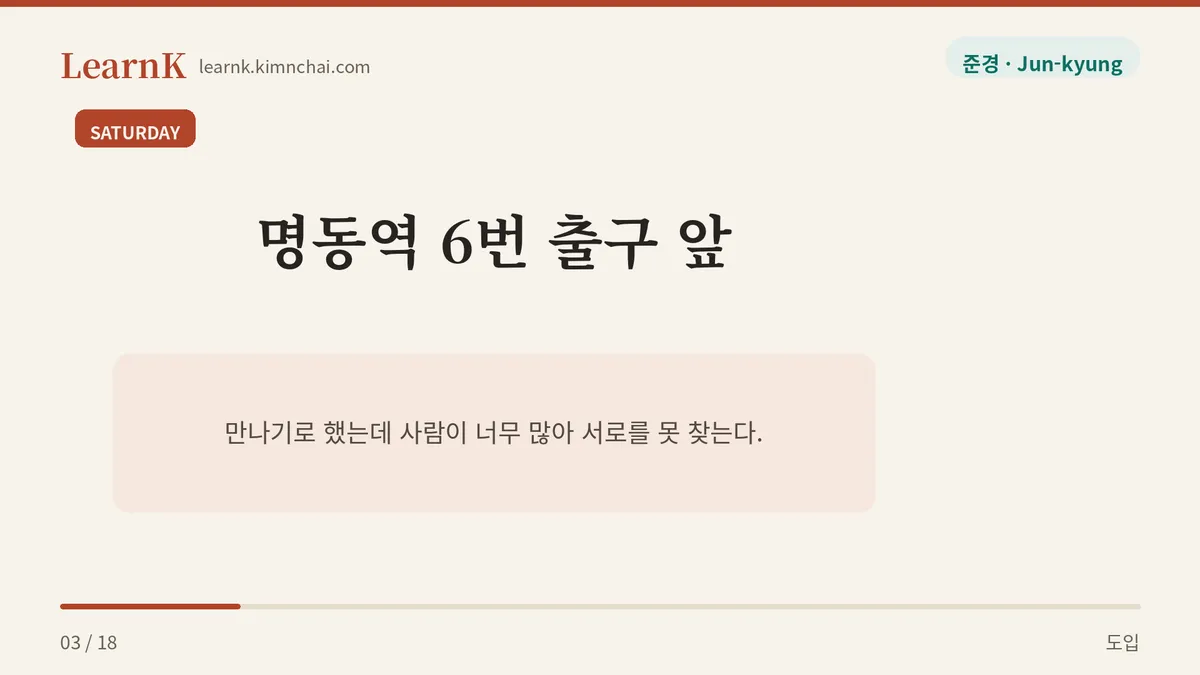
Situation: Saturday afternoon, in front of Exit 6 at Myeongdong Station. They agreed to meet, but there are so many people that they can’t find each other and are on the phone.
Jun-kyung: 야, 어디야? 나 6번 출구 계단 바로 앞인데. Hey, where are you? I’m right at the top of Exit 6.
Emily: 나도 6번이거든?! 근데 주말 명동은 진짜 앞이 안 보여. I’m at Exit 6 too! But on a weekend I literally can’t see past the crowd in Myeongdong.
Jun-kyung: 아, 파란 모자! 손 흔드는 사람 너지? Oh — blue cap! That’s you waving, right?
Emily: 어 보인다 보인다. 십 분을 헤맸네, 진짜. Yeah, I see you. I’ve been wandering for ten minutes.
Jun-kyung: 그러니까 내가 을지로입구 쪽에서 만나자고 했잖아. That’s why I said let’s meet over by Euljiro 1-ga.
Emily: 그래도 사촌 오면 명동부터 데려와야지. 여기 안 보면 서울 봤다고 못 하잖아. Still, when my cousin visits I have to bring her to Myeongdong first. You haven’t seen Seoul until you’ve seen this.
These Versions Sound Off
명동 (Myeongdong) is a proper noun you can use with anyone, so there’s no situation where it turns rude. Instead, let’s flag the two misunderstandings learners actually make most often.
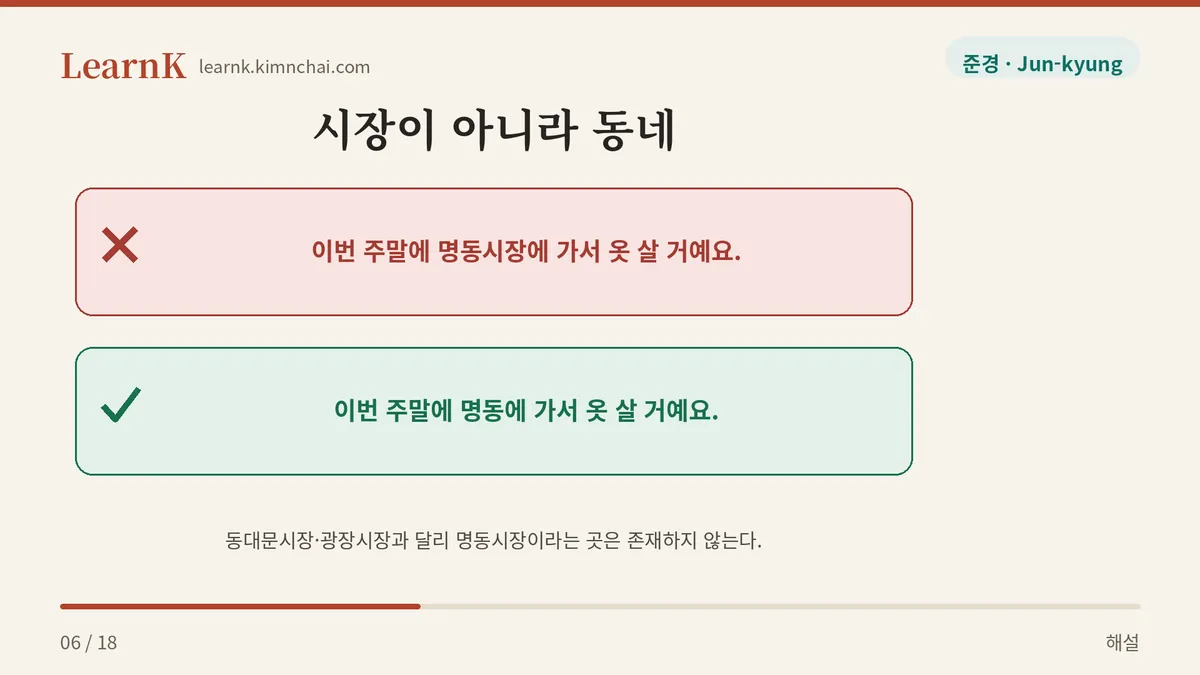
✗ 이번 주말에 명동시장에 가서 옷 살 거예요. (Ibeon jumare Myeongdongsijange gaseo ot sal geoyeyo.) ✓ 이번 주말에 명동에 가서 옷 살 거예요. (Ibeon jumare Myeongdonge gaseo ot sal geoyeyo.) — I’m going to Myeongdong this weekend to buy clothes. → Unlike 동대문시장 (Dongdaemun Market) or 광장시장 (Gwangjang Market), 명동 is a neighborhood name, not a market name. There is no such place as “명동시장,” so just say 명동에 (Myeongdonge).
✗ 저는 서울 중구 명동동에 삽니다. (Jeoneun Seoul Jung-gu Myeongdongdonge samnida.) ✓ 저는 서울 중구 명동에 삽니다. (Jeoneun Seoul Jung-gu Myeongdonge samnida.) — I live in Myeongdong, Jung-gu, Seoul. → The 동 (dong) in 명동 is already the administrative unit. Unlike 역삼동 (Yeoksam-dong) or 신사동 (Sinsa-dong), tacking another 동 on the end doubles up the unit.
Example Sentences by Situation
① Mapping out a route for a friend who’s in Seoul for the first time
For a friend with only half a day, minimizing travel distance is the best you can do.
시간이 반나절뿐이면 명동에서 남산까지 걸어 올라가는 코스가 제일 나아. (Sigani bannajeolppunimyeon Myeongdongeseo Namsankkaji georeo ollaganeun koseuga jeil na-a.) If you only have half a day, walking up from Myeongdong to Namsan is the best route.
② When someone asks where to buy cosmetics
Myeongdong has a reputation as a good place to comparison-shop, since the road shops are all bunched into the same few alleys.
화장품은 명동에서 사 — 가게가 붙어 있어서 값 비교하기 편해. (Hwajangpumeun Myeongdongeseo sa — gagega buteo isseoseo gap bigyohagi pyeonhae.) Buy your cosmetics in Myeongdong — the shops are right next to each other, so it’s easy to compare prices.
③ Giving your report back after a visit
“It was packed” is the standard closing line of any Myeongdong story.
어제 명동 갔다가 사람에 치여서 삼십 분 만에 나왔어요. (Eoje Myeongdong gatdaga sarame chiyeoseo samsip bun mane naowasseoyo.) I went to Myeongdong yesterday and left after thirty minutes — it was too packed.
Formal vs. Casual, and Related Expressions
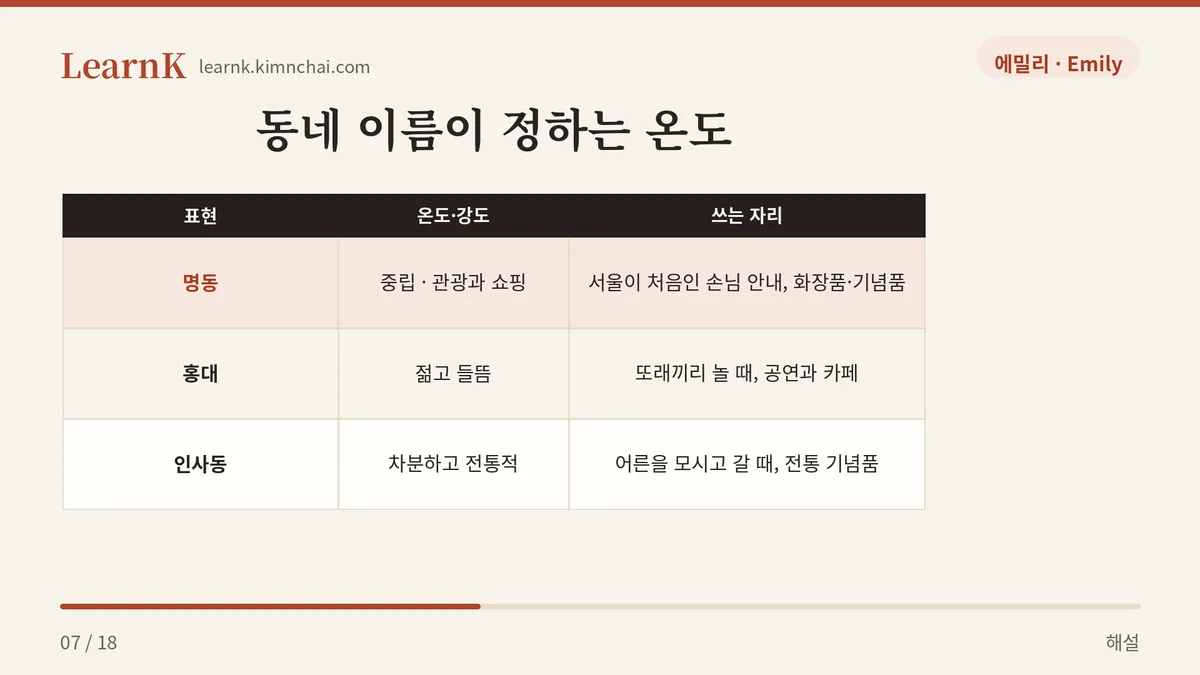
명동 (Myeongdong) is a proper noun, so its form never changes. Politeness is decided purely at the end of the sentence — to someone senior, 명동에 가시겠어요? (Myeongdonge gasigesseoyo?); to a friend, 명동 가자 (Myeongdong gaja). What actually sets the “temperature” is which neighborhood name you pick. Seoulites divide them up like this, depending on the purpose and the company.
| Expression | Tone · Intensity | Where it’s used |
|---|---|---|
| 명동 (Myeongdong) | Neutral · shorthand for tourism and shopping | Showing around a first-time visitor to Seoul; cosmetics and souvenir talk |
| 동대문 (Dongdaemun) | Practical · centered on the night | Buying lots of clothes cheaply; pre-dawn shopping |
| 홍대 (Hongdae) | Young and buzzing | Hanging out with people your own age; live shows, clubs, cafés |
| 인사동 (Insa-dong) | Calm and traditional | Taking an elder along; traditional souvenirs |
명동 갈까? (Myeongdong galkka?) and 홍대 갈까? (Hongdae galkka?) don’t just differ in destination — they set the character of the whole day. The first is sightseeing and shopping; the second is play and nightlife.
Cultural Background — The “Bright” 明 Left in the Name
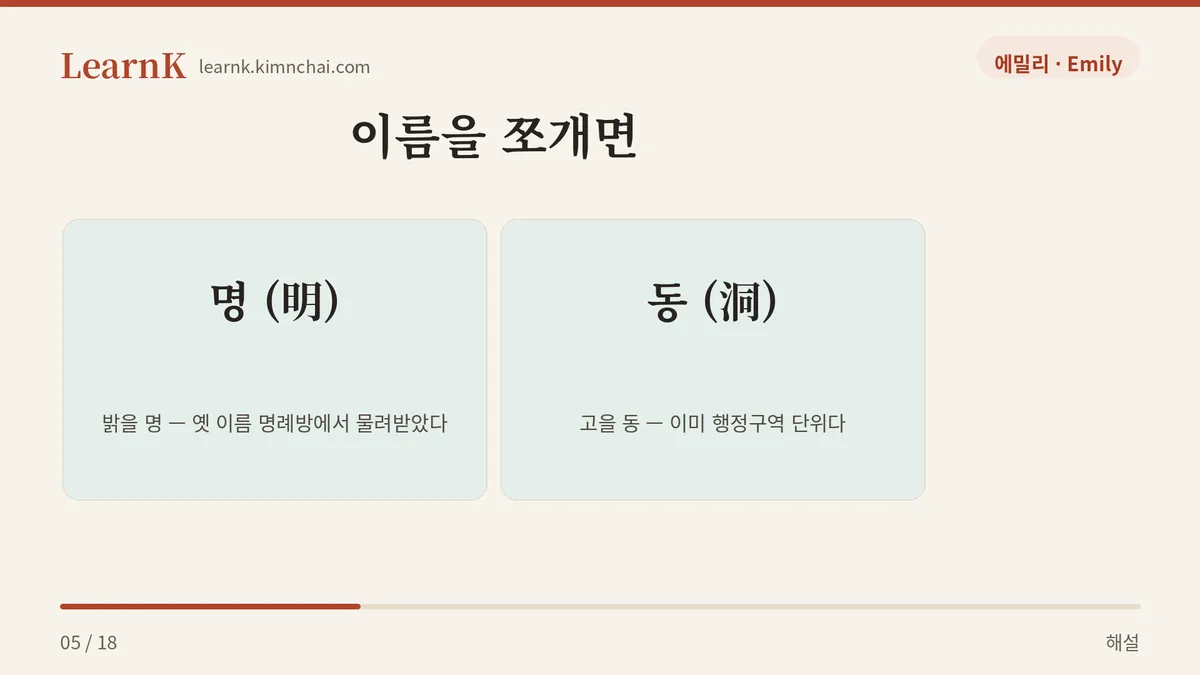
In hanja, 명동 is written 明洞: 明 (myeong, “bright”) plus 洞 (dong, “village, district”). The usual explanation is that during the Joseon era this area was called 명례방 (Myeongnyebang, 明禮坊), and the 明 was inherited from there. The fact that 명동성당 (Myeongdong Cathedral) — the symbol of Korean Catholicism — was originally named Myeongnyebang Cathedral comes from that same root. In other words, the name itself carries no meaning of “famous neighborhood.” Becoming famous came later.
And Myeongdong’s face really has changed with each generation. In the 1970s and ’80s it was a street of youth, full of music listening rooms, theaters, and tearooms, and that era’s impression still lingers in the dictionary’s examples.
명동은 젊은이들이 좋아할 만한 구경거리가 넘쳐 주말만 되면 젊은이들의 천국이 된다. (Myeongdongeun jeolmeunideuri joahal manhan gugyeonggeoriga neomchyeo jumalman doemyeon jeolmeunideurui cheon-gugi doenda.) Myeongdong overflows with sights young people love, so come the weekend it turns into a paradise for the young. — National Institute of Korean Language, Basic Korean Dictionary (krdict.korean.go.kr)
From the 2000s onward, cosmetics road shops and duty-free stores filled the alleys and it became a street for foreign tourists. That’s why, among younger Seoulites today, you’ll often hear 명동은 관광객들이 가는 데지 (Myeongdongeun gwangwanggaekdeuri ganeun deji) — “Myeongdong is where the tourists go.” Myeongdong shows up in dramas all the time too, but less as the neighborhood where the protagonist lives and more as the backdrop for scenes where someone loses another person in the crowd, or bumps into them by chance. A place with so many people that you can’t find each other — the conversation above is exactly that cliché. The hill in front of Myeongdong Cathedral, the stalls in the alleys, and the shop signs that flicker on in the evening are still the images most often chosen when you need a single frame that says “Seoul.”
Today’s Quiz
Which of the following sentences uses 명동 (Myeongdong) most naturally?
- 이번 주말에 명동시장에 가서 옷을 살 거예요. (Ibeon jumare Myeongdongsijange gaseo oseul sal geoyeyo.)
- 저는 서울 중구 명동동에 살고 있습니다. (Jeoneun Seoul Jung-gu Myeongdongdonge salgo itseumnida.)
- 사람이 너무 많아서 주말 명동은 걸어 다니기가 힘들어요. (Sarami neomu manaseo jumal Myeongdongeun georeo danigiga himdeureoyo.)
- 어제 명동역에서 쇼핑하고 화장품을 샀어요. (Eoje Myeongdongyeogeseo syopinghago hwajangpumeul sasseoyo.)
Answer: 3. The “명동시장” in 1 is a name that doesn’t exist, and 2 doubles up on 동. In 4, the shopping happened on the street, not inside the subway station, so 명동에서 (Myeongdongeseo) is the right form. Number 3 carries the same impression as the dictionary’s 복작거리다 (bokjakgeorida) example — the most Korean-sounding sentence of the four.
Definitions and example sentences are from the National Institute of Korean Language’s Basic Korean Dictionary (krdict.korean.go.kr); that portion of this post, including our translations, is licensed under CC BY-SA 2.0 KR.