내로남불 (naeronambul) — "When I Do It, It's Romance; When You Do It, It's an Affair"

내로남불
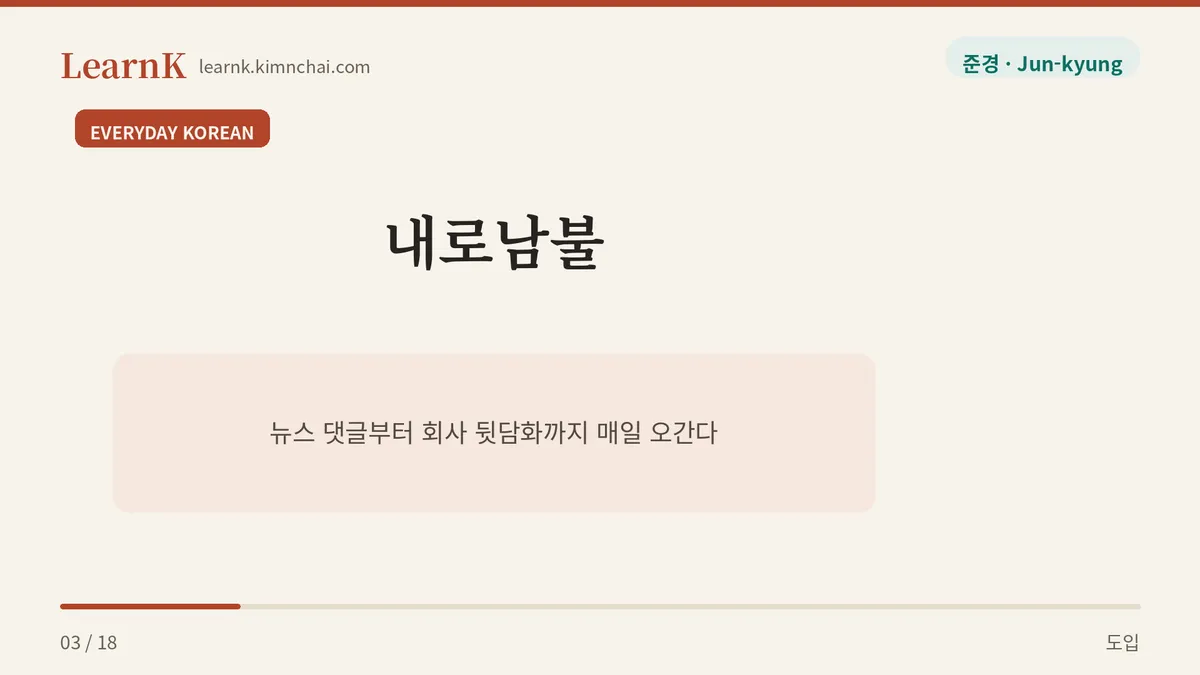
Picture this: someone who nags a friend for showing up late — “Why are you always late?” — but when they’re the one running late, they brush it off with “The traffic was terrible, I couldn’t help it.” You’ve seen this at least once, right? When someone is easy on themselves but strict with others over the exact same thing, Korean speakers sum it up in a single word — 내로남불 (naeronambul).
From news comments to chats with friends to office gossip, it’s one of the most frequently used expressions in Korean these days. Today, let’s really dig into it.
Meaning and Nuance
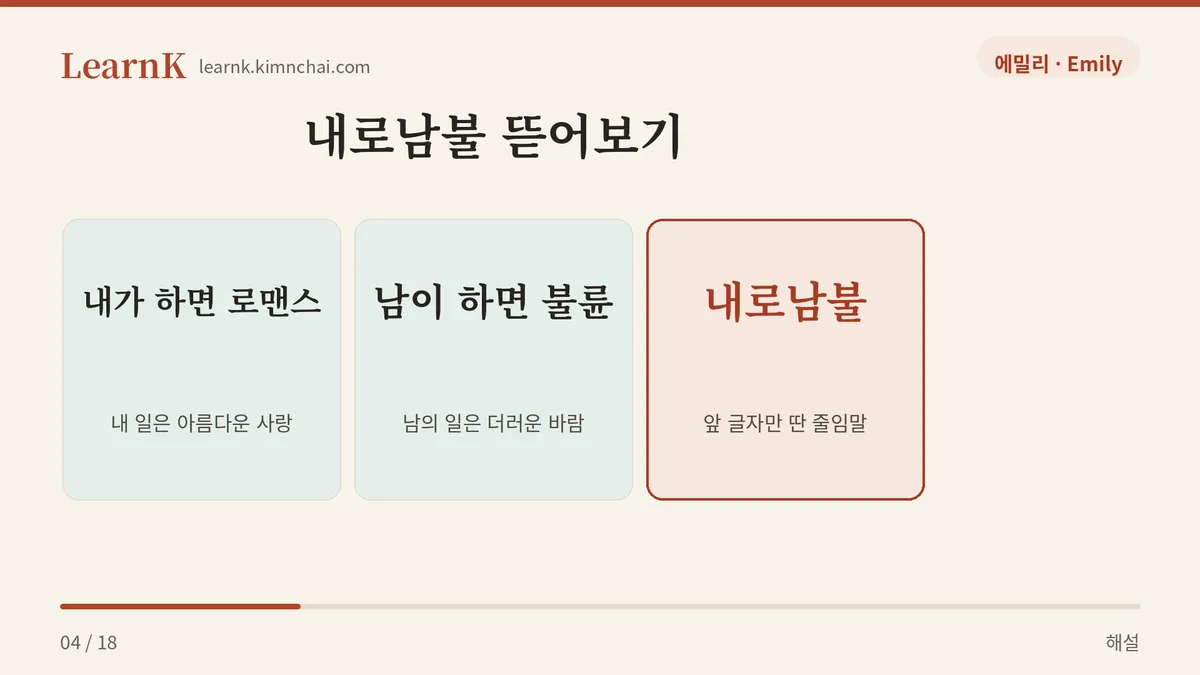
내로남불 is an abbreviation made from the first syllable of each part of a longer phrase: “내가 하면 로맨스, 남이 하면 불륜 (naega hamyeon romaenseu, nami hamyeon bullyun)” — spelled out, it means “When I do it, it’s a beautiful romance; when someone else does it, it’s a dirty affair (cheating).”
The heart of it is applying two different standards to the very same behavior. It carries almost the same nuance as the English “double standard,” or “rules for thee but not for me.” When I do it, there are understandable circumstances; when someone else does it, it becomes an unforgivable wrong — this expression pinpoints exactly that shamelessness.
Even though it sounds casual, the meaning underneath is pretty sharp. Because it calls out someone’s hypocrisy, there’s a hidden barb even when you say it with a smile. So unless you’re very close, people tend to use it when talking about a third party rather than saying it to someone’s face.
Seeing It in a Real Conversation
Situation: Sunday evening, sitting on the couch watching the news together. On screen is a politician who now says something completely different from what they used to say.
Jun-kyung: 아, 저 사람 진짜 어이없네. 몇 년 전엔 정반대로 말했으면서. Ugh, that guy is unbelievable. A few years ago he said the complete opposite.
Emily: 완전 내로남불이네. 자기가 하면 괜찮고, 남이 하면 안 되고. Total double standard. When he does it, it’s fine; when others do it, it’s not.
Jun-kyung: 그러니까. 저런 사람들이 제일 뻔뻔해. Exactly. People like that are the most shameless.
Emily: 근데 오빠도 지난주에 나 조금 늦었다고 엄청 뭐라 했잖아. 오빠는 맨날 늦으면서. But you gave me such a hard time last week just for being a little late. And you’re late all the time.
Jun-kyung: 어… 그건 좀 다르지. 나는 그날 이유가 있었고. Uh… that’s a bit different. I had a reason that day.
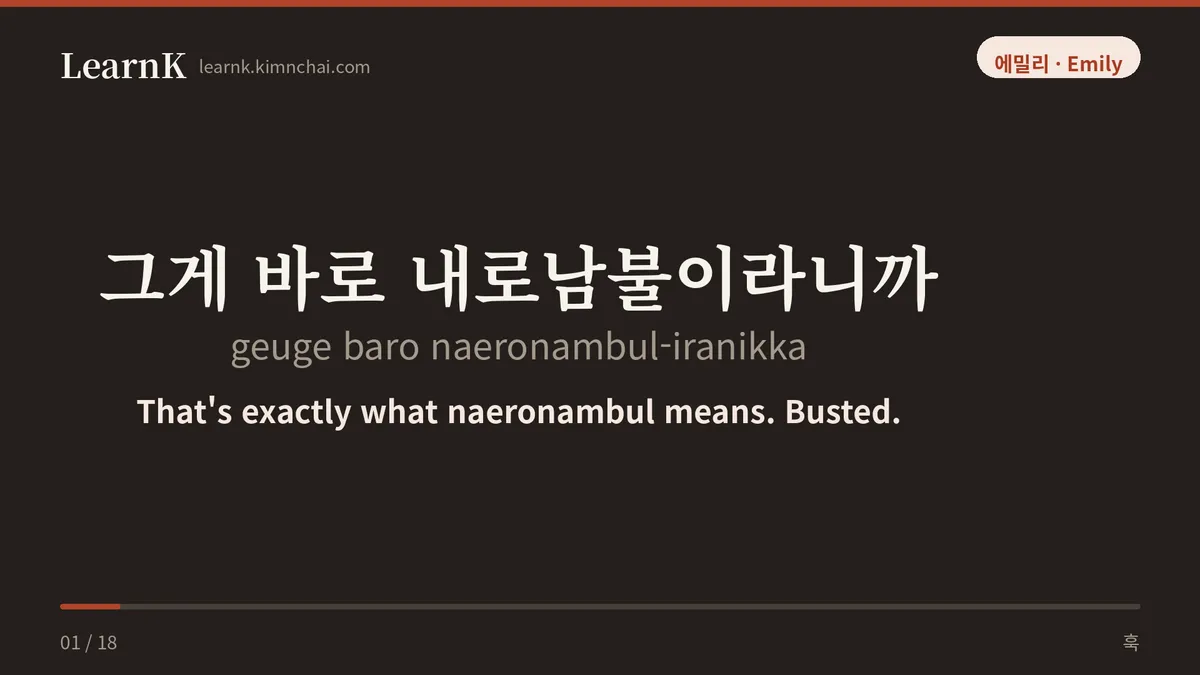
Emily: 그게 바로 내로남불이라니까. ㅋㅋㅋ 딱 걸렸어. That’s exactly what “naeronambul” means. Lol, busted.
Example Sentences by Situation
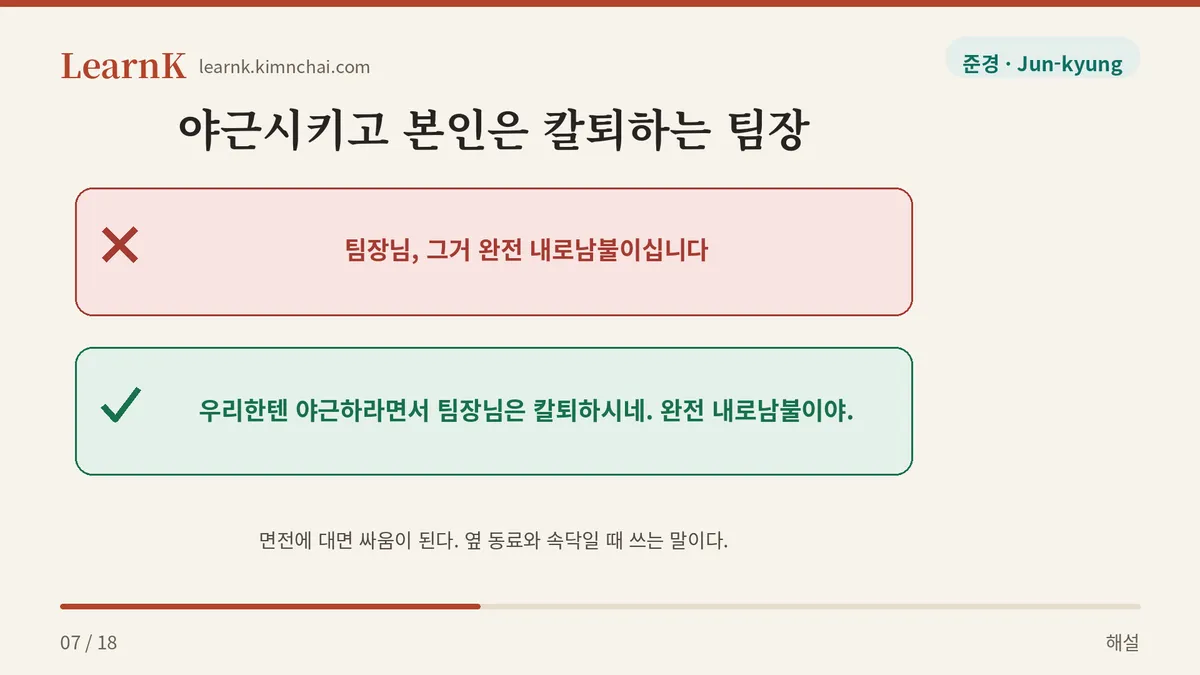
1. At work (a boss’s double standard) — When a team leader stresses to the staff that they should work overtime, yet leaves right on time every day themselves, coworkers whisper to each other like this:
“우리한텐 야근하라면서 팀장님은 칼퇴하시네. 완전 내로남불이야. (urihanten yageun haramyeonseo timjangnimeun kaltoehasine. wanjeon naeronambul-iya.)”
→ ‘칼퇴 (kaltoe)’ is a shortened form of ‘칼같이 정시에 퇴근한다’, meaning “to leave work exactly on time, sharp as a knife.”
2. Between a couple (a relationship spat) — When your partner is unhappy about you meeting a friend of the opposite sex, but insists that the ones they meet are “just friends.”
“너는 되고 나는 안 되고? 그거 내로남불 아니야? (neoneun doego naneun an doego? geugeo naeronambul aniya?)”
→ It sounds like a light-hearted complaint, but it’s a comeback that pokes right at the other person’s double standard.
Formal/Casual Speech and Similar Expressions
내로남불 works like a noun on its own, so you just change the predicate that follows it.
- Casual: 내로남불이야 / 내로남불이지 (naeronambul-iya / naeronambul-iji)
- Formal: 내로남불이에요 / 내로남불입니다 (naeronambul-ieyo / naeronambul-imnida)
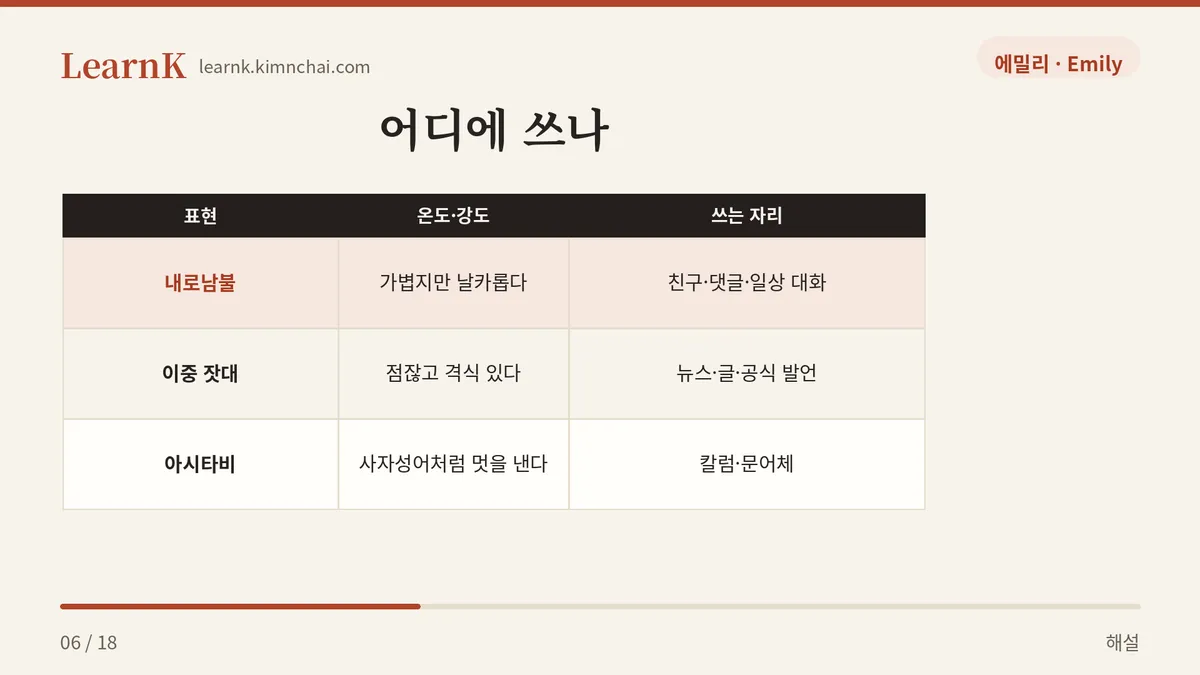
It’s good to know some similar expressions, too. 이중 잣대 (ijung jatdae) is a more polite, formal expression, so you’ll often see it in the news or in writing. 아시타비 (asitabi, 我是他非) means “I am right and others are wrong,” a newly coined term that reshapes 내로남불 as if it were a four-character idiom. Among old proverbs, 똥 묻은 개가 겨 묻은 개 나무란다 (ttong mudeun gaega gyeo mudeun gae namuranda) — “the dog covered in poop scolds the dog with a speck of chaff on it,” meaning “the person with the bigger fault blames someone for a small one” — has the same flavor.
Cultural Background
‘내로남불’ began being used in political circles in the 1990s to criticize the opposing side, and after the 2010s it rode the news and social media to become an everyday word for the whole nation. Now it’s used widely to call out “hypocrisy where words and actions don’t match” — not just in politics, but in romance, the workplace, family, and everywhere else. It’s also the word viewers most often type into live comments when a nasty boss or a chaebol-family character in a drama covers up their own faults while badgering everyone else. If you can use this one expression naturally, you’ve taken a step into the Koreans’ sense of ‘촌철살인’ humor — the art of the sharp, cutting one-liner.
Wrap-Up Quiz
A friend says this: “It’s fine if I play games for two hours, but if you play for even 30 minutes, it’s a waste of time.” What’s the one word for this attitude of being generous only toward yourself?
See the answer
내로남불 (naeronambul)! Generous toward yourself and strict toward others — a textbook double standard.