능글맞다 (neunggeulmatda) — The Face That Turns Your Scolding Into a Laugh
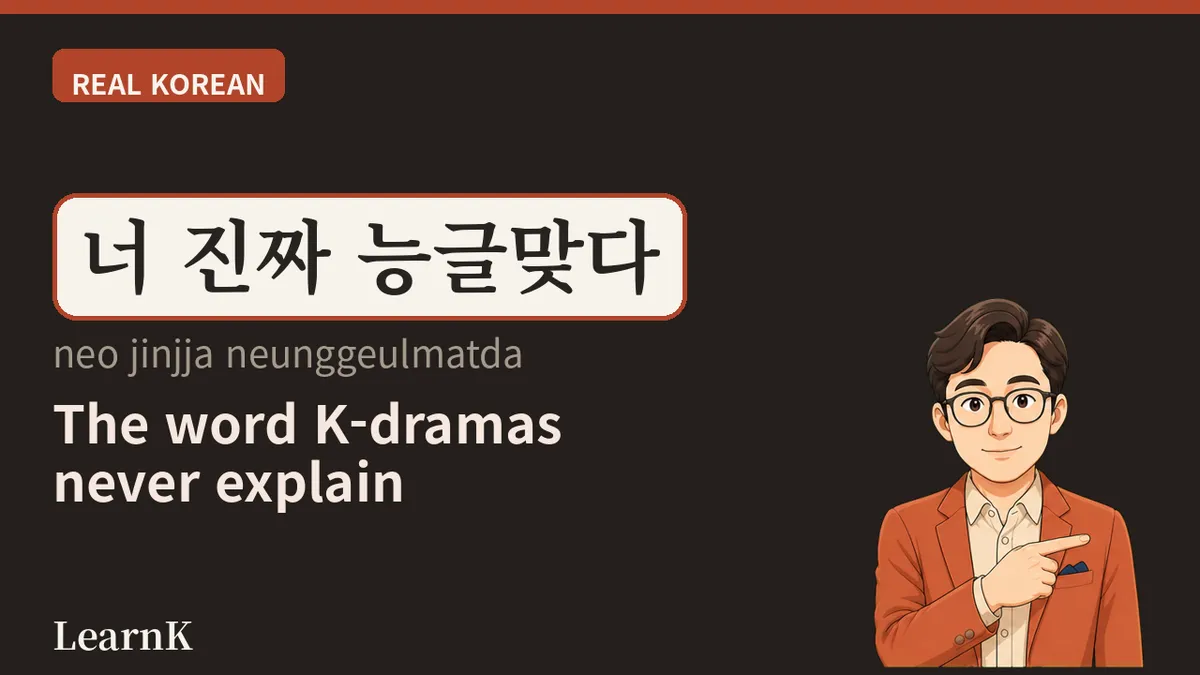
능글맞다
능글맞다 (neunggeulmatda) means having a sly, shameless streak — being a little cunning while wearing an innocent face. Someone who gets called out and, instead of turning serious, just brushes it off with a small smile. Someone who hears “no” and keeps pestering you with a grin. Someone who has already finished all the calculating on the inside while looking like they know nothing at all. Korean has a word for that person, and this is it.
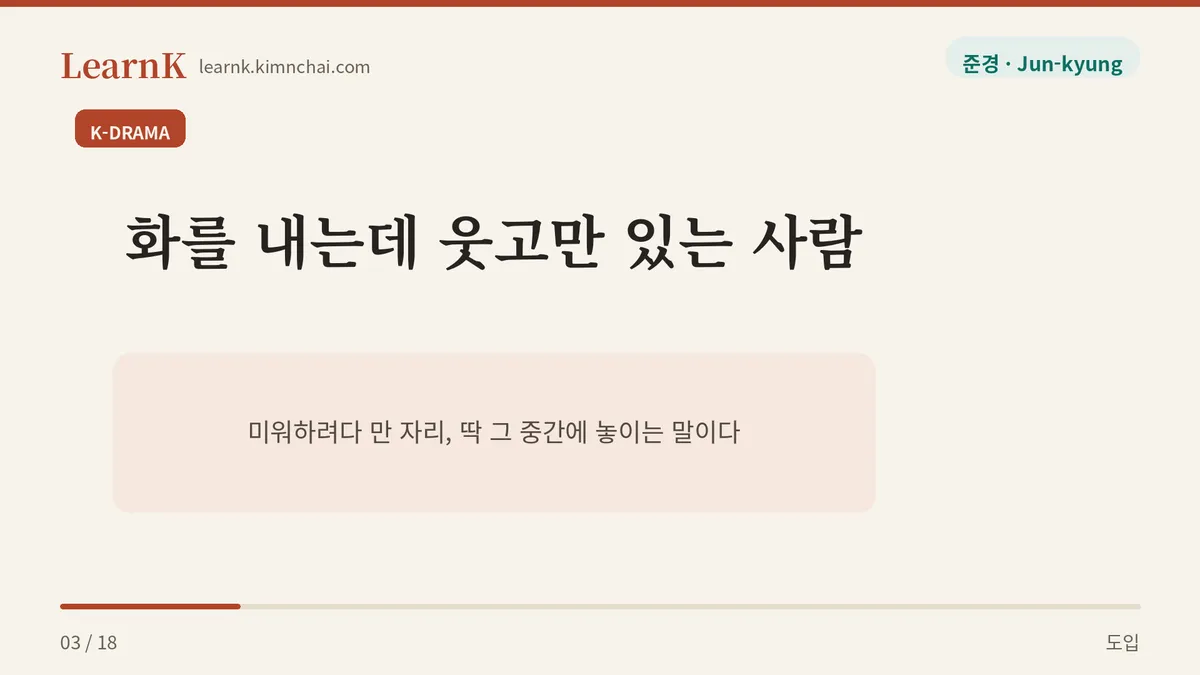
Watch enough Korean dramas and this word turns up in the subtitles pretty often. The female lead is genuinely angry; the male lead just keeps smiling. Right around the moment the angry one starts feeling awkward instead, a friend standing nearby drops a line: “쟤 진짜 능글맞아 (neunggeulmaja)” — “He is so shameless.” Used this way, the word is neither an insult nor a compliment. It sits exactly in the middle — in the spot where you meant to dislike someone and didn’t quite manage it.
The heart of this word is the face. Not being embarrassed where embarrassment is called for, and covering that nerve with a smile rather than with coldness. That’s why an expression is almost always attached to this word. In real conversation it shows up paired with laughter overwhelmingly often, as in 능글맞게 웃다 (neunggeulmatge utda), “to smile slyly.” Take the smile away and the word barely holds up. Someone who deceives people with a blank face isn’t 능글맞다 — that’s closer to plain 음흉하다 (eumhyunghada), “sinister.”
The intensity is milder than you’d guess. The dictionary gloss opens with 음흉하고 (“sinister and…”), which makes it sound frightening, but in practice it’s used much more lightly. You don’t really use it for someone who has done real harm. It’s more the kind of shamelessness that is 밉지 않은 (mipji aneun) — impossible to actually hate — the nerve you end up letting slide. It’s a negative word that can still carry affection: a word with a subtle temperature. If a Korean learner reads only the dictionary gloss and files it away as a “bad word,” they’ll miss the whole texture of the laughter in those drama scenes.
Checking It in the National Institute of Korean Language Dictionary
The National Institute of Korean Language’s Basic Korean Dictionary lists this word as an adjective and glosses it like this.
능글맞다 (neunggeulmatda) 「Adjective」 음흉하고 능청스러운 데가 있다. (To have something sly and brazenly innocent-seeming about one.) — National Institute of Korean Language, Basic Korean Dictionary (krdict.korean.go.kr)
The multilingual translations offered by the same dictionary are as follows.
[en] wily; sneaky — Somewhat cunning and shameless. [ja] あつかましい — 陰険でずうずうしいところがある。 [es] astuto, taimado, artero — Que tiene aspecto astuto e insidioso. [zh] 耍滑,油滑,赖皮 — 有阴险凶恶、假惺惺之处。 — National Institute of Korean Language, Basic Korean Dictionary (krdict.korean.go.kr)
Put the English gloss’s shameless next to the Japanese ずうずうしい (“brazen in a good-natured, thick-skinned way”) and you can see where this word’s center of gravity actually lies. It leans less on “deceives you” and more on “feels no embarrassment.” For reference, Portuguese is not among the translations listed in this dictionary. If we had to render it, malandro or cara de pau would come close — but we should note that this Portuguese is our own translation, not dictionary material.
The dictionary also carries two real usage examples. Both are reproduced here as they are, with commentary.
구렁이같이 능글맞다. — National Institute of Korean Language, Basic Korean Dictionary (krdict.korean.go.kr)
구렁이같이 능글맞다 (gureongigachi neunggeulmatda), “as slippery as a rat snake” — a 구렁이 is a large snake. Try to grab it and it slides right out of your hands; you can never tell which way it’s headed. This is what you say about the person who changes the subject every time you try to pin down responsibility, or who smiles and walks away when you’ve asked for an answer. The whole point of the metaphor is that feeling of never getting a grip.
표정이 능글맞다. — National Institute of Korean Language, Basic Korean Dictionary (krdict.korean.go.kr)
표정이 능글맞다 (pyojeongi neunggeulmatda), “the expression is sly” — the “face” we talked about earlier shows up right there in the dictionary’s own example. What matters is that the subject isn’t a person but an expression (표정). This word settles on the face before it settles on the behavior. The face with the corners of the mouth turned up while being scolded, the face that says sorry while the eyes are laughing — that’s what belongs here.
See It in a Real Conversation
Situation: Saturday morning at a traditional market. They’ve bought a box of strawberries and are just stepping out of the shop.
Jun-kyung: 봤지? 한 팩 더 받았잖아. See that? I got an extra pack.
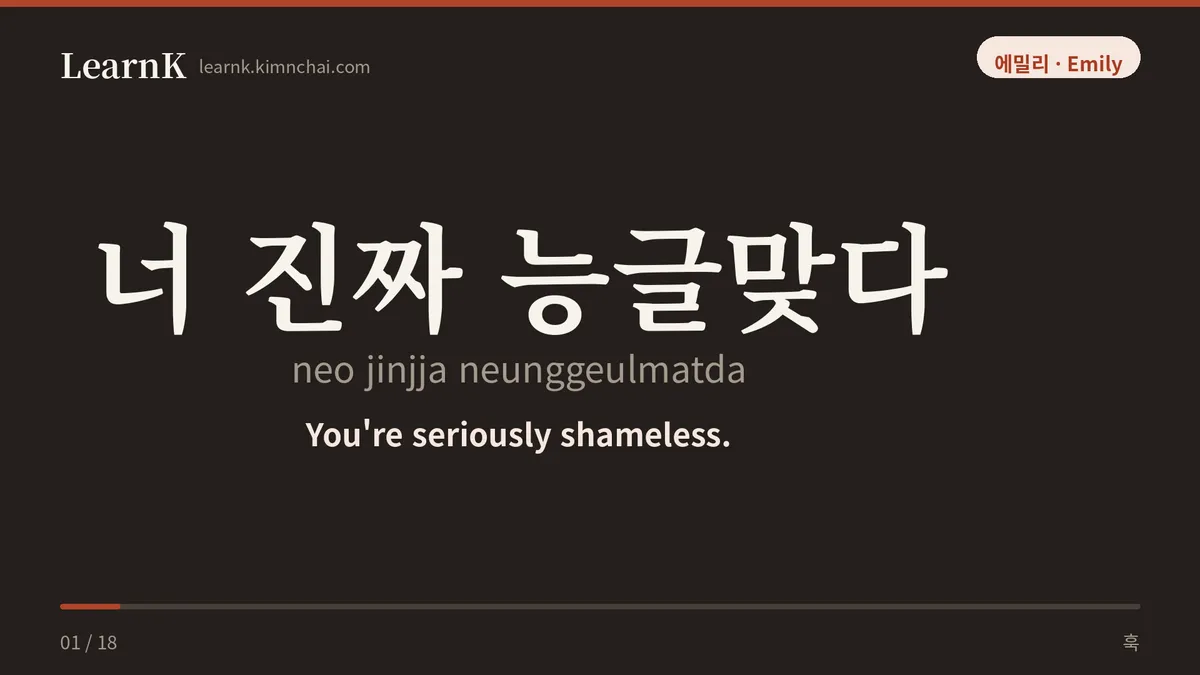
Emily: 아주머니가 안 된다고 세 번이나 말했는데 너는 계속 웃고만 있더라. 너 진짜 능글맞다. The lady said no three times and you just kept smiling. You’re seriously shameless.
Jun-kyung: 능글맞은 게 아니라 친화력이라고 하는 거야. That’s not being sneaky, that’s called being personable.
Emily: 그게 바로 능글맞은 거거든. 아까 그 표정 어디서 배웠어? That is exactly what being sneaky is. Where did you learn that face?
Jun-kyung: 우리 아버지. 아버지가 나보다 훨씬 능글맞으셔. My dad. He’s way slicker than me.
Emily: 아, 유전이었구나. 그럼 다음 주 수박은 네가 사 와. Ah, so it’s hereditary. Then you’re buying the watermelon next week.
Ways of Using It That Sound Off
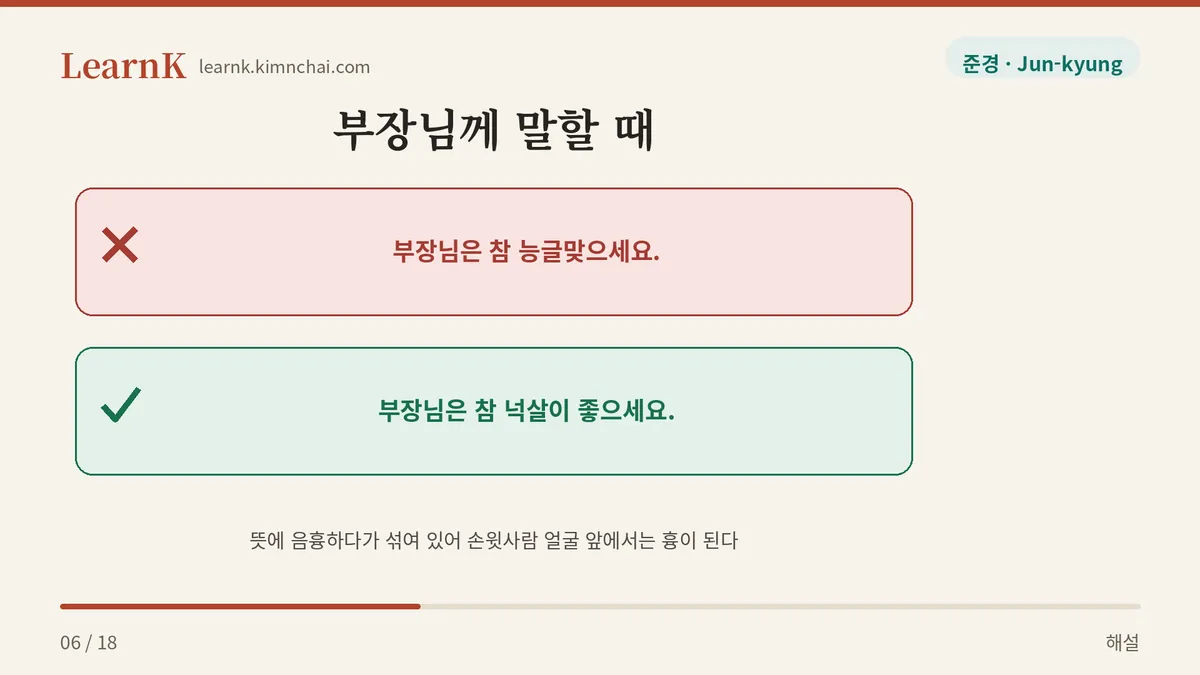
✗ (to your department head) 부장님은 참 능글맞으세요 (neunggeulmajeuseyo). ✓ (to your department head) 부장님은 참 넉살이 좋으세요 (neoksari joeuseyo). → Because “음흉하다 (sinister)” is baked into the meaning, saying this to someone senior’s face reads as a knock, not a compliment. If what you want to convey is that they’re warm and easy with people, 넉살이 좋다 (neoksari jota), “to have an easy, sociable nerve,” is the safe choice.
✗ 그 사람이 투자한다고 속여서 수억을 가로챘대. 진짜 능글맞아 (neunggeulmaja). ✓ 그 사람이 투자한다고 속여서 수억을 가로챘대. 진짜 악질이야 (akjiriya). → There’s a silly little laugh mixed into this word, so it can’t carry the weight of real damage. It fits light-hearted nerve, but used about a crime it makes the whole matter sound trivial.
Example Sentences by Situation
Situation 1 — A junior colleague, late for the third time, opens the office door. Not a trace of apology on his face; when your eyes meet, he just grins.
세 번째 지각해 놓고 능글맞게 (neunggeulmatge) 웃기만 한다. He’s late for the third time and all he does is smile that sly smile.
The scolding you had prepared gets stuck in your throat. This is the most common, most textbook place for this word.
Situation 2 — The day after a blind date, giving a friend the debrief. The first impression wasn’t great, but oddly, he stuck with you.
좀 능글맞은데 (neunggeulmajeunde) 이상하게 밉지가 않더라. He’s a bit of a smooth talker, but strangely I couldn’t dislike him.
The trick is that little pivot with ‘-는데’. Attach a reversal after a negative word and it turns into an expression of fondness. This is the classic way Koreans use this word affectionately.
Situation 3 — A holiday gathering; your nephew sidles over and links arms with you. He hasn’t even brought up pocket money yet, and you can already see where this is going.
이 녀석 벌써부터 능글맞아 (neunggeulmaja), 누구 닮았는지 모르겠네. This kid is already such a smooth operator — I have no idea who he takes after.
Used about a child, it’s less a reprimand than a way of saying they’re adorable. Same word, but the temperature changes completely depending on the age of the person you’re describing.
Polite and Casual Forms, and Similar Expressions
The casual form is 능글맞아 (neunggeulmaja); the polite forms are 능글맞아요 (neunggeulmajayo) and 능글맞습니다 (neunggeulmatseumnida). As we saw above, though, it’s rare to use this to someone’s face in polite speech — it’s usually said about an absent third party.
Since it’s an adjective, the modifier form is 능글맞은 (neunggeulmajeun). Treating it like a verb and writing ‘능글맞는’ is incorrect. ‘능글맞는 사람’ (✗) / ‘능글맞은 사람’ (✓).
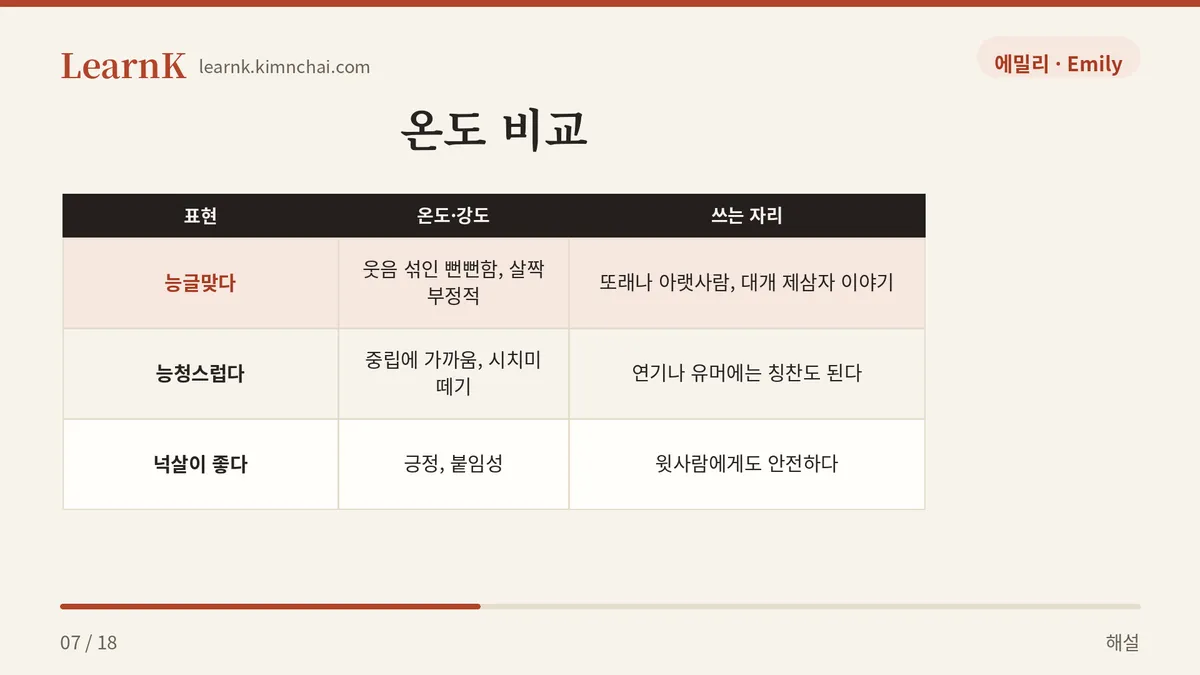
| Expression | Temperature / Intensity | Where it fits |
|---|---|---|
| 능글맞다 (neunggeulmatda) | Nerve mixed with a smile; mildly negative | Peers and juniors. Most often said about a third party |
| 능청스럽다 (neungcheongseureopda) | Close to neutral. Playing dumb | Also used for acting and humor. Can even be a compliment |
| 넉살이 좋다 (neoksari jota) | Positive. Sociable and easygoing | Safe even with someone senior |
| 뻔뻔하다 (ppeonppeonhada) | Strong criticism. No smile involved | Only when you don’t mind damaging the relationship |
It’s especially worth pinning down the difference from 능청스럽다 (neungcheongseureopda). 능청스러움 centers on “pretending not to know,” so it can even be used to praise an actor’s performance. 능글맞음, on the other hand, has an extra layer of hidden motive on top, which makes it hard to turn into a compliment.
Cultural Background — The Rat Snake You Can’t Hate
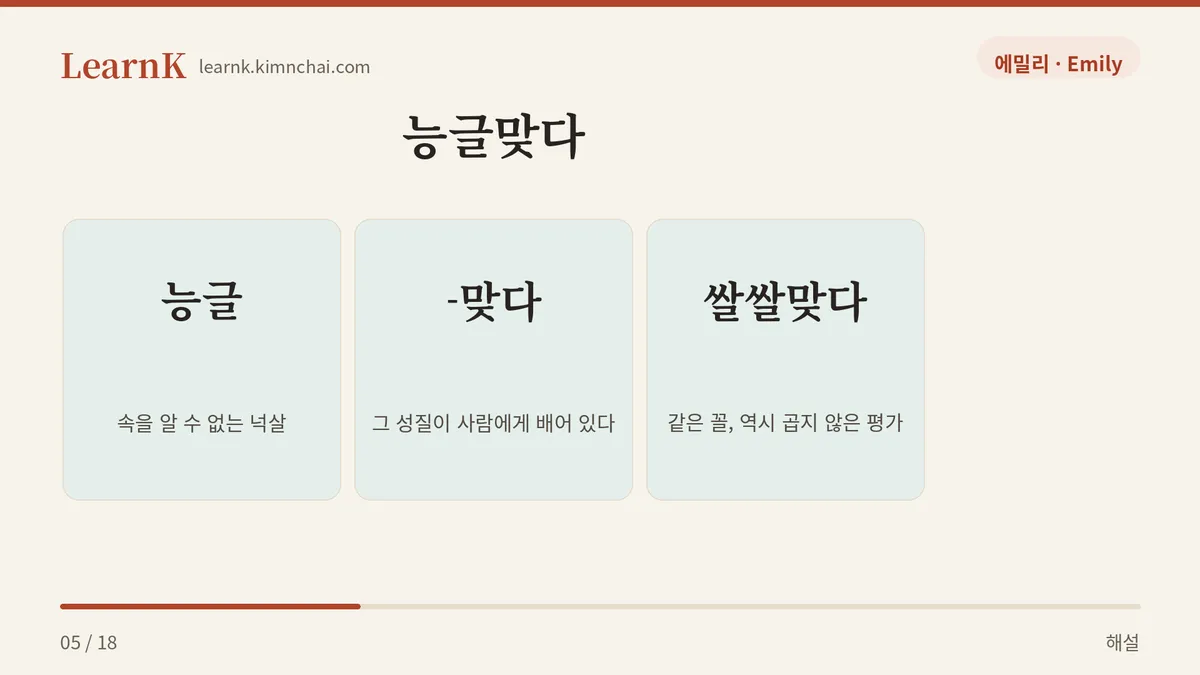
Look at how the word is built and you can see its character. The suffix ‘-맞다’ — as in 쌀쌀맞다 (ssalssalmatda), “cold and curt,” 청승맞다 (cheongseungmatda), “pitifully dreary,” 방정맞다 (bangjeongmatda), “flighty and fidgety,” and 앙증맞다 (angjeungmatda), “cutely tiny” — marks that the quality named by the preceding element is steeped into that person. As the list shows, words carrying this suffix are mostly used for unflattering judgments. So this word’s default setting is criticism too. For affection to mix in, the surrounding context has to support it.
The rat snake in the dictionary example isn’t a coincidence either. Korean has an old metaphor calling a person whose intentions you can’t read a 능구렁이 (neunggureongi), “an old rat snake,” and it describes the attitude of quietly fudging a matter instead of settling it clearly as 구렁이 담 넘어가듯 (gureongi dam neomeogadeut), “like a rat snake slipping over a wall.” There’s no basis for declaring that this word came from 구렁이, but the two expressions clearly share the same picture: a body that slides right out of your hands when you try to hold on.
This is also why the word turns up so often in dramas. Male leads in romance shows come in roughly two varieties. One is prickly until his real feelings get caught out; the other closes the distance with a smile from the very start. Korean viewers call the second type a “능글맞은 남주” — a sly male lead. He smiles when she’s angry, crosses the line she draws, and then shows his sincerity at the decisive moment. The reason this type is beloved is that his nerve never actually hurts the other person. And that is exactly the point at which this word stops being an insult. When both sides know there’s no malice behind the smile, the word becomes not a criticism but a declaration of surrender.
Today’s Quiz
Which of the following uses 능글맞다 (neunggeulmatda) most naturally?
- 인사를 해도 받지 않고 그냥 지나가더라. 참 능글맞다. He didn’t even return my greeting, just walked right past. So 능글맞다.
- 약속에 한 시간 늦어 놓고 미안하다는 말도 없이 웃기만 한다. 참 능글맞다. He was an hour late and just smiled without a word of apology. So 능글맞다.
- 시험 준비를 밤새워 했다더니 정말 능글맞다. I hear he stayed up all night studying for the exam — he’s really 능글맞다.
Answer: 2
Number 1 describes a cold, curt attitude, so 쌀쌀맞다 (ssalssalmatda) is the right word there. The diligence in number 3 has nothing to do with this word at all. Number 2 contains both of this word’s conditions — a situation that calls for embarrassment, and a smile produced right there in that moment. 능글맞다 only holds when those two overlap.
Definitions and example sentences are from the National Institute of Korean Language’s Basic Korean Dictionary (krdict.korean.go.kr); that portion of this post, including our translations, is licensed under CC BY-SA 2.0 KR.