Why Pajeon on a Rainy Day? — Today's Korean Word: '파전' (Pajeon)
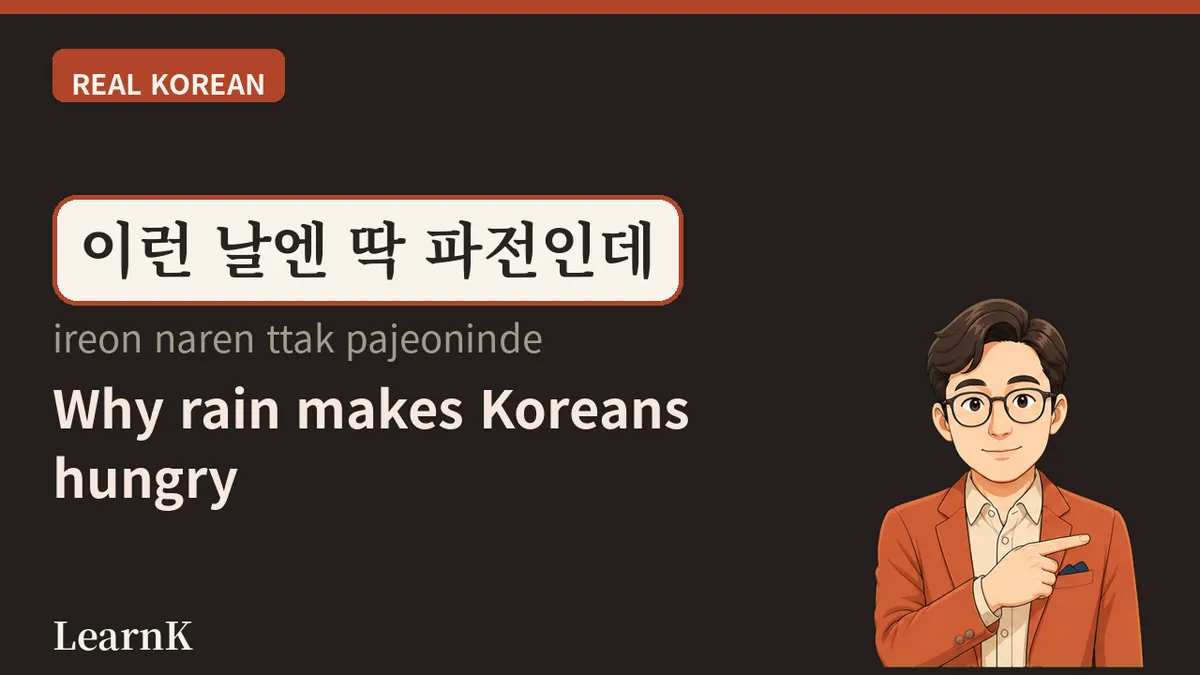
When it starts to rain, there’s one food that pops into Korean people’s heads almost automatically. When the sound of rain drifts in through the window, someone is bound to say: “On a day like this, it’s gotta be pajeon and makgeolli.” Today, we’re going to take a deep dive into exactly that word, 파전 (pajeon). It may be just one word, but packed inside it are Korea’s weather, its drinking culture, and even jeong (情) — that warm sense of connection between people.
파전
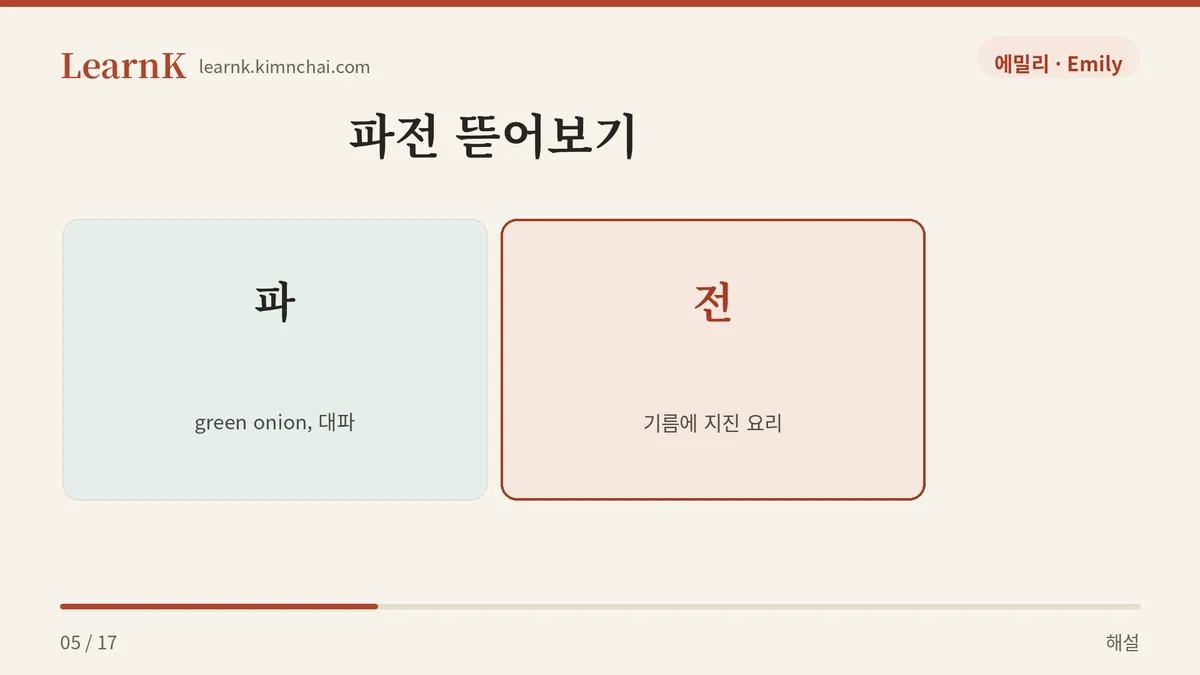
파전 (pajeon) is a dish made by mixing flour batter with plenty of long-cut green onions, adding seafood or other ingredients, and pan-frying it in oil. In English it’s often introduced as a “green onion pancake,” but honestly, it isn’t sweet like a pancake — it’s closer to a savory, salty pan-fried dish.
Here, ‘파 (pa)’ means green onion, and ‘전 (jeon, 煎)’ means a dish pan-fried in oil. So pajeon literally means “a jeon made with green onions.” Add a generous amount of seafood and it becomes 해물파전 (haemulpajeon); add kimchi and it becomes kimchijeon. Just put the name of an ingredient in front of ‘전 (jeon)’ and you get all sorts of different pancake names.
Pajeon is fried so it’s easy to eat with chopsticks, then dipped into a sauce of soy sauce mixed with vinegar and red pepper flakes. Its charm is the texture — crispy on the outside, moist on the inside — so it tastes best hot and fresh off the pan. The sharp, tingly aroma of green onion blends with the savory umami of the seafood, and one bite tells you instantly why Koreans love this food so much.
Checking the National Institute of Korean Language Dictionary
First, let’s look at the definition exactly as it appears in the National Institute of Korean Language’s Basic Korean Dictionary.
파전 (noun): A dish made by putting long-cut green onions, seafood, and the like into flour batter and pan-frying it. [en] pajeon; green onion pancake — National Institute of Korean Language, Basic Korean Dictionary (krdict.korean.go.kr)
Just from the definition, you can spot the three key elements: ‘green onion,’ ‘seafood,’ and ‘pan-fry,’ right? Now let’s look at some real example sentences the dictionary provides.
비 오는 날에는 파전에 막걸리를 곁들여 먹는 게 최고지. — National Institute of Korean Language, Basic Korean Dictionary (krdict.korean.go.kr)
This is the most iconic sentence showing that rainy days, pajeon, and makgeolli come as a set. Any Korean has heard this a hundred times.
저는 한국 요리를 배워서 불고기는 물론 파전도 만들 수 있어요. — National Institute of Korean Language, Basic Korean Dictionary (krdict.korean.go.kr)
Here, someone who has learned Korean cooking names pajeon as a dish they can confidently make. That also shows how much pajeon is considered a “quintessential Korean home-cooked dish.”
비도 오는데 파전에 동동주나 한잔 할까? — National Institute of Korean Language, Basic Korean Dictionary (krdict.korean.go.kr)
This is a warm, friendly sentence offering a friend a drink in casual speech. ‘동동주 (dongdongju)’ is a traditional liquor similar to makgeolli, and it pairs wonderfully with pajeon.
어제 막걸리와 파전을 같이 먹었는데 매우 맛있었어. — National Institute of Korean Language, Basic Korean Dictionary (krdict.korean.go.kr)
This is a sentence calmly recounting the experience of having pajeon and makgeolli together. And here too, makgeolli shows up right on cue.
A Real Conversation
Situation: Saturday afternoon, when rain suddenly pours down outside the window. Two people who are home together look out the window.
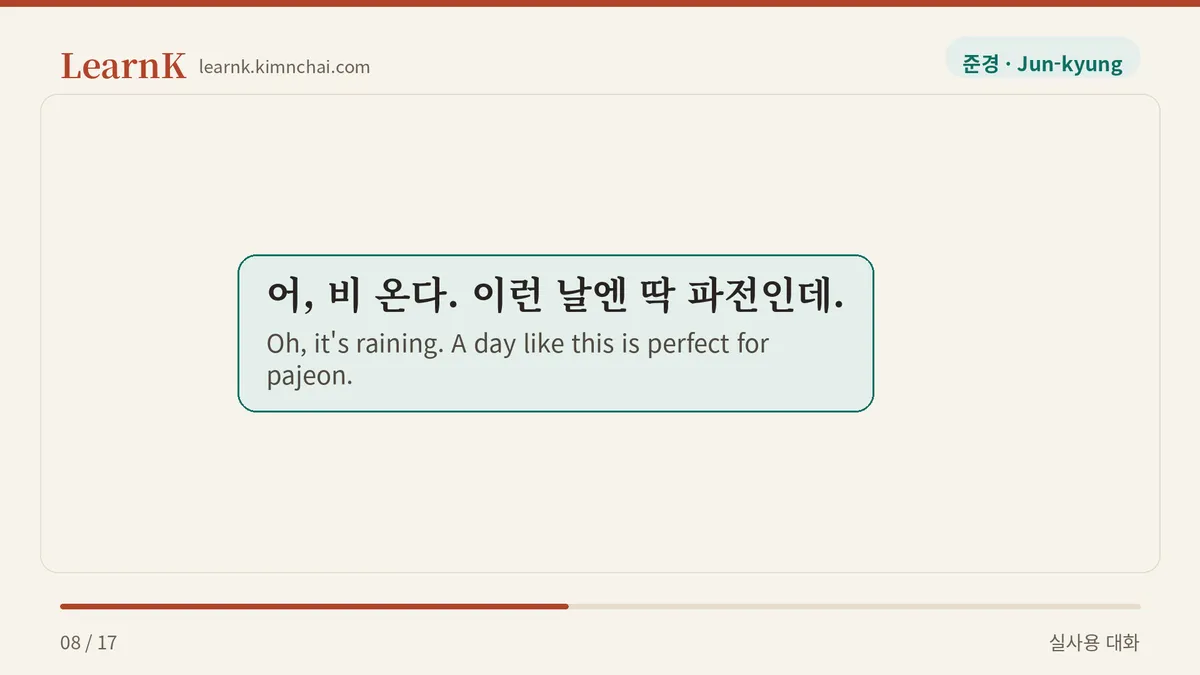
준경: 어, 비 온다. 이런 날엔 딱 파전인데. Oh, it’s raining. A day like this is perfect for pajeon.
에밀리: 그니까. 나 방금 그 생각 했어. 빗소리 들으니까 배고파지네. Right? I was just thinking that. The sound of rain is making me hungry.
준경: 냉장고에 파랑 오징어 있던데, 내가 파전 부쳐 줄까? There’s green onion and squid in the fridge. Should I make pajeon?
에밀리: 진짜? 그럼 나는 막걸리 사 올게. 파전엔 막걸리지. Really? Then I’ll grab some makgeolli. Pajeon goes with makgeolli.
준경: 역시 넌 한국 산 지 15년이라 이런 건 나보다 낫다니까. As expected — 15 years in Korea, you know this stuff better than me.
에밀리: 당연하지. 비 오는 날 파전은 국룰이잖아. Of course. Pajeon on a rainy day is basically the golden rule.
Example Sentences by Situation
1. On a rainy day, on the phone with a friend (casual speech) 비도 오는데 우리 파전에 막걸리 한잔 어때? (bido oneunde uri pajeone makgeolli hanjan eottae?) — A situation where you casually suggest going to a pajeon place since it’s raining.
2. Ordering at a market or restaurant (polite speech) 여기 해물파전 하나랑 동동주 한 주전자 주세요. (yeogi haemulpajeon harang dongdongju han jujeonja juseyo.) — An ordering sentence you’ll commonly hear at a traditional market or a pancake shop.
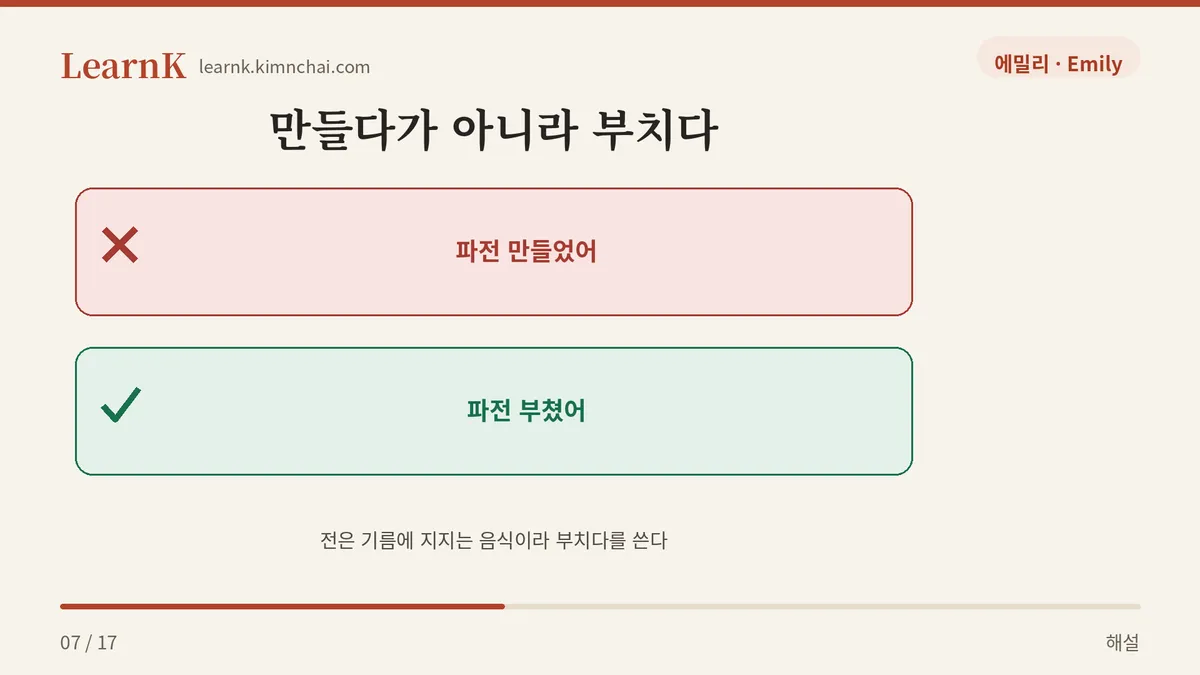
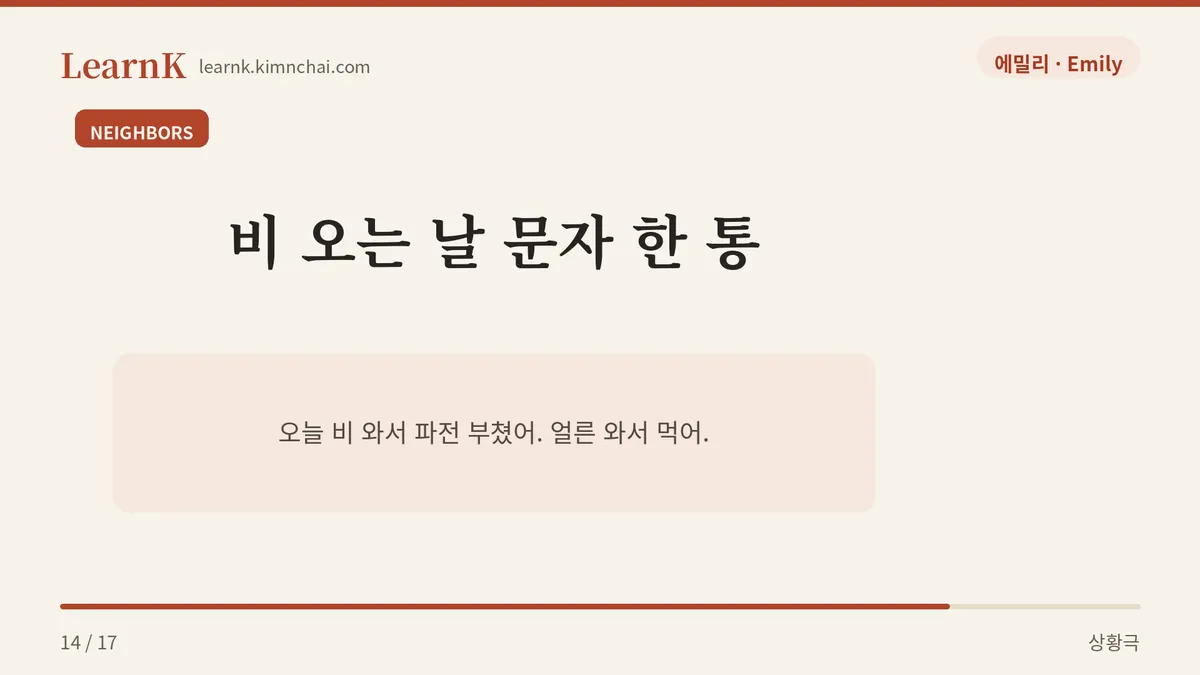
3. Making it yourself at home and calling someone over (casual speech) 오늘 비 와서 파전 부쳤어. 얼른 와서 먹어. (oneul bi waseo pajeon buchyeosseo. eolleun waseo meogeo.) — ‘부치다 (buchida)’ is a verb meaning to pan-fry a jeon in oil. For pajeon, it sounds more natural to say you “부친다 (buchinda, pan-fry it)” than that you “만든다 (mandeunda, make it).”
Polite vs. Casual Speech and Related Expressions
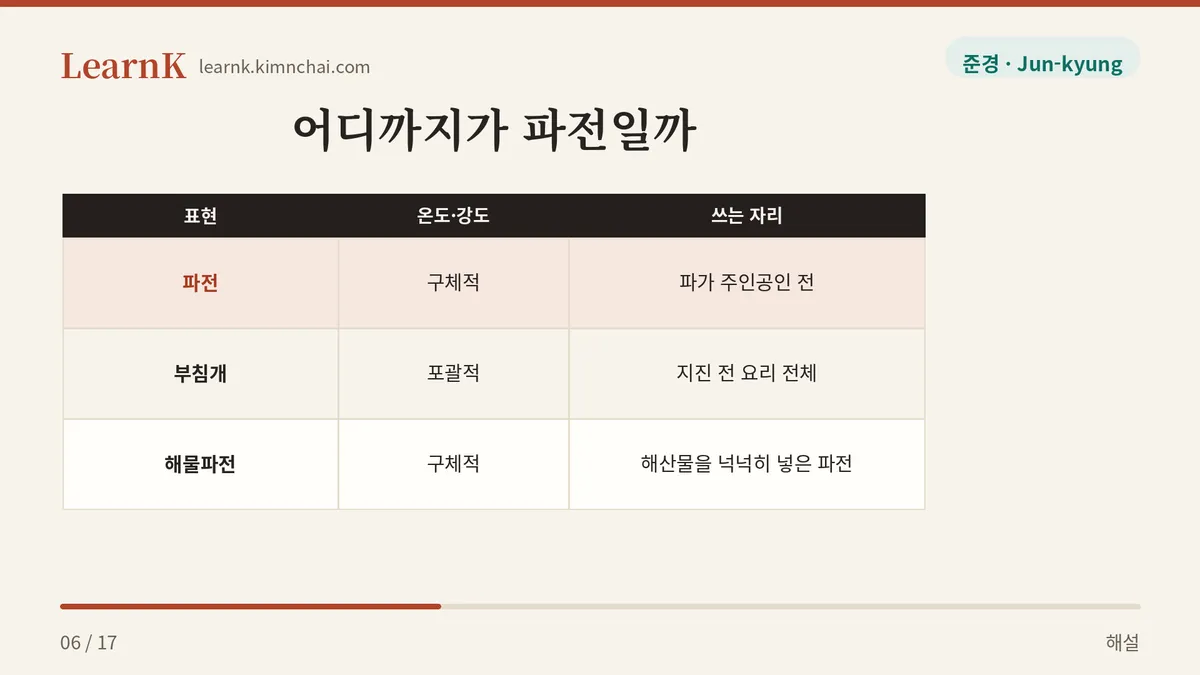
When offering some, in casual speech you’d say 파전 먹을래? (pajeon meogeullae?), and in polite speech 파전 드실래요? (pajeon deusillaeyo?). Pajeon is a type of 부침개 (buchimgae) — ‘buchimgae’ is the broad term covering all pan-fried jeon dishes, while ‘pajeon’ refers specifically to the one where green onion is the star. Depending on the region, it’s also called ‘지짐이 (jijimi).’ The name changes with the ingredients — kimchijeon, gamjajeon (potato), buchujeon (garlic chives) — so once you learn just this one word, pajeon, you can easily pick up the other jeon names.
Cultural Background
In Korea, the formula “pajeon on a rainy day” is almost common knowledge. There’s a fun theory behind it: the sizzling sound of pajeon frying in oil resembles the sound of rain falling outside the window, so it naturally comes to mind. In dramas, too, there’s a recurring scene where, on a rainy day, characters open up about their true feelings over pajeon and makgeolli. So pajeon isn’t just a food — it’s also a medium for sharing the mood of a rainy day and the warm bonds between people.
Each region also boasts its own pajeon. In particular, Busan’s ‘동래파전 (Dongnae pajeon)’ is famous for being made thick with plenty of chunky spring onions and seafood, and it has such a deep history that there’s even a story that it was presented to the king during the Joseon Dynasty. Tasting a region’s local pajeon while traveling is another way to enjoy Korea.
Closing Quiz
A Korean friend looks out the window and says, “On a day like this, it’s gotta be ○○!” It’s raining outside. What food goes in the ○○? (Answer: 파전 / pajeon!)
Definitions and example sentences are from the National Institute of Korean Language’s Basic Korean Dictionary (krdict.korean.go.kr); that portion of this post, including our translations, is licensed under CC BY-SA 2.0 KR.