사극 (sageuk) — The One Word Koreans Reach For When the Gat Hats and Palaces Show Up
사극
Watch Korean dramas long enough and sooner or later you’ll hit one with a palace, people in 갓 (gat) — the black horsehair hats — kneeling in a courtyard, and someone calling out 전하 (jeonha). That’s the moment Koreans toss out one short word instead of a genre name: 사극 (sageuk). It means a play, film, or drama made on the basis of events or people from history. Why this word matters to Korean learners is simple — it shows up exactly as-is in Netflix descriptions, in KakaoTalk chats with friends, and in your friend’s parents’ Saturday-evening conversation. You could spell it out as 역사 드라마 (yeoksa deurama, ‘history drama’) and be understood, but almost no Korean actually says it that way.
Let’s pin down one piece of nuance first. 사극 (sageuk) is neither praise nor a put-down — it’s a neutral genre label. It sits in the same slot as 멜로 (mello, romance) or 스릴러 (seurilleo, thriller), so it rides comfortably on both polite and casual speech, and it appears untouched in newspaper articles. That said, if you just say 사극 (sageuk) with nothing in front of it, your listener’s mind almost automatically jumps to a 조선 시대의 궁궐 (Joseon sidae-ui gunggwol, a Joseon-era palace). Knowing that default — or not knowing it — is what separates natural from not.
Checking with the National Institute of Korean Language
First, let’s see how the national institution’s dictionary defines the word.
사극 (sageuk) 「noun」 역사에 있던 일이나 사람을 바탕으로 만든 연극이나 영화나 드라마. [en] historical drama; historical film — A play, film, or drama based on historical events or figures. [ja] しげき【史劇】・れきしげき【歴史劇】・じだいげき【時代劇】 — 歴史上の事実や人物を題材にした演劇・映画・ドラマ。 [es] telenovela histórica, serie histórica — Telenovela, película u obra teatral basada en una persona o un hecho histórico. [zh] 历史剧 — 以历史事件或人物为基础而制作的戏剧、电影或电视剧。 — National Institute of Korean Language, Basic Korean Dictionary (krdict.korean.go.kr)
A Portuguese gloss isn’t included in this dictionary, so here’s our own rendering for reference: drama histórico — peça, filme ou série baseada em fatos ou personagens históricos. (Noting clearly that this is our translation, not the dictionary’s original text.)
Two things in the definition are worth a second look. First, the scope covers not just TV dramas but plays and films too. Second, the phrase ‘역사에 있던 일이나 사람을 바탕으로 (yeoksa-e itdeon irina sarameul batang-euro, based on events or people from history)’. It doesn’t have to be history — it just has to be based on it. That’s where 퓨전 사극 (fyujeon sageuk, fusion sageuk), which we’ll get to later, comes from.
Now let’s look at the dictionary’s actual example sentences.
이 사극은 조선 시대를 배경으로 한 드라마다. i sageugeun Joseon sidaereul baegyeong-euro han deuramada. This historical drama is a drama set in the Joseon era. — National Institute of Korean Language, Basic Korean Dictionary (krdict.korean.go.kr)
This is the most basic sentence of all — the exact frame you use to introduce a show in one line. Memorize ‘A는 B를 배경으로 한 드라마다 (A-neun B-reul baegyeong-euro han deuramada, A is a drama set in B)’ as a whole chunk and you can swap in any show you like.
사극에서 늘 임금 옆에 있는 저 사람은 누구예요? sageugeseo neul imgeum yeope inneun jeo sarameun nuguyeyo? Who is that person who’s always beside the king in historical dramas? — National Institute of Korean Language, Basic Korean Dictionary (krdict.korean.go.kr)
This is the tone of watching TV with someone and turning to ask them a question. It’s a polite-form question, so you can picture watching alongside a family member or neighbor of a different generation. This is exactly the kind of sentence a learner ends up using first — because once you start watching sageuk, you genuinely start wondering who the eunuch, the court lady, and the royal secretary beside the king actually are.
요즘 사극은 실제 역사와는 너무 거리가 먼 것 같습니다. yojeum sageugeun silje yeoksawaneun neomu georiga meon geot gatseumnida. Historical dramas these days seem too far removed from actual history. — National Institute of Korean Language, Basic Korean Dictionary (krdict.korean.go.kr)
A light bit of genre criticism. In Korea, every sageuk that airs drags an argument about historical accuracy along with it, and that whole sentiment is packed into this one sentence. It’s also worth noticing that it ends with ‘~는 것 같습니다 (~neun geot gatseumnida, it seems that…)’ to avoid sounding categorical. In Korean, criticism usually gets pressed down under a layer like this.
드라마는 역사극이 재미있는 것 같아. deuramaneun yeoksageugi jaemiinneun geot gata. When it comes to dramas, I think historical ones are the fun ones. — National Institute of Korean Language, Basic Korean Dictionary (krdict.korean.go.kr)
Here the word used isn’t 사극 (sageuk) but 역사극 (yeoksageuk). The two mean practically the same thing, and the dictionary treats them side by side. In spoken Korean, though, the shorter 사극 (sageuk) comes up overwhelmingly more often.
이 사극은 주인공이 관가에 끌려가 문초를 당하는 장면으로 시작했다. i sageugeun juingongi gwangga-e kkeullyeoga muncho-reul danghaneun jangmyeoneuro sijakhaetda. This historical drama opened with a scene of the protagonist being hauled to the government office and interrogated. — National Institute of Korean Language, Basic Korean Dictionary (krdict.korean.go.kr)
A narrative-style sentence summarizing a plot. What’s fun here is that old vocabulary you only ever meet in sageuk comes along with it — words like 관가 (gwangga, 官家, the government office) and 문초 (muncho, interrogation). Watch enough sageuk and words like these pile up in your ear on their own, which is part of why the genre is so good for learning Korean.
Seeing it in a real conversation
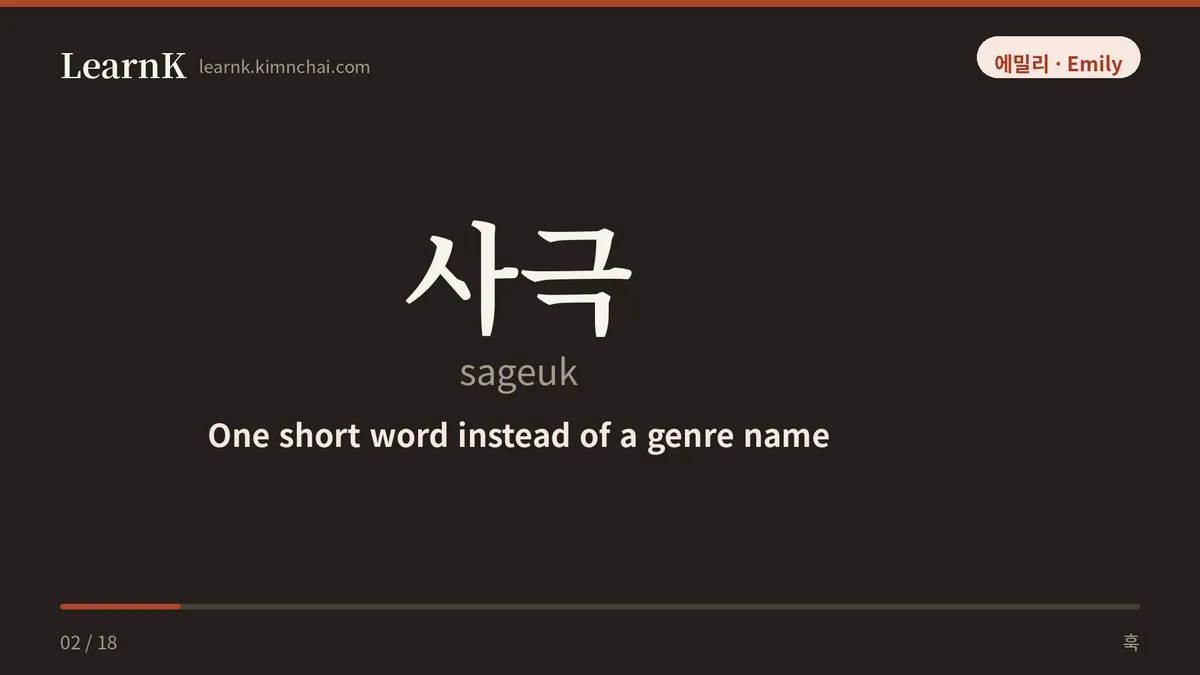
Scene: Saturday afternoon, a hanbok rental shop in front of Gyeongbokgung Palace. Emily is flipping through the rack one hanger at a time.
Jun-kyung: 뭘 그렇게 오래 골라. 아무거나 예쁜 거 입으면 되지. What’s taking you so long? Just pick whatever looks nice.
Emily: 아니, 나 저번에 본 사극에 나온 그 옷 찾는 중이야. No — I’m looking for the outfit from that historical drama I watched.
Jun-kyung: 아, 왕비 나오는 거? 그거 조선 초기 배경이라 대여점엔 잘 없어. Oh, the one with the queen? That’s set in early Joseon, so rental shops don’t really carry it.
Emily: 헐, 너 그런 것도 알아? 너 사극 안 좋아한다며. Whoa, you know that stuff? I thought you didn’t like historical dramas.
Jun-kyung: 안 좋아하긴. 엄마가 주말마다 틀어 놓으셔서 그냥 외워진 거야. Not like it — my mom has one on every weekend, so I just ended up memorizing them.
Emily: 어쩐지. 그럼 오늘 가이드는 너다. That explains it. You’re the guide today, then.
Saying it this way sounds off
Because 사극 (sageuk) is a genre label that doesn’t single anyone out, there’s no way to be rude with it. Instead, let’s cover the two misunderstandings about its scope that actually trip learners up.
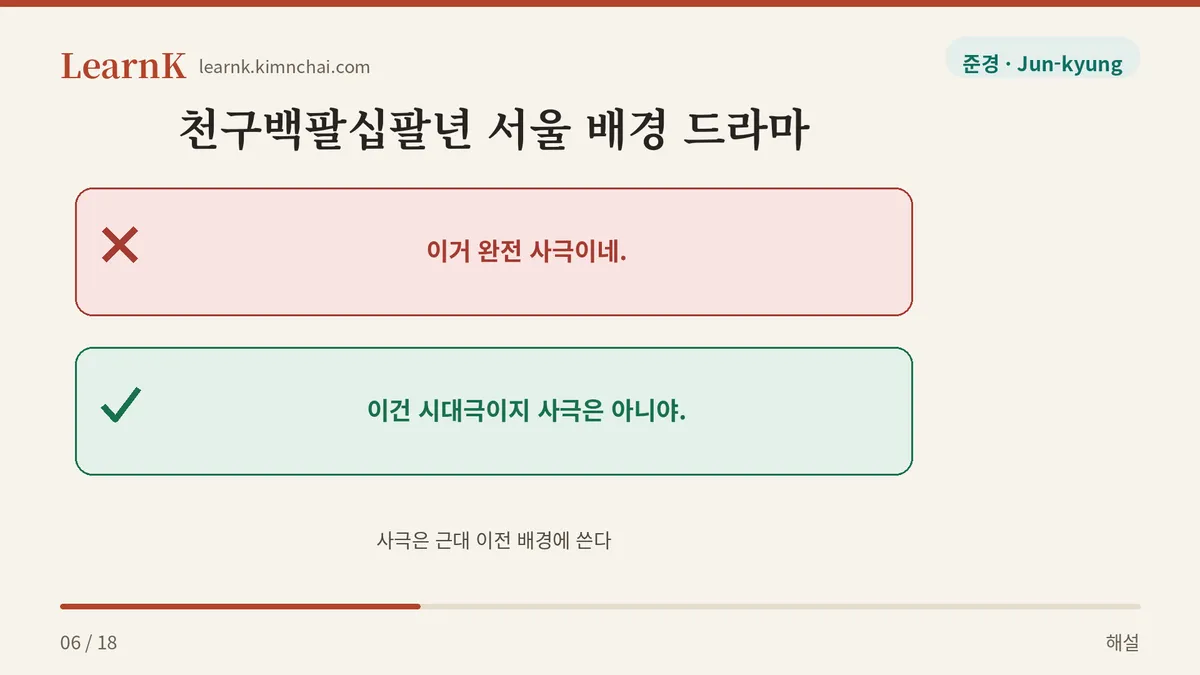
✗ (About a drama set in 1988 Seoul) 이거 완전 사극이네. (igeo wanjeon sageugine.) ✓ 이거 완전 복고다. (igeo wanjeon bokgoda.) / 이건 시대극이지 사극은 아니야. (igeon sidaegeugiji sageugeun aniya.) → 사극 (sageuk) is normally used for works set in the pre-modern era — Joseon, Goryeo, the Three Kingdoms. Works depicting a recent past like the 1980s–90s are called 시대극 (sidaegeuk, period drama) or 복고 드라마 (bokgo deurama, retro drama). Not everything set in the past is a sageuk.
✗ (Coming back from a drama about the French Revolution) 나 어제 사극 봤어. (na eoje sageuk bwasseo.) ✓ 나 어제 프랑스 사극 봤어. (na eoje Peurangseu sageuk bwasseo.) → A bare 사극 (sageuk) with nothing in front of it makes your listener think automatically of Korean history — and of Joseon in particular. For foreign historical works you need to put a country name in front, as in 영국 사극 (Yeongguk sageuk, British historical drama) or 중국 사극 (Jungguk sageuk, Chinese historical drama), so the conversation doesn’t go sideways.
Example sentences by situation
1) Recommending a show to a friend A Korean friend asks ‘요즘 뭐 봐? (yojeum mwo bwa?, what are you watching these days?)’. Leading with the genre speeds the conversation up.
나 요즘 사극에 빠졌어. 왕 얘기 말고 시장 사람들 얘기라 더 재밌더라. na yojeum sageuge ppajyeosseo. wang yaegi malgo sijang saramdeul yaegira deo jaemitdeora. (I’m hooked on historical dramas lately. It’s not about the king — it’s about the people in the market, so it’s even better.)
2) Explaining why Korean sounds hard The first time you watch a sageuk, it’s rough going without subtitles. Just say that experience out loud.
사극은 말투가 달라서 아직 자막 없이는 힘들어요. sageugeun maltuga dallaseo ajik jamak eopsineun himdeureoyo. (The way they talk in historical dramas is different, so I still can’t manage without subtitles.)
3) While traveling Go to a palace or a folk village and you’re guaranteed to hear ‘여기 사극 찍은 데야 (yeogi sageuk jjigeun deya, this is where they shot a sageuk)’. Feel free to ask first.
여기서 찍은 사극도 있어요? yeogiseo jjigeun sageukdo isseoyo? (Are there historical dramas that were filmed here?)
Polite vs. casual speech, and similar expressions
사극 (sageuk) is a noun, so the word itself has nothing to do with politeness levels — the predicate that follows sets the height of the speech. The same impression splits like this:
- Casual: 이 사극 진짜 재밌어. (i sageuk jinjja jaemisseo.)
- Polite: 이 사극 정말 재미있어요. (i sageuk jeongmal jaemiisseoyo.)
- Formal: 오랜만에 잘 만든 사극입니다. (oraenmane jal mandeun sageugimnida.)
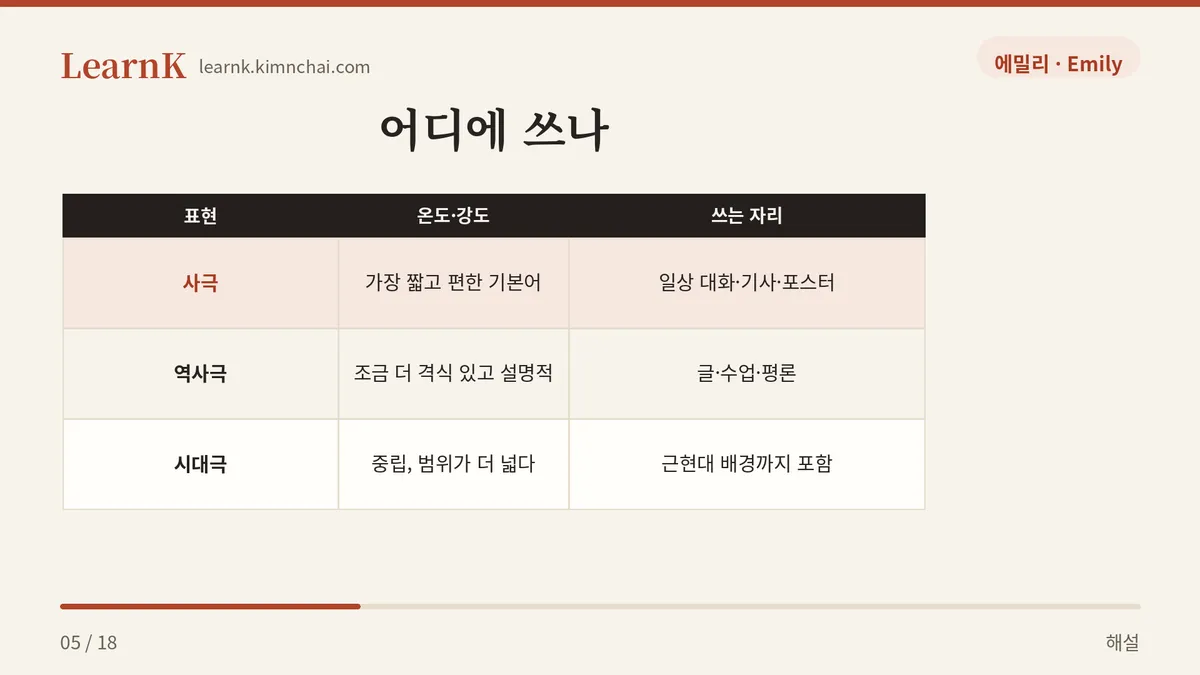
The near-synonyms overlap in meaning but each sits in a slightly different place.
| Expression | Temperature / intensity | Where it’s used |
|---|---|---|
| 사극 (sageuk) | The shortest, easiest default word | Everyday conversation, articles, posters — anywhere |
| 역사극 (yeoksageuk) | A bit more formal and explanatory | Writing, class, criticism. In speech, 사극 sounds more natural |
| 시대극 (sidaegeuk) | Neutral, broader in scope | Includes modern and contemporary settings. Used in contrast with 사극 |
| 퓨전 사극 (fyujeon sageuk) | Light, contemporary feel | Works that mix imagination and fantasy into history |
| 대하드라마 (daeha deurama) | Weighty and epic | Orthodox sageuk running dozens of episodes |
Cultural background — gat hats, palaces, and sageuk speech
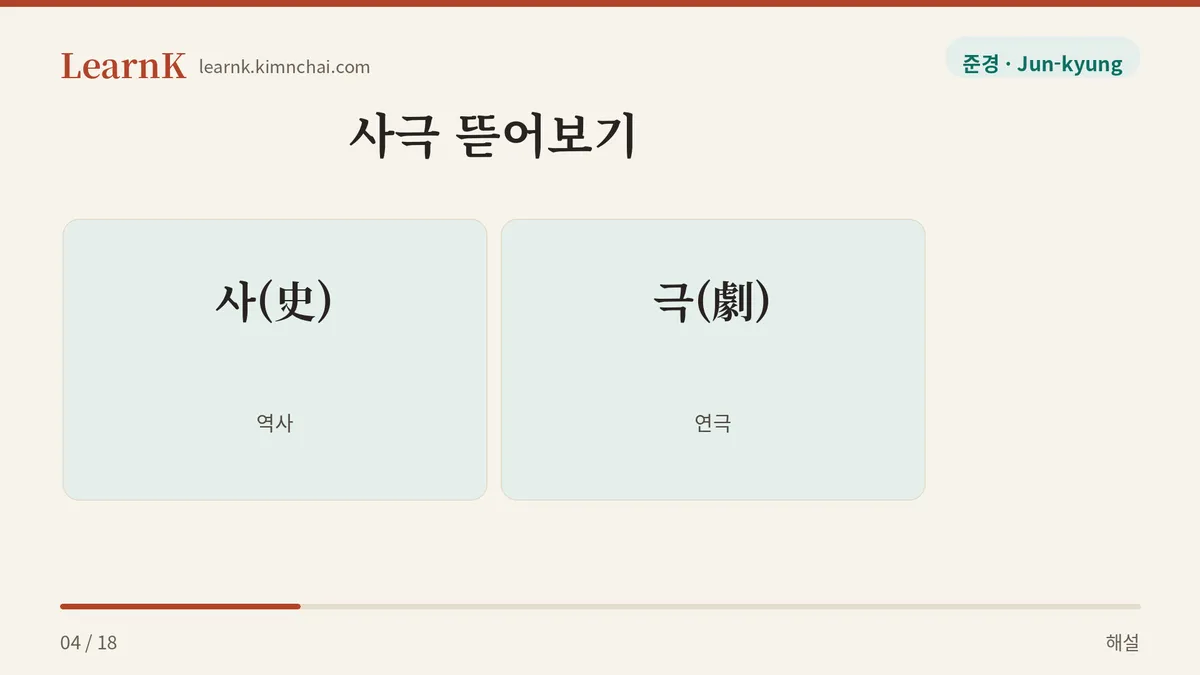
사극 (sageuk) is a Sino-Korean word. 사 (史) means history and 극 (劇) means drama, so it’s literally ‘history drama’. That’s why it overlaps completely in meaning with 역사극 (yeoksageuk) — but the two-syllable 사극 (sageuk), easier to say, took over the everyday slot.
The place sageuk holds in Korean broadcasting is special. For decades, the whole family gathering on a weekend evening to watch a 대하드라마 (daeha deurama) was a habit, and because of that, sageuk remains one of the few genres that younger people and their parents’ generation can talk about together. That’s exactly why asking a Korean friend’s parents ‘요즘 사극 뭐 보세요? (yojeum sageuk mwo boseyo?, what sageuk are you watching these days?)’ keeps the conversation from stalling.
The most interesting part for a learner is 사극 말투 (sageuk maltu, sageuk speech style). Sageuk use honorific expressions that no longer survive in modern Korean, kept up as a convention: 아니 되옵니다 (ani doeopnida, = 안 됩니다, ‘it cannot be done’), 성은이 망극하옵니다 (seong-eun-i manggeukhaopnida, ‘the king’s grace is boundless’), 전하 (jeonha, how you address the king), 마마 (mama, how you address the queen, crown prince, and so on). These aren’t words people use today, so don’t memorize them for real life — but they’re a living specimen of just how finely Korean honorifics developed.
These days, more 퓨전 사극 (fyujeon sageuk) — history with imagination mixed in — get made than strictly accurate orthodox sageuk. Because the dictionary definition leaves things open with ‘바탕으로 (batang-euro, based on) events or people from history’, works like these are still called sageuk. The permanently crowded hanbok rental shops, and the free palace admission if you’re wearing hanbok, are scenery this genre created too.
Today’s quiz
Which of the following would Koreans find least natural to call a ‘사극 (sageuk)’?
- A story of a king and his court officials unfolding in a Joseon palace
- A drama whose protagonist is a general of Goguryeo
- A drama depicting high school students in 1990s Seoul
- A drama whose protagonist is a real Joseon-era female physician
See the answer
Answer: 3
Numbers 1, 2, and 4 are all based on pre-modern events or figures, so they’re sageuk. Number 3 is set in the past, but it’s the modern era, so it’s usually called a 시대극 (sidaegeuk) or 복고 드라마 (bokgo deurama). Being set in the past doesn’t automatically make something a sageuk — if that’s the one thing you take away today, that’s plenty.
Definitions and example sentences are from the National Institute of Korean Language’s Basic Korean Dictionary (krdict.korean.go.kr); that portion of this post, including our translations, is licensed under CC BY-SA 2.0 KR.