That One Word in Every K-Drama Confession Scene — '사귀다', From Friends to Lovers
When you binge-watch K-dramas, there’s a certain kind of scene that always makes your heart drop. Two people gaze at each other in silence for a long moment, until at last one of them works up the courage and speaks in a trembling voice. Today’s expression is the very word that appears in that confession moment: 사귀다 (sagwida). Once you really understand this single word, the iconic scenes of romance dramas will start to sound completely different.
사귀다
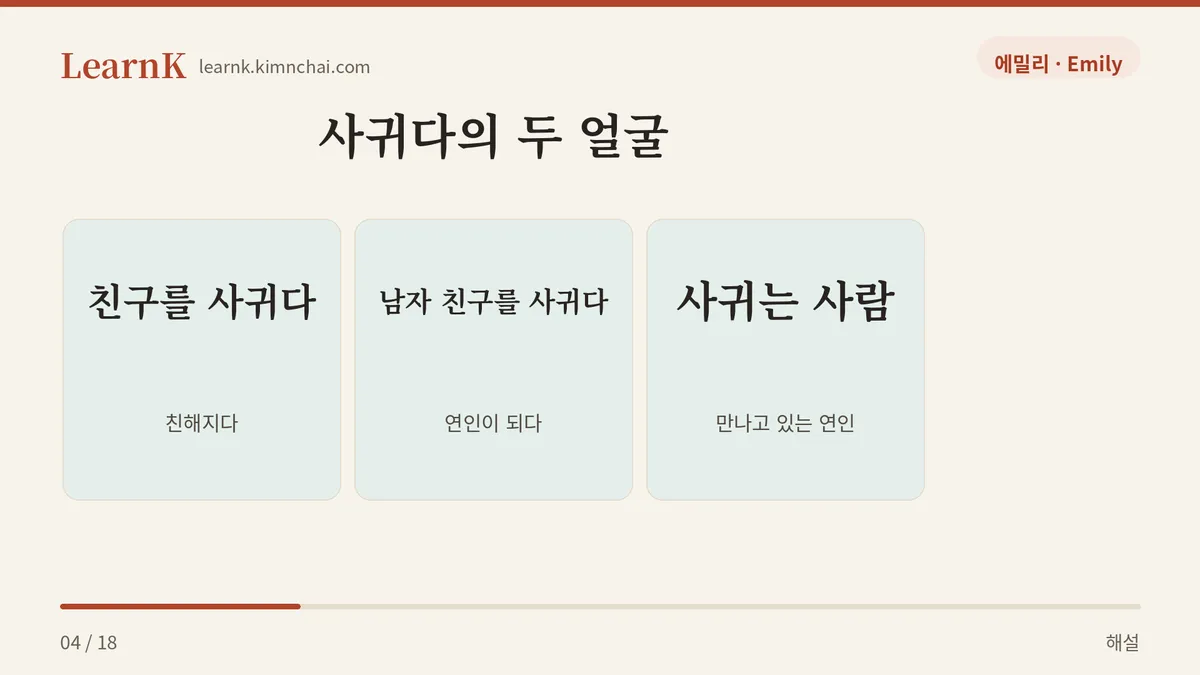
사귀다 (sagwida) is one word, but it has two faces. The first, as in “친구를 사귀다 (chingureul sagwida)” (to make a friend), means to get to know someone and grow close to them. The second, as in “남자 친구를 사귀다 (namja chingureul sagwida)” (to date a boyfriend), means to enter a romantic relationship. Curiously, the dictionary lists only one definition, yet Koreans naturally tell the two apart from context alone. If someone says “회사에서 좋은 사람들을 많이 사귀었어요 (sagwieosseoyo),” it means they’ve widened their circle of relationships, but if someone asks “저 두 사람 사귀어요 (sagwieoyo)?” it’s asking — one hundred times out of a hundred — about romance.
As a side note, a Portuguese translation isn’t included in the National Institute of Korean Language’s dictionary, so if we translate it ourselves, namorar / conviver is roughly the closest fit (not provided by the dictionary; our own translation).
Checking with the National Institute of Korean Language Dictionary
First, let’s look at how the Basic Korean Dictionary, published by the National Institute of Korean Language (a government body), defines this word.
사귀다 (verb)
- 서로 알게 되어 친하게 지내다. (To become acquainted with one another and grow close.) [en] get along with; go around with; go out with [ja] つきあう【付き合う】。こうさいする【交際する】 [es] juntarse, tratarse [zh] 交,结交,交往 — National Institute of Korean Language, Basic Korean Dictionary (krdict.korean.go.kr)
It’s notable that the English gloss includes “go out with” (사귀다·연애하다, to date). It shows that both friendship and romance are held within this one meaning. Let’s also look at the actual usage examples the dictionary provides.
남자 친구를 사귀다. (Namja chingureul sagwida.) — National Institute of Korean Language, Basic Korean Dictionary (krdict.korean.go.kr)
This is the most typical romantic sense. It carries a stronger feeling that the relationship is actively ongoing than “남자 친구가 있다 (namja chinguga itda)” (to have a boyfriend) does.
동급생과 사귀다. (Donggeupsaenggwa sagwida.) — National Institute of Korean Language, Basic Korean Dictionary (krdict.korean.go.kr)
This means being close friends with someone in the same class or grade. Here it leans toward friendship, not romance.
깊이깊이 사귀다. (Gipigipi sagwida.) — National Institute of Korean Language, Basic Korean Dictionary (krdict.korean.go.kr)
With the adverb “깊이깊이 (gipigipi)” (deeply, deeply) attached, the nuance comes alive of not a shallow, nodding-acquaintance relationship but a deep one where you open up your heart.
가까이하며 사귀다. (Gakkaihamyeo sagwida.) — National Institute of Korean Language, Basic Korean Dictionary (krdict.korean.go.kr)
This means keeping someone close, spending time together often, and building affection — it shows the very process by which a relationship is formed.
Seeing It in a Real Conversation
Scene: Friday night. They’re sitting at a parasol table in front of a convenience store, drinking canned beer. Emily has noticed the notifications that keep popping up on Jun-kyung’s phone.
Emily: 야, 아까부터 폰 계속 보잖아. 누구야, 누구. Hey, you’ve been glued to your phone this whole time. Who is it, who?
Jun-kyung: …그냥 아는 사람. …Just someone I know.
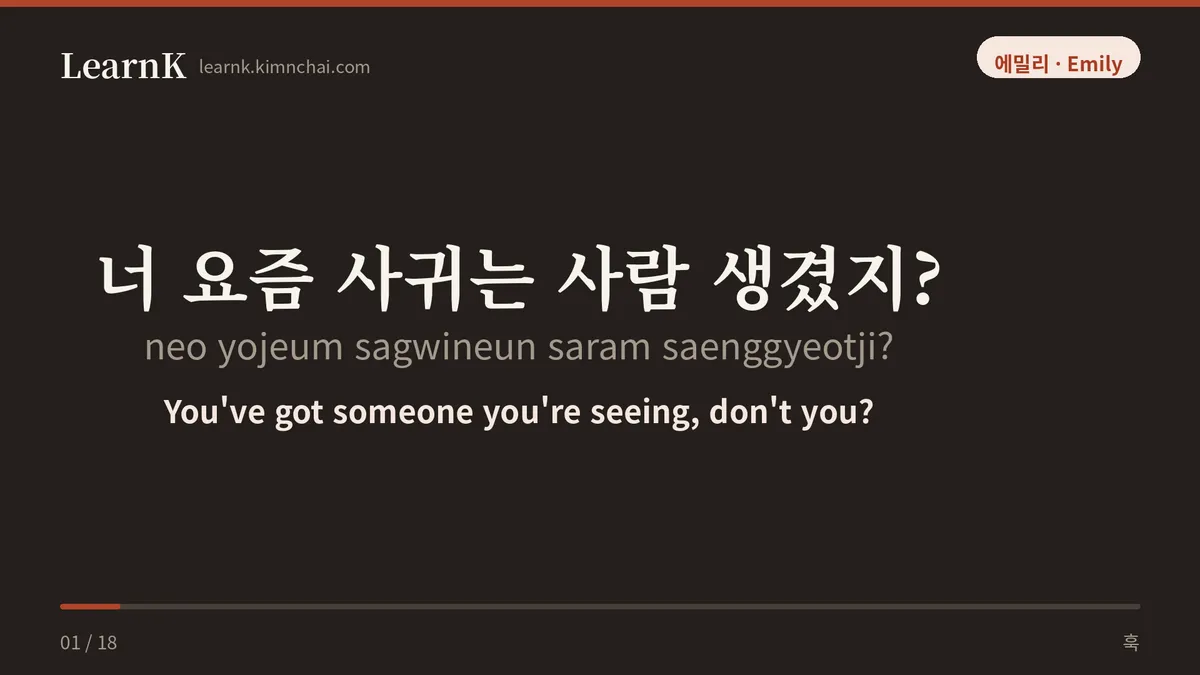
Emily: 아는 사람은 무슨. 너 요즘 사귀는 사람 생겼지? “Someone you know,” yeah right. You’ve got someone you’re seeing these days, don’t you?
Jun-kyung: 아직 정식으로 사귀자고는 안 했어. 한 달쯤 됐나. I haven’t officially asked her to go out yet. It’s been about a month, I guess.
Emily: 한 달을? 야, 너무 재지 말고 빨리 고백해! A whole month? Hey, stop overthinking it and just confess already!
Jun-kyung: 좀 천천히 가자. 잘 알고 나서 사귀어야 오래가지. Let’s take it slow. You’ve gotta really know someone before you date — that’s how it lasts.
Example Sentences by Situation
Let’s get comfortable with a variety of situations using example sentences we made ourselves.
-
A New Semester — The Friendship Sense — “저는 낯을 안 가려서 반 친구들하고 금방 사귀는 (sagwineun) 편이에요.” (Jeoneun nateul an garyeoseo ban chingudeulhago geumbang sagwineun pyeonieyo.) “I’m not shy, so I tend to make friends with my classmates quickly.” This describes being good at making friends in a new environment.
-
The Romantic Sense — “두 사람 사귄 (sagwin) 지 벌써 백 일이래.” (Du saram sagwin ji beolsseo baegil-lae.) “They say those two have already been dating for a hundred days.” This sentence is paired with ‘백일 (baegil)’ — the hundred-day anniversary that Korean couples treasure.
-
A Careful Rejection — “미안한데, 우리 지금은 그냥 친구로 지내자. 아직 사귀는 건 좀….” (Mianhande, uri jigeumeun geunyang chinguro jinaeja.) “Sorry, but for now let’s just stay friends. Dating is still a bit….” This is a situation of gently deferring or turning down a confession.
Formal vs. Casual Speech, and Similar Expressions
Confessions in dramas usually burst out in casual speech (반말, banmal). “나랑 사귈래? (narang sagwillae?)” (Will you go out with me?) is the most widely used form of confession line. If you want to say it a little more politely, you just add ‘-요 (-yo)’, as in “저랑 사귈래요? (jeorang sagwillaeyo?)”
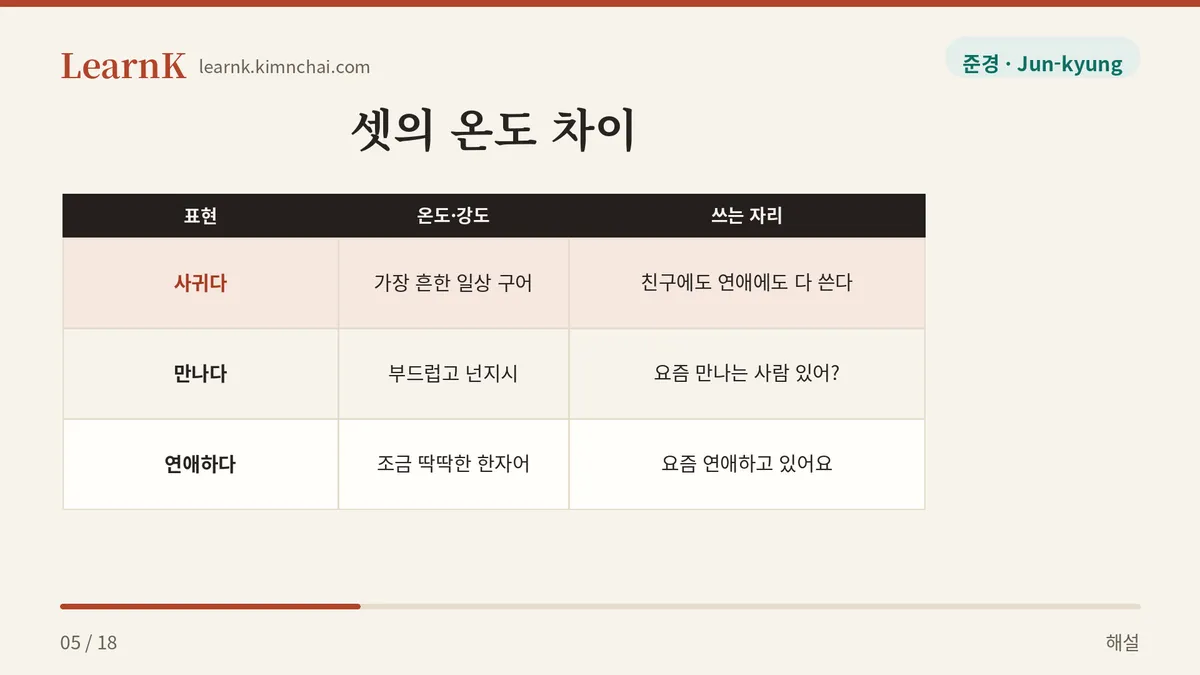
Let’s learn some similar expressions too. 만나다 (mannada) (to meet / see) is used with almost the same meaning as ‘사귀다’, as in “요즘 만나는 사람 있어? (yojeum mannaneun saram isseo?)” (Is there someone you’re seeing these days?), while 연애하다 (yeonaehada) (to be in a relationship) is a somewhat stiffer Sino-Korean expression. The ambiguous stage before you’re officially dating — when mutual attraction is going back and forth — is called 썸을 타다 (sseomeul tada) in today’s slang (roughly, “to have a thing going”). In other words, ‘썸 (sseom) → 고백 (gobaek, confession) → 사귀다 (sagwida)’ is the sequence of Korean-style romance.
Cultural Background
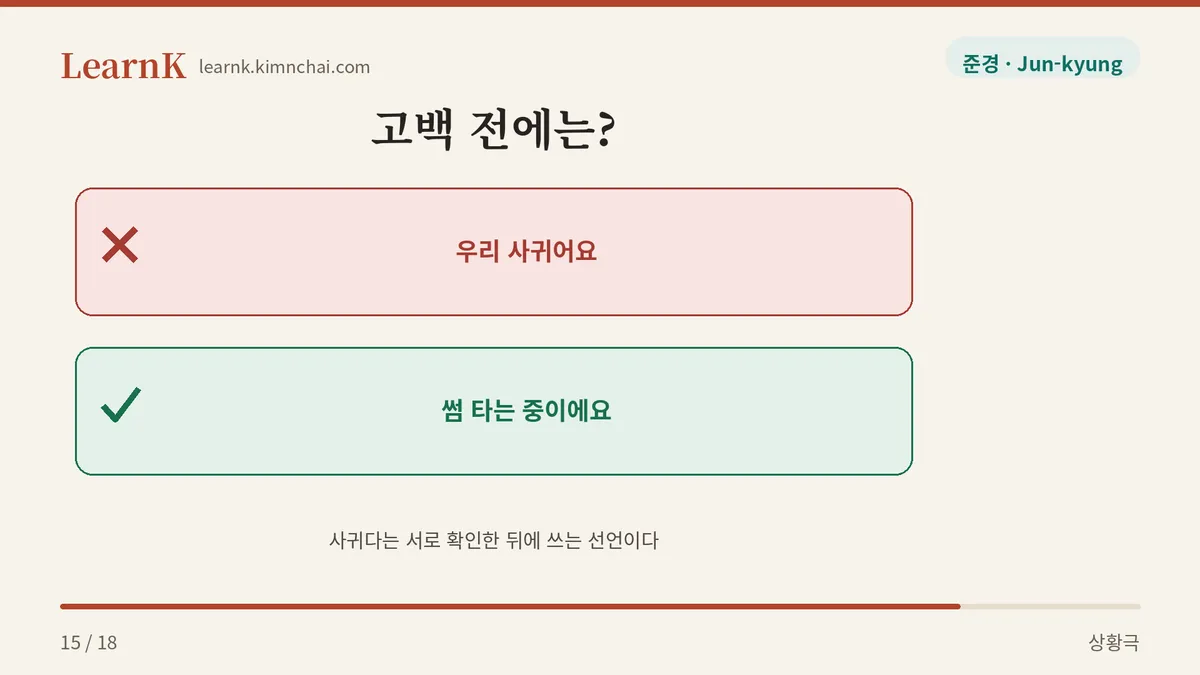
In Korean dating culture, ‘사귀다’ is close to a declaration. The moment two people who’d simply been meeting often decide, “우리 오늘부터 1일이야 (uri oneulbuteo iril-iya)” (“Starting today, it’s Day 1 for us”), the nature of the relationship officially changes. That’s why in dramas you so often see the lead trying to pin down the relationship, asking “우리 사귀는 거야, 아니야? (uri sagwineun geoya, aniya?)” (“Are we dating or not?”). And whenever relatives gather during the holidays, the question “너 요즘 사귀는 사람 없니? (neo yojeum sagwineun saram eopni?)” (“Don’t you have anyone you’re seeing these days?”) comes flying across the dinner table without fail — a classic bit of nagging that any young Korean can relate to. In this way, ‘사귀다’ goes beyond a word in the dictionary; it’s a word woven deep into Korean relationships and everyday life.
Closing Quiz
What is the most natural word to fill in the blank below?
“우리 한 달 넘게 매일 연락했잖아. 이제 우리 정식으로 ____?” (“We’ve talked every day for over a month now. So, shall we officially ____?”) ① 헤어질래 (heeojillae — break up) ② 사귈래 (sagwillae — go out) ③ 잊을래 (ijeullae — forget)
(Answer: ② 사귈래 (sagwillae) — Since this is a situation where two people who have been close for a long time are proposing to begin a romantic relationship, ‘사귈래’ is the correct answer.)
Definitions and example sentences are from the National Institute of Korean Language’s Basic Korean Dictionary (krdict.korean.go.kr); that portion of this post, including our translations, is licensed under CC BY-SA 2.0 KR.