The Word That Makes a Drama's Heart Race: '삼각관계'
The Word That Makes a Drama’s Heart Race: ‘삼각관계’
If you watch enough Korean dramas, there’s a moment you’re bound to run into. The kind-hearted male lead, the cold-hearted second-generation chaebol heir, and the female lead caught wavering between them. Viewers stay up all night debating, “Who’s she going to end up with this time?” and the day after an episode airs, social media splits into camps. And right at the center of all that fluttering excitement and heart-wrenching suspense sits today’s expression. It’s a word you absolutely must know to understand K-dramas: 삼각관계 (samgak-gwan-gye).
삼각관계
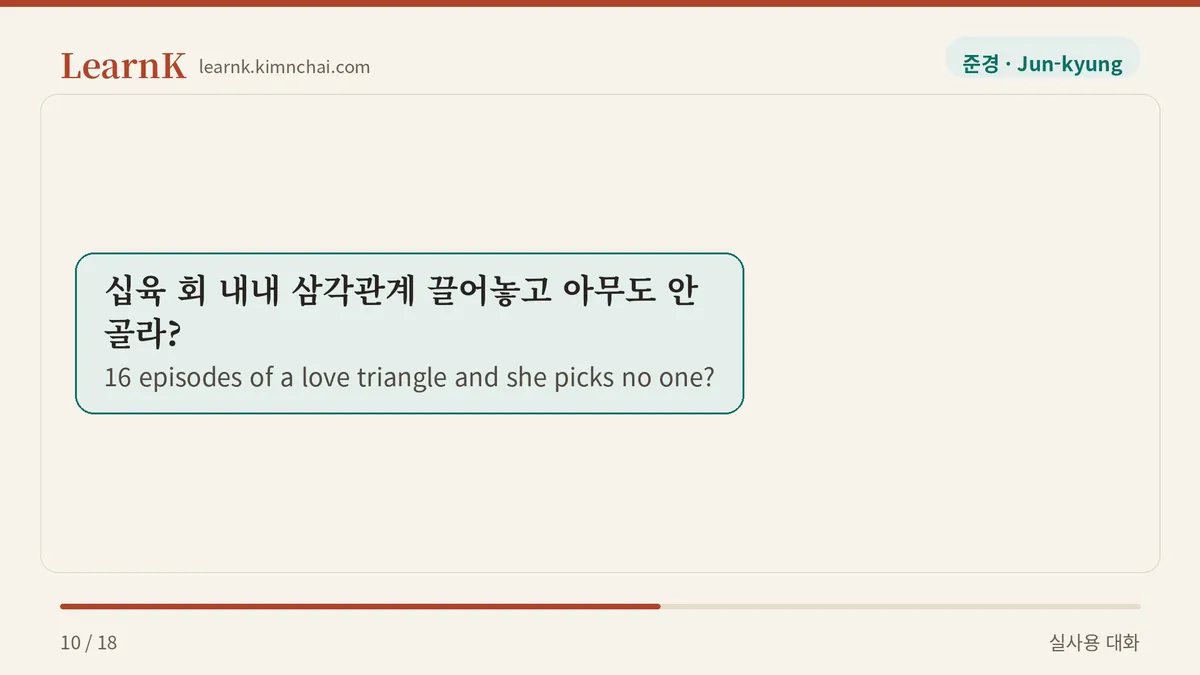
삼각관계 (samgak-gwan-gye) literally breaks down to mean “a 삼각(三角) — that is, a relationship made up of three angles.” 삼각 (samgak) is the same 삼각 as in 삼각형(三角形), meaning “triangle,” and 관계 (gwan-gye) means “a connection” or “a relationship.”
This word is used mainly in two kinds of situations. First, it can be neutral in meaning, like a relationship among three people, three organizations, or three countries. Second, it can mean the tangled romantic relationship in which three people all have feelings for one another — exactly what we so often see in dramas — that is, a “love triangle” in English. It shows up with the first meaning in the news and the second meaning in variety shows and dramas, so just look at the context to tell them apart.
Checking with the National Institute of Korean Language Dictionary
First, let’s look at the definition exactly as it appears in the authoritative Basic Korean Dictionary from the National Institute of Korean Language.
삼각관계 (noun)
- A relationship among three people. Or a relationship among three organizations or countries. — triangular relationship
- A relationship in which three people have romantic feelings for one another. — love triangle — National Institute of Korean Language, Basic Korean Dictionary (krdict.korean.go.kr)
Let’s also look at some real example sentences from the dictionary.
이 드라마는 주인공들의 삼각관계로 더욱 흥미진진해지고 있다. — National Institute of Korean Language, Basic Korean Dictionary (krdict.korean.go.kr)
This is exactly the “romance” meaning we talked about. It’s a textbook example of a 삼각관계 being used as a device to heighten the tension of a story.
삼각관계로 얽히다. — National Institute of Korean Language, Basic Korean Dictionary (krdict.korean.go.kr)
얽히다 (eolkida) is a verb meaning “to become complicatedly tangled, like threads getting knotted up,” and it pairs with 삼각관계 very often.
한국은 미국, 일본과 삼각관계를 유지해 오고 있죠? — National Institute of Korean Language, Basic Korean Dictionary (krdict.korean.go.kr)
This sentence points to the first meaning — a diplomatic relationship among three countries. It shows that the same word can be used for international politics, not just love.
삼각관계를 형성하다. — National Institute of Korean Language, Basic Korean Dictionary (krdict.korean.go.kr)
형성하다 (hyeong-seong-hada) means “to form some shape or state,” and it’s used when describing the process of a relationship taking shape.
As a side note, the Portuguese translation isn’t listed in the dictionary, so we’re offering our own: 삼각관계 → triângulo amoroso (when it carries the romantic meaning).
Example Sentences by Situation
Now let’s get a feel for it with some sentences we’ve made ourselves.
-
When chatting about a drama with a friend “이 드라마 삼각관계가 너무 심해서 누구를 응원해야 할지 모르겠어. (I samgak-gwan-gye-ga neomu simhaeseo…)” → It means the emotional lines among the three characters are so complicated that it’s hard to decide who to root for.
-
When worried about a friendship “우리 셋이 자꾸 삼각관계처럼 돼서 좀 어색해졌어.” → Even without romance, this expresses a situation where subtle feelings have arisen among three people and things have gotten awkward.
-
In a news or current-affairs context “세 회사가 특허를 두고 삼각관계를 형성했다.” → This is the neutral first meaning: not love, but the interests of three companies getting entangled.
Comparing Formal/Casual Speech and Similar Expressions
Because 삼각관계 is a noun, its form doesn’t change between formal and casual speech — only the verb that follows it changes.
- Casual: “둘이 삼각관계야? (samgak-gwan-gye-ya?)”
- Formal: “두 분이 삼각관계세요? / 삼각관계인가요?”
It’s good to know some similar expressions too. 짝사랑 (jjaksarang) is “one-sided love,” where only one person has feelings, whereas a 삼각관계 involves at least three people tangled together. Also, 밀당 (mildang) is a shortened form of 밀고 당기기 (“pushing and pulling”); 밀당 is a “dating technique” between two people, while 삼각관계 is the “structure” of a relationship — so they operate on different levels.
Cultural Background — Why Do K-Dramas Love the Love Triangle?
A 삼각관계 gives viewers the fun of “choosing.” Fandoms split depending on which side you root for, and that very debate becomes a hot topic. The scene where one man asks the wavering female lead, “나만 보면 안 돼?” (“Can’t you look only at me?”) is a staple of iconic drama moments. When the hearts of three people are locked in tension like this, the story burns at its hottest. The next time you watch a drama and catch yourself thinking, “Ah, this is a 삼각관계,” you’re already halfway to being a Korean-language master.
Closing Quiz
“한국, 미국, 일본 세 나라가 삼각관계를 이루고 있다.” — In this sentence, does 삼각관계 (samgak-gwan-gye) mean (A) a romantic relationship, or (B) a relationship among three countries?
Answer: (B) a relationship among three countries! You’ve now got it locked in that a 삼각관계 isn’t always a love story, right?
Definitions and example sentences are from the National Institute of Korean Language’s Basic Korean Dictionary (krdict.korean.go.kr); that portion of this post, including our translations, is licensed under CC BY-SA 2.0 KR.