We're Not Officially Dating Yet — Learning the Korean of "Talking Stage" with '삼귀다'
삼귀다
When you watch Korean dramas or variety shows, you’ll come across scenes where two people text every day and even go on dates, yet when someone asks, “Are we dating?” they just smile and dodge the question. They’re clearly not just friends, but they’re not an official couple either — that fuzzy, heart-fluttering in-between stage. These days, young Koreans call exactly this state 삼귀다 (samgwida).
When Do You Use It?
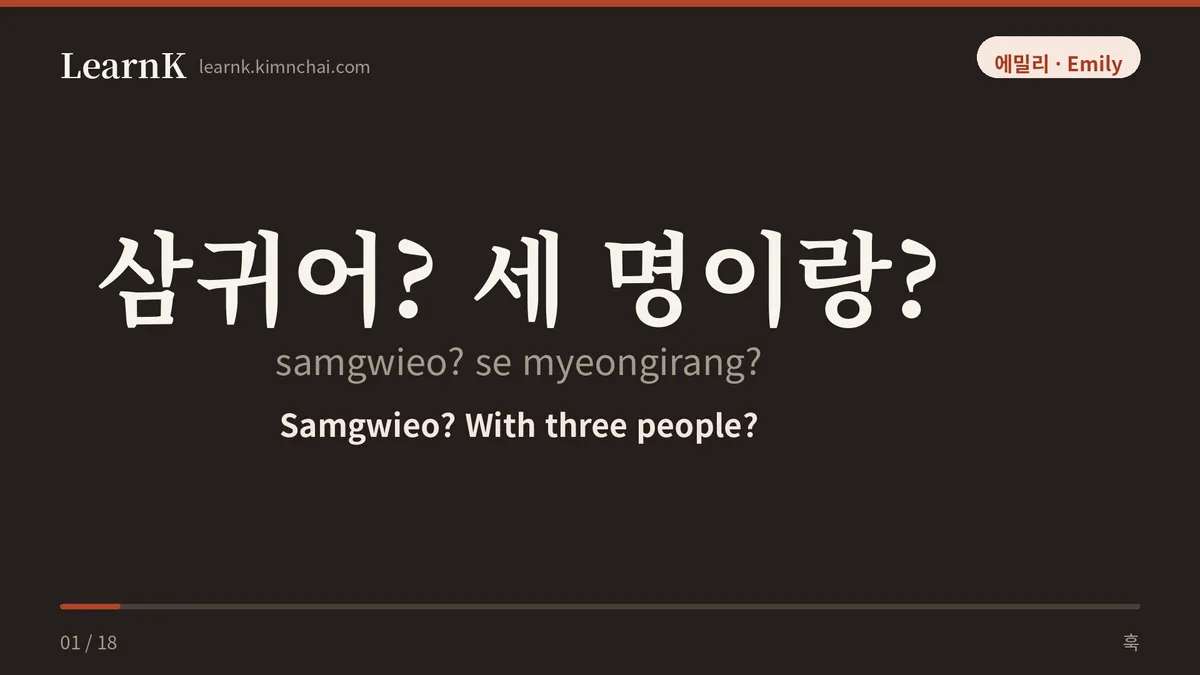
A friend has suddenly been glowing lately and keeps checking their phone. When you ask, “Did you get a boyfriend?” you get an answer like this: “사귀는 건 아니고, 삼귀는 중이야 (sagwineun geon anigo, samgwineun jungiya).” In other words, they haven’t officially become a couple yet, but they like each other and are in the process of getting to know one another. In terms familiar to English-speaking learners, it’s close to the “talking stage” or “we’re not officially dating yet.”
The Meaning and How the Wordplay Works
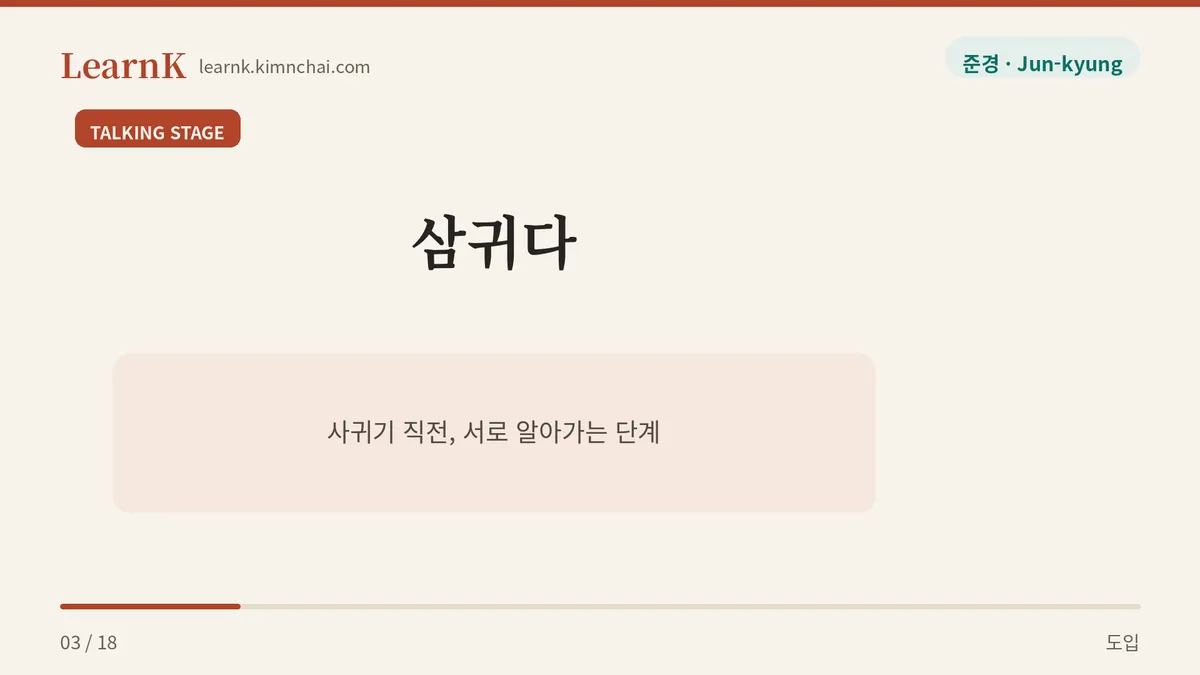
삼귀다 (samgwida) isn’t a standard word listed in the dictionary — it’s a newly coined slang term that emerged from the internet and everyday conversation. The fun of this word lies in its number-based pun.
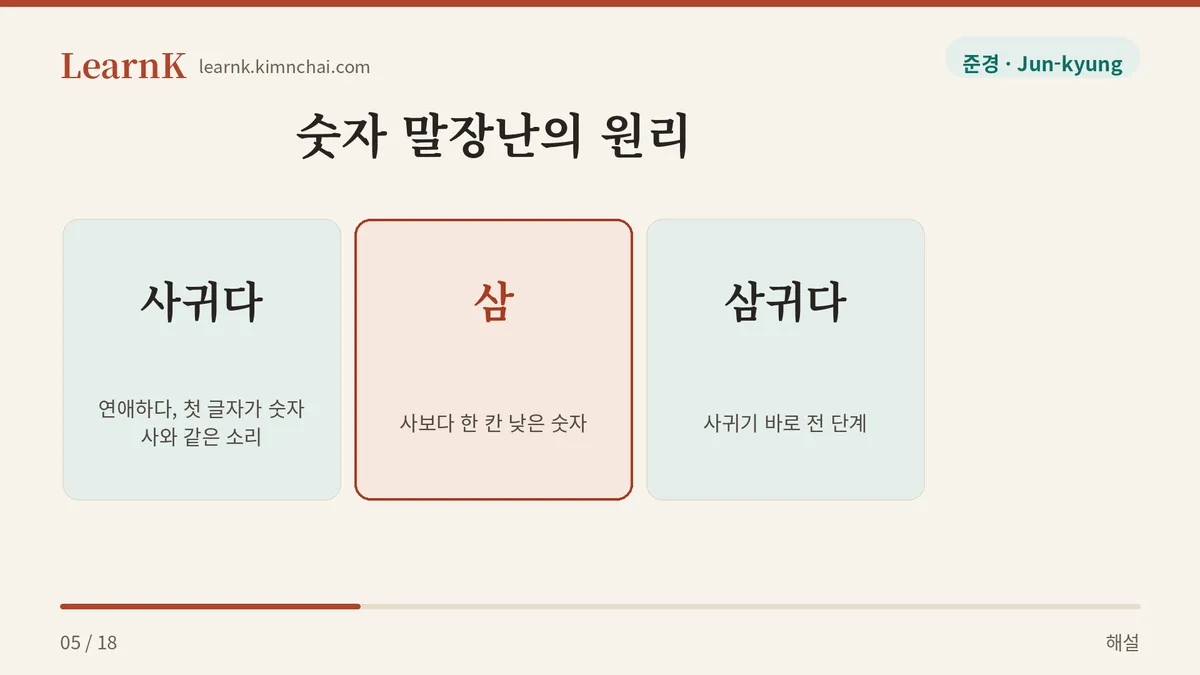
- 사귀다 (sagwida): the standard word meaning “to date, to go out with someone.” Its first syllable, 사 (sa), sounds the same as the number 4 (사).
- So people lowered the number by one and attached 삼 (sam, 3), to mean “we haven’t quite reached stage 4 (사귀다) yet — this is the stage right before it.”
Ultimately, 삼귀다 is a verb that expresses “the stage right before dating” — in other words, a relationship where you’re in a 썸 (sseom). For reference, 썸 (sseom) comes from the English word “something,” and it refers to the subtle exchange of feelings before becoming a couple. You could say 삼귀다 is a more playful, cuter way of expressing this 썸.
Example Sentences by Situation
Example 1 — Sharing your recent news with a friend
요즘 같은 과 선배랑 삼귀고 있어. 아직 고백은 안 했는데 곧 사귈 것 같아.
(yojeum gateun gwa seonbaerang samgwigo isseo. ajik gobaegeun an haenneunde got sagwil geot gata.)
These days I’m in the “삼귀다” stage with a senior in my major. I haven’t confessed my feelings yet, but I think we’ll be dating soon.
This is a situation where you’re not yet an official couple with a senior in the same department, but you’re both in the process of confirming your feelings. The phrase “곧 사귈 것 같아 (I think we’ll be dating soon)” nicely shows that 삼귀다 is the stage right before 사귀다.
Example 2 — Asking how things are going
너희 사귀는 거야, 삼귀는 거야? 확실히 말해 봐!
(neohui sagwineun geoya, samgwineun geoya? hwaksilhi malhae bwa!)
Are you two dating, or are you in the “삼귀다” stage? Tell me for sure!
This is a scene where a friend who’s curious about the two of you pins down the relationship with a direct question. Placing the two words side by side brings out the contrast and sounds very natural to native speakers.
Example 3 — When the relationship ends
삼귀다가 결국 흐지부지됐어. 사귀기도 전에 끝나 버렸네.
(samgwidaga gyeolguk heujibujidwaesseo. sagwigido jeone kkeutna beoryeonne.)
The “삼귀다” thing ended up fizzling out. It was over before we even started dating.
This is a situation where the relationship naturally faded and ended before the two became a couple. Because a 삼귀다 relationship isn’t an official one, it often wraps up quietly like this.
Comparing Formal and Casual Speech, and Similar Expressions
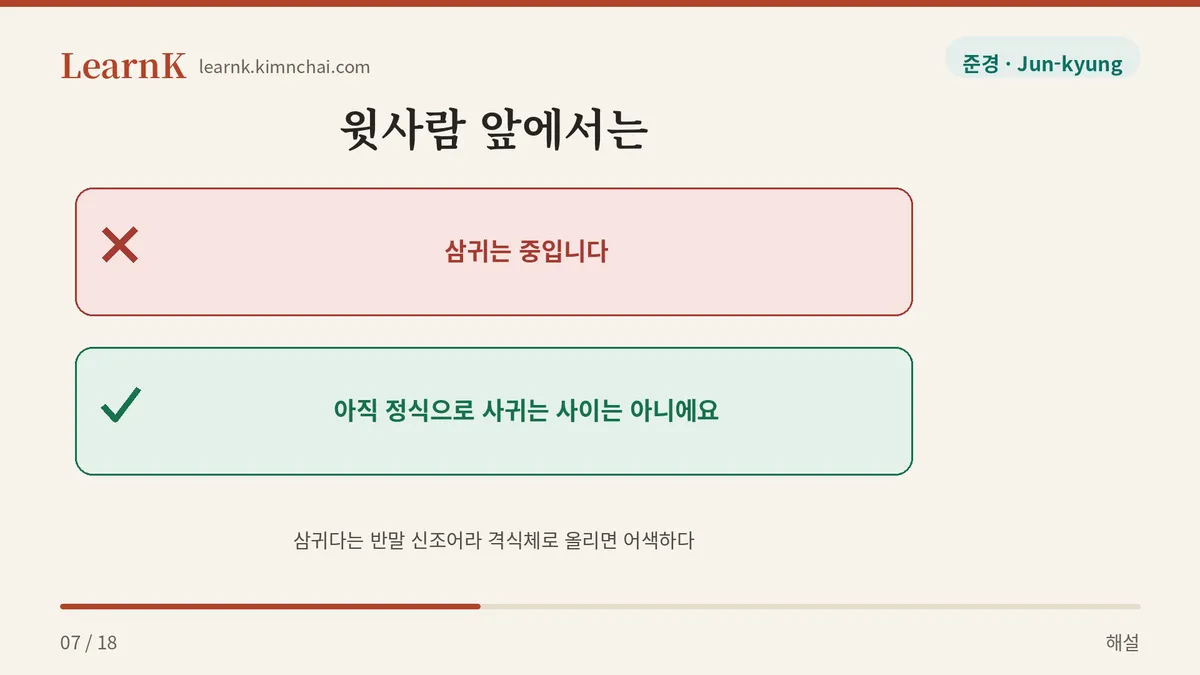
삼귀다 is mainly used in light, casual (반말) conversations between friends. It doesn’t suit situations with elders or where you need to be formal, so be careful.
- Casual (반말): 삼귀어? / 삼귀는 중이야 (samgwieo? / samgwineun jungiya)
- Rephrased in formal speech (존댓말): 아직 정식으로 사귀는 사이는 아니에요 (ajik jeongsigeuro sagwineun saineun anieyo) — rather than turning the word 삼귀다 itself into a formal form, it’s more natural to politely explain the meaning by paraphrasing it.
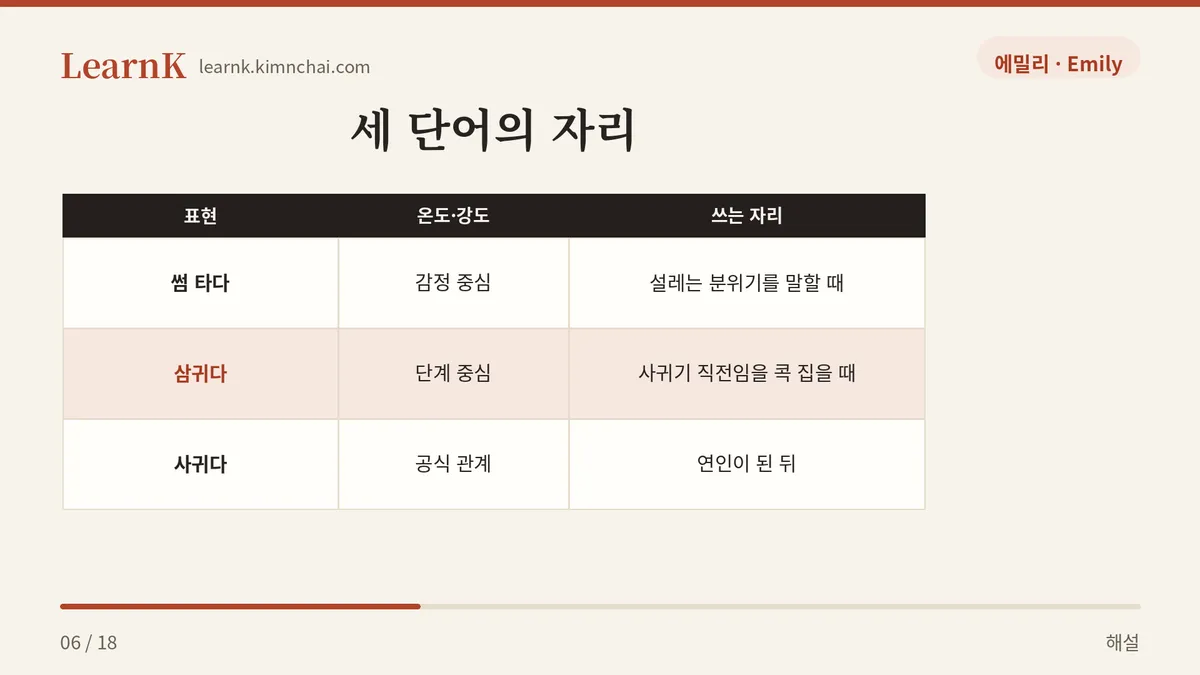
A similar expression is 썸 타다 (sseom tada, to have a 썸). The meaning is almost the same, but while “썸 타다” focuses on the mood and emotions of the relationship, “삼귀다” — like a partner word to “사귀다” — has a stronger sense of pinpointing the stage of the relationship.
Cultural Background
Korean dating culture even has the expression “우리 오늘부터 1일 (starting today, it’s Day 1 for us),” reflecting a sentiment that treats the day you officially start dating as something special. Because of this, the line between “a couple” and “not yet a couple” is sharp, and there was a need for a word to name that fluttering gray zone right before the line. 삼귀다 was born precisely to fill that blank. You could call it living, breathing Korean of this very moment — a blend of the younger generation’s love of wordplay and their romantic sensibilities.
Closing Quiz
A friend says, “나 요즘 삼귀는 사람 있어 (There’s someone I’m in the 삼귀다 stage with these days).” Which of the following best describes this friend’s situation?
- They already have an official partner they’re dating.
- They’re not dating yet, but there’s someone they like and are getting to know.
- They’re dating three people at the same time.
The answer is number 2. Remember how 삼귀다 is a pun meaning the stage (3) right before “사귀다 (4)”? Next time a Korean friend uses this word, you’ll be able to catch on and think, “Ah, they’re in the 썸 stage!”