세뱃돈 (sebaetdon): Everything About the 'New Year's Money' You Get After Bowing on Seollal
On the morning of Seollal (Lunar New Year), Korean children wake up early for a rather special reason. Dressed in colorful hanbok, they line up in front of their grandparents, parents, uncles, and aunts to perform a deep bow. And the moment that bow ends, a white envelope passes from the hands of the grown-ups into the hands of the children. That’s today’s expression: 세뱃돈 (sebaetdon). If you’ve ever seen children in a K-drama holiday scene receiving an envelope with sparkling eyes, what’s inside that envelope is exactly this — 세뱃돈.
세뱃돈
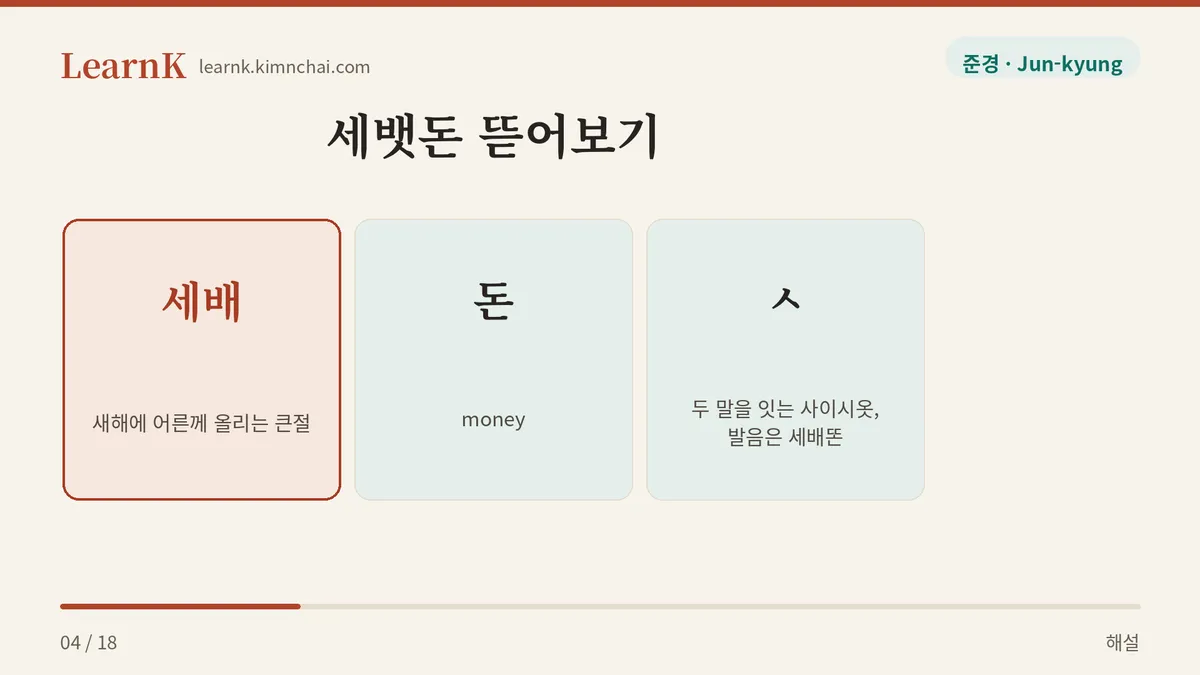
세뱃돈 (sebaetdon) is a combination of 세배 (sebae, the deep bow offered as a New Year’s greeting) and 돈 (don, money). In other words, it refers to the money that grown-ups give to children or younger family members after receiving a bow on 설 (seol, the Lunar New Year). In Korean spelling, a linking consonant (사이시옷, the ㅅ) is inserted between ‘세배’ and ‘돈’ to form ‘세뱃돈,’ and it’s pronounced [세배똔] or [세밷똔].
Shall we look at the nuance? 세뱃돈 isn’t just pocket money — it’s a token of the heart that comes as a set with 덕담 (deokdam, kind words wishing you good fortune). As the grown-up hands over the envelope, they add words like “새해 복 많이 받아라” (Have a blessed New Year) or “올해도 건강하고 공부 열심히 해라” (Stay healthy and study hard this year too). So more than the amount of money, 세뱃돈 carries the meaning of affection and blessing passed down across generations.
Checking with the National Institute of Korean Language Dictionary
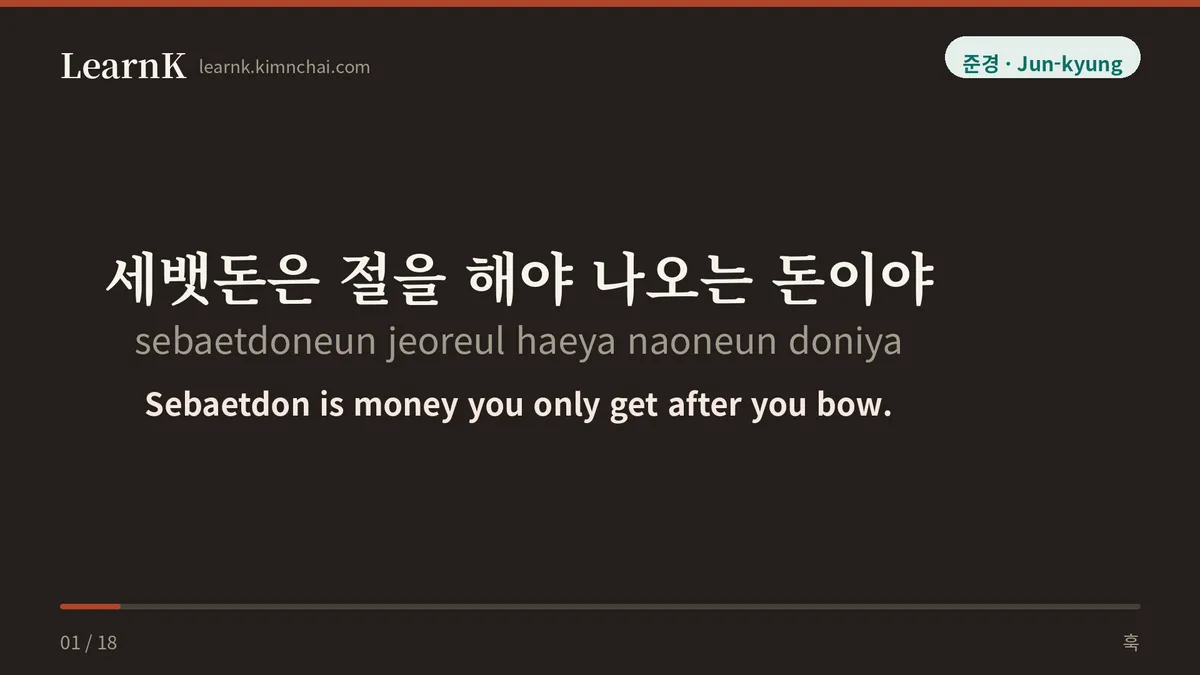
The Basic Korean Dictionary, published by the state-run National Institute of Korean Language, defines 세뱃돈 like this:
세뱃돈 (noun): Money received after bowing on Seollal. [en] sebaedon; sebaetdon — new year’s money: Money received after new year’s bows. [es] sebaetdon, dinero de Año Nuevo — Dinero que se recibe como regalo después del saludo de Año Nuevo. [zh] 拜年费,压岁钱 — 给人拜年时得到的赏钱。 — National Institute of Korean Language, Basic Korean Dictionary (krdict.korean.go.kr)
A Portuguese translation isn’t included in the dictionary, so we’ve provided our own to help with understanding (not dictionary material): dinheiro de Ano-Novo — dinheiro recebido após a reverência de Ano-Novo aos mais velhos.
Let’s also look at some real usage examples the dictionary provides.
나는 세배를 하고 부모님께 세뱃돈을 받았다. (I bowed and received 세뱃돈 from my parents.) — National Institute of Korean Language, Basic Korean Dictionary (krdict.korean.go.kr)
This is the sentence that shows the relationship between 세배 and 세뱃돈 most cleanly. The order — you ‘세배를 하고’ (do the bow) and as a result ‘세뱃돈을 받는다’ (receive the New Year’s money) — is laid out plainly.
제가 할머니께 세배를 드리니까 세뱃돈과 함께 덕담을 해 주셨어요. (When I bowed to my grandmother, she gave me 세뱃돈 along with kind words of blessing.) — National Institute of Korean Language, Basic Korean Dictionary (krdict.korean.go.kr)
This shows that it’s not just money changing hands — ‘덕담’ (words of blessing) come with it. It’s an example that tells you what the true heart of 세뱃돈 really is.
부모님은 언제나 빳빳한 새 지폐로 세뱃돈을 주셨다. (My parents always gave 세뱃돈 in crisp new bills.) — National Institute of Korean Language, Basic Korean Dictionary (krdict.korean.go.kr)
Here you can glimpse the Korean custom of exchanging money at the bank for 빳빳한 (ppatppathan, from 빳빳하다 = crisp and stiff like something brand new) new bills when preparing 세뱃돈. Giving new money rather than old money is a way of celebrating the fresh start of the New Year.
지수는 삼촌께 세뱃돈 대신 도서 상품권을 받았다. (Instead of 세뱃돈, Jisu received book gift certificates from her uncle.) — National Institute of Korean Language, Basic Korean Dictionary (krdict.korean.go.kr)
This is an example that captures changing times — these days people sometimes give book vouchers or culture vouchers instead of cash.
Situational Example Sentences (Original)
Here are three sentences we created, along with their situations, to show how the word is used in real conversation.
Situation 1 — A young nephew has just finished bowing
자, 절 잘했으니까 세뱃돈 (sebaetdon) 받아라. 올해도 무럭무럭 크고! (There you go, you bowed so nicely — take your 세뱃돈 (sebaetdon). Grow up big and strong this year too!)
A classic scene of a grown-up handing an envelope to a child and adding a blessing in casual speech.
Situation 2 — The day after the holiday, between friends in casual speech
야, 너 이번 설에 세뱃돈 (sebaetdon) 얼마 받았어? 나는 통장에 다 저금했어. (Hey, how much 세뱃돈 (sebaetdon) did you get this Seollal? I put mine all in my savings account.)
A very common conversation among peers, making the amount of 세뱃돈 the topic.
Situation 3 — A grown-up with no grandchildren, left with an unused envelope (our own creation, inspired by the dictionary examples)
올해는 아이들이 다 외국에 있어서 세뱃돈 (sebaetdon) 이 굳었네. 서운하기도 하고 말이야. (This year the kids are all abroad, so the 세뱃돈 (sebaetdon) stayed put. It’s a bit sad, honestly.)
Here 굳다 (gutda) means ‘money that would have gone out stayed put instead’ — an amusing expression that mixes wistfulness with thriftiness.
Comparing Formal/Casual Speech and Similar Expressions
The way you talk about ‘giving and receiving’ 세뱃돈 changes depending on the direction.
- From grown-up to child (casual): 세뱃돈 받아라 (sebaetdon badara). (Here, take your New Year’s money.)
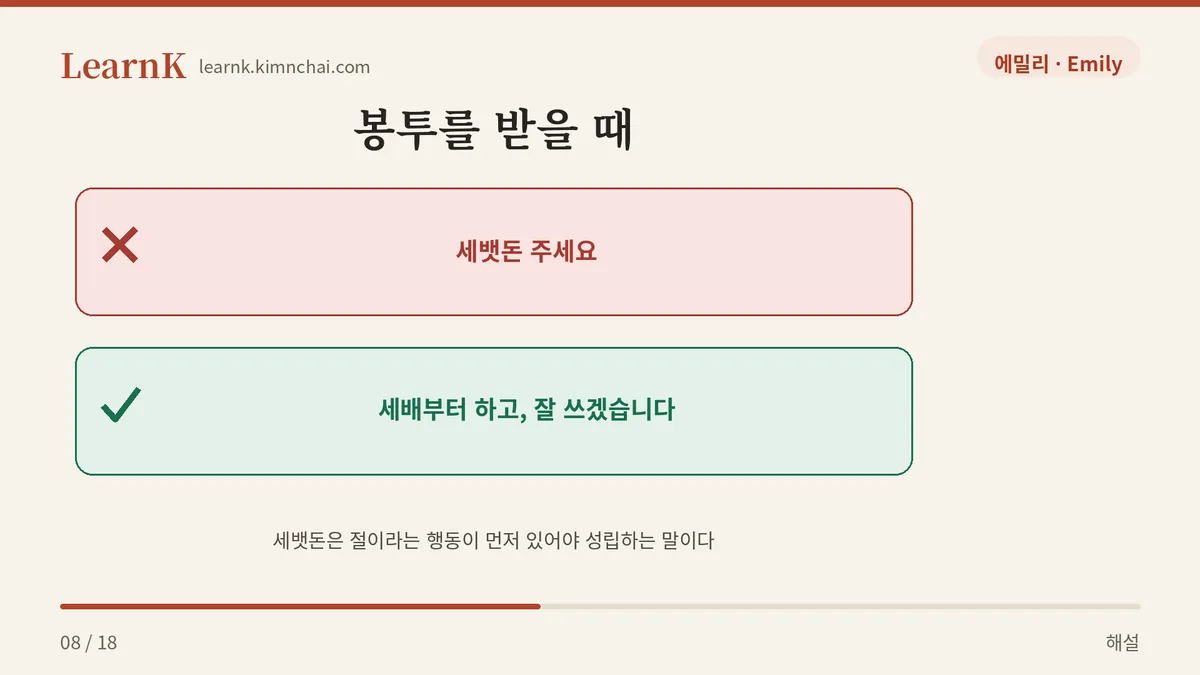
- From child to grown-up (formal): 세뱃돈 감사합니다 (sebaetdon gamsahamnida). (Thank you for the New Year’s money.) / 잘 쓰겠습니다 (jal sseugesseumnida, 잘 쓰겠습니다 = I’ll put it to good use, gratefully).
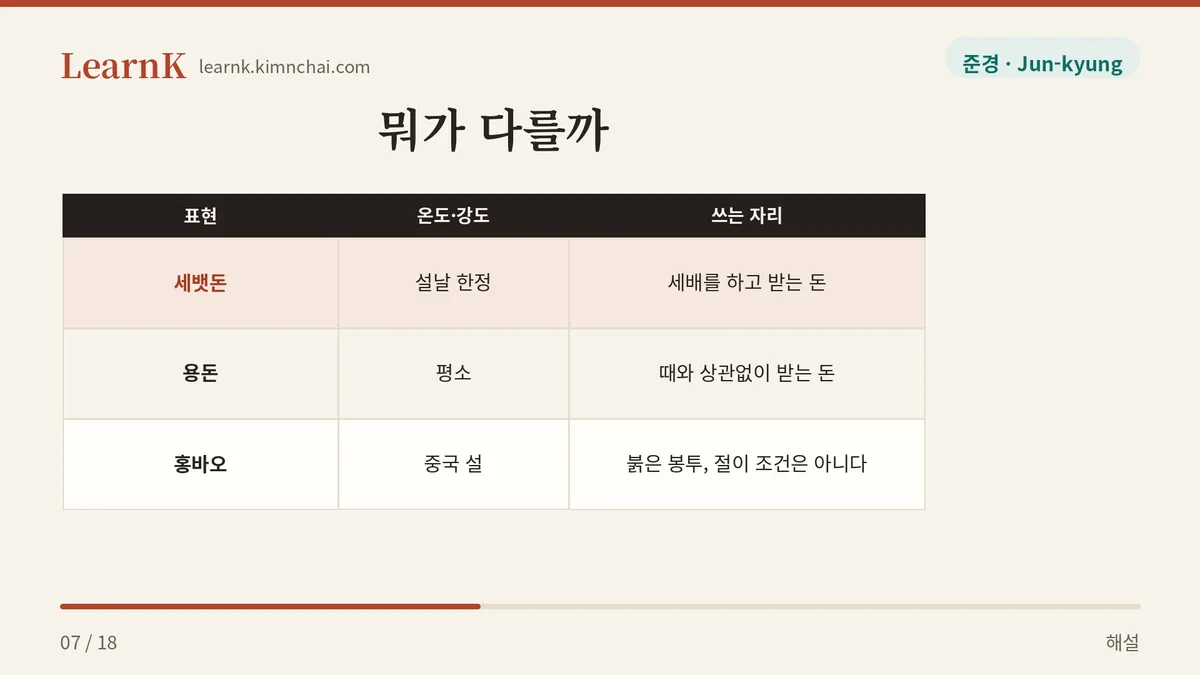
There are also words that are similar but different. 용돈 (yongdon) is ordinary everyday pocket money, so it’s used anytime regardless of the New Year, whereas 세뱃돈 is paired only with the Seollal bow. It may look similar to China’s 압세돈 (apsedon) — the red envelope known as ‘hongbao’ — but a defining feature of Korea’s 세뱃돈 is that it only comes about after the action of ‘세배 (the deep bow)’ has been performed first.
Cultural Background
The custom of 세뱃돈 sits within the flow of Seollal morning: after performing 차례 (charye, the holiday memorial rite offered to ancestors), the whole family bows to their elders. In holiday episodes of dramas, you’ll regularly see kids comparing amounts of 세뱃돈 with their siblings, or a parent taking the envelope away saying “엄마가 보관해 줄게” (Mom will keep it safe for you). This ‘Mom’s Bank’ is a national memory that any Korean will smile and relate to. Lately, more households send 세뱃돈 by bank transfer or mobile payment, but the warmth of handing over an envelope of crisp new bills with both hands is still very much beloved.
Closing Quiz
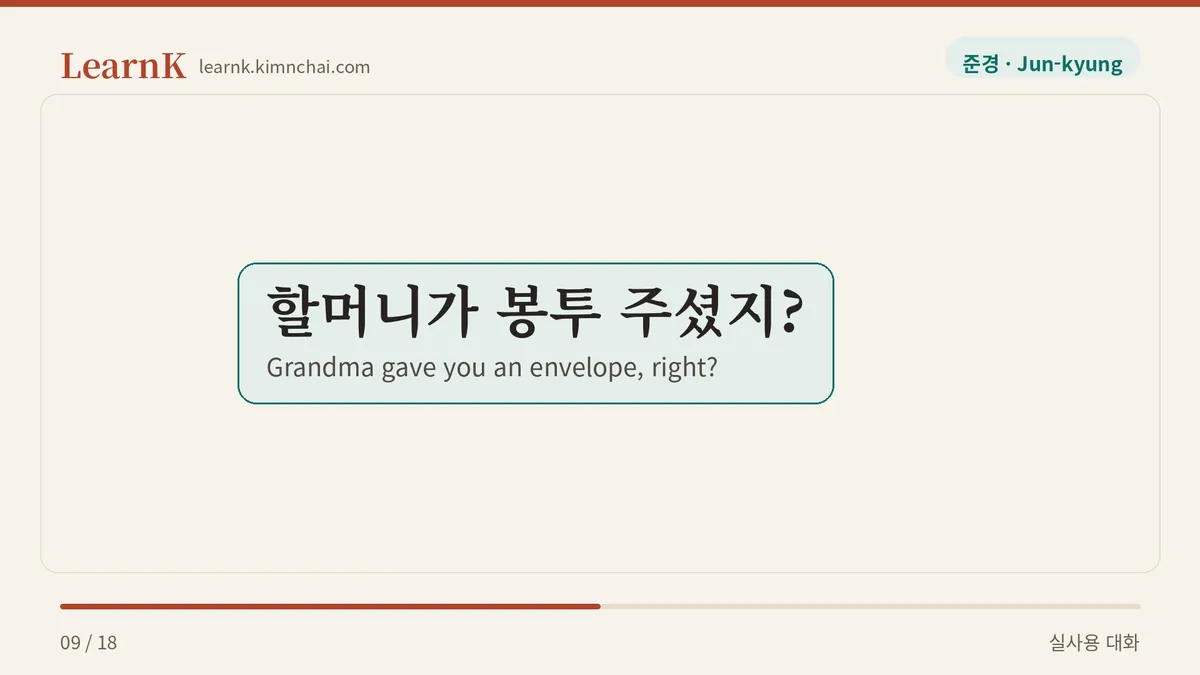
Q. In Korea, what is the one thing you absolutely must do ‘before’ receiving your 세뱃돈?
① Sing a song ② Offer a 세배 (deep bow) to your elders ③ Cook tteokguk (rice cake soup)
Think back on what you learned today and see if you can guess the answer. (Hint: the answer is hidden inside the word ‘세뱃돈’ itself!)
Definitions and example sentences are from the National Institute of Korean Language’s Basic Korean Dictionary (krdict.korean.go.kr); that portion of this post, including our translations, is licensed under CC BY-SA 2.0 KR.