Sikhye — The Korean You Learn Standing in Front of the Jjimjilbang Fridge
식혜 (sikhye) means a sweet traditional Korean drink: cooked rice is fermented in barley malt water, sugar is added, the whole thing is boiled down, and then it’s chilled and served cold. It’s that drink you’ve seen — pale yellow liquid with white grains of rice bobbing on the surface.
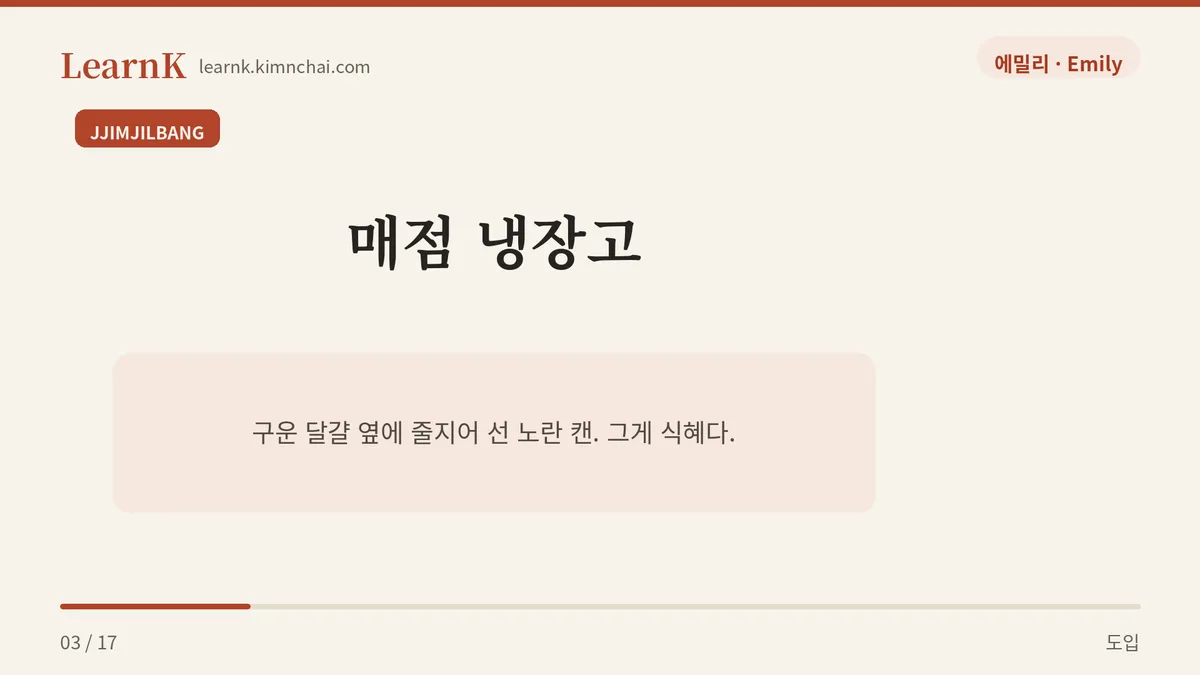
If you’ve come to Korea and been to a jjimjilbang (Korean bathhouse) even once, chances are you’ve already had it. You sweat it all out in a hot room, come out, open the fridge at the snack counter — and there, right next to the baked eggs, is a row of yellow cans. That’s sikhye. A surprising number of people say they never learned the name and just pointed at it with a finger.
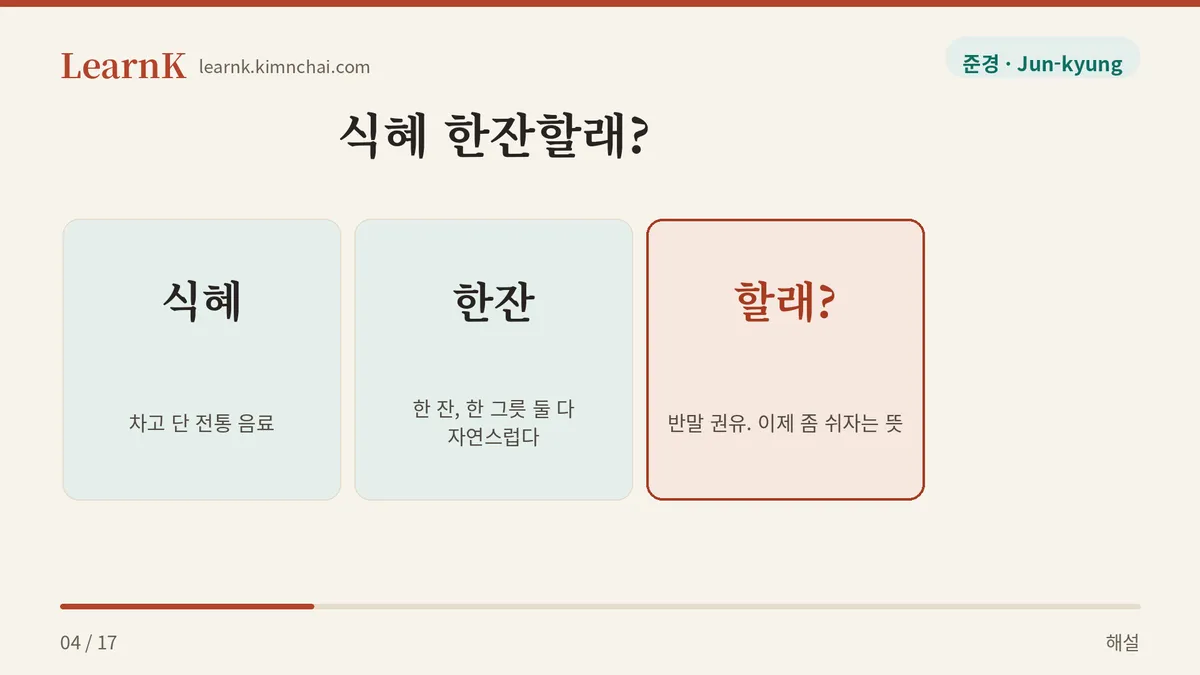
식혜 is the name of a thing, so it carries no formal/informal (존댓말·반말) distinction of its own. What it does have is a very clear set of places where it belongs — after a meal (dessert), after a good sweat (the jjimjilbang), and when guests come over (hospitality). So 식혜 한잔할래? (sikhye hanjanhallae?) isn’t an invitation to drink alcohol; it’s closer to “let’s sit down and take a break now.” It’s a signal that you’re finishing with something cold and sweet rather than a hot coffee.
Checking the National Institute of Korean Language dictionary
식혜 (sikhye) 「noun」 A sweet-flavored traditional Korean beverage: cooked rice is put into barley malt water to ferment, sugar is added once the rice grains float to the top, the liquid is boiled down, and it is cooled before drinking. — National Institute of Korean Language, Basic Korean Dictionary (krdict.korean.go.kr)
Here are the translations the same dictionary provides in other languages.
[en] sikhye; sweet rice punch — A sweet-flavored traditional Korean beverage, made by fermenting cooked rice in barley malt water, adding sugar, and boiling it down, drunk after cooling. [ja] シケ。カムジュ【甘酒】 — 麦芽から抽出した水にご飯を入れて発酵させた後、飯粒が浮き上がったら砂糖を加えて煮詰めたものを冷やして飲む甘味のある韓国の伝統飲料。 [es] sikye, bebida dulce de arroz — Bebida típica coreana hecha con granos de arroz y malta para dar el sabor dulce. [zh] 甜米露 — 一种甜的韩国传统饮料,把麦芽放在水中泡开之后放入米饭酿熟,等到饭粒发酵之后再放入白糖煮沸,等冷却之后食用。 — National Institute of Korean Language, Basic Korean Dictionary (krdict.korean.go.kr)
The dictionary doesn’t include a Portuguese definition. The one below isn’t a dictionary quotation — it’s our own rendering: sikhye, bebida doce de arroz: bebida tradicional coreana de sabor doce, feita fermentando arroz cozido em água de malte de cevada e servida gelada.
Let’s also read through the real usage examples the dictionary lists.
내가 식혜를 국자로 휘젓자 가라앉았던 밥알이 동동 떴다. — National Institute of Korean Language, Basic Korean Dictionary (krdict.korean.go.kr)
When I stirred the sikhye with a ladle, the rice grains that had settled floated back up.
If you keep it in a big bowl, the rice grains sink to the bottom. You give it one stir with a ladle to lift the grains, and only then scoop it out — that’s a proper serving. 동동 (dongdong) is the word for the way small, light things bob on the surface of water.
식혜를 추운 바깥에 놓아두었더니 안에 박빙이 생겼다. — National Institute of Korean Language, Basic Korean Dictionary (krdict.korean.go.kr)
I left the sikhye outside in the cold, and a thin layer of ice formed inside it.
Leave it out in the yard or on the balcony in winter and a thin sheet of ice — 박빙 (bakbing) — forms on the surface. Plenty of people think sikhye with a crunch of ice crystals is the very best version.
나는 밥을 먹고 후식으로 식혜를 마시면 소화가 잘되는 듯하다. — National Institute of Korean Language, Basic Korean Dictionary (krdict.korean.go.kr)
When I drink sikhye for dessert after a meal, my digestion seems to go better.
This is the most common place sikhye shows up. Barley malt is believed to aid digestion, so people reach for it especially after a heavy, oily holiday meal.
할머니께서는 전통 음료 중에서도 식혜와 수정과를 즐겨 드셨다. — National Institute of Korean Language, Basic Korean Dictionary (krdict.korean.go.kr)
Of all the traditional drinks, my grandmother especially enjoyed sikhye and sujeonggwa.
The word that follows sikhye around like a best friend is 수정과 (sujeonggwa). Both are traditional dessert drinks that appear together on the holiday table, so they often get mentioned side by side in the same sentence.
저희 집에 가서 식혜 한잔 드시지요. — National Institute of Korean Language, Basic Korean Dictionary (krdict.korean.go.kr)
Come over to our place and have a glass of sikhye.
This is how you invite a guest home. Sikhye slots into the spot where “차 한잔하시죠 (cha hanjanhasijyo — let’s have a cup of tea)” would go, and it’s a fairly formal invitation.
Seeing it in a real conversation
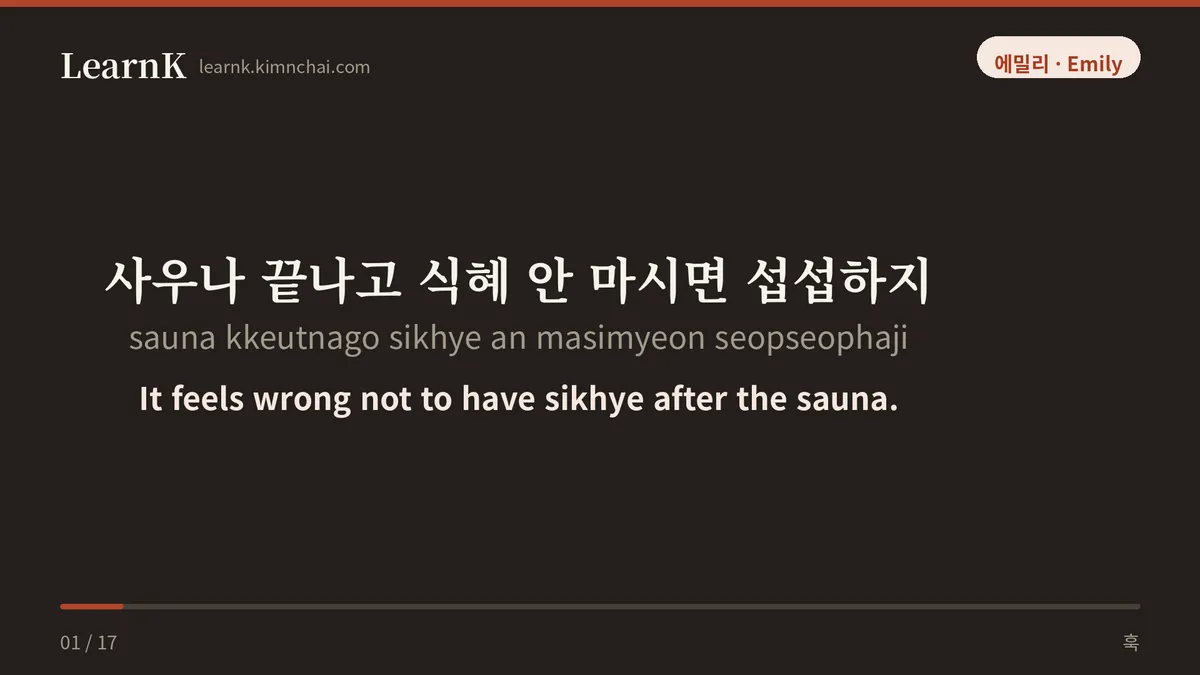
The scene: a jjimjilbang on a Saturday evening. They’ve sweated it all out and are now standing in front of the snack counter.
Jun-kyung: 아, 살 것 같다. 뭐 마실래? 내가 살게. Ah, I feel alive again. What do you want to drink? It’s on me.
Emily: 나 저기 노란 캔. 식혜. That yellow can over there. Sikhye.
Jun-kyung: 오, 좀 아는데? 외국인들은 보통 이온 음료 집던데. Oh, you know your stuff. Foreigners usually grab a sports drink.
Emily: 무슨 소리야, 나 한국 산 지 15년이야. 사우나 끝나고 식혜 안 마시면 섭섭하지. What are you talking about? I’ve lived in Korea for fifteen years. It just feels wrong not to have sikhye after the sauna.
Jun-kyung: 근데 밥알은 어떡해? 다 마셔도 바닥에 남잖아. But what about the rice grains? They’re still stuck at the bottom when you finish.
Emily: 그건 뚜껑 열고 털어 먹는 거지. 그게 제일 맛있는데. You pop the lid open and shake them out. That’s the best part.
This sounds off
Since 식혜 is the name of a thing, it isn’t a word you adjust depending on who you’re talking to. Instead, here are two misunderstandings learners trip over all the time.
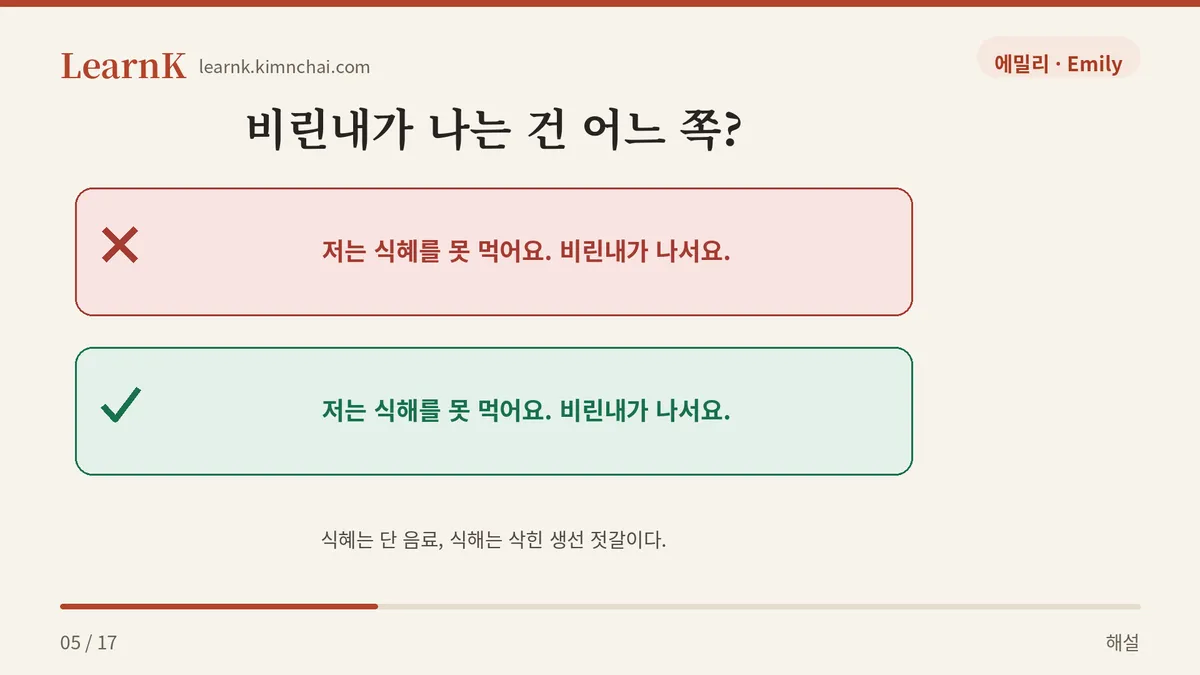
✗ 저는 식혜를 못 먹어요. 비린내가 나서요. ✓ 저는 식해를 못 먹어요. 비린내가 나서요. (“I can’t eat sikhye/sikhae. It smells fishy to me.”) → 식혜 (sikhye) is the sweet drink; 식해 (sikhae) is a kind of salted, fermented seafood dish made with fish, rice, and chili powder. One letter apart, and they belong to completely different parts of the table.
✗ 식혜 한잔하자고요? 저는 술을 못 마셔서요. ✓ 식혜 한잔하자고요? 좋아요, 저 그거 좋아해요. (“You want to have a glass of sikhye? — I can’t drink alcohol, though.” vs. “Sure, I love that stuff.”) → There’s no alcohol in sikhye. It’s easy to mistake it for a drinking invitation, since 한잔하다 (hanjanhada) usually means “let’s go for a drink” and the Japanese gloss is 甘酒 (amazake) — but when a drink’s name comes in front of it, it isn’t an invitation to a drinking session.
Example sentences by situation
1) A holiday evening, after the table has been cleared The grown-ups are sprawled on the sofa and the kids are running around. Everyone’s full, but their mouths are restless. “배부른데 식혜 한 그릇만 더 먹을까? (baebureunde sikhye han georeut-man deo meogeulkka?)” “I’m stuffed, but should I have just one more bowl of sikhye?” — People drink it out of cans too, but homemade sikhye is scooped into a bowl. That’s why both 한 잔 (han jan, “a glass”) and 한 그릇 (han georeut, “a bowl”) sound natural.
2) Looking for it at a convenience store “저기요, 식혜 있어요? (jeogiyo, sikhye isseoyo?)” “Excuse me, do you have sikhye?” “냉장고 맨 아래 칸에 있어요. (naengjanggo maen arae kane isseoyo.)” “It’s on the bottom shelf of the fridge.” — Canned sikhye is usually near the bottom of the drinks fridge, next to the pear juice and aloe drinks. In summer it sometimes gets moved up to a more visible spot.
3) Serving a guest “식혜 좀 드릴까요? 어머니가 직접 담그신 거예요. (sikhye jom deurilkkayo? eomeoniga jikjeop damgeusin geoyeyo.)” “Would you like some sikhye? My mother made it herself.” — Sikhye goes with the verb 담그다 (damgeuda). Just as you 담그다 kimchi, you 담그다 sikhye. Saying it was made at home rather than bought is itself a mark of care, and that one sentence changes the whole weight of the hospitality.
Formal and informal forms, and related expressions
When you’re offering it, the wording splits depending on who you’re talking to.
- Informal: 식혜 한잔할래? (sikhye hanjanhallae?)
- Polite: 식혜 한잔 드시겠어요? (sikhye hanjan deusigesseoyo?)
- More formal still: 식혜 좀 내어 드릴까요? (sikhye jom naeeo deurilkkayo?)
Comparing it with the drinks that occupy similar spots makes sikhye’s position clearer.
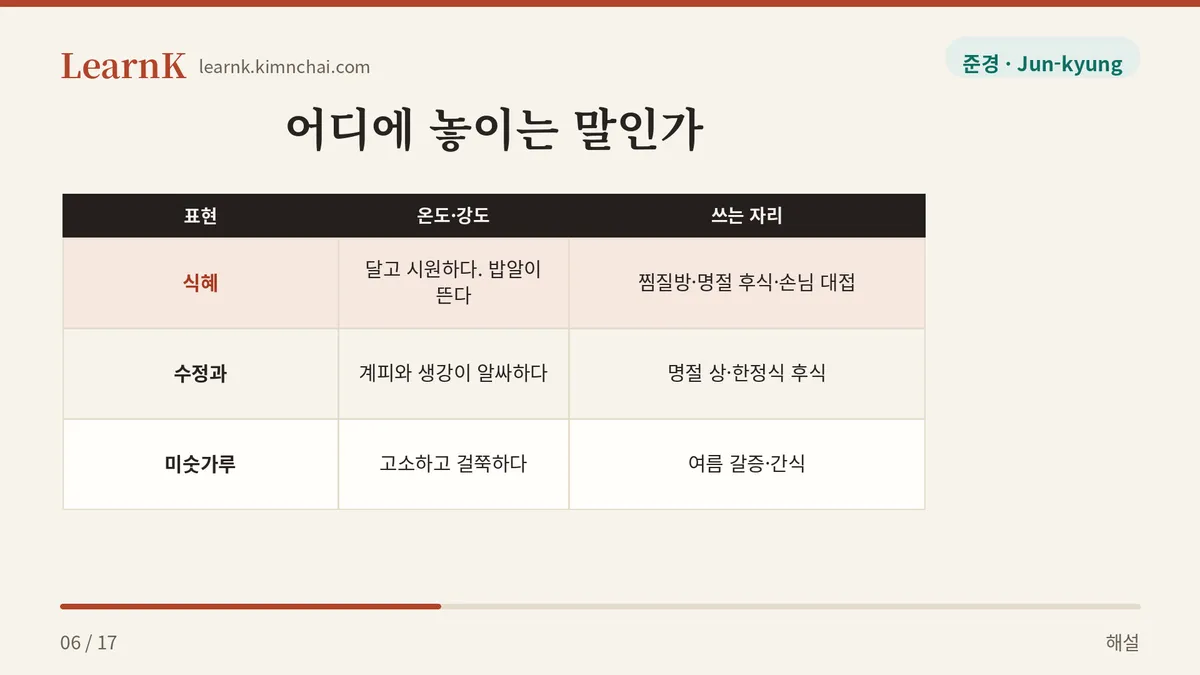
| Expression | Temperature & intensity | Where it’s used |
|---|---|---|
| 식혜 (sikhye) | Sweet and cold, with rice grains floating in it | Jjimjilbang, holiday dessert, serving guests |
| 수정과 (sujeonggwa) | Sharp and deep with cinnamon and ginger | The holiday table, dessert at a traditional Korean restaurant. Kids rarely ask for it |
| 감주·단술 (gamju·dansul) | Refers to essentially the same thing as sikhye | What some families and regions call it. It lives on in the way older people speak |
| 미숫가루 (misutgaru) | Nutty and thick | Summer thirst and snacking. Not a post-meal dessert drink |
Cultural background — the drink you have after a good sweat
In hanja it’s written 食醯. It differs from the 식해 (食醢) we saw earlier by exactly one final character, and yet one is a sweet drink and the other is fermented fish. Even Korean speakers occasionally mix the pair up in writing.
The way it’s made lives up to its name. You steep barley malt in water, put cooked rice into that water, and keep it warm; the rice grains slowly ferment. When the grains start floating up one by one, it’s done — that’s when you add sugar, bring it to a boil, and let it cool. So the phrase from the dictionary example, 밥알이 동동 떴다 (“the rice grains floated up”), isn’t just description — it’s the signal that the batch is finished. It takes so long that few households make it on an ordinary day; mostly it gets made in one big batch on a labor-intensive occasion like a holiday or a celebration. Put a batch like that out on the balcony in winter and a film of thin ice forms on top.
For younger Koreans today, sikhye’s home turf is the jjimjilbang. Wrapping a towel around your head into “sheep horns,” cracking a baked egg on your forehead to peel it, and drinking a can of sikhye — the three come as a set. Korean dramas return again and again to the scene where characters sit on the jjimjilbang floor peeling eggs and finally say what’s on their minds, and the yellow can in their hand is usually sikhye. So learning this word isn’t really about learning one drink. It’s closer to learning one of the ways Koreans say, “okay, let’s rest now.”
Today’s quiz
An uncle who has eaten far too much holiday food leans back on the sofa and says the following. Which word belongs in the blank?
“기름진 걸 너무 많이 먹었더니 속이 답답하네. ______ 한 그릇만 줄래?”
“I ate way too much greasy food and my stomach feels heavy. Could you give me a bowl of ______?”
① 식해 ② 식혜 ③ 미숫가루 ④ 수정과
Answer: ② 식혜 (sikhye) The thing people reach for after a meal, as a dessert that helps digestion, is sikhye. ① is fermented salted fish, so it doesn’t fit here at all; ③ is more of a summer snack than a dessert. ④ 수정과 (sujeonggwa) is a holiday dessert too, but the thing that most commonly follows “속이 답답하다 (my stomach feels heavy)” is a bowl of sikhye with rice grains floating in it.
Definitions and example sentences are from the National Institute of Korean Language’s Basic Korean Dictionary (krdict.korean.go.kr); that portion of this post, including our translations, is licensed under CC BY-SA 2.0 KR.