원작 (wonjak) — The Line That Always Flashes On Screen in Episode 1
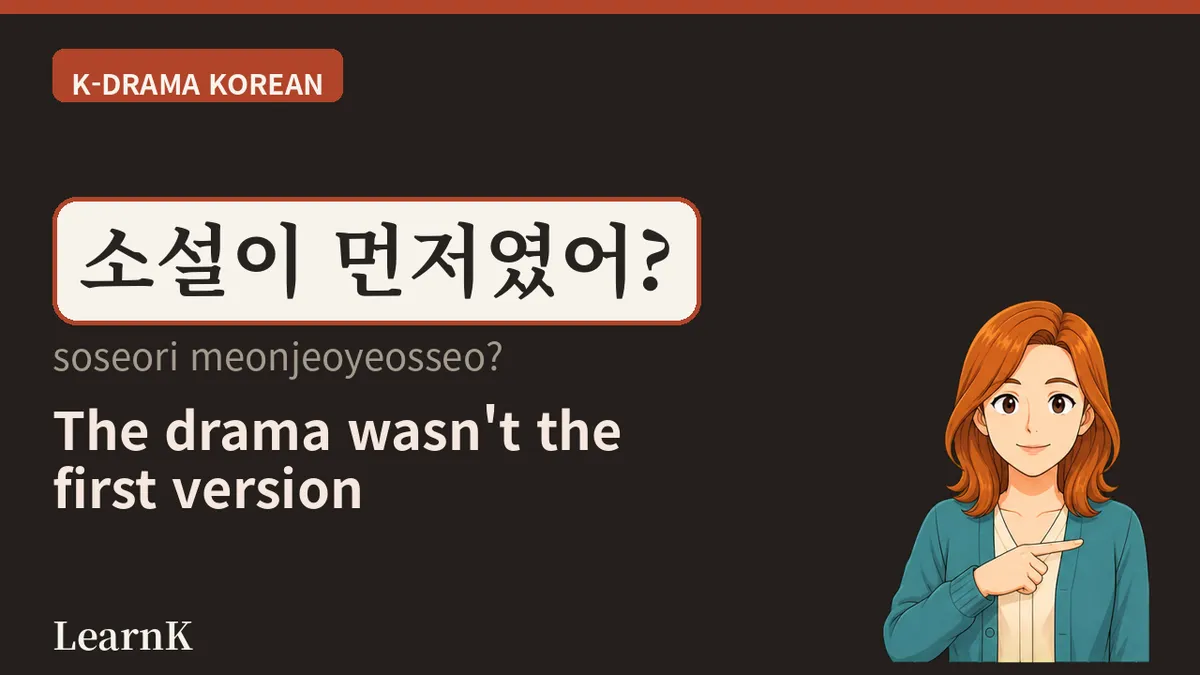
원작 (wonjak)
원작 (wonjak) means the original work — a work as it stood before it was turned into the script of a play or a movie, or translated into another language. Put on a Korean drama and, in the seconds before episode 1 begins, a small caption appears in the corner of the screen: “이 드라마는 웹툰 《○○○》을 원작으로 합니다.” (This drama is based on the webtoon ○○○.) And once the first week of airing is over, community boards split neatly in half between two kinds of posts — “원작이랑 너무 다르다” (it’s so different from the original) and “원작에 진짜 충실하다” (it’s really faithful to the original). For a learner who wants to get even a word in edgewise in a conversation about Korean content, this one isn’t optional.
The key thing is that 원작 (wonjak) can’t stand on its own. It always needs a partner. Only when a later work exists — a drama, a film, a play, a musical, a translated edition — does the earlier thing become an “원작.” If a novelist who has just finished a manuscript says “제 원작을 소개합니다” (Let me introduce my original work), it sounds oddly untethered to Korean ears. Nothing has been adapted yet, so it’s just a novel. The word itself is neutral in temperature, but the moment fans start using it, it quietly becomes a measuring stick. “원작보다 낫다” (better than the original), “원작 훼손이다” (this ruins the original) — whenever a ruler is laid against a work, this word is holding it.
Checking It in the National Institute of Korean Language Dictionary
원작 「명사」 (noun) The original work before being turned into the script of a play or movie, or translated into a foreign language. — National Institute of Korean Language, Basic Korean Dictionary (krdict.korean.go.kr)
The dictionary carries glosses in other languages as well.
[en] original work; original — The original work before being turned into the script of a play or movie, or translated into a foreign language. [ja] げんさく【原作】 — 演劇や映画の脚本にしたり翻訳したりする前の、元の作品。 [es] original — Obra teatral o película producida directamente por su autor sin traducción en otro idioma o guión. [zh] 原作 — 创作成话剧或电影的剧本,或翻译成他国语言之前的原来的作品。 — National Institute of Korean Language, Basic Korean Dictionary (krdict.korean.go.kr)
※ There is no Portuguese gloss in the dictionary. The following is our own translation — obra original — a obra original, antes de ser adaptada para o roteiro de uma peça ou filme, ou traduzida para outro idioma.
Below are four of the dictionary’s real usage examples, quoted as they appear, each with a note on the kind of setting the sentence would come from.
원작 소설의 인기가 그대로 드라마로 반영되기 때문이겠죠. It’s probably because the popularity of the original novel carries straight over into the drama. — National Institute of Korean Language, Basic Korean Dictionary (krdict.korean.go.kr)
This is how a broadcaster or a journalist might talk in an interview. The ending -겠죠 (-getjyo) lays a careful bit of guesswork over the sentence. What’s worth noticing here is the shape 원작 소설 (wonjak soseol) — a genre word attached directly after 원작. In real conversation this pattern is overwhelmingly the most common one: 원작 소설 (wonjak soseol, original novel), 원작 웹툰 (wonjak weptun, original webtoon), 원작 만화 (wonjak manhwa, original comic), 원작 영화 (wonjak yeonghwa, original film).
소설이 영화로 각색되면서 시나리오는 원작의 내용과 많이 달라졌다. As the novel was adapted into a film, the screenplay came to differ a great deal from the content of the original. — National Institute of Korean Language, Basic Korean Dictionary (krdict.korean.go.kr)
A textbook sentence from a film review. 각색 (gaksaek), meaning adaptation, is 원작’s constant companion, and the two almost always turn up in the same paragraph. Memorize just these skeletons — ‘A가 B로 각색되다 (A-ga B-ro gaksaekdoeda)’, A is adapted into B, and ‘원작과 달라지다 (wonjakgwa dallajida)’, to differ from the original — and you can get through a whole review.
연극을 흥미롭게 하기 위해 각색 과정에서 원작에 없던 등장인물이 추가되었다. To make the play more interesting, a character who was not in the original was added during the adaptation process. — National Institute of Korean Language, Basic Korean Dictionary (krdict.korean.go.kr)
원작에 없던 (wonjage eopdeon), not in the original — an expression that gets used hundreds of times a day in fan communities. 원작에 없던 인물 (a character not in the original), 원작에 없던 장면 (a scene not in the original), 원작에 없던 대사 (a line not in the original). Arguments over an adaptation usually open with exactly these five syllables.
원작과 달리 개작된 작품에서는 주인공들이 행복한 결말을 맺는다. Unlike the original, in the reworked version the main characters reach a happy ending. — National Institute of Korean Language, Basic Korean Dictionary (krdict.korean.go.kr)
This is the case where the ending has been changed. 개작 (gaejak) means a rewrite that goes further than 각색 — a heavier hand on the material. Korean dramas turning a novel’s tragic ending into a happy one is genuinely common, and every time it happens, viewers talk about it in precisely this sentence pattern.
A Real Conversation
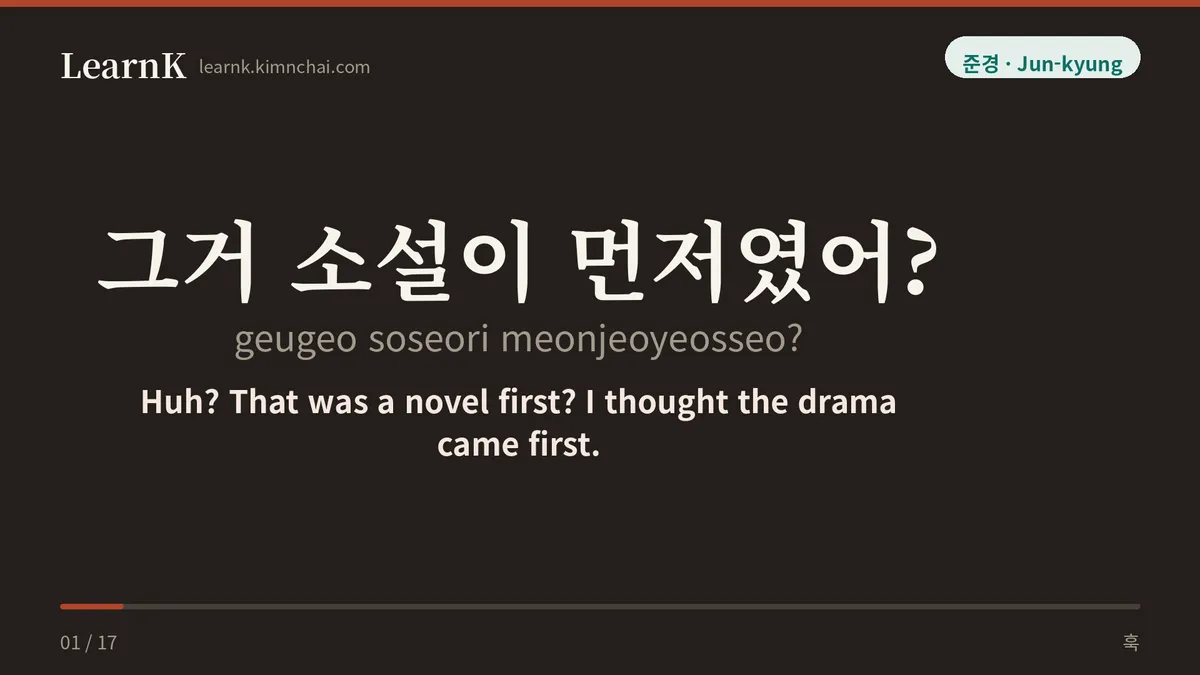
Situation: Saturday afternoon, the fiction section of a neighborhood secondhand bookstore. Emily has come looking for the book her current drama is based on, and Jun-kyung has tagged along.
Emily: 준경아, 찾았다! 나 이거 사러 온 거야. 요즘 보는 드라마 원작이래. Jun-kyung, found it! This is what I came for. They say it’s the original novel of the drama I’m watching.
Jun-kyung: 어? 그거 소설이 먼저였어? 난 드라마가 처음인 줄 알았는데. Huh? That was a novel first? I thought the drama came first.
Emily: 응. 근데 결말이 완전 다르대. 드라마는 해피엔딩인데 원작은 아니라던데? Yeah. But apparently the ending is totally different. The drama has a happy ending, but the original doesn’t.
Jun-kyung: 야, 그럼 읽지 마. 다 알고 보면 김새잖아. Hey, then don’t read it. It ruins it if you already know everything.
Emily: 아니야, 나는 꼭 원작까지 봐야 직성이 풀리더라고. No way, I’m not satisfied until I’ve read the original too.
Jun-kyung: 하여튼 별나. 다 읽으면 나도 좀 빌려줘. You’re something else. Lend it to me when you’re done.
This Sounds Off
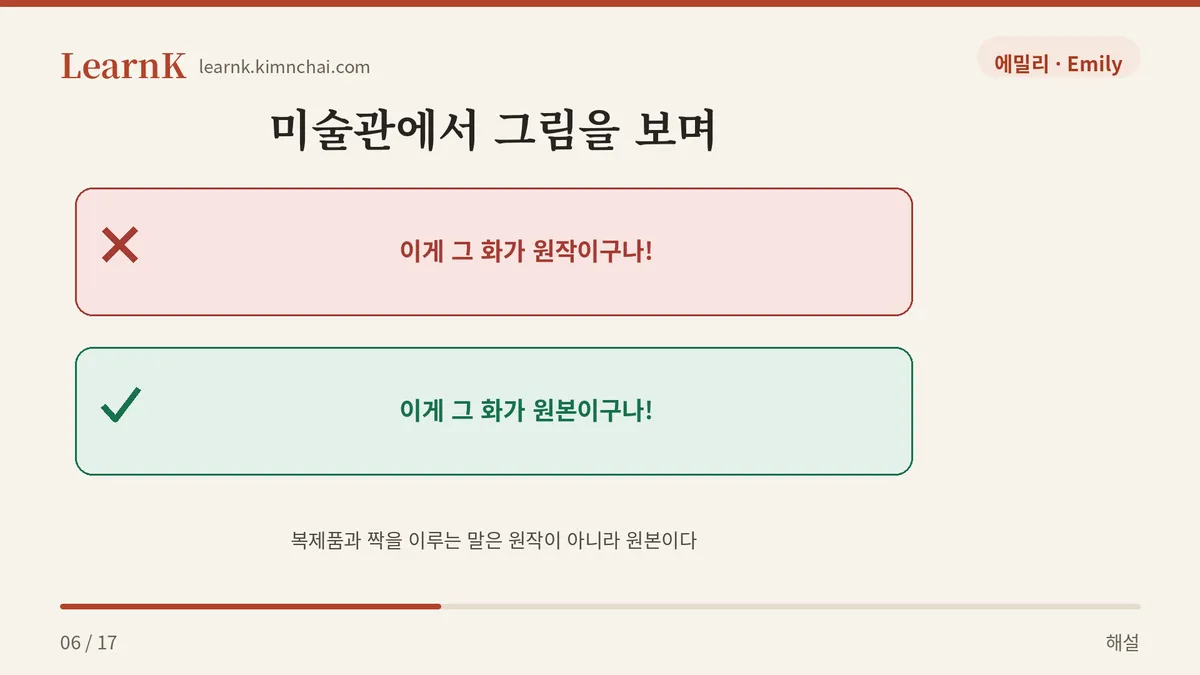
✗ (Looking at a painting in a museum) 우와, 이게 그 화가 원작이구나! ✓ (Looking at a painting in a museum) 우와, 이게 그 화가 원본이구나! / 진품이구나! Wow, so this is that painter’s original! → 원작 is for when a separate “remade” work — an adaptation or a translation — actually exists. If you mean that the painting in front of you is the real thing rather than a reproduction, the right words are 원본 (wonbon) or 진품 (jinpum). Say 원작 and a Korean speaker will ask you back, “So did they make a movie out of it?”
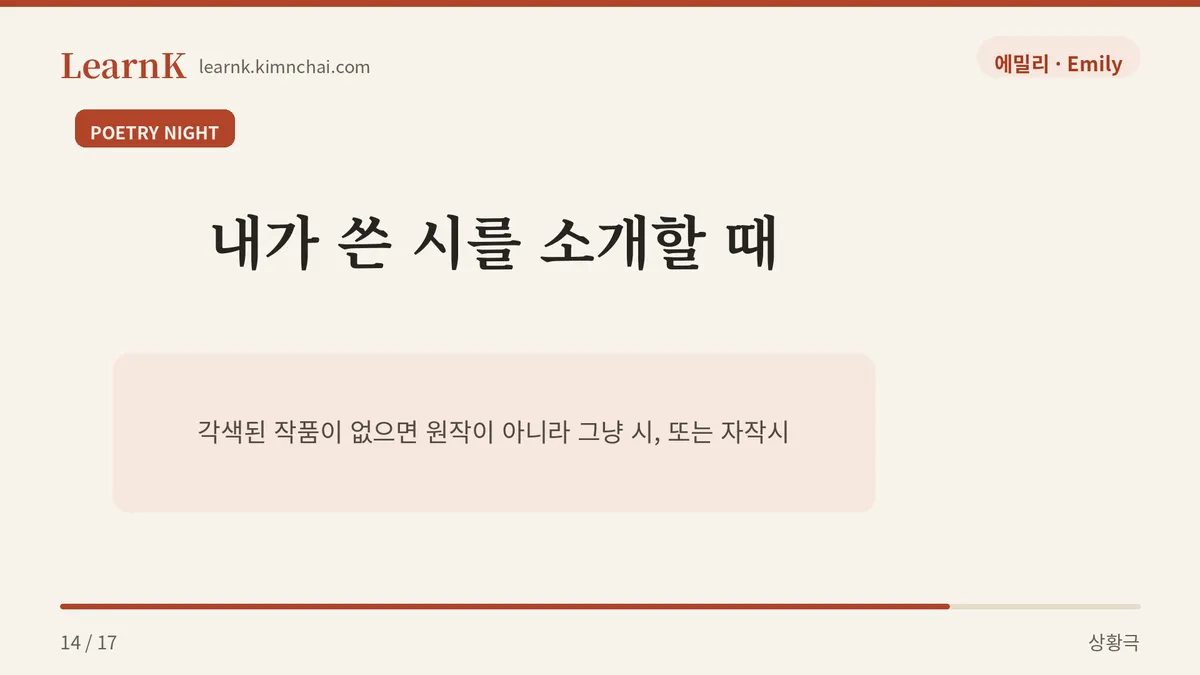
✗ (At a poetry reading) 제가 어제 쓴 원작 시를 읽어 드릴게요. ✓ (At a poetry reading) 제가 어제 쓴 시를 읽어 드릴게요. / 제 자작시를 읽어 드릴게요. I’ll read you the poem I wrote yesterday. / I’ll read you a poem of my own. → 원작 always demands a partner: the original of what. Attach it when no derived work exists and the meaning floats off into nothing. If you want to stress that you made it yourself, use 자작 (jajak), one’s own work.
Example Sentences by Situation
1. Recommending a drama to a friend (casual speech) 이 드라마 웹툰이 원작이야. 원작도 진짜 재밌어. (i deurama weptuni wonjagiya. wonjakdo jinjja jaemisseo.) This drama is based on a webtoon. The original is really good too. → The single most common form. Learn just ‘A가 원작이다 (A-ga wonjagida)’, A is the original, and most recommendation conversations will roll along fine.
2. When a film fell short of expectations, to a coworker (polite speech) 원작을 너무 많이 잘라내서 조금 아쉬웠어요. (wonjageul neomu mani jallanaeseo jogeum aswiwosseoyo.) They cut too much from the original, so it was a bit disappointing. → Rather than saying flat out that it was bad, you soften it to 아쉽다 (aswipda), a bit of a shame — classic Korean understatement. And it’s the textbook way to judge something with the original as your reference point.
3. Asking a bookstore employee (polite speech) 혹시 그 드라마 원작 소설도 들어와 있나요? (hoksi geu deurama wonjak soseoldo deureowa innayo?) By any chance, do you have the original novel of that drama in stock? → The 혹시 (hoksi), by any chance, at the front lowers the threshold of the request. Just that one word makes the whole question land much more gently.
Politeness Levels and Neighboring Words
원작 is a noun, so the word itself doesn’t shift between polite and casual. What shifts is the end of the sentence. With a friend, 원작이야 (wonjagiya); with an elder or someone you’ve just met, 원작이에요 (wonjagieyo); in a presentation or an official setting, 원작입니다 (wonjagimnida).
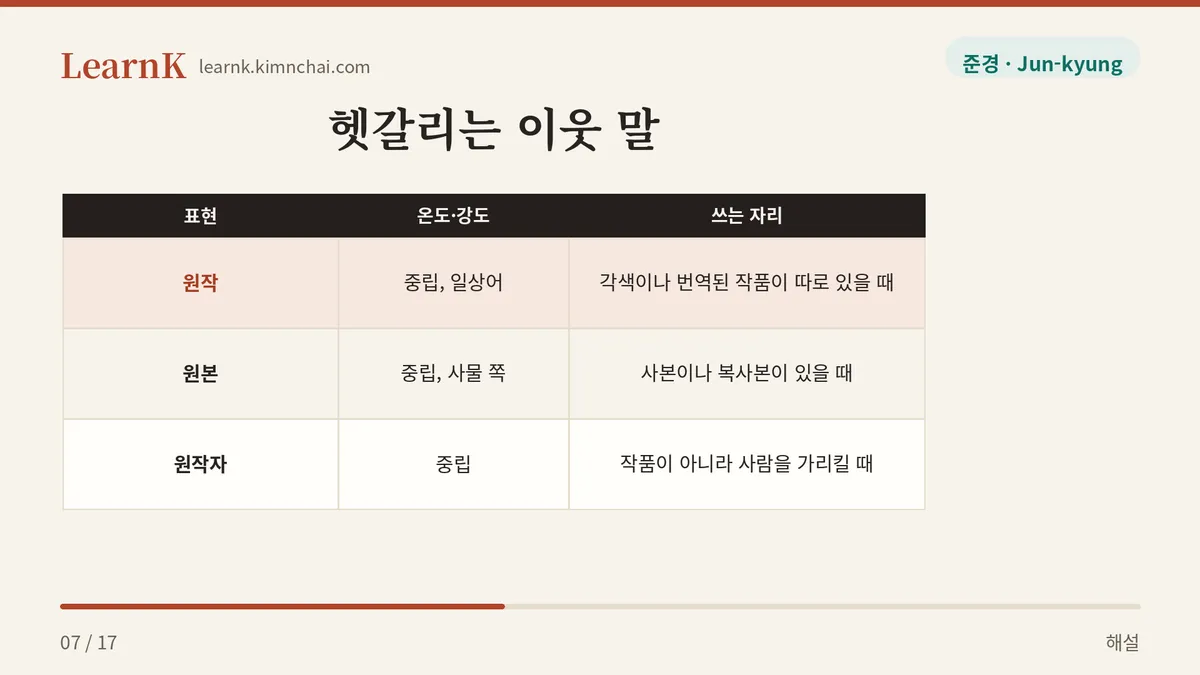
The easily confused neighbors are best laid out in a table.
| Expression | Tone / intensity | Where it’s used |
|---|---|---|
| 원작 (wonjak) | Neutral, everyday | When an adapted or translated work exists separately. The basic word for drama, film, and webtoon talk |
| 원본 (wonbon) | Neutral, object-oriented | When a copy or duplicate exists. Documents, paintings, files |
| 원저 (wonjeo) | Stiff, literary | The book a translation is based on. Publication data, academic papers |
| 원작자 (wonjakja) | Neutral | Points to the person, not the work. “원작자의 허락을 받다” (to get the original creator’s permission) |
| 오리지널 (orijineol) | Light, casual | Social media and reviews. Roughly “오리지널 버전이 낫다” (the original version is better) |
In one line: if there’s a work made over from it, 원작; if there’s a copy made of it, 원본; if you mean the person, 원작자.
Cultural Background — A Country Where the Webtoon Comes First
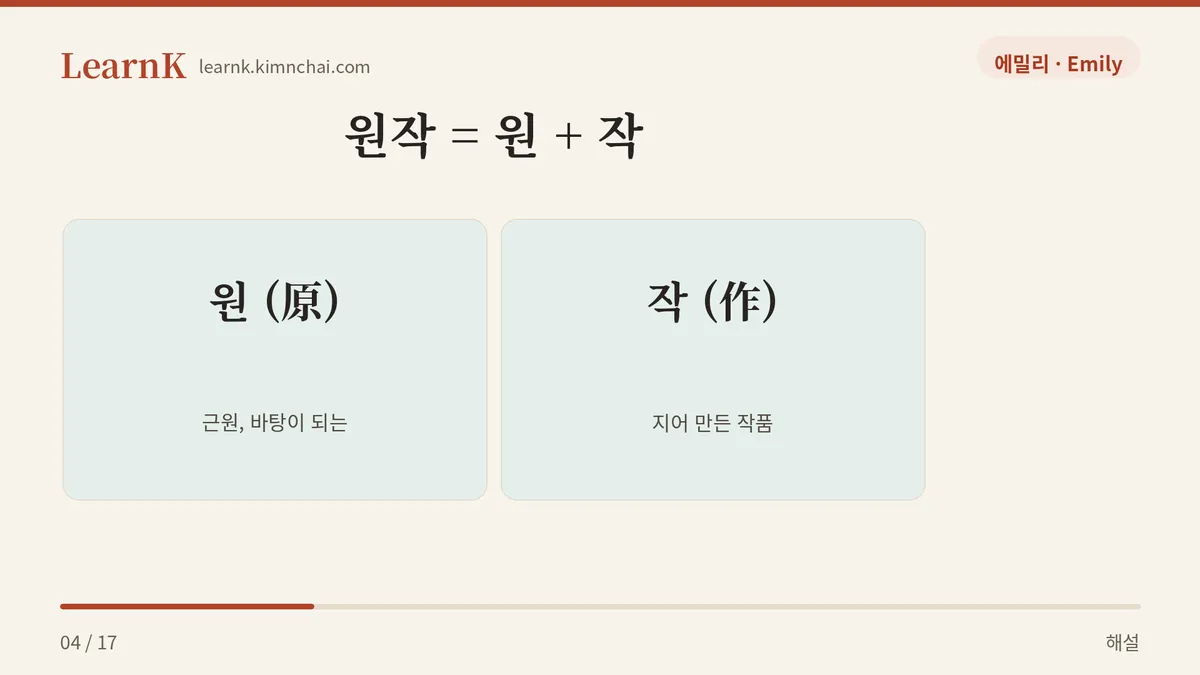
원작 is a Sino-Korean word. 원 (原, source) and 작 (作, to make) join to give “the work that is the source.” Line up the other words that use the same 原 and the meaning settles into place on its own — 원본 (原本, the source book or document), 원문 (原文, the text before translation), 원어 (原語, the language before it was carried over). Because Korea, China, and Japan share these characters, the Japanese 原作 (げんさく) and the Chinese 原作 show up letter-for-letter in the dictionary’s translation column above. For learners with a background in Chinese characters, this word comes free.
There’s a reason you hear it so often in Korea specifically. Since the 2010s, a large share of Korean dramas have started life as webtoons and web novels. Misaeng (미생, tvN, 2014), about the daily grind of an office worker; Itaewon Class (이태원 클라쓰, JTBC, 2020), about young people starting a business; All of Us Are Dead (지금 우리 학교는, Netflix, 2022), set in a school — in every case the webtoon came first and the drama followed. So Korean viewers are thoroughly used to meeting a story twice. Once as the 원작, and once again as the drama.
Meeting things twice turned comparison into a culture. While a show is airing, “원작 팬” (original-work fans) and “드라마 시청자” (drama viewers) speak two different languages. The original-work fans ask why a character who wasn’t in the original is on screen; the drama viewers say the adaptation improved on it. Out of this came 원작 훼손 (wonjak hweson) — literally damage to the original, a fairly sharp-edged way of saying the adaptation ruined the story. On the other side sits the compliment 원작에 충실하다 (wonjage chungsilhada), faithful to the original. If you’re learning Korean by watching Korean dramas, you’ll run into these two phrases in the comment section before you ever meet them in the subtitles.
Today’s Quiz
Which of the following uses 원작 (wonjak) correctly?
① 이 계약서는 복사본이 아니라 원작입니다. This contract isn’t a copy, it’s the 원작. ② 그 드라마는 일본 만화가 원작이에요. That drama is based on a Japanese comic. ③ 제가 어제 처음 쓴 원작 시를 읽어 드릴게요. I’ll read you the 원작 poem I wrote for the first time yesterday.
Show the answer
Answer: ②
The comic came first and the drama was made over from it, so the comic is the 원작. ① calls for 원본, the word that pairs with a copy. In ③ nothing has been adapted yet, so 원작 simply doesn’t hold up — just say “제가 쓴 시” (the poem I wrote).
Definitions and example sentences are from the National Institute of Korean Language’s Basic Korean Dictionary (krdict.korean.go.kr); that portion of this post, including our translations, is licensed under CC BY-SA 2.0 KR.