워라밸 (worabael): The Korean Buzzword for Work-Life Balance
When you watch Korean dramas, you’ll sometimes come across a scene where the main character, worn out from working late, sighs and says, “If I keep living like this, my 워라밸 (worabael) is going to fall apart.” Coworkers might even ask each other over lunch, “Does your team have decent 워라밸 (worabael)?” Today, let’s take a deep dive into a buzzword that Korean people really use all the time in everyday life: 워라밸 (worabael).
워라밸
워라밸 (worabael) is a shortened form made by taking just the first sounds of the English phrase ‘Work-Life Balance (워크 라이프 밸런스, wokeu raipeu baelleonseu).’ It combines the first sound of each English word — ‘워 (work)’, ‘라 (life)’, and ‘밸 (balance)’ — making it a classic example of a Korean-style abbreviated buzzword. It means the balance between work and life — in other words, a state in which your work life and your personal life are in harmony, without tilting too far in either direction.
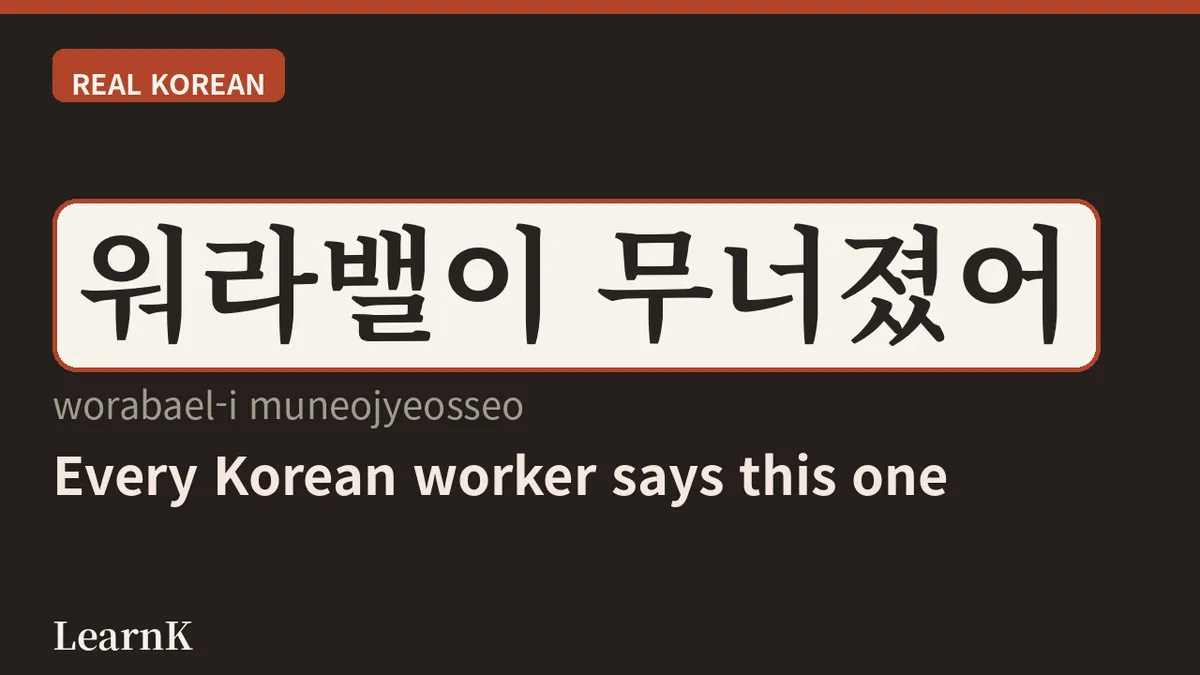
For example, a company where you don’t have to work late and you have plenty of time to enjoy hobbies and rest after work is described as one where “워라밸이 좋다 (worabael-i jota),” meaning the work-life balance is good. On the flip side, when you’re always busy and buried in work with no personal time, people say “워라밸이 없다 (worabael-i eopda)” (there’s no work-life balance) or “워라밸이 무너졌다 (worabael-i muneojyeotda)” (the work-life balance has collapsed).
Nuance and Usage
Rather than being an official standard word listed in the dictionary, 워라밸 is a piece of slang (신조어, sinjoeo) that spread widely starting in the late 2010s. Because of that, its nuance goes beyond simply ‘balance’ — it carries the values of a younger generation that prioritizes quality of life. In the past, there was a strong atmosphere of “you have to stake your life on your job to succeed,” but these days, Koreans in their 20s and 30s tend to think, “Money matters, but so does my life,” and they love using this word.
It mostly comes up in conversations about jobs, employment, and changing careers, and it’s often used as a standard for evaluating a company or when talking about one’s way of life.
Example Sentences by Situation
Situation 1 — To a friend thinking about changing jobs
연봉은 조금 낮아도 워라밸이 좋은 회사로 옮기고 싶어. (yeonbong-eun jogeum najado worabael-i joeun hoesa-ro omgigo sipeo.) Even if the salary is a bit lower, I want to move to a company with good work-life balance.
This sentence clearly shows the values of today’s generation, who consider their personal time more important than their 연봉 (yeonbong, annual salary).
Situation 2 — Asking about a new job
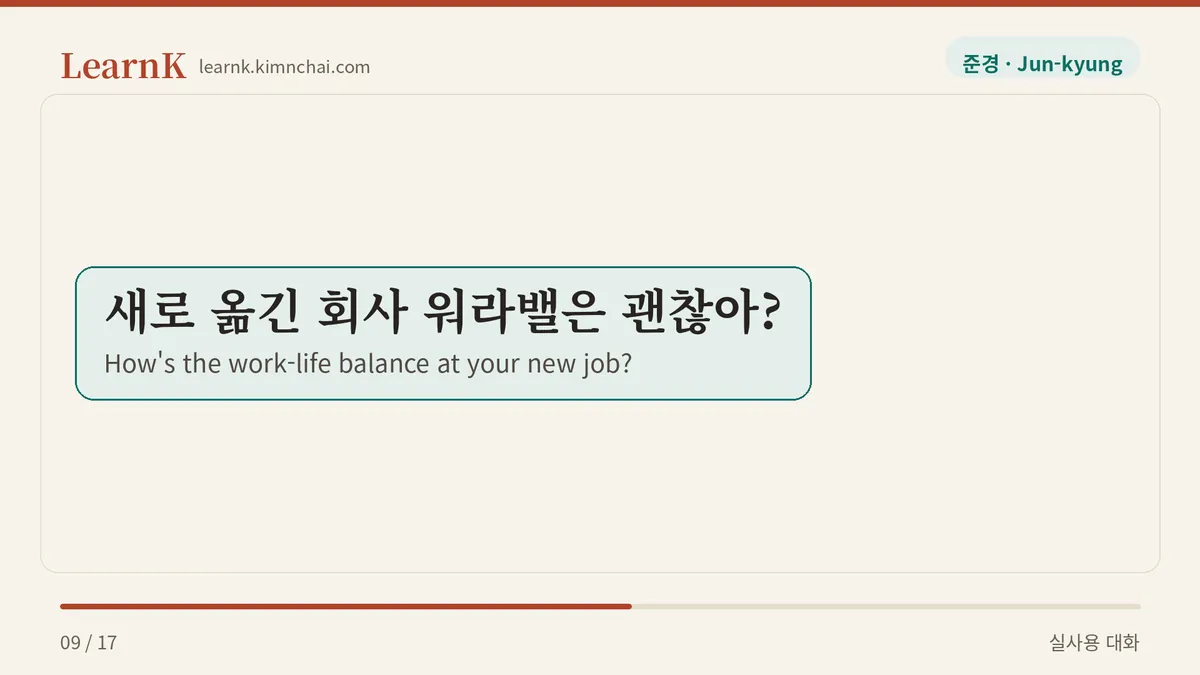
새로 들어간 회사는 워라밸 어때? (saero deureogan hoesa-neun worabael eottae?) How’s the work-life balance at your new company?
This is a very natural expression for asking about a friend’s or coworker’s work environment. It basically compresses questions like “Do you work late a lot?” and “Do you get to leave on time?” into a single word.
Situation 3 — Complaining about a busy stretch
요즘 프로젝트 때문에 워라밸이 완전히 무너졌어. (yojeum peurojekteu ttaemune worabael-i wanjeonhi muneojyeosseo.) Because of a project lately, my work-life balance has completely collapsed.
Using it together with ‘무너지다 (muneojida)’, meaning ‘to collapse,’ emphasizes a state where the balance has been severely broken. You can feel the exhaustion of someone whose work has completely swallowed up their life.
Formal vs. Casual Speech, and Similar Expressions
Because 워라밸 is a noun, you can make it either polite or casual just by changing the sentence ending.
- Casual: 워라밸이 좋아. (worabael-i joa.)
- Polite: 워라밸이 좋아요. (worabael-i joayo.) / 워라밸이 좋습니다. (worabael-i jotseumnida.)
That said, since it’s slang, in very formal settings (official reports, or speaking respectfully to your elders) it’s safer to use the spelled-out expression “일과 삶의 균형 (il-gwa salm-ui gyunhyeong)” (the balance between work and life). Related buzzwords that often come up alongside it include “조용한 사직 (joyonghan sajik)” (quiet quitting), which means quietly taking care of your own life without standing out at the company, and “저녁이 있는 삶 (jeonyeog-i inneun salm)” (a life with evenings), which refers to a relaxed life where you actually get your evenings to yourself.
Cultural Background
The popularity of 워라밸 is closely tied to changes in Korean society. Korea was long famous for its long working hours, but when the 52-hour workweek was introduced in 2018, the movement to break away from a ‘life of nothing but work’ grew stronger. Even in dramas, the office worker who used to keep the lights on late into the night gradually shifted into someone who leaves on time and enjoys their hobbies. In recent workplace dramas, it’s not even awkward anymore to see a new employee confidently declare, “저는 워라밸이 중요합니다 (jeoneun worabael-i jungyohamnida)” (Work-life balance is important to me) — that’s how much this word has become a keyword symbolizing the lives of Korea’s young people.
Today’s Quiz
What’s the most natural word to fill in the blank below?
“이 회사는 야근도 없고 휴가도 자유로워서 정말 ______이/가 좋아. (i hoesa-neun yageun-do eopgo hyuga-do jayurowaseo jeongmal ______i/ga joa.)” (“This company has no late-night work and flexible vacation time, so the ______ is really good.”)
① 워라밸 (worabael) ② 지각 (jigak, being late) ③ 야근 (yageun, working late)
(Answer: ① 워라밸 (worabael) — no late-night work and flexible vacation means the balance between work and life is well maintained!)
Now that you’ve learned 워라밸 (worabael) today — how’s your own 워라밸 right now? Let us know in the comments!