아무튼 (amuteun) — The One Word That Lands You on the Point When the Story Runs Long
아무튼
My first day in the new apartment, the washing machine wouldn’t run, so I called a repair technician, but his route was jammed with traffic, so I stopped by the building management office first, and then the conversation with the security guard dragged on and… the listener’s face is slowly clouding over. This is exactly the moment when Korean speakers land the story with a single word. 아무튼 (amuteun) means “no matter how things stand.” It’s a signal that whatever the circumstances were, they’re being set aside — only the conclusion is coming next.
Words like this are the last ones a Korean learner gets their hands on. The meaning fits in one line; the hard part is knowing when to reach for it. 아무튼 doesn’t change what a sentence means. It changes the direction of the conversation. However long and tangled the previous talk was, it pushes it aside once with a “never mind all that,” and then puts the full weight on the one sentence that’s left.
That’s why what follows 아무튼 is usually short and solid. 아무튼 잘됐다 (amuteun jaldwaetda), 아무튼 고마워 (amuteun gomawo), 아무튼 결론은 이겁니다 (amuteun gyeollon-eun igeomnida). You sweep up all the circumstances you just spread out, brush them off to one side with one hand, and leave only the thing you actually wanted to say.
The temperature is close to neutral. It isn’t an angry word, and it isn’t an affectionate one. What it does do is put the speaker in the seat of “the person wrapping things up.” So when you fold up your own story with it, it sounds modest; when you fold up someone else’s story, it can easily sound like you’re rushing them. That difference is the heart of today’s post.
Checking the National Institute of Korean Language Dictionary
First, let’s see how the national language institute’s dictionary spells this word out.
아무튼 「Adverb」 무엇이 어떻게 되어 있든. (mueosi eotteoke doeeo itdeun.) — No matter what is how. [en] in any case; anyway — Regardless of how something turns out. [ja] とにかく。なにはともあれ【何はともあれ】 — 何がどうなっていても。 [es] en todo caso, de todos modos — Sea como fuere. [zh] 反正,总之 — 不管怎么样。 — National Institute of Korean Language, Basic Korean Dictionary (krdict.korean.go.kr)
The dictionary carries no Portuguese definition. Let us note clearly that the line below is not a dictionary quotation but our own rendering — de qualquer forma; de todo modo — Independentemente de como as coisas aconteçam.
“무엇이 어떻게 되어 있든” — no matter what is how. The definition itself already has the shape of putting everything that came before into parentheses. Now let’s look at the dictionary’s actual example sentences and see in what kinds of situations those parentheses go up.
아무튼 시험이 끝나서 좋다. (amuteun siheomi kkeutnaseo jota.) Anyway, I’m just glad the exam is over. — National Institute of Korean Language, Basic Korean Dictionary (krdict.korean.go.kr)
Whether the exam went well or badly isn’t known yet. This is a sentence that grabs hold of one single fact — whatever the grade turns out to be, it’s finished. This is 아무튼 in its most basic use.
차 사고가 나서 약간의 부상을 당하기는 했지만 아무튼 무사해서 다행이었다. (cha sagoga naseo yakganui busang-eul danghagineun haetjiman amuteun musahaeseo dahaeng-ieotda.) There was a car accident and I did get slightly injured, but anyway, I was relieved to come out of it safe. — National Institute of Korean Language, Basic Korean Dictionary (krdict.korean.go.kr)
Notice the -기는 했지만 (-gineun haetjiman) in front. You acknowledge the bad thing first, fold it away with 아무튼, and place the good conclusion at the end. This -지만 … 아무튼 … frame comes out of Korean conversation as one prefabricated piece.
난 함께 싸우지 못하지만 아무튼 성공적으로 해결되길 바랄게. (nan hamkke ssauji mothajiman amuteun seonggongjeogeuro haegyeoldoegil baralge.) I can’t fight alongside you, but anyway, I’ll be hoping it all works out successfully. — National Institute of Korean Language, Basic Korean Dictionary (krdict.korean.go.kr)
Instead of explaining at length how sorry you are that you can’t help, you fold it away in one move and leave only the encouragement. This shows up very often when you want to cut an apology or an excuse short.
알았어, 아무튼 넌 그 곳에 갈 수 있기만 하면 된다는 거지? (arasseo, amuteun neon geu gose gal su itgiman hamyeon doendaneun geoji?) Okay — so anyway, all you need is to be able to get there, right? — National Institute of Korean Language, Basic Korean Dictionary (krdict.korean.go.kr)
This is a sentence that listens to the other person’s long explanation and then confirms just the main point. The 알았어 (arasseo) in front matters. Because you give a signal that you heard the whole thing before folding it away, it doesn’t come across as rude.
지수는 항상 반지와 목걸이를 하고, 화장을 진하게 하고 비싼 옷을 입고, 아무튼 화려한 여자였다. (Jisuneun hangsang banjiwa mokgeorireul hago, hwajang-eul jinhage hago bissan oseul ipgo, amuteun hwaryeohan yeojayeotda.) Jisu always wore rings and necklaces, did her makeup heavy and dressed in expensive clothes — anyway, she was a glamorous woman. — National Institute of Korean Language, Basic Korean Dictionary (krdict.korean.go.kr)
Here it’s the use where you’re listing several things and then move to “to put it in a word.” When a list looks like it could go on forever, 아무튼 puts the period at the end of it.
Seeing It in a Real Conversation
Setting: the evening of Emily’s moving day. The boxes have finally all made it upstairs, and the two of them are sitting among them waiting for jjajangmyeon delivery.
Emily: 아니 사다리차가 두 시간이나 늦게 왔잖아. 엘리베이터 예약도 앞집이랑 겹치고. The ladder truck showed up two hours late. And the elevator booking overlapped with the neighbors’.
Jun-kyung: 그래서 아까 관리실 아저씨랑은 얘기 잘 됐어? So did things work out with the building manager?
Emily: 겨우. 근데 그릇 담은 상자 하나가 안 보여. 어디 갔지? Barely. But one box of dishes is missing. Where did it go?
Jun-kyung: 아무튼 짐은 다 들어왔잖아. 상자는 내일 밝을 때 찾자. Anyway, everything made it inside. Let’s look for the box tomorrow in the daylight.
Emily: 그러네. 아무튼 오늘 진짜 고마워. 너 없었으면 나 아직 1층에 있어. True. Anyway, thank you so much today. Without you I’d still be down on the first floor.
Jun-kyung: 짜장면이나 빨리 와라. 배고파 죽겠다. Just let the jjajangmyeon get here already. I’m starving.
Jun-kyung’s 아무튼 folds away a single worry; Emily’s 아무튼 folds away the entire day and leaves only the gratitude. Same word — different size of thing being folded.
This Is Where It Sounds Off
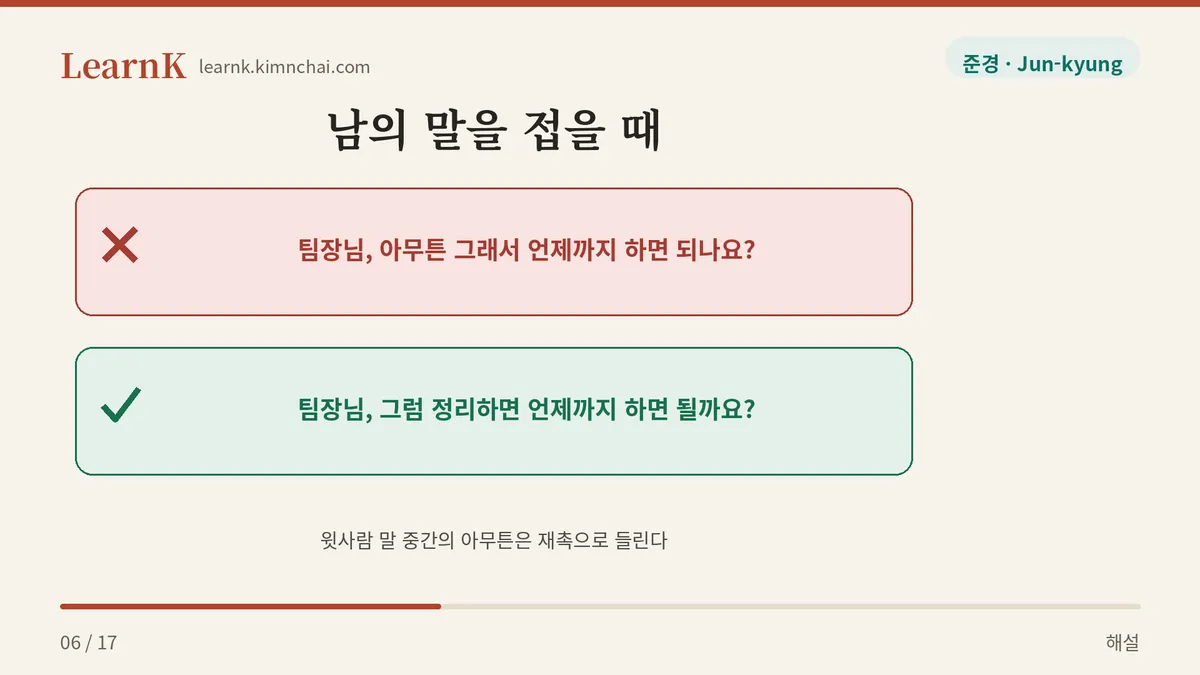
✗ (while your team lead is explaining the background) 팀장님, 아무튼 그래서 언제까지 하면 되나요? (timjangnim, amuteun geuraeseo eonjekkaji hamyeon doenayo?) — “Boss, anyway, so by when do I need to have this done?” ✓ (while your team lead is explaining the background) 팀장님, 그럼 정리하면 언제까지 하면 될까요? (timjangnim, geureom jeongnihamyeon eonjekkaji hamyeon doelkkayo?) — “Boss, then to sum up, by when should I have this done?” → 아무튼 has the force of shoving the previous talk aside with a “never mind that.” Drop it into the middle of a senior person’s speech and it sounds like you’re hurrying them. When you’re folding up someone else’s talk, 정리하면 (jeongnihamyeon, “to sum up”) or 그러니까 말씀은 (geureonikka malsseumeun, “so what you’re saying is”) is the safer side.
✗ (right after a friend has been crying and pouring out something hard) 아무튼 잘될 거야. (amuteun jaldoel geoya.) — “Anyway, it’ll work out.” ✓ 많이 힘들었겠다. 그래도 잘될 거야. (mani himdeureotgetda. geuraedo jaldoel geoya.) — “That must have been so hard. Still, it’ll work out.” → The content is comfort, but the 아무튼 reads as “enough about that.” Right after someone has poured their feelings out, don’t fold — put down a word that receives them first.
To sum it up: when you’re folding up your own story, use it all you like; when you’re folding up someone else’s, think once more.
Example Sentences by Situation
① When a meeting drags on (polite speech) — opinions are split and you’ve been going in circles for thirty minutes. The person who has to reach a decision turns the wheel.
아무튼 이번 주 안에는 결정을 해야 합니다. (amuteun ibeon ju aneneun gyeoljeong-eul haeya hamnida.) Anyway, we need to make a decision within this week.
Here 아무튼 means “who’s right can wait until later.” It lets everyone move to the next step without settling who was correct.
② When a friend wraps up their own story (casual speech) — they’ve been telling you about the breakup for twenty minutes or so, and then they fold it up themselves.
아무튼 그래서 헤어졌어. (amuteun geuraeseo heeojyeosseo.) Anyway, so that’s how we ended up breaking up.
This 아무튼 is also a signal: “I’m going to stop talking about this now.” The listener should not press for more — just receive it with a 그랬구나 (geuraetguna, “I see”).
③ Before hanging up the phone (polite speech) — you’ve been catching up for a while with a 선배 (seonbae, senior) you hadn’t spoken to in ages.
아무튼 조만간 얼굴 한번 봬요. (amuteun jomangan eolgul hanbeon bwaeyo.) Anyway, let’s meet up in person sometime soon.
This is an extremely common sentence for signaling the end of a call. In situations where it’s hard to come out and say “let’s hang up now,” 아무튼 gently does that job instead.
Politeness Levels and Similar Expressions
아무튼 is an adverb, so in itself it carries neither honorific nor plain register. The politeness is decided by the predicate that follows — 아무튼 감사합니다 (amuteun gamsahamnida) and 아무튼 고마워 (amuteun gomawo) are both natural. That said, in very formal settings (an official report, a written apology) it isn’t much used, because of that feeling of shoving the previous talk aside. In speech people also attach 요 (yo) and use it as a standalone word: 아무튼요 (amuteunyo).
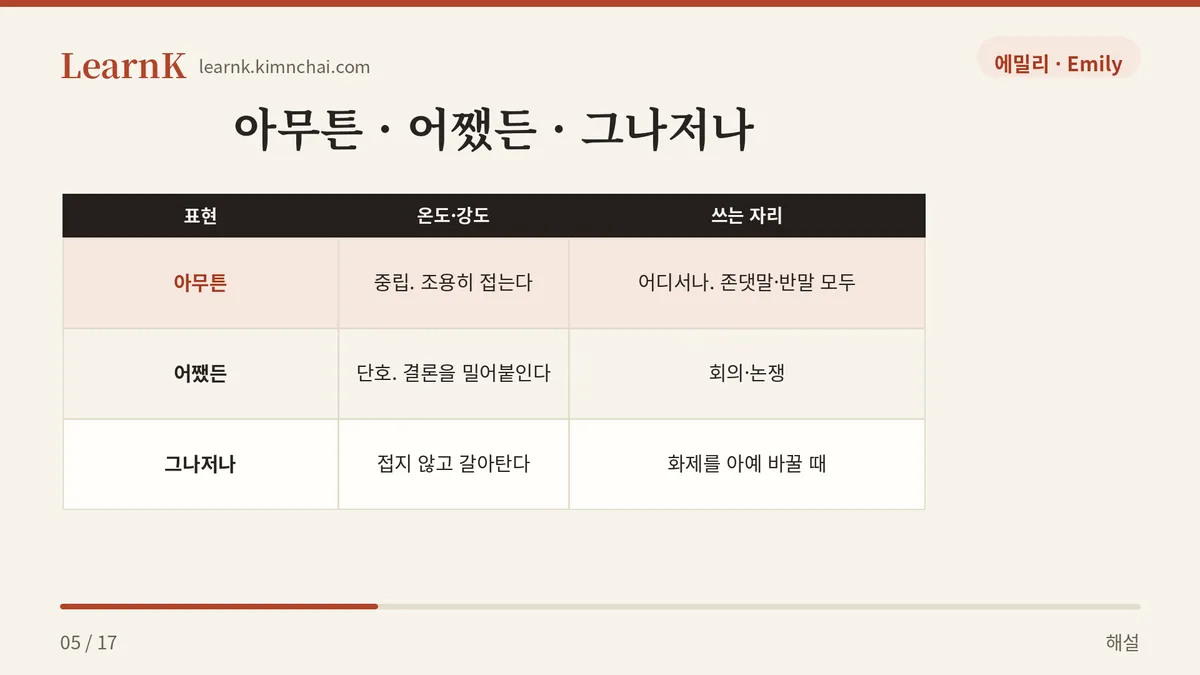
This is a spot with an unusual number of near-synonyms. The meanings are almost the same; the temperature is different.
| Expression | Temperature / strength | Where it’s used |
|---|---|---|
| 아무튼 (amuteun) | Neutral. Folds things away quietly | Anywhere. Polite or casual speech alike |
| 어쨌든 (eojjaetdeun) | A bit more decisive. Pushes the conclusion through | Meetings, arguments. 어쨌든 마감은 내일이잖아 (eojjaetdeun magameun naeirijana) — “Either way, the deadline is tomorrow” |
| 하여튼 (hayeoteun) | Often carries a note of disapproval | A jab between close friends. 하여튼 너는 못 말려 (hayeoteun neoneun mot mallyeo) — “Honestly, there’s no stopping you” |
| 여하튼 (yeohateun) | Stiffer and more literary than 아무튼 | Writing, formal remarks |
| 그나저나 (geunajeona) | Doesn’t fold — it switches tracks | When changing the topic entirely. 그나저나 밥은 먹었어? (geunajeona babeun meogeosseo?) — “Anyway, have you eaten?” |
| 아무튼지 (amuteunji) | Same meaning, an old-fashioned spoken form | Speech of older speakers. It appears in dictionary examples too |
When you’re unsure, there’s one test. If you’re stating the conclusion of the preceding story, it’s 아무튼; if you’re bringing up a new topic unrelated to it, it’s 그나저나.
Cultural Background — How to Fold a Story Instead of Cutting It Off
Korean conversation rests heavily on a sense that you don’t cut someone off mid-sentence. You wait until the other person finishes, and even when you do have to break in, you slip in a bit of backchanneling like 아, 그렇구나 (a, geureoguna) first. 아무튼 is a word that grew up inside this culture. It doesn’t slice the previous talk with a knife — it folds it over like a sheet of paper and moves on, so neither the one doing the cutting nor the one being cut has to feel embarrassed. That’s why the word sounds most natural when you’re folding up your own story yourself.
In dramas, too, 아무튼 usually comes out of the mouth of a character whose heart is in a tangle. Someone who tried to confess and failed tosses it out to clean up the air that has gone awkward; a family member who has been arguing for a long time uses it to fold the conversation and leave the room, knowing that saying more won’t help. The moment viewers hear that one word, they know: ah, this person didn’t get to say everything they wanted to. The more unsaid words there are, the louder 아무튼 rings.
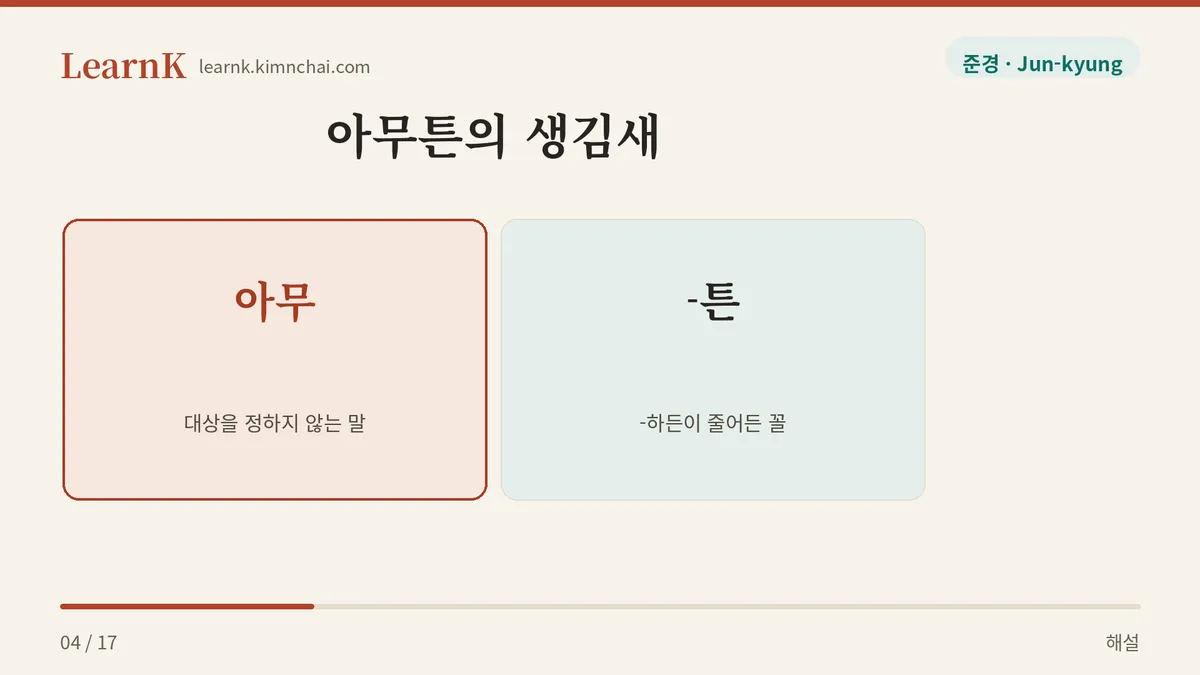
Let’s take a quick look at the shape of the word, too. The 아무 (amu) in front is the same 아무 as in 아무나 (amuna, “anyone at all”) and 아무 데나 (amu dena, “anywhere at all”) — a word that leaves the object unspecified. The -튼 (-teun) on the back is taken as a contracted form of -하든 (-hadeun). In effect, 아무렇게 되든 (amureoke doedeun, “however it turns out”) got compressed whole into a single word. The spelling trips up Korean speakers too: it’s not 아뭏든 but 아무튼. That’s because it settled as an adverb written the way it sounds — and 하여튼 (hayeoteun), 요컨대 (yokeondae) and 한사코 (hansako) belong to the same group.
Today’s Quiz
A friend has spent thirty minutes complaining about their boss, and now they’re trying to wrap the story up themselves. What fits most naturally in the blank?
”…그래서 내가 그냥 참았어. ( ) 다음 주에 팀 바뀌니까 괜찮아.” (“…geuraeseo naega geunyang chamasseo. ( ) da-eum jue tim bakkwinikka gwaenchana.”) “…so I just let it go. ( ) I’m switching teams next week, so it’s fine.”
① 그나저나 (geunajeona) ② 아무튼 (amuteun) ③ 오히려 (ohiryeo)
Answer: ② 아무튼 (amuteun)
① 그나저나 (geunajeona) is for switching to a new topic unrelated to what came before (그나저나 점심 먹었어? (geunajeona jeomsim meogeosseo?) — “Anyway, did you have lunch?”). ③ 오히려 (ohiryeo) is for stating a fact that runs contrary to expectation. This slot is about folding away a long spread of circumstances and leaving one conclusion, so 아무튼 is the right fit. For reference, 어쨌든 (eojjaetdeun) would also work here, but it would sound a little more decisive.
If a moment comes today when a story starts running long, try attaching it in your head: 아무튼 — so what was it I wanted to say?
Definitions and example sentences are from the National Institute of Korean Language’s Basic Korean Dictionary (krdict.korean.go.kr); that portion of this post, including our translations, is licensed under CC BY-SA 2.0 KR.