앙숙 (angsuk) — The Pair Who Clash Every Time They Meet, So Why Do They Never Walk Away?
앙숙 (angsuk)
앙숙 (angsuk) means a relationship in which two people hold a grudge and hate each other. It doesn’t describe one big blowup and done — it points to a relationship where the dislike has piled up over time until it hardened.
Watch enough Korean dramas and you will hit this scene every single time. From the moment the two leads first meet, their eyes go sharp, and from then on they clash over every little thing. They clash in the meeting room, they clash in the elevator, and eventually one of them moves in next door. But the viewer already knows — around episode 12, those two are going to be holding hands. Koreans have one word for this relationship: 앙숙 (angsuk).
Meaning and nuance
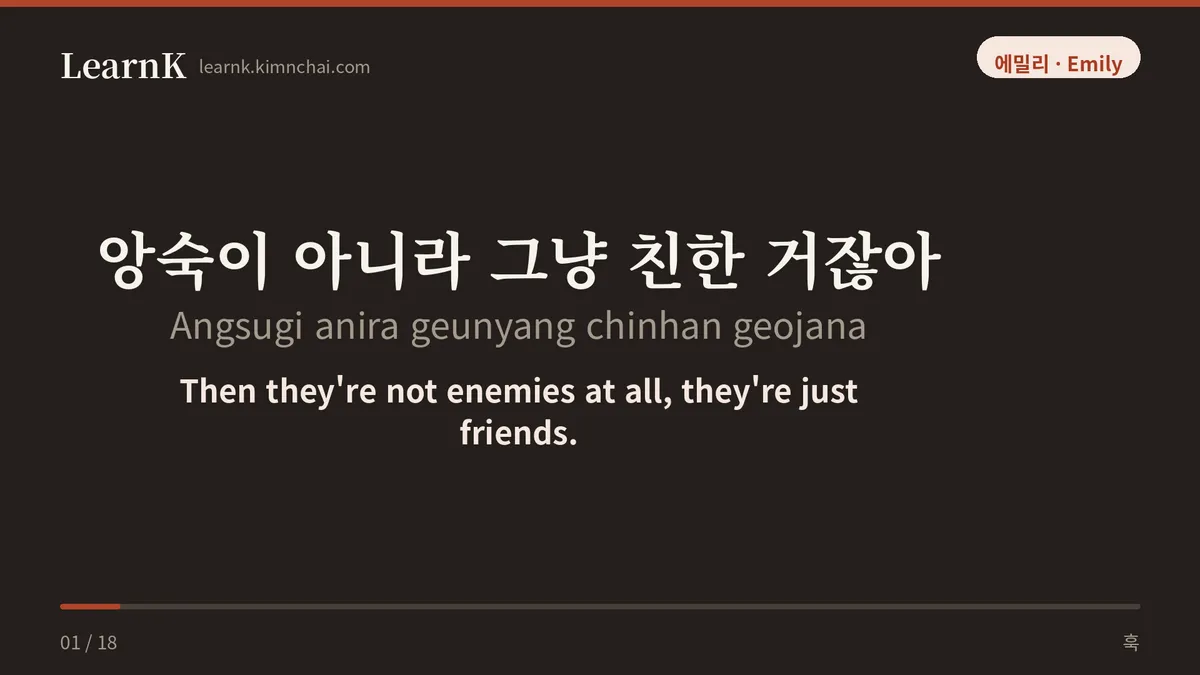
앙숙 (angsuk) carries three conditions that are hard to replace with any other word.
First, it is mutual. If one side does the hating and the other side isn’t even thinking about it, that’s not 앙숙 (angsuk). Both people have to stand facing each other, hating equally. That’s why 앙숙 (angsuk) mostly shows up alongside relationship words like 앙숙 사이 (angsuk sai) and 앙숙 관계 (angsuk gwangye).
Second, it needs time. Two people who fought for the first time yesterday cannot be 앙숙 (angsuk). The dislike has repeated and accumulated until even the original reason has gone blurry — that’s 앙숙 (angsuk). This is exactly why dictionary example sentences tend to come with 오래전부터 (oraejeonbuteo), “from long ago.”
Third, the meaning is strong but the tone is surprisingly light. This is the part learners miss most easily. 앙숙 (angsuk) rarely comes out of someone’s mouth with a serious face. Two baseball teams, an older brother and a younger brother, the neighbor’s cat and our cat — it shows up far more often when people are saying it with a smile. For a genuinely serious grudge, Koreans reach for a different word.
And one more thing. 앙숙 (angsuk) is mostly a word you use while observing a third party. 쟤네 둘은 앙숙이야 (jyaene dureun angsugiya), “those two are angsuk,” is completely natural, but 우리는 앙숙이에요 (urineun angsugieyo), “we’re angsuk,” has to be used with the situation in mind. We’ll come back to this feel later.
Checking it in the National Institute of Korean Language dictionary
Here is exactly how the dictionary compiled by the national language institute records this word.
앙숙 「명사 (noun)」 원한을 품고 서로 미워하는 사이. — A relationship in which people hold a grudge and hate each other. [English] being like cats and dogs; being on bad terms — A state of having a grudge against and hate one another, or such a relationship. [Japanese] あだ【仇】/ あだがたき・きゅうてき【仇敵】 — 恨みがあって憎み合う関係。 [Spanish] personas que se odian, enemigos — Personas que se odian y sienten rencor el uno por el otro, la relación entre ellas. [Chinese] 冤家对头,死对头,宿敌 — 怀着怨恨,相互讨厌的关系。 — National Institute of Korean Language, Basic Korean Dictionary (krdict.korean.go.kr)
The English gloss is the fun one: being like cats and dogs. The picture drawn by Korean 앙숙 (angsuk) and the picture drawn by the English idiom overlap almost perfectly.
The dictionary doesn’t carry a Portuguese translation. For reference, our own rendering would be something like inimigos figadais / pessoas que se odeiam mutuamente — and we should be clear that this Portuguese alone is our translation, not a dictionary quote.
Now let’s look at the actual usage examples the dictionary provides.
그 둘은 틈만 나면 서로 물어뜯는 앙숙이다. — National Institute of Korean Language, Basic Korean Dictionary (krdict.korean.go.kr)
Geu dureun teumman namyeon seoro mureotteunneun angsugida. “Those two are angsuk who tear into each other the second they get a chance.” 틈만 나면 (teumman namyeon), “whenever there’s an opening,” is the key. It’s not that they fight constantly — it’s that the moment a chance to run into each other appears, they fight without fail. The persistence and the repetition of 앙숙 (angsuk) are both packed into that one phrase.
오래전부터 앙숙이었던 두 집단은 세력 다툼을 그치지 않았다. — National Institute of Korean Language, Basic Korean Dictionary (krdict.korean.go.kr)
Oraejeonbuteo angsugieotdeon du jipdaneun seryeok datumeul geuchiji anatda. “The two groups, angsuk since long ago, never stopped fighting for power.” 앙숙 (angsuk) isn’t only for two individuals. Company against company, team against team, family line against family line — groups can be 앙숙 (angsuk) with each other too. You’ll meet this usage often in historical dramas and in the society pages of the news.
앙숙으로 지내다. / 앙숙이 되다. / 앙숙 사이. / 앙숙 관계. — National Institute of Korean Language, Basic Korean Dictionary (krdict.korean.go.kr)
Angsugeuro jinaeda / Angsugi doeda / Angsuk sai / Angsuk gwangye. These are the four collocations the dictionary lays out. Memorize them whole and you can use them right away. 앙숙이 되다 (angsugi doeda) means the relationship turned that way, while 앙숙으로 지내다 (angsugeuro jinaeda) means that state is ongoing. They point in different directions in time.
처음에는 만나기만 하면 싸우는 앙숙이었는데 자꾸 싸우다 보니 정이 들어서 사귀기 시작했어요. — National Institute of Korean Language, Basic Korean Dictionary (krdict.korean.go.kr)
Cheoeumeneun mannagiman hamyeon ssauneun angsugieonneunde jakku ssauda boni jeongi deureoseo sagwigi sijakaesseoyo. “At first we were angsuk who fought every time we met, but after fighting so much we grew attached and started dating.” It’s a dictionary example, and yet it reads like a drama synopsis condensed into one line. We’ll pull this sentence back out in the cultural background section.
나와 승규는 어릴 때부터 친한 동네 친구였지만 한 여자를 사이에 두고 다툰 후 앙숙이 되어 버렸다. — National Institute of Korean Language, Basic Korean Dictionary (krdict.korean.go.kr)
Nawa Seunggyuneun eoril ttaebuteo chinhan dongne chinguyeotjiman han yeojareul saie dugo datun hu angsugi doeeo beoryeotda. “Seung-gyu and I were close neighborhood friends since childhood, but after we fought over a woman we ended up angsuk.” 앙숙 (angsuk) forms more painfully between people who were once close than between strangers. This example shows exactly that.
A real conversation
Scene: the third-base stands at Jamsil Baseball Stadium. It’s a weekend game between two old rival teams, bottom of the 8th.
Jun-kyung: 야, 저기 봐. 1루쪽 완전 뒤집어졌어. 진짜 앙숙이구나, 이 두 팀. Hey, look over there. The first-base side has completely lost it. These two teams really are arch-rivals.
Emily: 근데 왜 이렇게까지 사이가 나빠? 무슨 일 있었어? But why do they dislike each other this much? Did something happen?
Jun-kyung: 옛날에 한국시리즈에서 몇 번 붙었거든. 그때부터 서로 못 잡아먹어서 안달이야. They met in the Korean Series a few times back in the day. They’ve been out for each other ever since.
Emily: 아, 그럼 30년 넘은 앙숙 관계네. 부모가 자식한테 물려주고 그러겠다. Ah, so it’s a rivalry over 30 years old. Parents probably hand it down to their kids.
Jun-kyung: 물려주지, 당연히. 근데 웃긴 게, 경기 끝나면 저 사람들 같이 치맥해. Of course they do. But the funny part is, after the game they go get chicken and beer together.
Emily: 뭐야, 그럼 앙숙이 아니라 그냥 친한 거잖아. What? Then they’re not enemies at all, they’re just friends.
This is where it sounds off
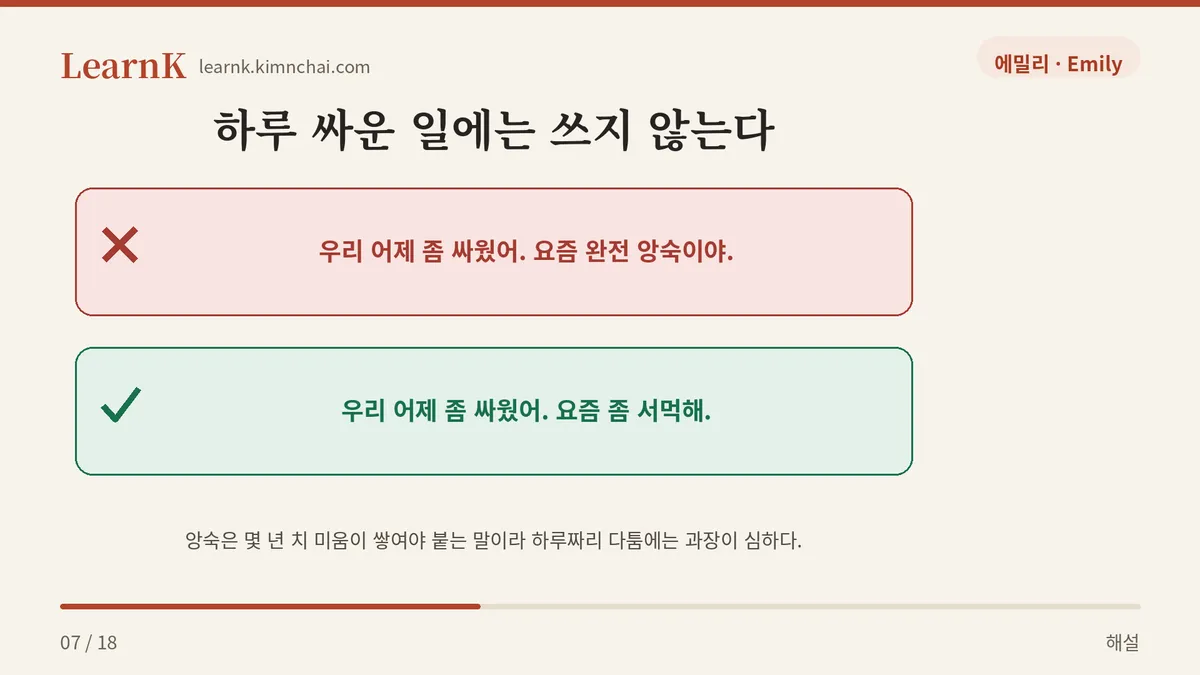
✗ (To a friend, the day after a fight with your husband) 우리 어제 좀 싸웠어. 요즘 완전 앙숙이야. (Uri eoje jom ssawosseo. Yojeum wanjeon angsugiya.) — “We had a bit of a fight yesterday. We’re total angsuk these days.”
✓ (To a friend, the day after a fight with your husband) 우리 어제 좀 싸웠어. 요즘 좀 서먹해. (Uri eoje jom ssawosseo. Yojeum jom seomeokae.) — “We had a bit of a fight yesterday. Things are a little awkward between us right now.”
→ 앙숙 (angsuk) is a label that only sticks after years’ worth of dislike have piled up. Use it for one argument yesterday and the exaggeration is so heavy that your listener will gasp, “Are you getting divorced?” For a temporary state, 서먹하다 (seomeokada), “to be awkward with each other,” or 사이가 안 좋다 (saiga an jotda), “to be on bad terms,” is the right fit.
✗ (In an official meeting, in front of your department head) 부장님, 저희 팀이랑 영업팀은 원래 앙숙이잖아요. (Bujangnim, jeohui timirang yeongeoptimeun wonrae angsugijanayo.) — “Sir, our team and the sales team have always been angsuk, you know.”
✓ (In an official meeting, in front of your department head) 부장님, 저희 팀이랑 영업팀이 좀 부딪히는 일이 많죠. (Bujangnim, jeohui timirang yeongeoptimi jom budichineun iri manchyo.) — “Sir, our team and the sales team do run into friction fairly often.”
→ The grammar is flawless, but the setting is wrong. If you define two departments as 앙숙 (angsuk) in an official forum, a line you tossed out as a joke becomes a declaration that lives on in the minutes. In that room it’s safer not to name the relationship at all, and to describe only the phenomenon.
Example sentences by situation
1. When a cousin you haven’t seen in ages asks about you and your sibling at a holiday gathering
우리 형이랑 나는 고등학교 때까지 완전 앙숙이었어. 근데 군대 갔다 오니까 세상 둘도 없는 친구 됐지. (Uri hyeorang naneun gohakgyo ttaekkaji wanjeon angsugieosseo. Geunde gundae gatda onikka sesang duldo eomneun chingu doetji.) “My older brother and I were complete angsuk right up through high school. But after I came back from the military, we became the closest friends in the world.”
Used between siblings, 앙숙 (angsuk) actually sounds affectionate — because a twist is coming right behind it. The past-tense 앙숙이었어 (angsugieosseo) already carries the meaning “but not anymore,” so when Koreans hear this sentence they naturally expect a reconciled ending.
2. When explaining a long-running turf war between two departments to a coworker
저 두 부서는 평소엔 괜찮은데 예산 회의만 열리면 앙숙이 돼요. (Jeo du buseoneun pyeongsoen gwaenchanneunde yesan hoeuiman yeollimyeon angsugi dwaeyo.) “Those two departments are fine most of the time, but the moment a budget meeting opens they turn into angsuk.”
앙숙이 되다 (angsugi doeda) fits especially well when a condition is attached. It brings out the sense that it isn’t always like this — the relationship only flips in a specific situation. Unlike the misuse example above, this sentence is small talk between coworkers, so the temperature matches.
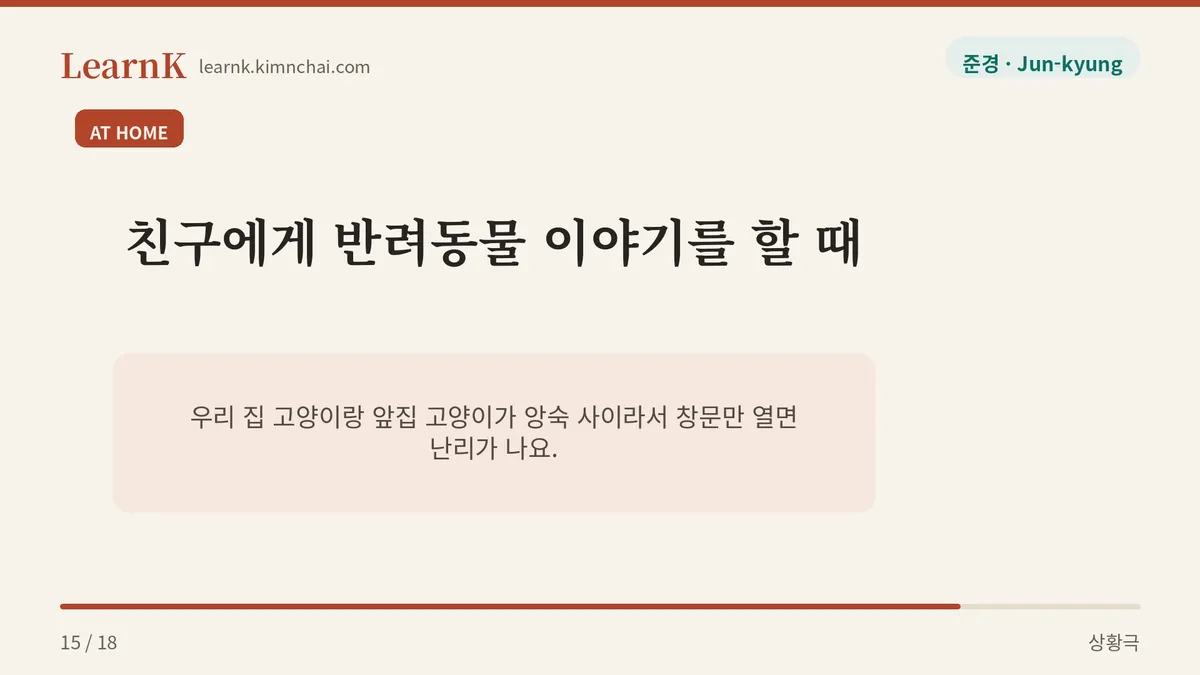
3. When telling a friend visiting your home about your pets
우리 집 고양이랑 앞집 고양이가 앙숙 사이라서 창문만 열면 난리가 나요. (Uri jip goyangirang apjip goyangiga angsuk sairaseo changmunman yeolmyeon nalliga nayo.) “Our cat and the cat across the way are angsuk, so the second I open the window all hell breaks loose.”
This sentence shows just how lightly 앙숙 (angsuk) can be used. Applied to animals rather than people, the weight drops out entirely and it becomes a cute joke. Read it alongside the dictionary’s English gloss, like cats and dogs, and it gets even funnier.
Polite and casual forms, and similar expressions
앙숙 (angsuk) is a noun, so it carries no politeness level of its own. The predicate that closes the sentence decides that.
- Casual: 쟤네 둘은 앙숙이야. (angsugiya)
- Polite: 그 두 분은 앙숙이에요. (angsugieyo)
- Formal: 두 집단은 오랜 앙숙입니다. (angsugimnida)
That said, being able to use the formal form and being allowed to use the word in a formal setting are two different things. 앙숙 (angsuk) passes judgment on a human relationship, so it suits storytelling far better than reports or official statements.
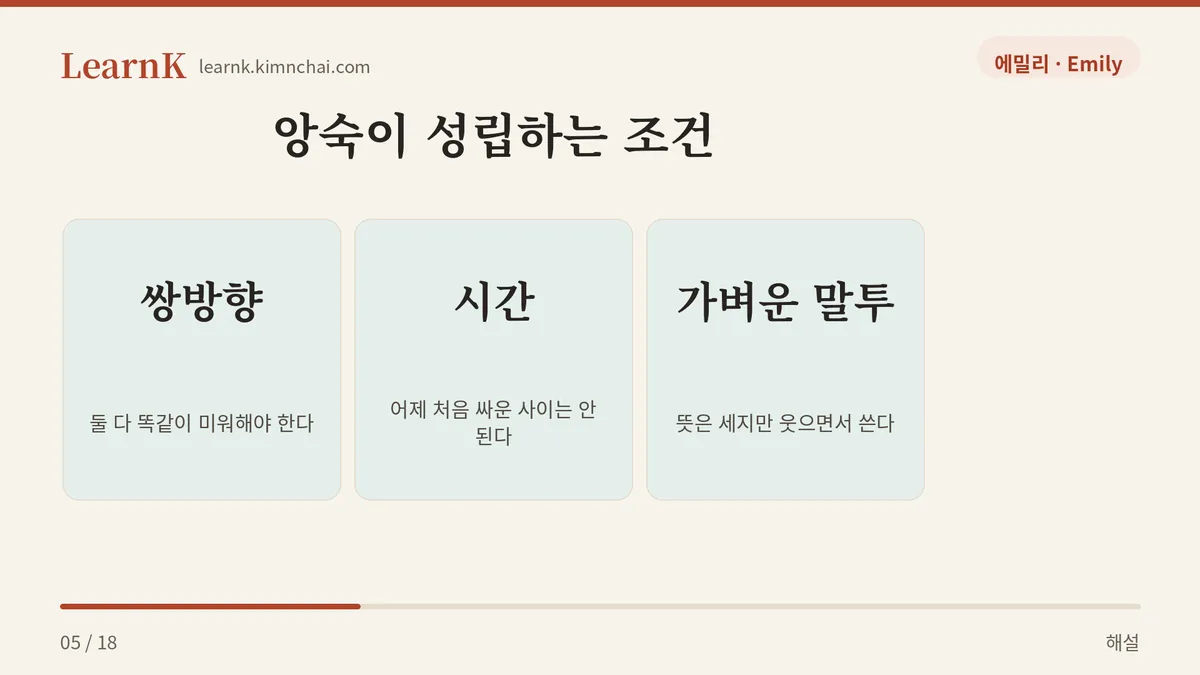
Lining up the words that look similar makes its place clear.
| Expression | Temperature / intensity | Where it’s used |
|---|---|---|
| 앙숙 (angsuk) | Long-accumulated dislike. Strong, but also usable jokingly | Talking about a third party’s relationship. Sports teams, siblings, neighbors, departments |
| 라이벌 (raibeol) | Competitive spirit at the center, dislike is thin | Between people testing their skills. Can even be a compliment |
| 원수 (wonsu) | The heaviest. A stage where forgiveness is hard | Someone who caused real, serious harm. Jokingly twisted into 웬수 (wensu) |
| 사이가 안 좋다 (saiga an jotda) | The mildest and most neutral | Anywhere. When you want to say it carefully and indirectly |
The difference between 앙숙 (angsuk) and 라이벌 (raibeol) matters most. 라이벌 (raibeol) has recognition of the other person built into it, which is why a sentence like 저 선수는 제 좋은 라이벌입니다 (jeo seonsuneun je joeun raibeorimnida), “that player is a good rival of mine,” works. 앙숙 (angsuk) has none of that respect. 저 선수는 제 좋은 앙숙입니다 (jeo seonsuneun je joeun angsugimnida) simply doesn’t work.
Cultural background — the strange feeling called 미운 정 (miun jeong)
In Korean dramas, 앙숙 (angsuk) is effectively the starting line of a romance. If the two leads get along from the beginning, the story won’t roll, so the writer first makes them as unable to stand each other as possible. And the reason this setup works is that Korean has a concept called 미운 정 (miun jeong), “the attachment born of dislike.”
정 (jeong) means the attachment that builds up through long, close, sometimes abrasive contact — and Koreans believe that attachment doesn’t only grow out of liking someone. Hating someone while continuing to run into them is, in the end, also a kind of rubbing up against each other, and what accumulates that way is 미운 정 (miun jeong). That’s why the saying 미운 정도 정이다 (miun jeongdo jeongida), “even the attachment born of dislike is attachment,” makes sense. This is the background that lets a drama’s angsuk-to-love turn feel not the least bit forced to Korean viewers.
What’s fun is that even the National Institute of Korean Language dictionary has this narrative sitting in it as an example sentence. It’s the one we saw earlier: “처음에는 만나기만 하면 싸우는 앙숙이었는데 자꾸 싸우다 보니 정이 들어서 사귀기 시작했어요.” A drama writer didn’t invent it — a dictionary compiler picked it as a typical use of the word.
Outside of dramas, the place 앙숙 (angsuk) gets the most exercise is professional baseball. Korean pro baseball has a few rivalries decades in the making, and on the days those teams meet, the word 앙숙 (angsuk) pours out of the broadcasts and the articles. Yet the actual atmosphere at the ballpark is closer to what Jun-kyung says in the conversation above: once the game ends, people in different uniforms go eat fried chicken together. This is exactly why the word doesn’t sound frightening in Korean. Here, 앙숙 (angsuk) isn’t the end of a relationship so much as a sign that the relationship runs unusually deep.
Today’s quiz
Which of the following uses 앙숙 (angsuk) most naturally?
- 오늘 아침에 지하철에서 발을 밟혀서 그 사람이랑 앙숙이 됐어요. (Oneul achime jihacheoreseo bareul balpyeoseo geu saramirang angsugi dwaesseoyo.) — “Someone stepped on my foot on the subway this morning, so we became angsuk.”
- 우리 옆집이랑 저희 집은 주차 문제로 10년째 앙숙이에요. (Uri yeopjirang jeohui jibeun jucha munjero 10-nyeonjjae angsugieyo.) — “Our next-door neighbors and my family have been angsuk for ten years over parking.”
- 저는 김 선배를 정말 존경해요. 좋은 앙숙이거든요. (Jeoneun Gim seonbaereul jeongmal jongyeonghaeyo. Joeun angsugigeodeunyo.) — “I really respect Kim sunbae. He’s a good angsuk of mine.”
- 부장님, 제안서 검토 결과 두 부서가 앙숙임을 보고드립니다. (Bujangnim, jeanseo geomto gyeolgwa du buseoga angsugimeul bogodeurimnida.) — “Sir, following review of the proposal, I report that the two departments are angsuk.”
Answer: 2
Number 1 happened this morning, so no time has accumulated at all — 앙숙 (angsuk) requires piled-up years. Number 3 contains respect, so this is a slot for 라이벌 (raibeol), not 앙숙 (angsuk). Number 4 has the meaning right but clashes with its setting as an official report — 두 부서 간 갈등이 있음을 보고드립니다 (du buseo gan galdeungi isseumeul bogodeurimnida), “I report that there is conflict between the two departments,” is the fitting version. Number 2 has everything: ten years of time, a repeating cause in the parking problem, and a mutual relationship between neighbors. Perfect.
Definitions and example sentences are from the National Institute of Korean Language’s Basic Korean Dictionary (krdict.korean.go.kr); that portion of this post, including our translations, is licensed under CC BY-SA 2.0 KR.