반말 (banmal): The Fine Line Between Friendly and Rude
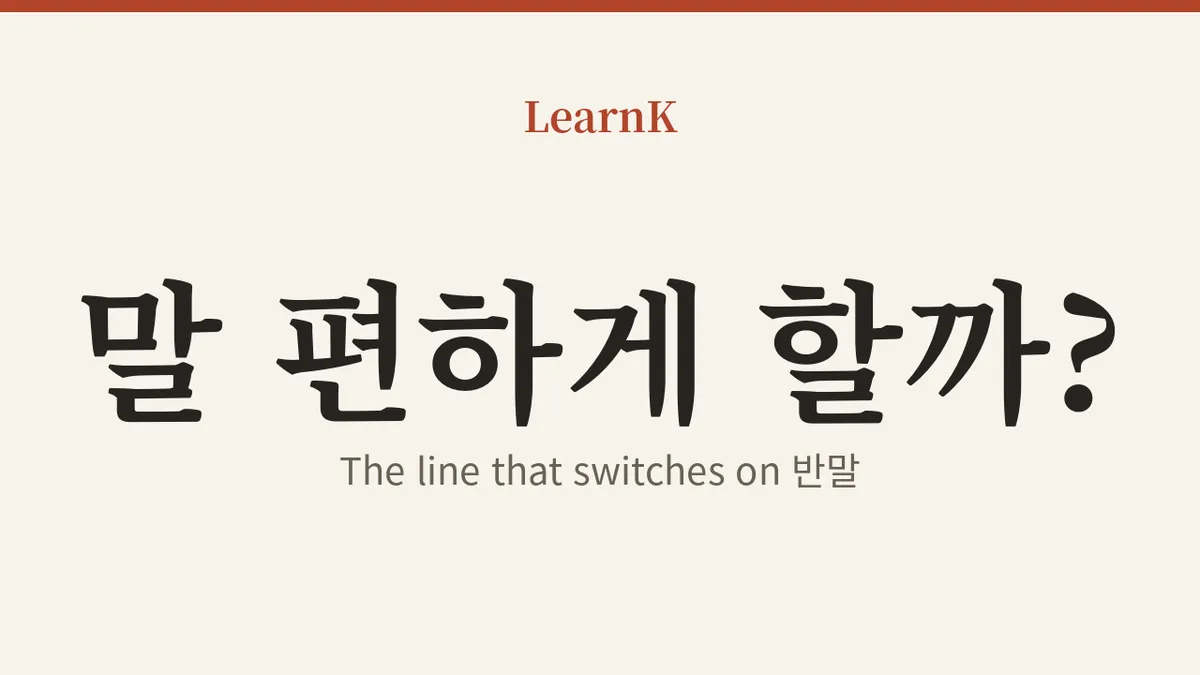
If you watch Korean dramas, you’ll notice this scene comes up again and again. Two people who’ve just met are speaking to each other in polite, formal language, when at some point one of them suggests, “우리 말 편하게 할까? (uri mal pyeonhage halkka?)” — “Should we speak more casually?” After that one line, the way they talk changes completely. The ‘-요 (-yo)’ at the end of their sentences disappears, and their speech becomes much shorter and lighter. This casual way of speaking is exactly today’s expression, 반말 (banmal).
반말 is a concept every Korean learner absolutely needs to understand. It’s not something you can master just by memorizing a definition — to avoid mistakes, you have to know who to use it with, when, and why. Used well, it can bring two people much closer; used wrongly, it can make you come across as deeply rude. It’s a real double-edged sword of a speech style.
반말
반말 (banmal) refers to a way of speaking in which you end your sentences short and casually, rather than raising them the way you would in polite speech. For example, if you take the polite 밥 먹었어요? (bap meogeosseoyo?) and change it into 반말, you get 밥 먹었어? (bap meogeosseo?). The biggest hallmark is that the honorific ‘-요 (-yo)’ at the end of the sentence drops away.
반말 has two main characters. One is the 반말 of closeness (친밀함, chinmilham) — the casual speech style used comfortably between close friends, siblings, and people with a long history together. The other is the 반말 of talking down (낮춤, natchum) — the speech style used from a higher position toward someone younger or lower in status. The same 반말 can, depending on the situation, signal “we’re close, right?” or signal “I’m above you.”
Checking with the National Institute of Korean Language dictionary
The National Institute of Korean Language’s Basic Korean Dictionary explains 반말 with two meanings.
반말 (noun)
- An informal, light way of speaking used without formality when two people are very close or when their seniority relationship isn’t clearly defined. [en] informal speech — An informal speech used when two people are very close or their relationship does not clearly define who is the senior. [es] tuteo — Forma de hablar sin formalidad entre gente muy cercana o cuando no necesariamente se debe utilizar ‘usted’. [zh] 平语,非敬阶用语 — 双方非常亲密或尊称关系不明确时使用的非正式语气。 — National Institute of Korean Language, Basic Korean Dictionary (krdict.korean.go.kr)
- Speech used to talk down to someone as if to a person younger than you or lower in status. [en] informal speech — A speech used to talk down to a younger or inferior person. [es] tuteo — Estilo de hablar de ‘tú’ a alguna persona de menor edad o de un puesto de menor rango. [zh] 不敬之词 — 像对比自己年龄或地位低下的人一样使用的用语。 — National Institute of Korean Language, Basic Korean Dictionary (krdict.korean.go.kr)
(The dictionary has no Portuguese translation, so the following is our own: pt — fala informal, usada entre pessoas muito próximas ou para se dirigir a alguém mais jovem ou de posição inferior.)
If we look at the real usage examples the dictionary provides alongside these definitions, you start to get a feel for why 반말 is so often used in a negative light.
처음 보는 사람이 나에게 반말을 찍찍 갈겨 몹시 불쾌했다. Cheoeum boneun sarami naege banmareul jjikjjik galgyeo mopsi bulkwaehaetda. (A person I was meeting for the first time rudely spat 반말 at me, and it was extremely unpleasant.) — National Institute of Korean Language, Basic Korean Dictionary (krdict.korean.go.kr)
This is a situation where someone you’ve just met suddenly uses 반말, and it leaves you offended. The blunt verb ‘갈기다 (galgida)’ — to hurl or spit out — is attached, which emphasizes the rudeness.
자기가 입사 시기가 더 빠르다며 선배랍시고 반말을 하는데 듣기가 거북살스러워. Jagiga ipsa sigiga deo ppareudamyeo seonbaerapsigo banmareul haneunde deutgiga geobuksalseureowo. (They act all senior just because they joined the company a little earlier and use 반말 with me, and it’s uncomfortable to hear.) — National Institute of Korean Language, Basic Korean Dictionary (krdict.korean.go.kr)
This is a scene where someone is uncomfortable with a coworker who uses 반말 simply because they joined the company a bit earlier. Here, 반말 is being used as a tool to display who’s “above” and who’s “below.”
너보다 민준이가 나이가 어린데 왜 너한테 반말을 해? Neoboda Minjuni naiga eorinde wae neohante banmareul hae? (Minjun is younger than you, so why is he using 반말 with you?) — National Institute of Korean Language, Basic Korean Dictionary (krdict.korean.go.kr)
This is a situation pointing out that it’s strange for a younger person to use 반말 with an older person. It shows just how closely age and speech style are tied together in Korean.
우리 손아래 동서는 나이가 많아서 그런지 내가 반말을 쓰면 기분 나빠하는 것 같아. Uri sonarae dongseoneun naiga manaseo geureonji naega banmareul sseumyeon gibun nappahaneun geot gata. (Maybe because my younger sister-in-law is actually older than me in age, she seems to take offense when I use 반말 with her.) — National Institute of Korean Language, Basic Korean Dictionary (krdict.korean.go.kr)
This is a subtle situation where, by family relation, the person is your junior, but because they’re older in age, they feel uncomfortable when you use 반말. It nicely captures the dilemma you face when relationship and age don’t line up.
Example sentences by situation
Situation 1 — Between friends (the 반말 of closeness)
야, 오늘 저녁에 시간 있어? 같이 영화 보자. Ya, oneul jeonyeoge sigan isseo? Gachi yeonghwa boja. (Hey, do you have time this evening? Let’s watch a movie together.)
Between close friends of the same age, this is how casually you’d speak. ‘있어요? (isseoyo?)’ became ‘있어? (isseo?)’, and ‘봐요 (bwayo)’ became ‘보자 (boja).’
Situation 2 — Suggesting 반말
우리 나이도 같은데 그냥 말 놓자. Uri naido gateunde geunyang mal noja. (We’re the same age, so let’s just drop the formalities.)
말을 놓다 (mareul nota) is an idiomatic expression meaning “to start using 반말.” Between people who’d been using polite speech, it’s a signal to bring the relationship one step closer.
Situation 3 — Rude 반말 (talking down)
처음 보는 사이인데 왜 반말이세요? Cheoeum boneun saiinde wae banmariseyo? (We’ve only just met — why are you speaking to me in 반말?)
This is a scene where someone uses 반말 even though you’ve only just met, and you protest — politely, using honorific speech instead. By pointing it out in polite language, you subtly signal, “I’m being courteous here.”
존댓말 and 반말, and some related words
The opposite of 반말 is 존댓말 (jondaenmal) or 높임말 (nopimmal) — the speech style that treats the other person with respect by elevating them. You can easily tell them apart by looking at the end of the sentence.
- 존댓말 (polite): 어디 가세요? (gaseyo?) / 감사합니다 (hamnida)
- 반말 (casual): 어디 가? (ga?) / 고마워 (gomawo)
A related word is 공대 (gongdae), meaning “speech that treats the other person courteously” — in other words, it overlaps with 존댓말. One of the dictionary examples, “그 녀석은 반말도 공대도 아니게 말끝을 흐리며 (that guy trailed off his sentence endings, neither 반말 nor 공대)”, refers to an attitude of mumbling ambiguously so it’s unclear whether you’re using 반말 or 존댓말. Koreans, too, will trail off their sentence endings like this and read the room when a relationship is ambiguous.
Cultural background — 반말 is the “thermometer of a relationship”
In Korean dramas, 반말 is a powerful device for showing the distance between characters. The moment two people who’d been using polite speech first break into 반말 with each other is often staged as a standout scene where a romance suddenly leaps forward. Conversely, when an angry character abruptly snaps at someone in 반말, it becomes a signal that the relationship has gone sour. For instance, a scene where a boss browbeats a subordinate in 반말 dramatically lays bare the power dynamic between them.
In real life, the safest principle for a foreign learner is this: Always start with 존댓말, and wait until the other person offers 반말 or tells you it’s okay to speak casually. Using 반말 first with someone older or higher in status is an especially serious breach of etiquette. Think of 반말 as a kind of “relationship upgrade” that you break into by mutual agreement after you’ve grown close.
Today’s quiz
You’re in Korea and want to strike up a conversation with someone you’ve just met who looks older than you. Which of the following is the most appropriate speech style?
- In 반말: “너 이름이 뭐야? (Neo ireumi mwoya?)” — “What’s your name?”
- In 존댓말: “성함이 어떻게 되세요? (Seonghami eotteoke doeseyo?)” — “May I ask your name?”
- Neither 반말 nor 존댓말 — just trailing off your sentence endings
(Answer: #2. With someone you’ve just met, and especially with someone senior to you, you must start in 존댓말 to avoid being rude. Save 반말 for after you’ve grown close and agreed on it!)
Definitions and example sentences are from the National Institute of Korean Language’s Basic Korean Dictionary (krdict.korean.go.kr); that portion of this post, including our translations, is licensed under CC BY-SA 2.0 KR.