부산 (busan) — The Busan You Pack a Suitcase For, and the 부산 That Lives in the Dictionary
부산 (busan) means “a state so dizzying or noisy that you can’t keep your head straight.” And yet, say 부산 in front of a Korean and nine out of ten will picture the sea first — the country’s second-largest city, the southern port town of 부산 (Busan), with the waves at Haeundae and the crates of fish at Jagalchi Market. Learn Korean long enough and you’ll keep running into words like this: same sound, completely different roots. Today we’ll sort out both Busans at once — the one you pack in your suitcase, and the one that lives in the dictionary.
부산
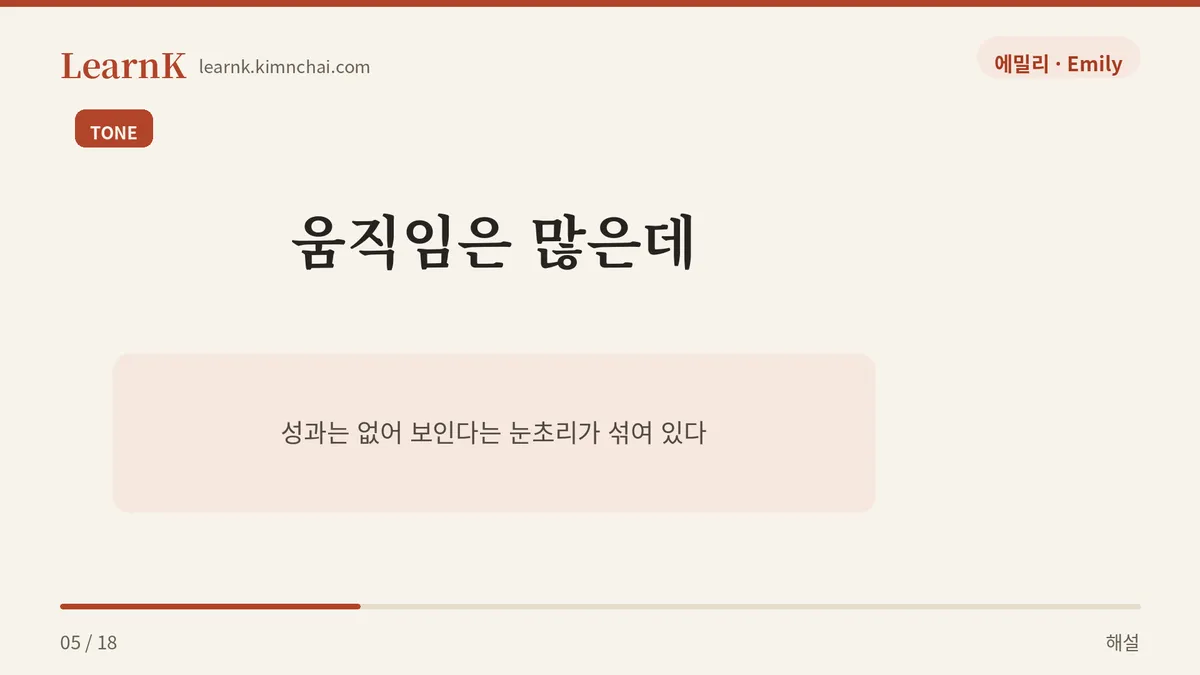
Let’s start with the 부산 that’s actually listed in the dictionary with a definition. This 부산 is not quite the same as 바쁘다 (bappeuda), “to be busy.” 바쁘다 states a fact — you have a lot to do. 부산 describes visible commotion. People going back and forth, things banging into each other, and the person watching starts to feel frazzled. Because of that, the word carries a faintly disapproving temperature: all that motion, not much to show for it.
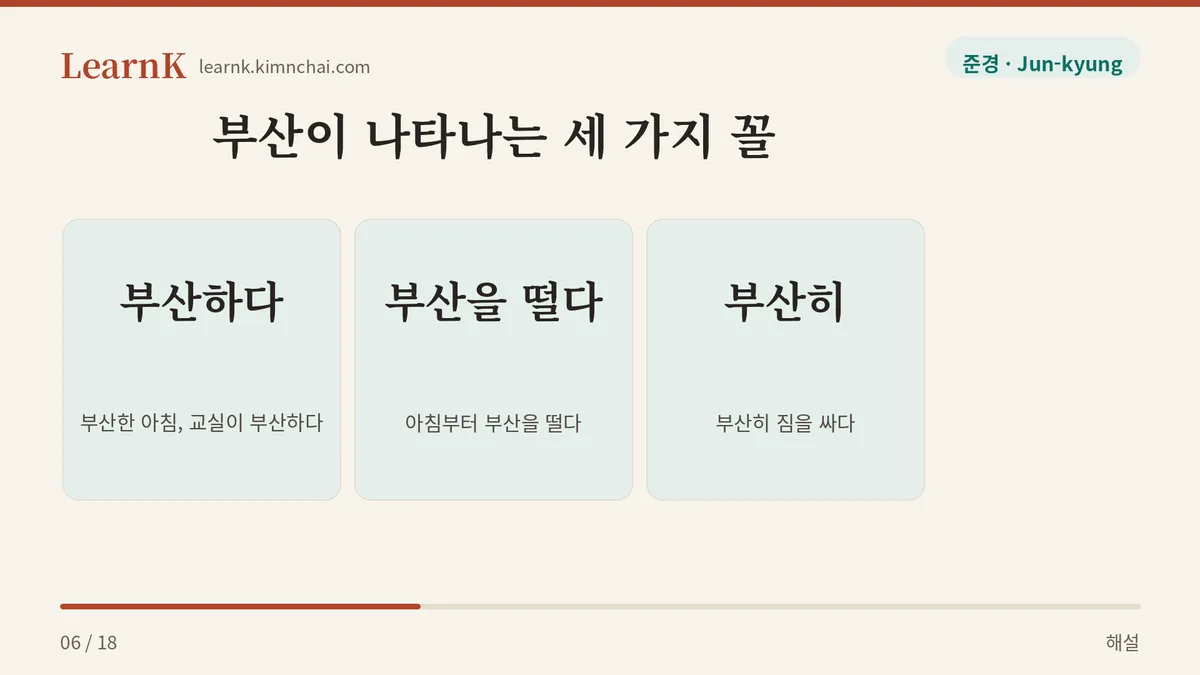
The important thing is that it almost never stands alone. It’s a noun, but in real life it shows up in three shapes, essentially always:
- 부산하다 (busanhada) — 부산한 아침 (busanhan achim) “a hectic morning,” 교실이 부산하다 (gyosiri busanhada) “the classroom is in an uproar”
- 부산을 떨다 (busaneul tteolda) — 아침부터 부산을 떨다 (achimbuteo busaneul tteolda) “to make a fuss from early morning” (to carry on noisily)
- 부산히 (busanhi) — 부산히 짐을 싸다 (busanhi jimeul ssada) “to pack in a flurry”
The city name 부산, on the other hand, is a proper noun, so it needs no definition. What you should memorize is how it pairs with particles — learn these whole and your travel Korean starts rolling immediately: 부산에 가다 (busan-e gada) “go to Busan,” 부산으로 가다 (busan-euro gada) “head for Busan,” 서울에서 부산까지 (seoure-seo busan-kkaji) “from Seoul to Busan,” 부산 사람 (busan saram) “a Busan person.” Use 에 (e) to pin down the destination, 으로 (euro) to point in a direction.
Checking the National Institute of Korean Language dictionary
부산 (noun) A state so dizzying or noisy that one can’t keep one’s head straight. [en] bustle; fuss — A state of being so noisy and disordered that one feels upset. [ja] 慌ただしくてうるさくて落ち着きがないさま。 [es] alboroto, bullicio, ajetreo, atasco — Ambiente desordenado y ruidoso tanto que desconcierta. [zh] 吵闹,闹腾,忙活 — 混乱或嘈杂到让人头晕。 — National Institute of Korean Language, Basic Korean Dictionary (krdict.korean.go.kr)
The dictionary has no Portuguese definition, so we translated one ourselves — agitação; alvoroço (barulho e desordem que deixam a pessoa aturdida). To be clear: that one is ours, not the dictionary’s.
Here’s the fun part — look at the example sentences the dictionary shows alongside it. The definition is “noisy commotion,” but every 부산 in the examples is the city. That’s exactly the kind of spot where learners get tangled, so we’ve kept the sentences as they are and added the situation behind each one.
저 내일 부산에 가요. — National Institute of Korean Language, Basic Korean Dictionary (krdict.korean.go.kr)
→ (jeo naeil busan-e gayo) “I’m going to Busan tomorrow.” The most basic form — telling a coworker your plans for tomorrow. 에 (e) pins down where you’re arriving.
부산이 고향이에요? — National Institute of Korean Language, Basic Korean Dictionary (krdict.korean.go.kr)
→ (busani gohyang-ieyo) “Is Busan your hometown?” You’ve just met someone and their intonation isn’t quite Seoul speech, so you ask, carefully. An extremely common opening conversation in Korea.
서울과 부산 간의 거리는 얼마나 됩니까? — National Institute of Korean Language, Basic Korean Dictionary (krdict.korean.go.kr)
→ (seoulgwa busan gane georineun eolmana doemnikka) “What is the distance between Seoul and Busan?” The pattern ~간(間)의 거리 (~gan-ui geori) leans literary. In conversation, 서울에서 부산까지 얼마나 걸려요? (seoure-seo busan-kkaji eolmana geollyeoyo) “How long does it take from Seoul to Busan?” sounds far more natural.
고속 도로를 타고 남쪽으로 달려 부산에 가까워지자 우리들은 설레기 시작했다. — National Institute of Korean Language, Basic Korean Dictionary (krdict.korean.go.kr)
→ “As we ran south down the expressway and drew near Busan, we started to feel a flutter of excitement.” That moment when the scenery outside the car window changes and you start to smell the sea. One sentence, and you have everything about what Busan feels like to a Korean.
나는 운전해서 부산에 갈 때는 경부 고속 도로를 이용한다. — National Institute of Korean Language, Basic Korean Dictionary (krdict.korean.go.kr)
→ “When I drive to Busan, I take the Gyeongbu Expressway.” The 경부 고속 도로 (gyeongbu gosokdoro) is Korea’s flagship expressway, linking Seoul and Busan. Even the name is built from one character each: 京 from Seoul (경) and 釜 from Busan (부).
A real conversation
Scene: Platform 3 at Seoul Station. The KTX to Busan leaves in three minutes, and Emily is only now sprinting up the stairs.
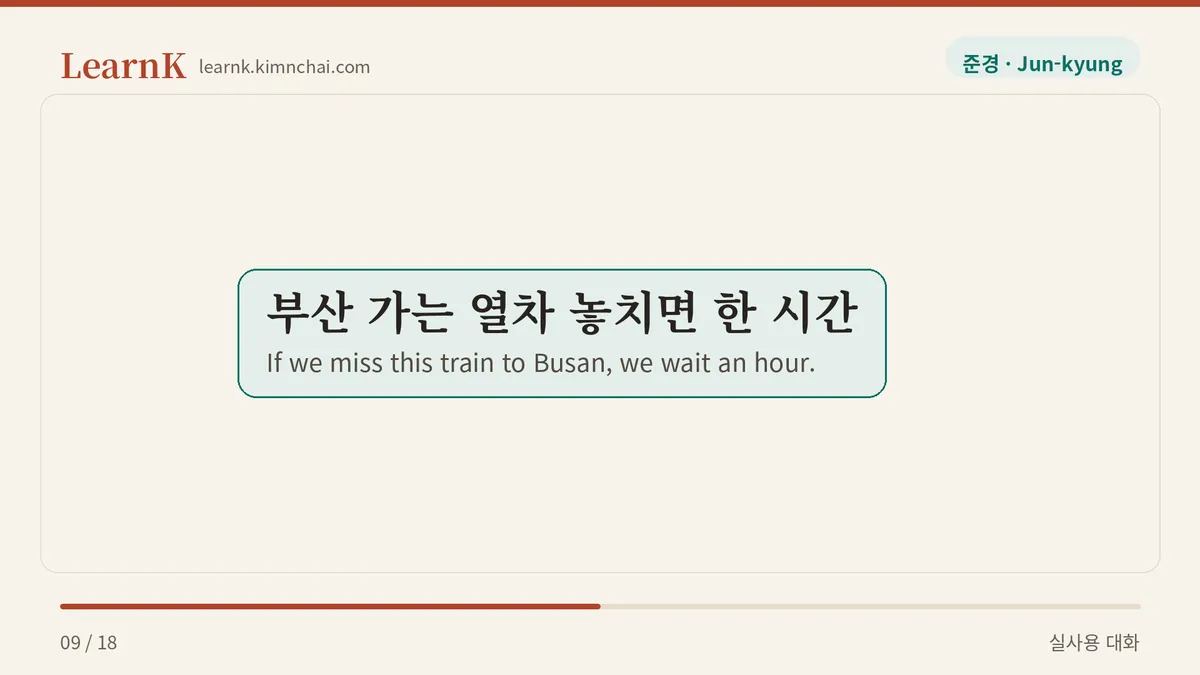
Jun-kyung: 야! 빨리! 부산 가는 열차 이거 놓치면 한 시간 기다려야 돼. Hey! Hurry! If we miss this train to Busan, we have to wait an hour.
Emily: 가고 있어, 가고 있어! 아, 김밥 사느라고… I’m coming, I’m coming! Ah, I was buying gimbap…
Jun-kyung: 됐고 일단 타. 먹는 건 앉아서 먹어. Forget it, just get on. You can eat once you sit down.
Emily: 근데 너 아침부터 왜 이렇게 부산을 떨어? 두 시간 반이면 도착하잖아. But why have you been making such a fuss since this morning? We’ll be there in two and a half hours.
Jun-kyung: 어? 너 그 말도 알아? 도시 말고 그 부산? Huh? You know that word too? Not the city — that 부산?
Emily: 나 여기 산 지 십오 년이야. 야, 문 닫힌다! I’ve lived here fifteen years. Hey, the doors are closing!
This is where it sounds off
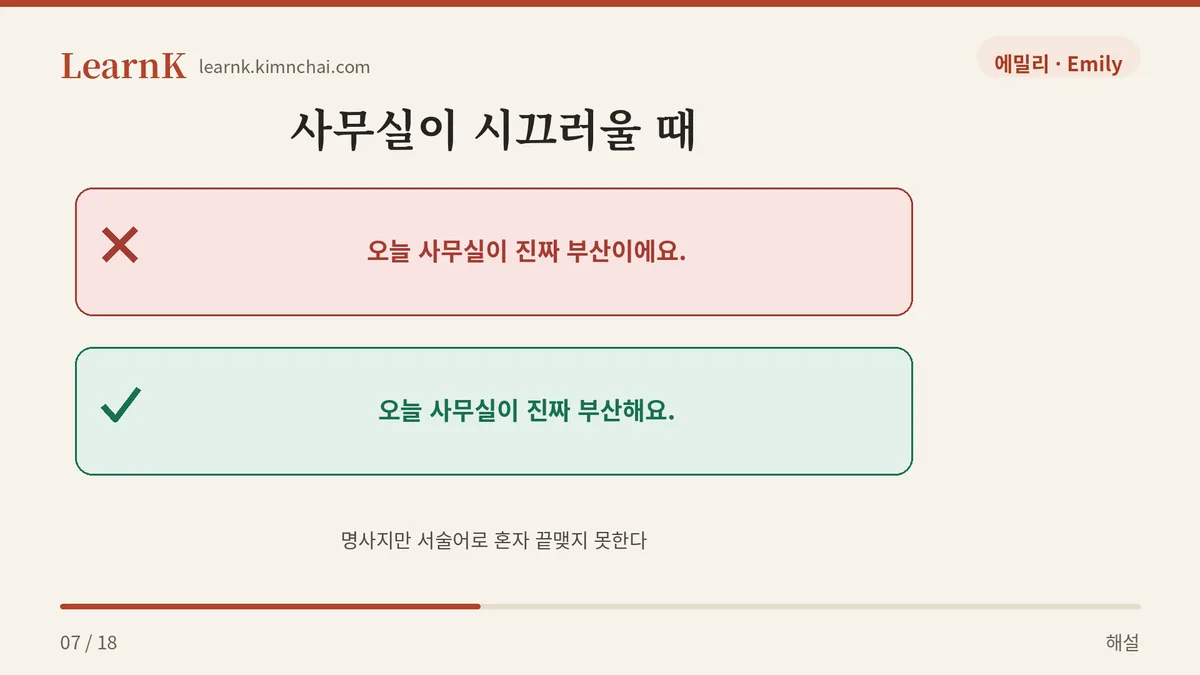
✗ 오늘 사무실이 진짜 부산이에요. (oneul samusiri jinjja busan-ieyo) ✓ 오늘 사무실이 진짜 부산해요. (oneul samusiri jinjja busanhaeyo) — “The office is really hectic today.” → This meaning of 부산 can’t stand on its own. Even though it’s a noun, ending a sentence with 부산이다 (busan-ida) sounds, to a Korean ear, like the sentence stopped halfway. Remember it in three shapes only: 부산하다 · 부산을 떨다 · 부산히.
✗ (to your manager) 부장님, 아침부터 부산을 떠시네요. (bujangnim, achimbuteo busaneul tteosineyo) ✓ (to your manager) 부장님, 아침부터 많이 바쁘시네요. (bujangnim, achimbuteo mani bappeusineyo) — “You’ve been so busy since this morning, sir.” → 부산을 떨다 comes mixed with a scolding note: you’re kicking up a needless fuss. Attach it to a senior’s movements and it reads as “wandering around pointlessly” — a genuine discourtesy. With people above you, 바쁘시네요 (bappeusineyo) is the safe choice.
Example sentences by situation
1) Talking about holiday plans (to a friend) 이번 연휴에 부산에 가려고 기차표 알아보고 있어. (ibeon yeonhyu-e busan-e garyeogo gichapyo arabogo isseo) I’m looking up train tickets — I’m planning to go to Busan this holiday.
2) Asking directions at your accommodation (polite) 부산 처음인데요, 해운대까지 여기서 얼마나 걸려요? (busan cheoeum-indeyo, haeundae-kkaji yeogi-seo eolmana geollyeoyo) It’s my first time in Busan — how long does it take to get to Haeundae from here?
3) To a family member who overslept (casual, second meaning) 아침부터 뭘 그렇게 부산해? 아직 삼십 분 남았어. (achim-buteo mwol geureoke busanhae? ajik samsip bun namasseo) Why are you in such a flurry this early? We still have thirty minutes.
Politeness levels and similar expressions
For the city name, you only change the sentence ending — 부산에 가 (busan-e ga) (casual) / 부산에 가요 (busan-e gayo) (polite) / 부산에 갑니다 (busan-e gamnida) (formal). Same for the dictionary meaning — 부산해 (busanhae) / 부산해요 (busanhaeyo) / 부산합니다 (busanhamnida). One caveat: 부산을 떨다 (busaneul tteolda) passes judgment on someone else’s behavior, so putting it in polite form doesn’t make the rudeness go away.
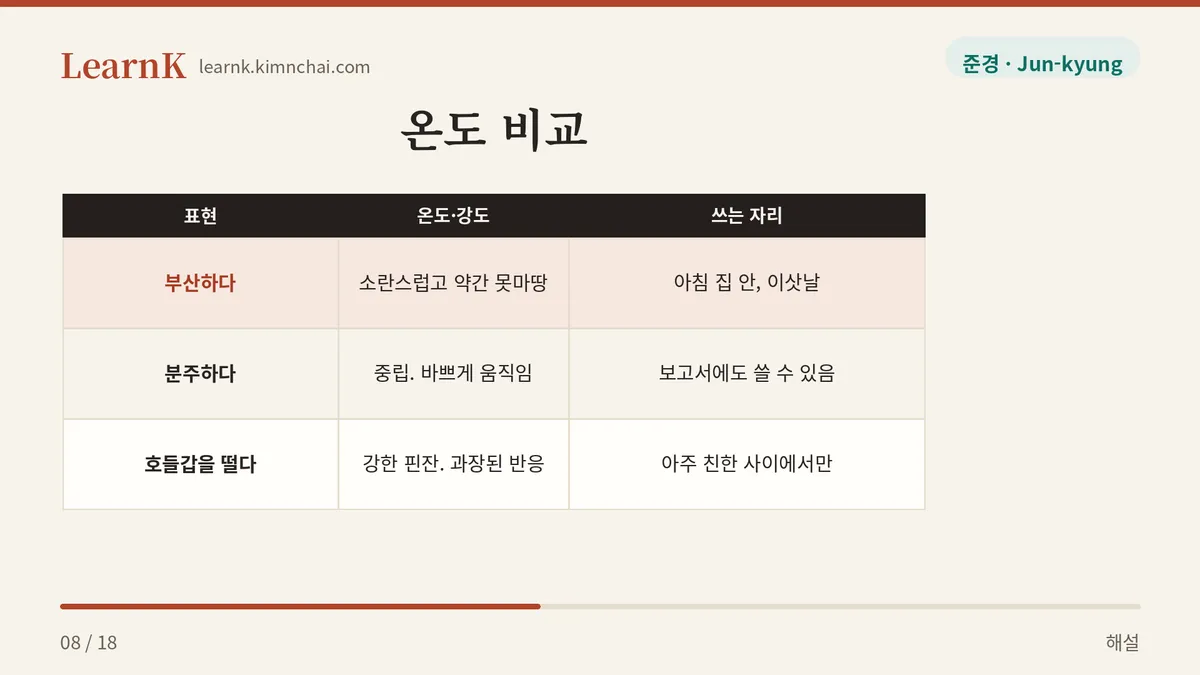
| Expression | Tone & intensity | Where it fits |
|---|---|---|
| 부산하다 (busanhada) | Noisy and frazzling, mildly disapproving | The house in the morning, moving day, a classroom before an exam |
| 분주하다 (bunjuhada) | Neutral. Moving about busily | Fine in writing and even in reports |
| 어수선하다 (eosuseonhada) | Untidy, unsettled. A state more than a sound | Rooms, moods, even your state of mind |
| 호들갑을 떨다 (hodeulgabeul tteolda) | Strong reproach. An overblown reaction | Only with very close friends |
| 바쁘다 (bappeuda) | Neutral. Having a lot to do | Safe even with people above you |
Cultural background — two and a half hours from Seoul Station
The hanja for the city are 釜山: 釜, “cauldron,” and 山, “mountain.” The widely known account is that a mountain in the old district looked like an upturned cauldron, hence the name. So the dictionary’s 부산 and the city 부산 share nothing but a sound — a pure homonym. You’ll occasionally hear someone explain that the city is called Busan because it’s a noisy port town, but that story is made up.
Take the KTX from Seoul Station and you’re at Busan Station in two and a half hours. That sense of distance is lodged in the Korean mind as the basic unit of going away, which is why Busan turns up in songs and dramas as “the southern end, where the sea is.” It’s also why the zombie disaster film 《부산행》 (busanhaeng), released internationally as Train to Busan (2016), works as a title with nothing but a destination in it.
When you arrive in Busan, the first thing that gets a shock is your ears. The Busan dialect swings widely up and down in pitch and drops off short at the end of a sentence. Markers like ~예 (~ye), ~아이가 (~aiga), and the sentence-opening 마 (ma) are the classics. The drama Reply 1997 (응답하라 1997, tvN, 2012) is about high schoolers living in Busan, so the characters speak this dialect from the first episode to the last — and a learner raised on standard Korean will miss about half of it without subtitles the first time. Gukje Market, the setting of the film Ode to My Father (국제시장, 2014); Jagalchi Market with its dawn auctions; the beaches at Haeundae and Gwangalli; and the Busan International Film Festival (BIFF) every autumn — for a traveler, Busan isn’t one city so much as a list.
Put both Busans in a single sentence and you get this: 부산역은 늘 부산하다. (busanyeogeun neul busanhada) — “Busan Station is always in a bustle.” Say that near-identical-sounding sentence to a Korean and they’ll usually laugh. It’s a pun, but there’s no better way to memorize both words at once.
Today’s quiz
Which of the following sentences sounds off?
① 저 내일 부산에 가요. (jeo naeil busan-e gayo) ② 아침부터 집 안이 부산해요. (achim-buteo jip ani busanhaeyo) ③ 이사하는 날이라 부산히 짐을 쌌다. (isahaneun nal-ira busanhi jimeul ssatda) ④ 오늘 사무실이 정말 부산이에요. (oneul samusiri jeongmal busan-ieyo)
The answer is ④. This meaning of 부산 can’t serve as a predicate on its own, so you can’t end with 부산이에요. Fix it to 부산해요 (busanhaeyo) and it sounds natural. ① uses the city name, while ② and ③ correctly use the 부산하다 and 부산히 forms.
Definitions and example sentences are from the National Institute of Korean Language’s Basic Korean Dictionary (krdict.korean.go.kr); that portion of this post, including our translations, is licensed under CC BY-SA 2.0 KR.