청국장 (cheonggukjang) — The Fermented Stew That Scares You with Its Smell and Wins You Over with Its Taste
청국장
청국장 (cheonggukjang) means a kind of soybean paste made by fermenting boiled soybeans — or the stew you cook with it. If you open the front door at a Korean friend’s place and a smell hits your nose before anything else does, while the host goes right on calmly setting the table, then nine times out of ten what’s bubbling in the kitchen is 청국장.
Few Korean foods have such a gap between first impression and reality. The smell pushes you away; the taste holds you there. That’s why Koreans recommending 청국장 to a foreign friend almost always say things in the same order. They bring up the smell first, and then tell you to try just one spoonful.
청국장 points to two things at once. One is the paste itself — boiled soybeans fermented for just two or three days. Lift a spoonful and long sticky threads stretch out, with the beans still whole and intact. The other is the stew made by simmering that paste down with tofu, kimchi, and young summer squash. If you say 청국장 주세요 (cheonggukjang juseyo) at a restaurant, nobody scoops you out a lump of paste. What comes out is a stew, bubbling away in an earthenware pot.
Even among fermented soybean foods, the timeline sets it apart from 된장 (doenjang). 된장 ages for months or even years, but 청국장 ferments in a few days. That short fermentation is what creates the strong smell — and what keeps the beans whole at the same time. When Koreans talk about the taste, the word they reach for most is 구수하다 (gusuhada), a warm, nutty, toasty savoriness; when they talk about the smell, the word is often 쿰쿰하다 (kumkumhada), that musty, funky note. Neither is an insult. 구수하다 is straightforwardly a compliment, and 쿰쿰하다 is closer to an affectionate “you know the smell I mean, right?”
Checking the National Institute of Korean Language Dictionary
청국장 (cheonggukjang) 「noun」 삶은 콩을 발효시켜서 만든 된장의 한 가지. 또는 그것으로 끓인 찌개. A type of doenjang, soybean paste, made by fermenting boiled soybeans; or a jjigae, stew, cooked with it. — National Institute of Korean Language, Basic Korean Dictionary (krdict.korean.go.kr)
Notice that the dictionary writes the meaning in two branches. One word carrying both the paste and the stew — that’s the heart of this entry. The translations into other languages keep the same structure.
[en] cheonggukjang; rich soybean paste — A type of doenjang, soybean paste, or jjigae, stew, made with it. [ja] チョングクチャン — ゆでた豆を発酵させて作ったテンジャンの一種類で、納豆に似ている。また、それで煮立てたチゲ料理。 [es] cheonggukjang — Un tipo de Doenjang hecha fermentando soyas hervidas o estofado cocido con él. [zh] 清国酱汤,清曲酱汤,臭酱汤 — 煮熟的大豆发酵而成的大酱之一;或指用其炖煮而成的汤。 — National Institute of Korean Language, Basic Korean Dictionary (krdict.korean.go.kr)
The dictionary doesn’t carry a Portuguese translation. So let us be clear that the line below is not a dictionary quotation but our own rendering. (Our own translation) cheonggukjang — um tipo de pasta de soja fermentada, ou o ensopado feito com ela.
Now let’s look at the real usage examples the dictionary lists alongside the entry. We give each one exactly as written, and add a note on the kind of situation the sentence comes from.
입안을 감치는 할머니의 청국장 맛은 누구도 따라 올 수 없다. — National Institute of Korean Language, Basic Korean Dictionary (krdict.korean.go.kr)
ibaneul gamchineun halmeoniui cheonggukjang maseun nugudo ttara ol su eopda. — “Nobody can match the lingering taste of Grandma’s cheonggukjang.” In a single sentence, this shows where 청국장 sits in Korean memory. It’s food remembered not as restaurant cooking, but as your grandmother’s own hand.
청국장이라는 건데 냄새는 별로지만 맛은 좋아. — National Institute of Korean Language, Basic Korean Dictionary (krdict.korean.go.kr)
cheonggukjangiraneun geonde naemsaeneun byeollojiman maseun joa. — “It’s called cheonggukjang. The smell isn’t great, but the taste is good.” This is the classic way of offering it to someone trying it for the first time. That order — acknowledging the smell before anything else — is exactly how it goes in real conversation too.
집에서 청국장을 끓였더니 냄새가 지독스레 난다. — National Institute of Korean Language, Basic Korean Dictionary (krdict.korean.go.kr)
jibeseo cheonggukjangeul kkeullyeotdeoni naemsaega jidokseure nanda. — “I cooked cheonggukjang at home and now the smell is awful.” Anyone who has ever simmered 청국장 in an apartment knows this situation. Open the windows, run the fan — the smell still hangs around for a day.
네, 청국장이 아주 별미거든요. — National Institute of Korean Language, Basic Korean Dictionary (krdict.korean.go.kr)
ne, cheonggukjangi aju byeolmigeodeunyo. — “Yes, cheonggukjang really is a delicacy.” This is polite speech, recommending it to a guest. 별미 (byeolmi) means “a specially delicious dish,” used for food that isn’t everyday fare and is all the more welcome for it.
나는 시골에서 직접 콩을 재배하고 수확하여 메주를 띄워 청국장을 만들었다. — National Institute of Korean Language, Basic Korean Dictionary (krdict.korean.go.kr)
naneun sigoreseo jikjeop kongeul jaebaehago suhwakhayeo mejureul ttuiwo cheonggukjangeul mandeureotda. — “Out in the countryside I grew and harvested the soybeans myself, fermented the meju, and made cheonggukjang.” Everything from planting the beans to fermenting the paste fits into one sentence. 띄우다 (ttuiuda) is the everyday word for “to ferment,” and it’s a verb that follows 청국장 around wherever it goes.
A Real Conversation
Setting: Saturday afternoon, Jun-kyung’s place. Emily rings the bell, steps inside, and stops dead in the entryway.
에밀리: 어? 야, 이거 무슨 냄새야. 뭐 상했어? Huh? Hey, what’s that smell? Did something go bad?
준경: 상하긴. 청국장 끓이는 중이야. 어제 엄마가 시골에서 보내 주셨어. Gone bad, my foot. I’m making cheonggukjang. My mom sent it from the countryside yesterday.
에밀리: 아, 이게 그 냄새구나. 나 사실 청국장 처음이야. 된장찌개랑 많이 달라? Ah, so this is that smell. Honestly, it’s my first time with cheonggukjang. Is it very different from doenjang jjigae?
준경: 훨씬 구수해. 냄새만 넘기면 밥 두 공기야. Way nuttier. Get past the smell and you’ll eat two bowls of rice.
에밀리: 알았어, 딱 한 숟갈만. …어? 어어? 이거 왜 이렇게 맛있어? Okay, just one spoonful. …Huh? Wait — why is this so good?
준경: 거봐. 청국장은 냄새로 겁주고 맛으로 잡는 거야. Told you. Cheonggukjang scares you with the smell and wins you over with the taste.
This Sounds Awkward

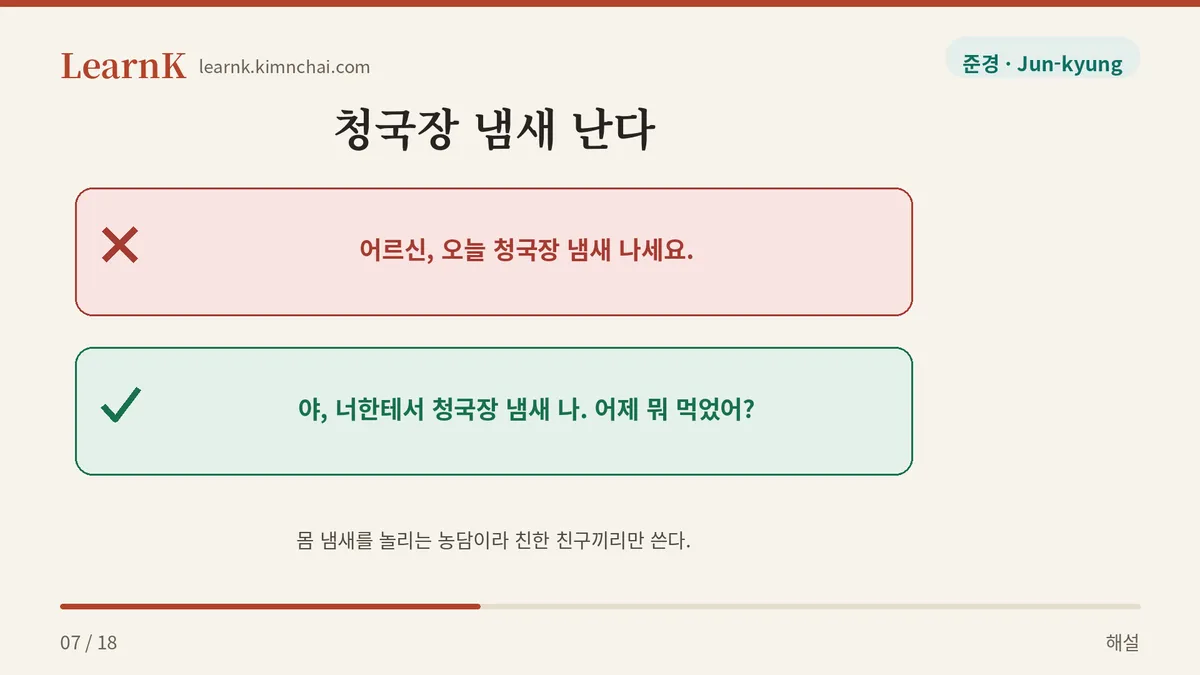
✗ (to an elder you’re meeting for the first time) 어르신, 오늘 청국장 냄새 나세요. ✓ (to a close friend) 야, 너한테서 청국장 냄새 나. 어제 뭐 먹었어? → In Korea, saying “청국장 냄새 난다” is far more often a joke about body odor or foot odor than a comment about food. It’s teasing that only works between close friends; used on someone you’ve just met or on anyone senior to you, it lands as plain rudeness.
✗ 청국장은 한국식 낫토니까 밥에 그냥 비벼 먹으면 돼요. ✓ 청국장은 보통 찌개로 끓여 먹어요. 낫토처럼 그대로 먹지는 않아요. → Both are fermented boiled soybeans, so the stringy threads do look alike. But 낫토 (natto) goes straight onto rice in its fermented state, while 청국장 is mashed with salt, garlic, and chili powder, then simmered with tofu and kimchi and served as a hot stew. Introduce it as “Korean natto” and the mismatch starts the moment it reaches the table.
Example Sentences by Situation
① Ordering at a home-style lunch spot Lunchtime; you and a coworker walk in and sit down. It’s the kind of place where you don’t need to study the menu for long.
여기 청국장 정식 둘이요. (yeogi cheonggukjang jeongsik duriyo.) “Two cheonggukjang set meals here, please.” At a restaurant, this one line brings rice, an earthenware pot of 청국장, and a few vegetable side dishes. 정식 (jeongsik) means a full set meal that comes with side dishes.
② Right before cooking it at home Weekend afternoon; you put the pot on the stove and give the family in the living room a heads-up.
나 청국장 끓일 거니까 창문 좀 열어 줘. (na cheonggukjang kkeullil geonikka changmun jom yeoreo jwo.) “I’m about to make cheonggukjang, so open a window, would you?” Opening the windows before simmering 청국장 is practically a ritual in Korean homes. The smell clings to clothes and curtains all day long.
③ Recommending it to a first-timer What you say as you push the earthenware pot toward a foreign friend.
냄새는 좀 세지만 한번 먹어 봐. 진짜 구수해. (naemsaeneun jom sejiman hanbeon meogeo bwa. jinjja gusuhae.) “The smell is a bit strong, but give it a try. It’s genuinely nutty and savory.” Naming the smell up front instead of hiding it is the polite way to offer this dish. Hide it and get caught, and your friend will never pick up the spoon again.
Polite and Casual Forms, and Similar Expressions
청국장 is the name of a thing, so the word itself doesn’t go up or down in politeness. Instead, the verb you pair it with sets the level. To someone senior it becomes 청국장 드셔 보셨어요? (cheonggukjang deusyeo bosyeosseoyo?), and to a friend, 청국장 먹어 봤어? (cheonggukjang meogeo bwasseo?). When offering it to an elder, there are situations where “청국장 드실 줄 아세요?” (“Do you know how to eat cheonggukjang?”) sounds more natural than “청국장 좋아하세요?” (“Do you like cheonggukjang?”). With this dish, whether you can eat it comes before whether you like it.
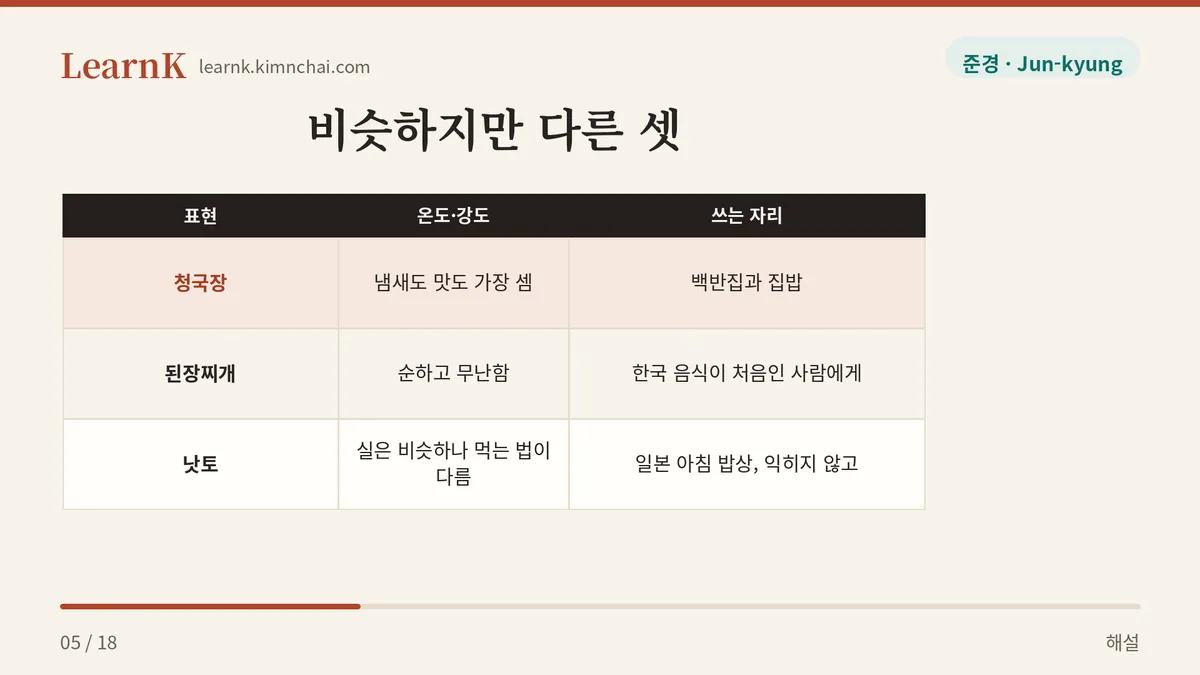
| Expression | Intensity | Where it’s used |
|---|---|---|
| 청국장 (cheonggukjang) | Strongest in both smell and taste; deeply 구수하다 | Home-style diners and home cooking. Rarely served at formal entertaining |
| 청국장찌개 (cheonggukjangjjigae) | Same dish, meaning made explicit | When you want to make clear you mean the stew, not the paste |
| 된장찌개 (doenjangjjigae) | Mild and easygoing | Anywhere. The safe pick for someone new to Korean food |
| 낫토 (natto) | Similar stringiness, but different smell and way of eating | The Japanese breakfast table. Eaten as is, uncooked |
Cultural Background — The Food Whose Smell Opens the Door First
청국장 has long been winter food. Wrap boiled soybeans in rice straw, tuck them into the warm spot on the heated floor, and in a few days they’ve fermented. Unlike 된장, which makes you wait months, this could be made fast when you were in a hurry — and that fact shaped the whole character of the dish. It has been written in Chinese characters as 淸麴醬, but there are several competing theories about where the name comes from and no settled answer. The only sure thing is that it doesn’t take long to make.
The places 청국장 shows up in Korean dramas are almost fixed. Not a glamorous restaurant, but the wooden floor of a country house, an old home-style diner, a table set by a mother. It’s often placed in scenes where a character worn out by the city comes home and sits down to a meal, and sometimes a character who was holding their nose at the smell ends up emptying two bowls of rice — the show’s way of telling you their heart has softened. On screen, this dish plays less the role of a culinary boast than of a signal: I’ve come home.
Even today, 청국장 carries a strong reputation as health food. Because it’s fermented, older people are especially fond of it, and at restaurants it’s a go-to on days when you want to take care of yourself. At the same time, it’s a dish people hesitate to eat for lunch near the office because of the smell. On days with an afternoon meeting, coworkers really do say, “Let’s eat something other than cheonggukjang today.” A food that people love but eat only in the right setting — that’s where 청국장 stands in Korea now.
Today’s Quiz
A Korean friend has set a pot of 청국장 in front of you, a first-timer. Now suppose the roles are reversed and you’re recommending this dish to another foreign friend. Which of the following sounds most natural?
- 이거 낫토니까 밥에 그냥 비벼 먹어. (“This is natto, so just mix it into your rice.”)
- 냄새는 좀 세지만 한번 먹어 봐. 진짜 구수해. (“The smell is a bit strong, but give it a try. It’s genuinely nutty and savory.”)
- 어? 너한테서 청국장 냄새 나는데? (“Huh? You smell like cheonggukjang.”)
The answer is number 2. Acknowledging the smell first and then recommending the taste is the Korean etiquette for introducing this dish. Number 1 wrongly presents 청국장 as the same thing as natto, and gets the way of eating it wrong too. Number 3 isn’t about food at all — it’s a joke about body odor, so it’s rude with someone you’ve just met.
Definitions and example sentences are from the National Institute of Korean Language’s Basic Korean Dictionary (krdict.korean.go.kr); that portion of this post, including our translations, is licensed under CC BY-SA 2.0 KR.