Chuseok — Why Koreans Head Back to Their Hometowns Once a Year
When a holiday weekend rolls around, the whole country starts buzzing with a single word — from the ticket counters at train stations to the checkout lines at big supermarkets. That word is 추석 (Chuseok). If you watch Korean dramas, it’s the term that shows up without fail alongside scenes of the whole family in hanbok doing deep bows, or bumper-to-bumper highways. Today, let’s take a deep dive into Chuseok, the big holiday that every Korean experiences at least once a year.
추석 (Chuseok)
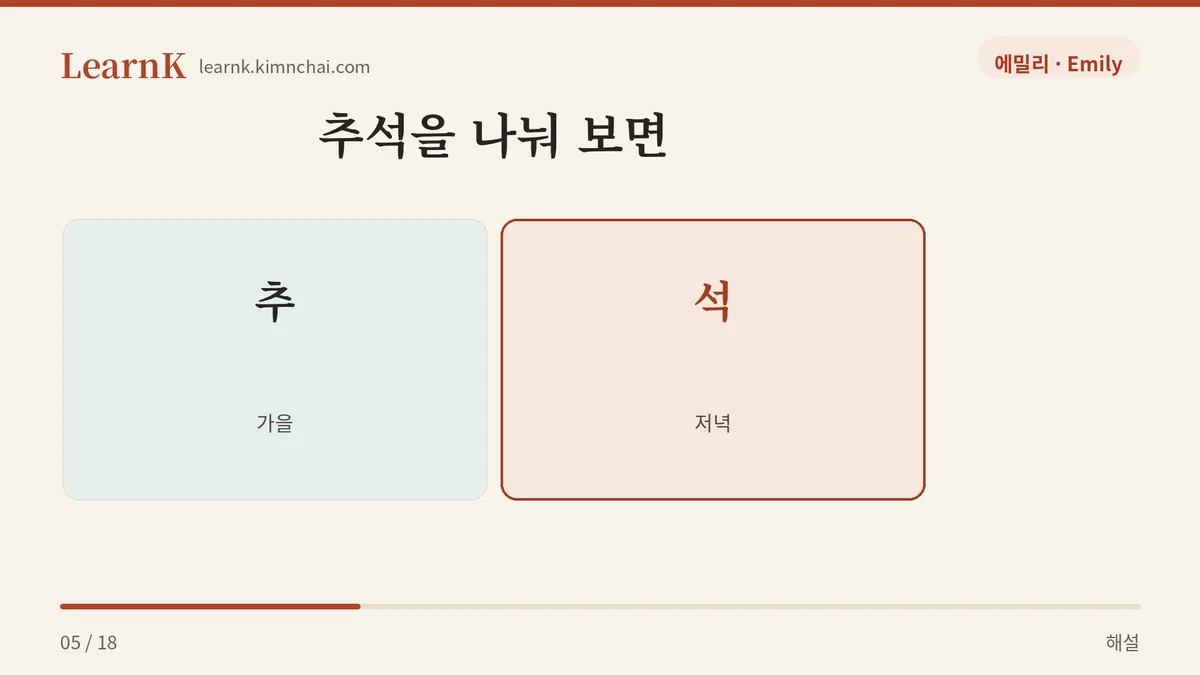
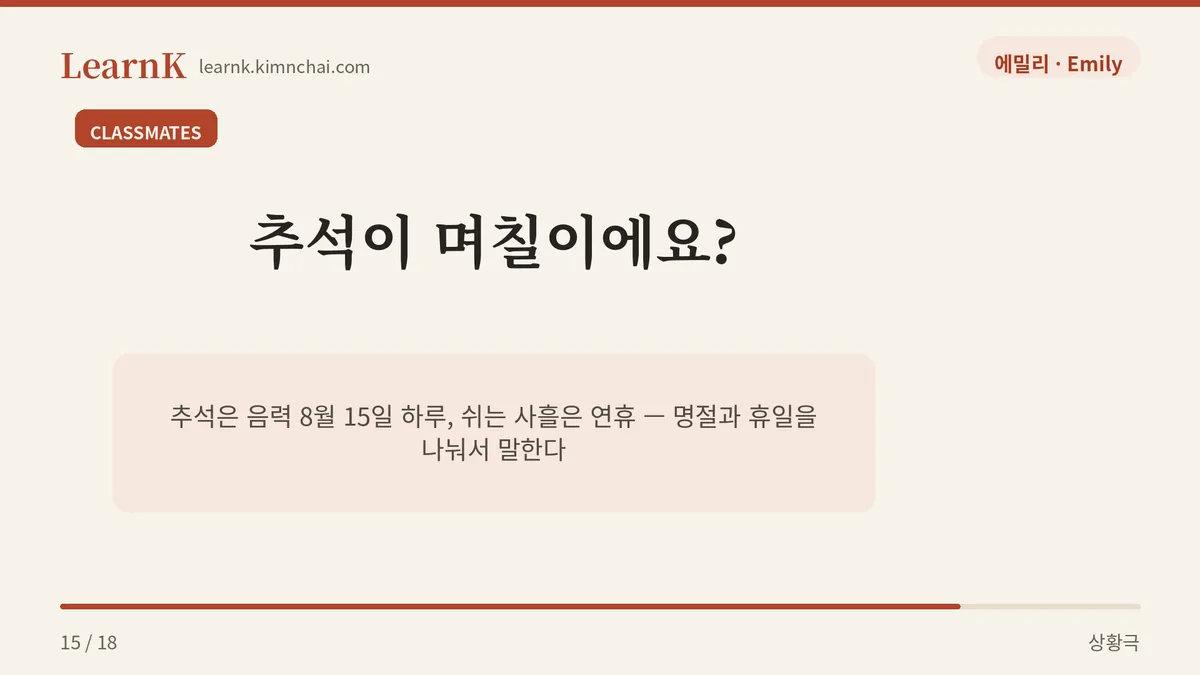
추석 (Chuseok) is one of Korea’s most iconic holidays, celebrated on the 15th day of the 8th month of the lunar calendar. It’s often introduced as “Korea’s Thanksgiving,” and the comparison actually fits pretty well, since it’s a day to give thanks to one’s ancestors and to nature for the year’s harvest. On this day, people shape half-moon-shaped rice cakes called 송편 (songpyeon) from freshly harvested rice, set out freshly picked fruit, and hold an ancestral memorial rite called 차례 (charye).
In terms of nuance, Chuseok carries far more weight than a simple “holiday.” It’s a word that drags along a whole bundle of feelings — hometown, family, the journey home. So when a Korean hears “추석 (Chuseok),” what comes to mind before the date on the calendar is a jam-packed highway and the faces of relatives gathered on the wooden floor of the family’s main house. Along with the lunar New Year, 설 (Seollal), it’s counted as one of Korea’s two biggest holidays.
Checking the National Institute of Korean Language Dictionary
추석 「noun」 One of Korea’s holidays. Falling on the 15th day of the 8th lunar month, people prepare foods such as songpyeon (rice cakes made from freshly harvested rice) and fresh fruit, and hold an ancestral memorial rite (charye). They also enjoy folk games such as ssireum (wrestling), juldarigi (tug-of-war), and ganggangsullae (a circle dance). [en] Chuseok — One of traditional Korean holiday; it falls on the 15th day of the 8th month by the lunar calendar; on this day, people prepare special foods like songpyeon, half-moon rice cake, and newly harvested fruits, and hold a memorial service for their ancestors; they also enjoy folk games such as ssireum, juldarigi, and ganggangsullae. [ja] チュソク。旧暦の盆休み — 韓国の節日の一。陰暦8月15日で、新米で作った「ソンピョン」という餅や走りの果物などの食物を用意して、祭祀を行う。 [es] Chuseok, fiesta de cosecha — Una de las fiestas coreanas. La que se celebra en el 15 de agosto en el calendario lunar preparando platos como songpyeon o frutas de la primera cosecha para prestar el servicio conmemorativo a los antepasados. [zh] 中秋节 — 韩国的节日之一。农历8月15日,人们准备用新米做的松糕及当季水果进行祭祀。并且举行摔跤、拔河、圆圈舞等民俗游戏。 — National Institute of Korean Language, Basic Korean Dictionary (krdict.korean.go.kr)
For reference, a Portuguese translation isn’t listed in the dictionary, so the following is our own rendering — Chuseok (Ação de Graças coreana): um dos principais feriados tradicionais da Coreia, no 15º dia do 8º mês do calendário lunar.
Let’s also take a look at some real usage examples from the dictionary.
이번 추석에는 오랜만에 형제들이 모두 와서 온 가족이 다 모이게 됐다. (This Chuseok, all the siblings came for the first time in ages, so the whole family got to gather together.) — National Institute of Korean Language, Basic Korean Dictionary (krdict.korean.go.kr)
Siblings who’d been living apart come together in one place thanks to the holiday — it’s the most classic Chuseok scene there is. The phrase ‘온 가족이 다 모이다’ (the whole family gathers) reveals that the heart of this holiday ultimately lies in the “gathering.”
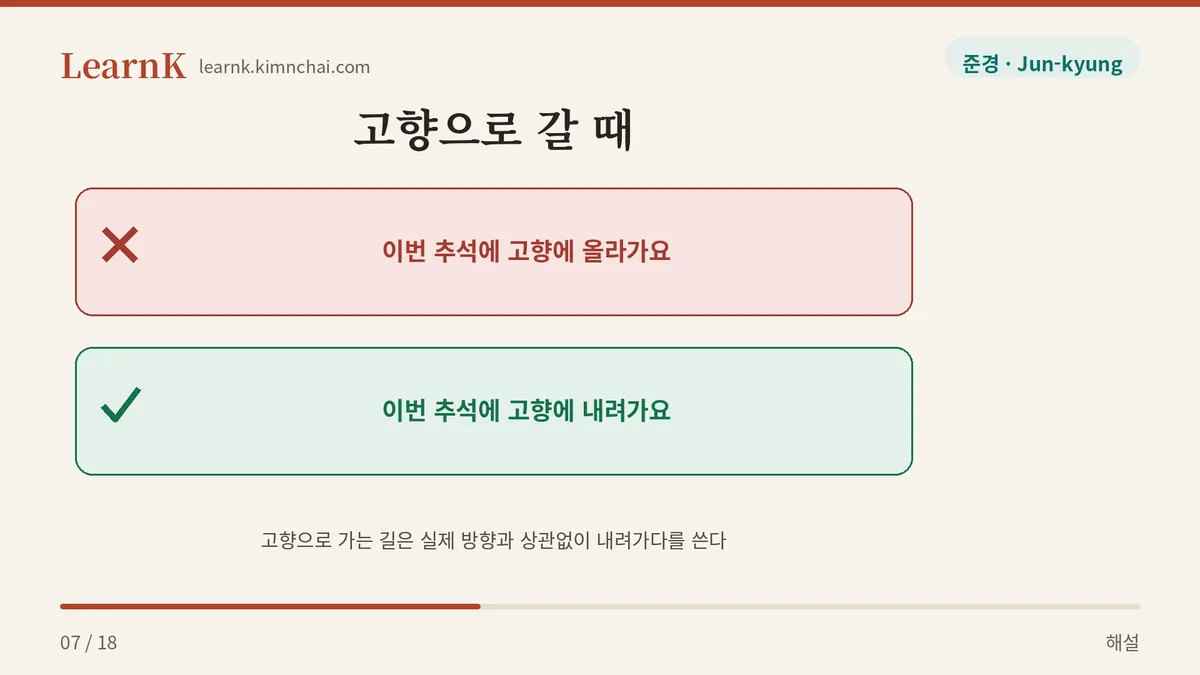
승규는 이번 추석에 부모님이 계신 고향집에 내려간다. (This Chuseok, Seung-gyu is heading down to his hometown home where his parents live.) — National Institute of Korean Language, Basic Korean Dictionary (krdict.korean.go.kr)
When someone lives in a big city and goes to the province where their parents live for the holidays, they say they ‘내려간다’ (go down). A fun point is that even when the actual direction isn’t south, going to one’s hometown is still called ‘내려가다’ (going down).
추석 연휴가 끝나자 서울로 오는 차량들이 많아 경부 고속 도로 곳곳이 밤새 정체되었다. (Once the Chuseok holiday ended, so many cars were heading toward Seoul that stretches of the Gyeongbu Expressway were jammed all night.) — National Institute of Korean Language, Basic Korean Dictionary (krdict.korean.go.kr)
When the holiday ends, this time the procession runs in the opposite direction, back into the cities. One thing you can’t leave out when it comes to Chuseok is exactly this staggering traffic congestion.
어머니는 설이나 추석에 감주를 만드신다. (My mother makes gamju on Seollal or Chuseok.) — National Institute of Korean Language, Basic Korean Dictionary (krdict.korean.go.kr)
There are foods, like 감주 (gamju, also called sikhye — a sweet rice punch), that people lovingly make only on the holidays. It’s an example sentence that nicely shows how Chuseok is also a holiday where the whole family sits down together to “eat.”
Seeing It in a Real Conversation
Situation: The evening two days before the Chuseok holiday. In front of the apartment elevator, Jun-kyung — dragging a huge suitcase — runs into his neighbor Emily.
Emily: 어, 준경 씨 벌써 내려가요? 추석은 모레인데. Oh, you’re heading down already? Chuseok isn’t until the day after tomorrow.
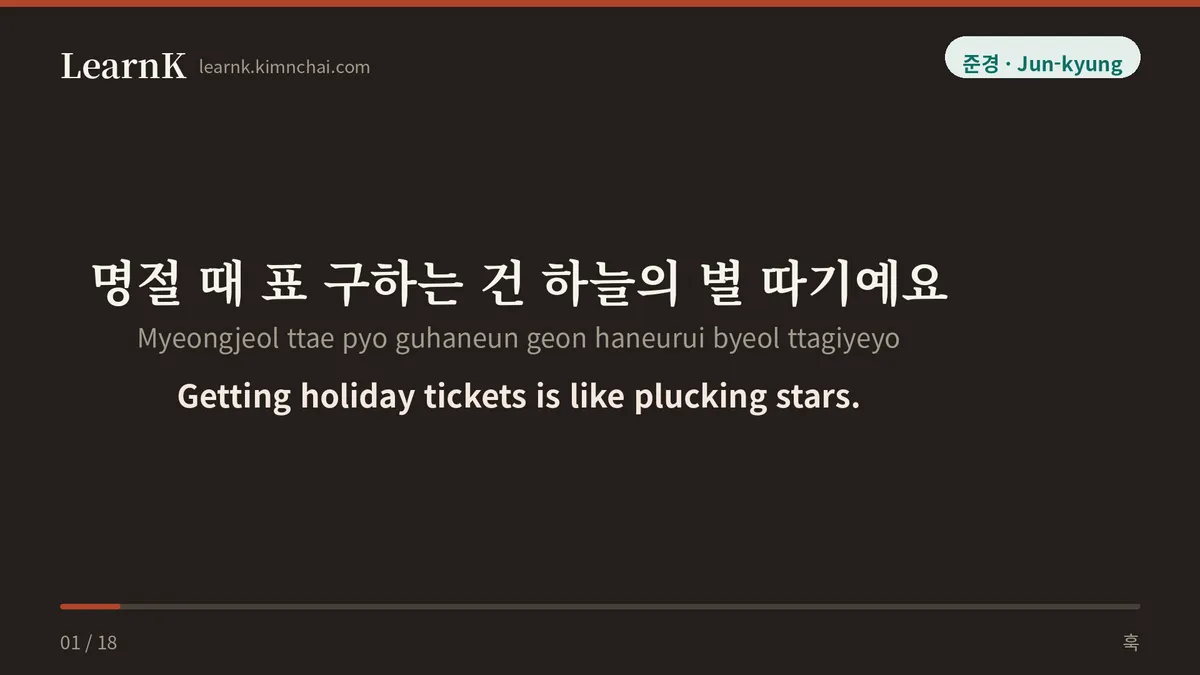
Jun-kyung: 어차피 기차표를 못 구해서요. 명절 때 표 구하는 건 하늘의 별 따기예요. I couldn’t get a train ticket anyway. Getting tickets during the holidays is like plucking stars from the sky.
Emily: 아, 하긴. 나도 작년 추석에 고속버스 겨우 탔잖아요. Ah, true. I barely caught an express bus last Chuseok too.
Jun-kyung: 에밀리 씨는 이번에 뭐 해요? 송편은 빚어요? What about you this time, Emily? Are you making songpyeon?
Emily: 그럼요. 시댁 가서 온 식구랑 같이 빚어요. 나 이제 손 제법 빨라졌어요. Of course. I go to my in-laws’ and make them with the whole family. My hands are pretty quick now.
Jun-kyung: 오, 완전 한국 사람 다 됐네요. 그럼 추석 잘 쇠고, 연휴 끝나고 봐요! Wow, you’ve totally become Korean. Well, have a good Chuseok, see you after the break!
Example Phrases by Situation
1. Asking a friend you haven’t seen in a while about their holiday plans 이번 추석에 뭐 해? 고향 내려가? (Ibeon Chuseoge mwo hae? Gohyang naeryeoga?) As a holiday approaches, this is the kind of thing friends toss back and forth almost like a greeting. ‘내려가다’ (to go down) is that expression you learned earlier.
2. Offering a polite holiday greeting when parting ways 추석 잘 보내세요. (Chuseok jal bonaeseyo.) This is a go-to well-wishing phrase you can comfortably use even with people older than you. Similarly, ‘즐거운 추석 되세요’ (Have a joyful Chuseok) is also used very often.
3. Asking after someone once the holiday is over 추석 잘 쇠셨어요? (Chuseok jal soesyeosseoyo?) ‘쇠다’ is a native Korean verb meaning “to observe/spend a holiday.” It pairs up with holidays, as in ‘추석을 쇠다’ (to spend Chuseok) or ‘설을 쇠다’ (to spend Seollal).
Formal/Informal Speech and Similar Expressions
Chuseok itself is a noun, so it doesn’t have separate formal and informal forms, but the greetings you use with it change depending on whom you’re addressing.
- To a friend (informal): 추석 잘 보내! / 추석 잘 쇠! (Chuseok jal bonae! / Chuseok jal soe!)
- To an elder (formal): 추석 잘 보내세요 / 즐거운 한가위 되세요. (Chuseok jal bonaeseyo / Jeulgeoun Hangawi doeseyo.)
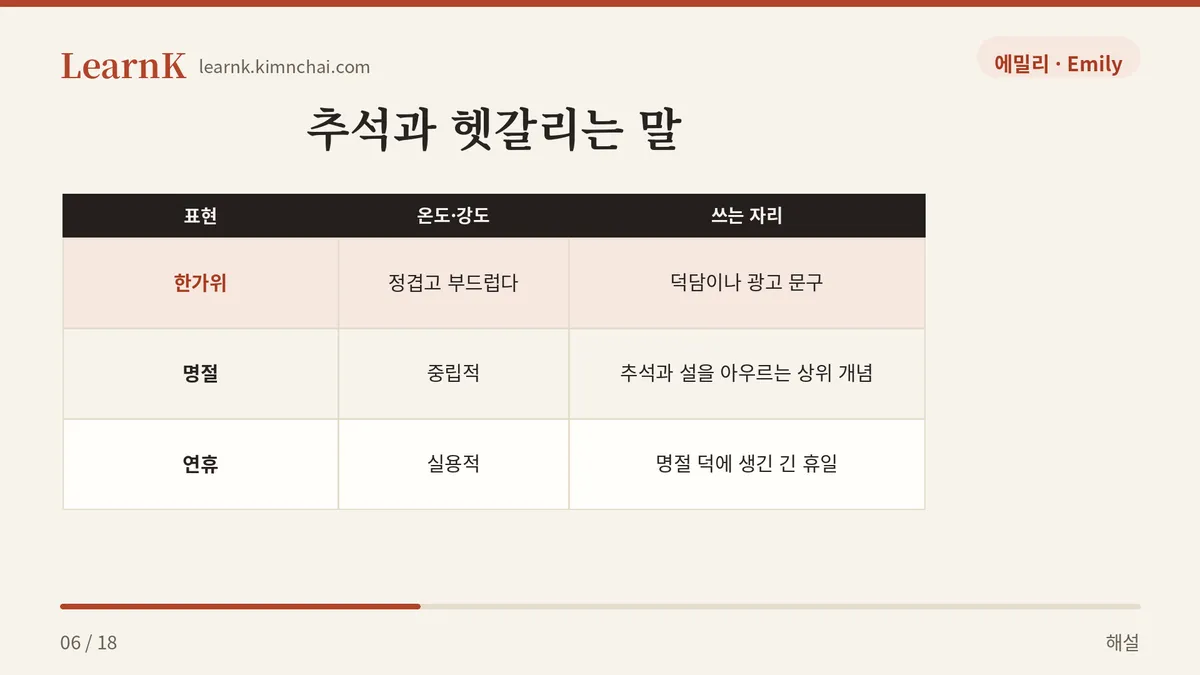
A similar word is 한가위 (Hangawi). It’s the pure-Korean term for Chuseok, where ‘한’ means “big” and ‘가위’ means “the middle” (the very middle of the 8th lunar month). If ‘추석 (Chuseok)’ feels a bit more everyday and formal, ‘한가위 (Hangawi)’ is used more warmly and affectionately in well-wishes and advertising copy, as in ‘즐거운 한가위 되세요’ (Have a joyful Hangawi). Also, 명절 (myeongjeol) is the broader category that encompasses both Chuseok and Seollal, while 연휴 (yeonhyu) refers to the “long holiday” that Chuseok creates — so it’s good to keep them distinct in your mind.
Cultural Background — Chuseok in Dramas and Daily Life
In Korean dramas, the Chuseok episode is a staple. The whole family gathering at the main house, the smell of oil wafting as they fry up jeon (savory pancakes), a couple bickering from the stress of holiday prep, and a relative you haven’t seen in ages asking “So when are you getting married?” — these scenes are practically clichés. A protagonist worn out by holiday nagging quietly slipping away to the rooftop is a situation many family dramas have painted with a mix of laughter and bittersweetness.
In real daily life, too, Chuseok is a huge event — big enough to be called “the great migration of the nation.” Weeks before the holiday, the war for train tickets breaks out, and supermarkets pile up gift sets in mountains. Lately, the number of people who travel somewhere or quietly rest alone instead of going down to their hometown has grown, so the “scenery of Chuseok” is slowly changing. Even so, the wish for the year’s peace and well-being made while gazing up at the full moon remains unchanged, now as ever.
Today’s Quiz
What holiday name goes in the blank?
“엄마, 저 이번 ___에는 꼭 고향에 내려갈게요. 송편도 같이 빚어요!” (“Mom, this ___ I’ll definitely come down to our hometown. Let’s make songpyeon together!”)
Hint: It falls on the 15th day of the 8th lunar month, and it’s a big Korean holiday where people shape songpyeon from freshly harvested rice and hold ancestral rites. It also pairs up with the verb ‘쇠다,’ used as in ‘___을 쇠다.’
Answer: 추석 (Chuseok) — in pure Korean, it’s also called 한가위 (Hangawi).
Definitions and example sentences are from the National Institute of Korean Language’s Basic Korean Dictionary (krdict.korean.go.kr); that portion of this post, including our translations, is licensed under CC BY-SA 2.0 KR.