Feeling Frustrated While Watching a K-Drama? Today's Expression: '고구마 (goguma)'
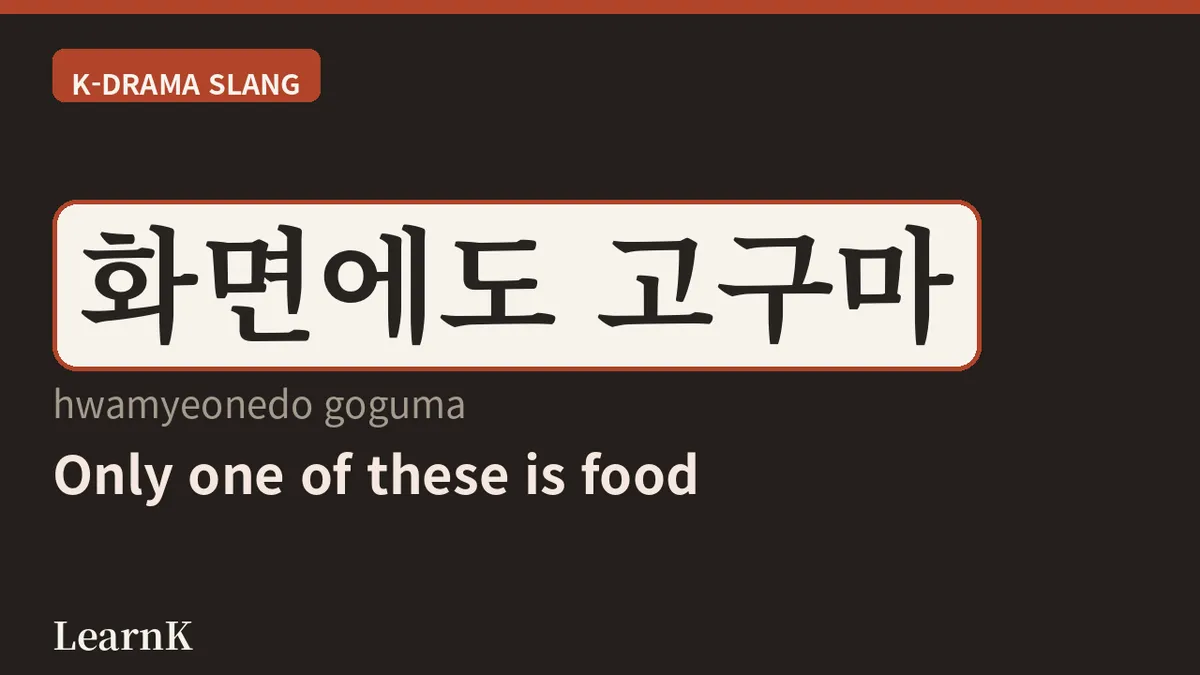
Have you ever been watching a K-drama where the main character can’t clear up a misunderstanding, keeps swallowing the words they want to say, and just takes abuse from a bad person? In those moments, the viewer’s chest feels completely blocked — like you rushed to swallow a sweet potato without any water. That’s why Korean drama fans call this kind of frustrating storyline “고구마 (goguma).” Today, let’s dig into this fun expression that has grown beyond a vegetable name to describe an emotion.
고구마
고구마 (goguma) originally means the sweet root vegetable that’s brown on the outside and yellow on the inside. In English, it’s a sweet potato. But this sweet potato has one particular trait: it’s so dry and dense that eating it without water makes your throat clog up and your chest feel stuffy.
A new meaning was born from exactly this feeling. When the plot of a drama or story doesn’t unfold smoothly and stays frustratingly 답답하게 (dapdaphage) blocked up, people started calling it — and the character who causes that frustration — “고구마.” On the flip side, a satisfying, refreshing turn of events is compared to a fizzy soda and called 사이다 (saida). The two words are always used as a pair.
Checking the National Institute of Korean Language Dictionary
First, let’s look at the original meaning given by the National Institute of Korean Language dictionary.
고구마 (noun): The root of a plant, brown or red on the skin and yellowish inside, with a sweet and savory taste. [en] sweet potato; yam / [es] batata, boniato, camote / [zh] 红薯,甘薯 — National Institute of Korean Language, Basic Korean Dictionary (krdict.korean.go.kr)
(The Portuguese translation isn’t in the dictionary, so we’ve added our own for learners: [pt] batata-doce.)
Shall we also look at the actual example sentences the dictionary provides?
어머니는 공부하는 아이에게 빵이나 고구마 같은 간식거리를 챙겨 주셨다. — National Institute of Korean Language, Basic Korean Dictionary (krdict.korean.go.kr)
A sweet potato is exactly the kind of simple snack a mom packs for a child studying late into the night. In Korea, the sweet potato is a classic wintertime snack.
난 단 고구마보다는 담백한 감자가 더 좋아. — National Institute of Korean Language, Basic Korean Dictionary (krdict.korean.go.kr)
The sweet potato and the potato are a pair that always gets compared. If you like sweet flavors, you pick the sweet potato; if you like plain, clean flavors, you pick the potato.
너는 감자랑 고구마랑 어떤 게 더 좋아? — National Institute of Korean Language, Basic Korean Dictionary (krdict.korean.go.kr)
This is a casual, informal (반말) sentence where friends ask each other about their preferences. It’s a natural question that comes up often in everyday conversation.
이게 바로 새로 개발된 개량종 고구마란다. — National Institute of Korean Language, Basic Korean Dictionary (krdict.korean.go.kr)
This sentence carries the tone of an adult (“-란다”) proudly introducing a new variety.
Example Sentences by Situation
Now let’s make some sentences ourselves, using the figurative meaning that drama fans use.
-
이 드라마 진짜 고구마야. 답답해서 못 보겠어. (i deurama jinjja gogumaya. dapdaphaeseo mot bogesseo.) → A situation where you complain to a friend in casual speech (반말) when the plot is just too frustrating. (“This drama is such a 고구마. It’s so frustrating I can’t watch it.”)
-
주인공이 3회 내내 고구마 백 개 먹은 것처럼 답답하게 굴어요. (juingongi 3hoe naenae goguma baek gae meogeun geotcheoreom dapdaphage gureoyo.) → “고구마 백 개” (a hundred sweet potatoes) is an exaggerated idiomatic expression that emphasizes the frustration. (“For all of episode 3, the main character acts so frustratingly, like they’ve eaten a hundred sweet potatoes.”)
-
드디어 사이다 전개다! 고구마 구간 끝났어. (deudieo saida jeongaeda! goguma gugan kkeutnasseo.) → This expresses the joy of the moment when the frustrating stretch ends and things become satisfying. (“Finally, a 사이다 turn of events! The 고구마 stretch is over.”)
Comparing Polite and Casual Speech, and Similar Expressions
With a friend, you’d use casual speech (반말) like “완전 고구마야 (wanjeon gogumaya)” (“total 고구마”), and when being polite, you’d use honorific speech (존댓말) like “조금 고구마 같은 전개네요 (jogeum goguma gateun jeongaeneyo)” (“the plot is a bit 고구마-like, isn’t it”). Standard words that express a similar feeling include 답답하다 (dapdaphada) (to feel stuffy/frustrated) and 속 터지다 (sok teojida, feeling so frustrated your insides could burst). You can think of “고구마” as a cute, light, newly coined way to express this emotion.
Cultural Background
This expression exploded in use especially in dramas featuring a frustrating main character who is “nothing but nice and can’t speak up for themselves.” Viewers flood the live comment section with “고구마” to share their frustration. That’s why dramas these days deliberately include 사이다 (saida) scenes — where the main character fights back in a satisfying way — to strike a balance. Scenes where a character finally can’t take it anymore and snaps back triumphantly often get talked about as classic “사이다 lines.”
Today’s Quiz
While watching a drama, your friend cries out, “아, 진짜 고구마다!” Which best matches how this friend feels? ① The plot is satisfying and refreshing ② The plot is frustrating and stifling ③ They’re hungry and want to eat a sweet potato
Answer: ② (It means the chest-clogging frustration.)
Definitions and example sentences are from the National Institute of Korean Language’s Basic Korean Dictionary (krdict.korean.go.kr); that portion of this post, including our translations, is licensed under CC BY-SA 2.0 KR.