Today's Korean: 귀찮다 (gwichanta) — the Real Everyday Word for When You Can't Be Bothered
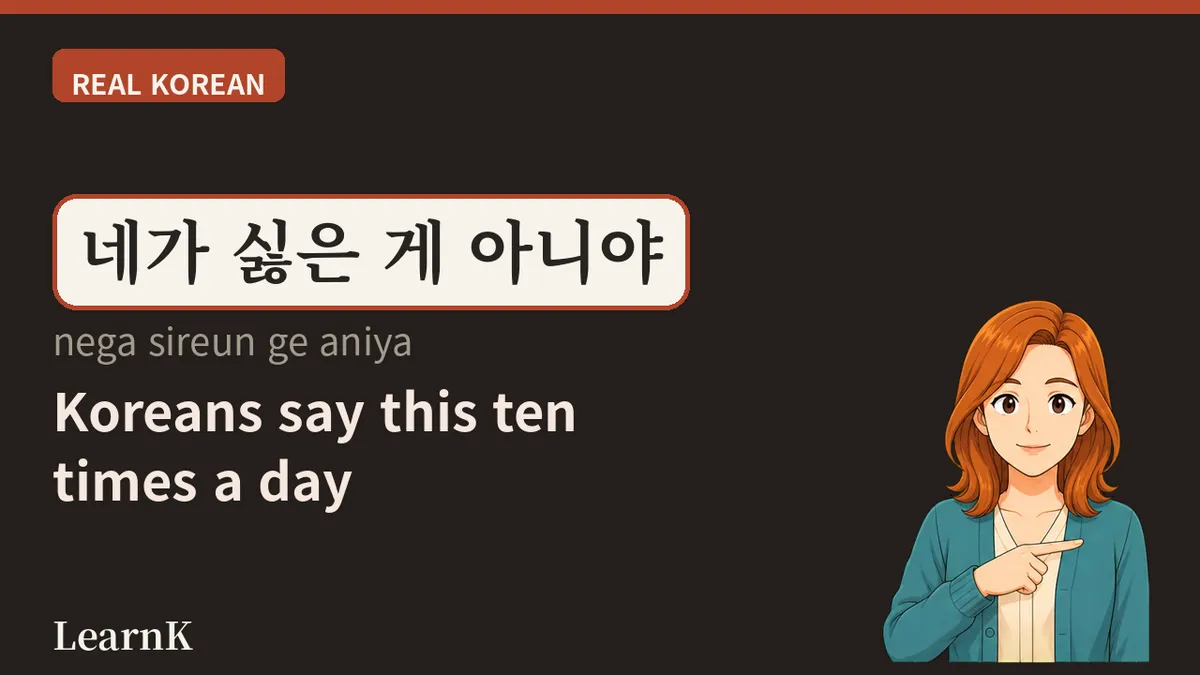
When you watch Korean dramas, you’ll often catch a scene where the lead is slumped on the couch, mumbling “아, 귀찮아… (a, gwichana…).” When you don’t want to get out of bed, when you can’t be bothered to wash up, when someone keeps talking to you and it’s getting annoying — the phrase Koreans blurt out several times a day is exactly today’s expression.
귀찮다
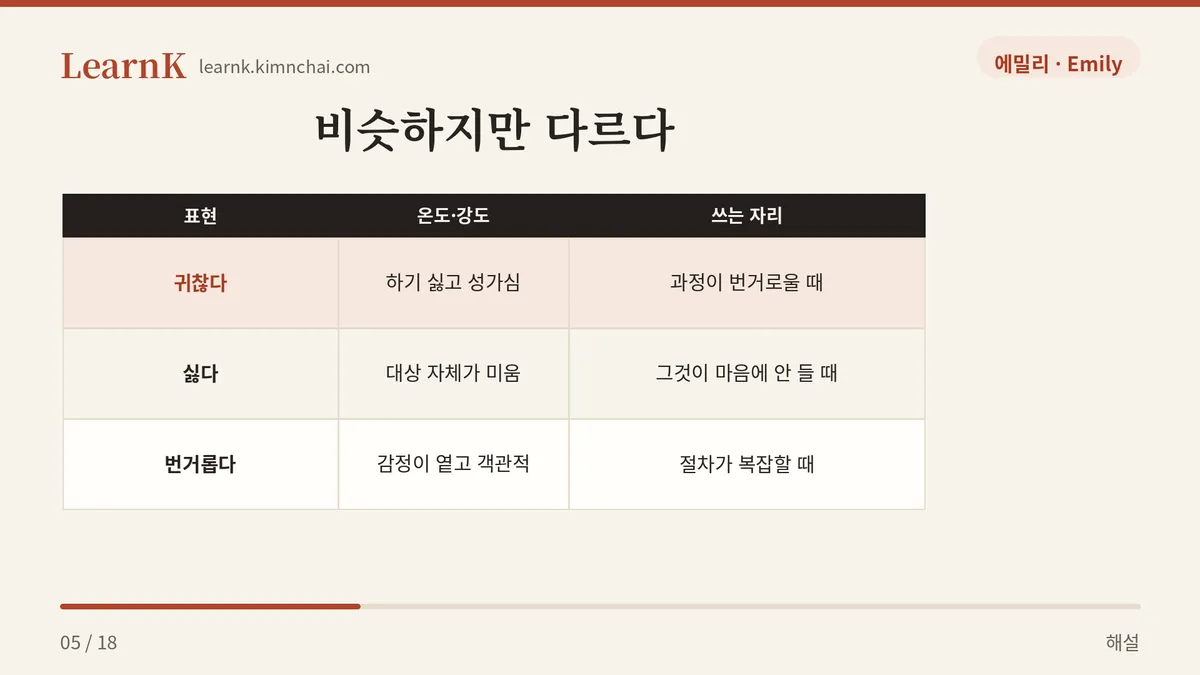
귀찮다 (gwichanta) is an adjective meaning “to not want to do something and find it a bother.” It’s a little different from simply 싫다 (silta). If 싫다 is the feeling that you dislike the thing itself, 귀찮다 is closer to “the effort and hassle involved in doing it feels burdensome.”
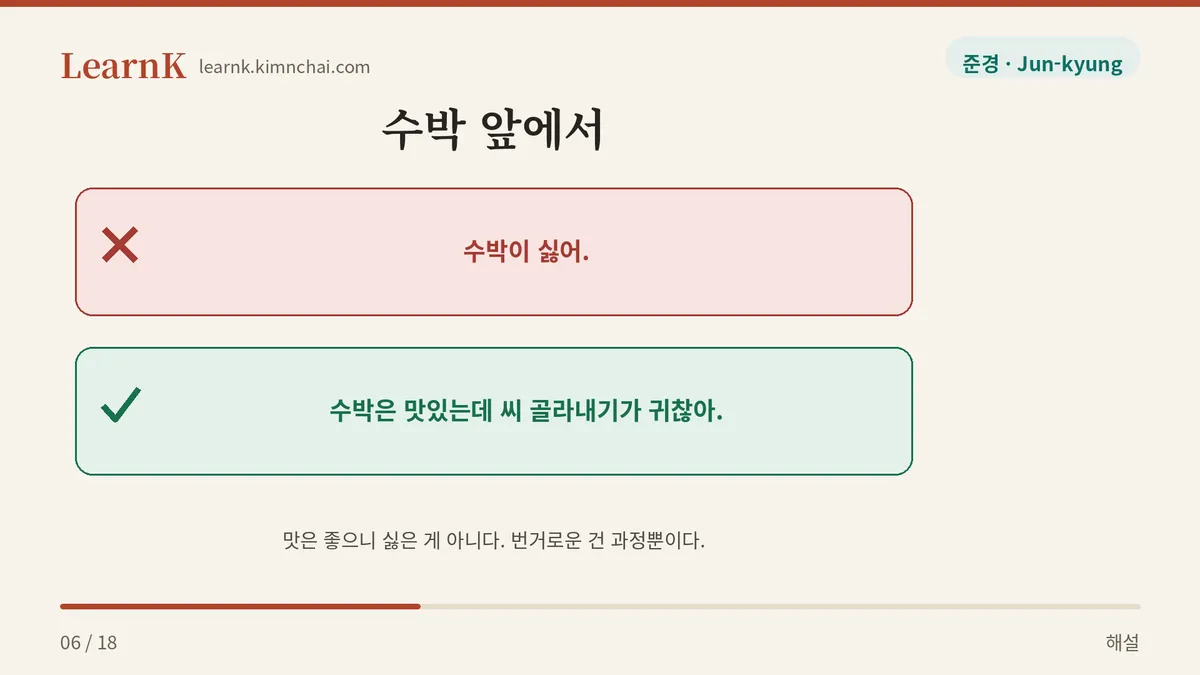
For example, watermelon is delicious, so you don’t dislike it — but picking out the seeds one by one can be 귀찮다. In other words, even when the outcome is good, you can call it 귀찮다 if the process is a hassle. This subtle nuance is the heart of the word.
Checking the National Institute of Korean Language Dictionary
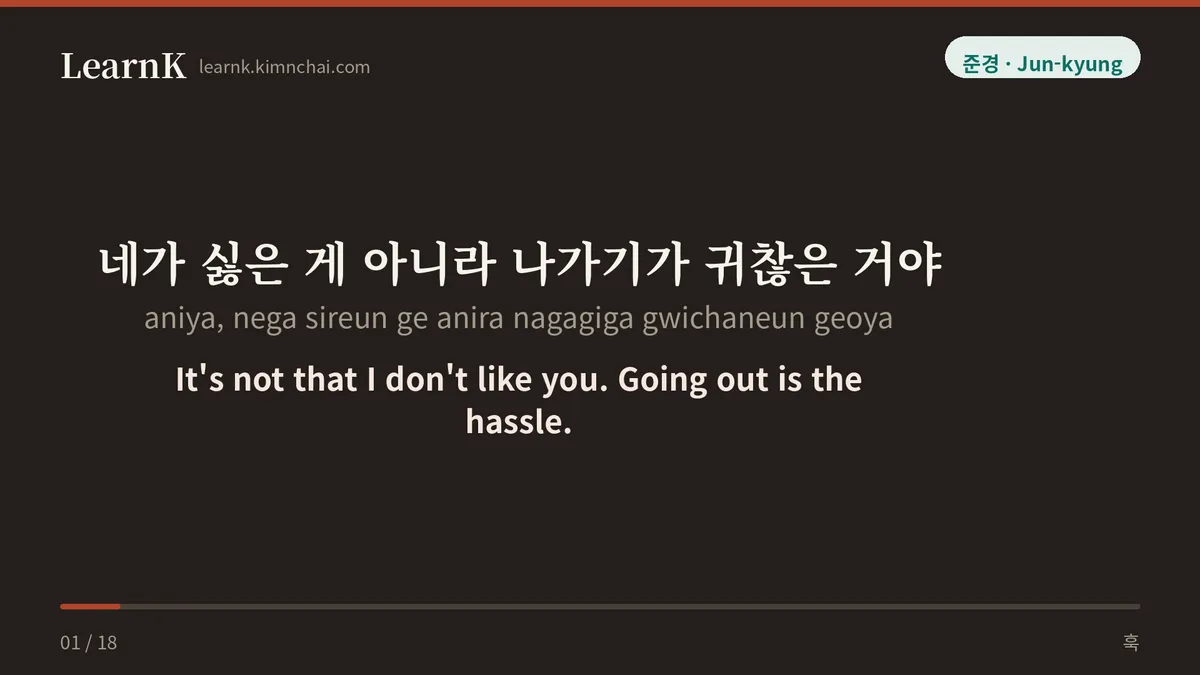
The National Institute of Korean Language’s Basic Korean Dictionary defines 귀찮다 like this:
귀찮다 (gwichanta) (adjective): 싫고 성가시다 (silgo seonggasida) — to dislike something and find it a bother. [en] feel annoyed — Disliking and feeling tired of doing something. [ja] めんどうだ【面倒だ】 — 嫌で、厄介だ。 [es] fastidioso, molesto, tedioso — Que fastidia y molesta. [zh] 麻烦,厌烦 — 不喜欢,讨厌。 — National Institute of Korean Language, Basic Korean Dictionary (krdict.korean.go.kr)
The dictionary doesn’t include a Portuguese translation, so for reference, our own rendering would be roughly chato, incômodo (귀찮은, 성가신 — gwichaneun, seonggasin). (our own translation)
Let’s also look at the real usage examples listed in the dictionary.
안내원은 화장실을 찾는 손님에게 귀찮다는 듯 턱으로 화장실 쪽을 가리킬 뿐이었다. — National Institute of Korean Language, Basic Korean Dictionary (krdict.korean.go.kr)
This sentence paints a picture of an indifferent attitude: finding it too much of a bother to kindly explain, the attendant just jerks his chin toward the restroom for the customer instead of using words. ‘귀찮다는 듯 (gwichantaneun deut)’ means “with an annoyed, put-upon expression or attitude.”
지수는 계량스푼을 사용하기 귀찮다고 눈짐작으로 소금을 넣었다가 국을 버렸다. — National Institute of Korean Language, Basic Korean Dictionary (krdict.korean.go.kr)
Here, finding the effort of measuring precisely too much of a hassle, Jisu (지수) eyeballed the salt and ended up ruining the soup. It’s a great illustration of why 귀찮다 so often becomes the excuse behind a botched task.
수박은 맛있지만 씨가 많아서 그것을 일일이 골라내는 것이 귀찮다. — National Institute of Korean Language, Basic Korean Dictionary (krdict.korean.go.kr)
This example captures exactly the nuance explained earlier — “the result is good, but the process is a hassle.”
방을 치우라는 엄마의 말에 승규는 귀찮다고 구시렁대다가 꾸중을 들었다. — National Institute of Korean Language, Basic Korean Dictionary (krdict.korean.go.kr)
A very familiar household scene: told to clean his room — something he doesn’t want to do — Seunggyu (승규) grumbles that it’s 귀찮아 and gets scolded for it.
Example Sentences by Situation (our own creations)
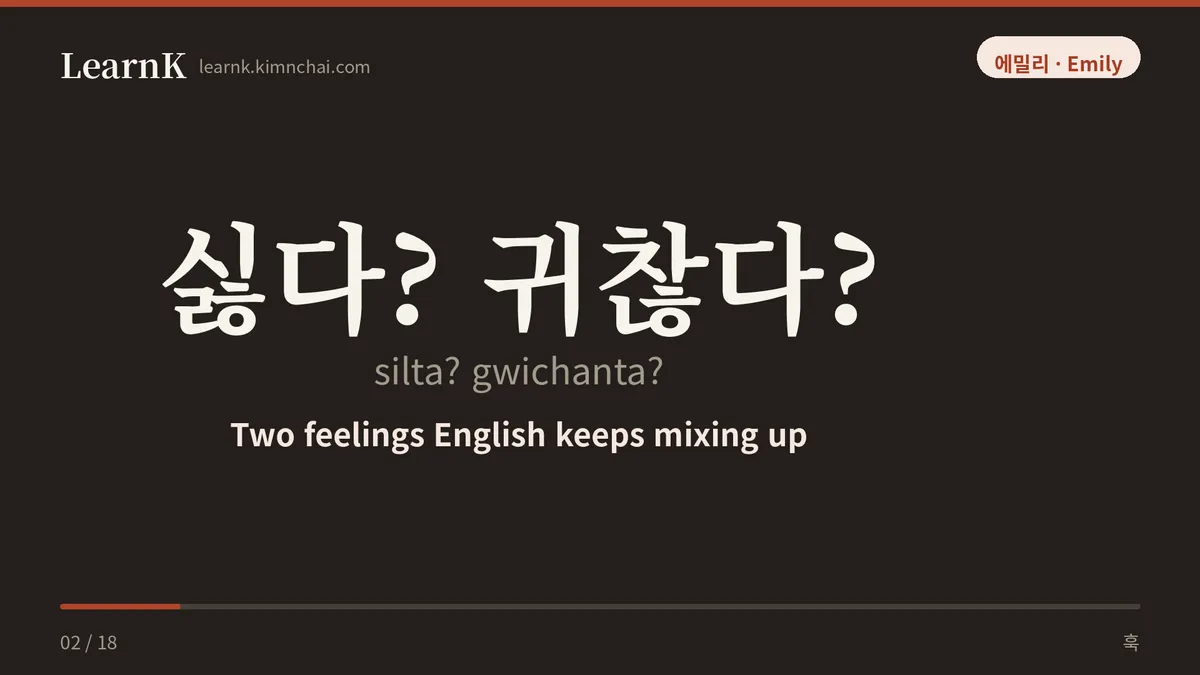
Situation 1 — Weekend morning, in bed. A friend texts to go hiking, but you don’t want to crawl out from under the covers:
오늘은 그냥 집에 있을래. 나가기 귀찮아. (oneureun geunyang jibe isseullae. nagagi gwichana.) (“I’ll just stay home today. I can’t be bothered to go out.”)
Situation 2 — In the middle of cooking. You hate the idea of dishes piling up in the sink, so you order delivery instead:
설거지하기 귀찮아서 그냥 시켜 먹었어. (seolgeojihagi gwichanaseo geunyang sikyeo meogeosseo.) (“Doing the dishes felt like too much of a hassle, so I just ordered in.”)
Situation 3 — At work (polite speech). Venting to a coworker about the tedium of repetitive tasks:
매번 보고서 양식을 새로 만드는 게 좀 귀찮네요. (maebeon bogoseo yangsigeul saero mandeuneun ge jom gwichanneyo.) (“Making a fresh report template every single time is kind of a pain.”)
Comparing Polite/Casual Forms and Similar Expressions
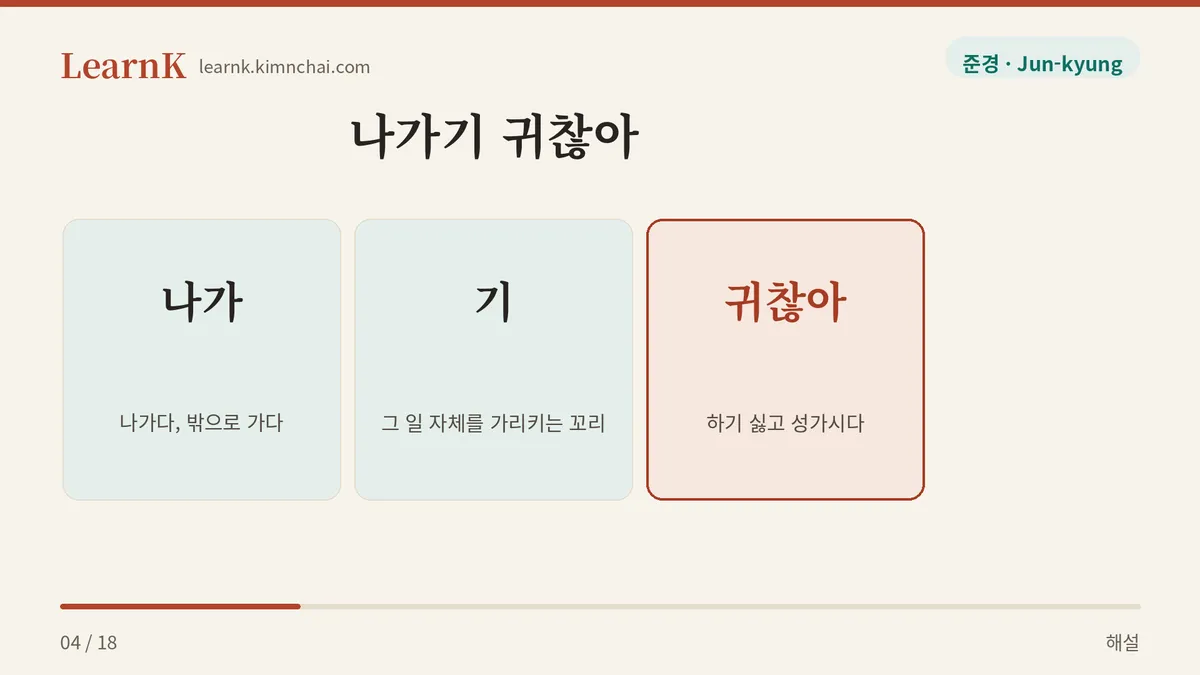
- Casual: 귀찮아 (gwichana)
- Polite: 귀찮아요 (gwichanayo) / even more formal: 귀찮습니다 (gwichanseumnida)
It’s also worth knowing some similar expressions.
- 번거롭다 (beongeoropda): means a procedure is complicated and takes a lot of effort. It carries less emotional color than 귀찮다 and is more objective. Ex: 절차가 번거롭다 (jeolchaga beongeoropda) — “the procedure is cumbersome.”
- 성가시다 (seonggasida): has a strong nuance of something (or someone) repeatedly bothering you and playing on your mind.
- 하기 싫다 (hagi silta): purely “don’t want to do it,” independent of any sense of hassle.
Cultural Background
귀찮다 is a staple line for the listless or aloof characters in dramas. A character sprawled out repeating “아, 귀찮아 (a, gwichana)” makes viewers laugh and relate at the same time. Younger generations these days even use the punny coinage ‘귀차니즘 (gwichanijeum).’ By tacking the English suffix “-ism” onto 귀찮다, it jokingly names “a disposition where everything feels like a bother.” It’s an internet buzzword that isn’t in the dictionary, but it shows just how affectionately Koreans regard this feeling.
Wrap-up Quiz
Which word fits most naturally in the blank below?
“수박은 맛있는데 씨 골라내기가 정말 ______.” (“Watermelon is delicious, but picking out the seeds is really ______.”) (a) 맛있다 (masitda) (b) 귀찮다 (gwichanta) (c) 반갑다 (bangapda)
The answer is (b) 귀찮다 (gwichanta). Remember the word’s core nuance: “the result is good, but the process is a hassle”!
Definitions and example sentences are from the National Institute of Korean Language’s Basic Korean Dictionary (krdict.korean.go.kr); that portion of this post, including our translations, is licensed under CC BY-SA 2.0 KR.