계시다 (gyesida) — The Word You Use When an Elder "Is" Somewhere
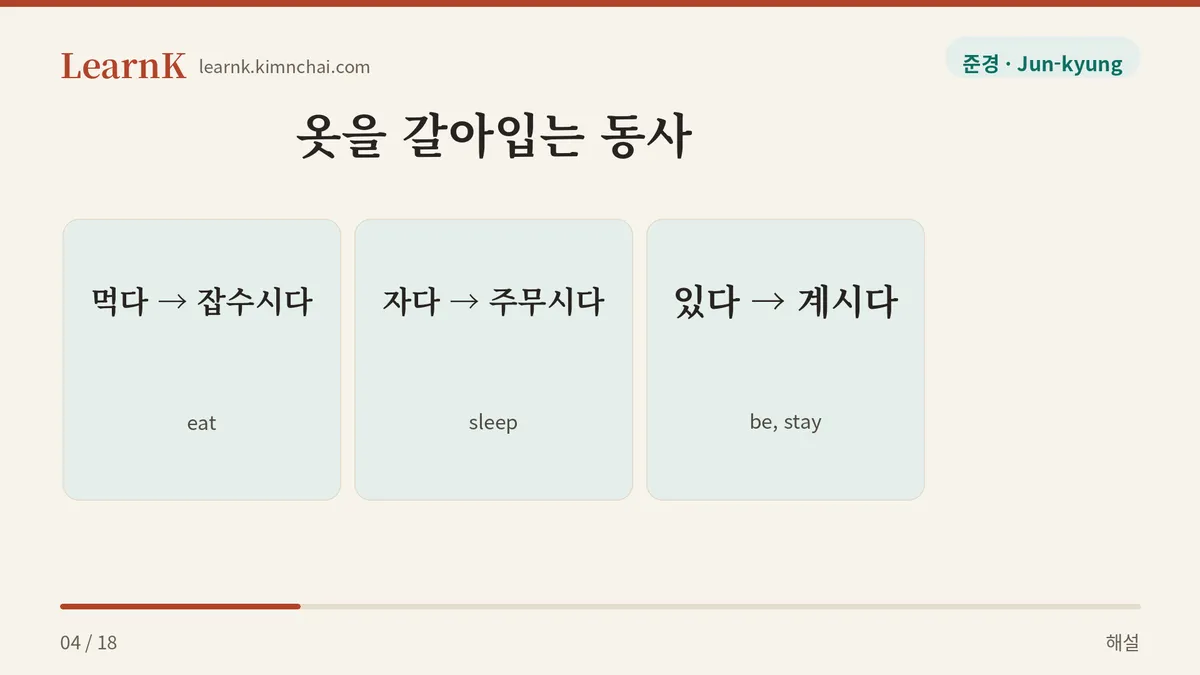
계시다 (gyesida) is the honorific way of saying that a person of high standing or an elder is in — or lives in — a certain place. It’s the honorific form of 있다 (itda), and what makes it unusual is that it doesn’t just swap out an ending: the body of the word itself changes. Korean has a handful of verbs that change clothes entirely like this — 먹다 (meokda) becomes 잡수시다 (japsusida), 자다 (jada) becomes 주무시다 (jumusida), and 있다 (itda) becomes 계시다 (gyesida).
Learners usually meet this word in one of two places. One is the parting greeting 안녕히 계세요 (annyeonghi gyeseyo); the other is the line you toss out as you push open a shop door, 사장님 계세요? (sajangnim gyeseyo?). Both appear early in textbooks, so people memorize them whole and often walk right past the fact that 계시다 is sitting inside them. But take these two greetings apart and the character of 계시다 shows itself plainly — a person, and specifically someone above you, being in a certain place.
계시다
계시다 turns up in three main situations.
First, an elder lives somewhere. As in 「부모님은 지금 부산에 계세요 (bumonimeun jigeum busane gyeseyo)」 — this is about residence.
Second, an elder is somewhere. As in 「할머니 안방에 계셔 (halmeoni anbange gyesyeo)」 — being in that spot right now. This is the most common of the three.
Third, an elder holds a position or post. 「아버지는 교육청에 계십니다 (abeojineun gyoyukcheonge gyesimnida)」 refers to affiliation and rank in a roundabout way. This third meaning is why Koreans so often ask what an adult does for a living with 「어디 계세요? (eodi gyeseyo?)」. It lands far more gently than 「무슨 일 하세요? (museun il haseyo?)」.
One condition runs through all three meanings. The subject must be a person, and that person must be someone above you. A bag doesn’t 계시다, time doesn’t 계시다, and neither do you yourself. Hold on to just this one condition and you’ve already filtered out half of all misuse.
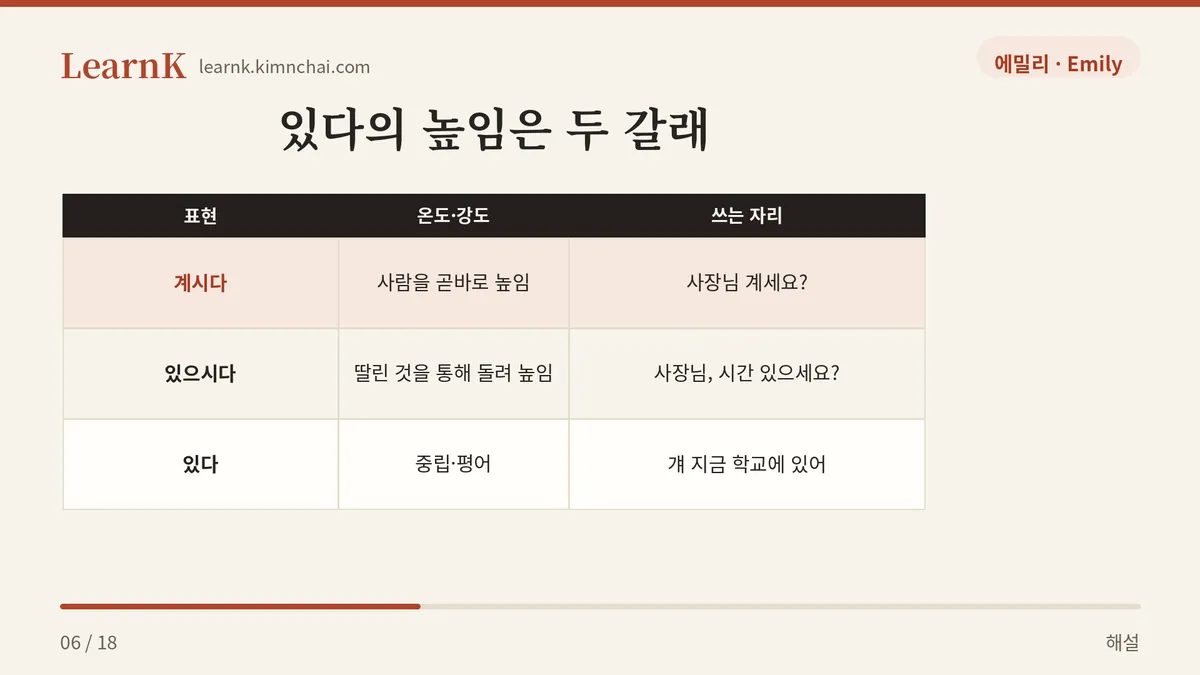
And here is the fork where learners stumble most often. The honorific of 「있다」 actually splits two ways. When you elevate the person directly, it’s 계시다; when you elevate them indirectly, through something that belongs to them, it’s 있으시다 (isseusida). 「사장님 계세요?」 asks whether the boss — the person — is there, while 「사장님, 시간 있으세요? (sajangnim, sigan isseuseyo?)」 asks whether time is something the boss has. Time isn’t a person, so it can’t 계시다. Korean grammar calls this distinction direct versus indirect honorification, but you don’t need the terms. If you’re asking “is that person physically there?”, use 계시다 — remember it that way and you’ll almost never get it wrong in practice.
Checking the National Institute of Korean Language dictionary
계시다 「verb」
- (honorific) For a person of high standing or an elder to live somewhere.
- (honorific) For a person of high standing or an elder to be somewhere.
- (honorific) For a person of high standing or an elder to hold a certain position or post. — National Institute of Korean Language, Basic Korean Dictionary (krdict.korean.go.kr)
Notice that all three definitions open with “(honorific) for a person of high standing or an elder.” This is a word with the target of the honor nailed right into its definition.
The dictionary carries translations into other languages as well.
[en] live / be — (honorific) For one’s senior or superior to live somewhere, to be somewhere, or to have position or status. [ja] いらっしゃる — 地位の高い人や目上の人がどこかに住んでいる/いる/ある位置や職位に就いていることを表す尊敬語。 [es] residir / encontrarse — (TRATAMIENTO HONORÍFICO) Vivir o estar en un lugar un superior o mayor; estar en un puesto o cargo. [zh] (尊称)身份高的人或长辈生活在某地/正在某个地方/身居某个地位或职位。 — National Institute of Korean Language, Basic Korean Dictionary (krdict.korean.go.kr)
A Portuguese translation isn’t included in this dictionary. For reference, our own rendering would be something like 「estar / morar (tratamento honorífico)」 — noted here as our translation, not the dictionary’s own text.
Let’s look at the dictionary’s actual usage examples too.
- 가만 계시다.
- 경로당에 계시다.
- 한국에 계시다.
- 회사에 계시다.
- 민준이는 자기 아버지가 고위직에 계시다며 거들먹거들먹했다. — National Institute of Korean Language, Basic Korean Dictionary (krdict.korean.go.kr)
가만 계시다 (gaman gyesida) — an elder staying put, not moving. In real life you’ll hear it more often as 「가만히 계세요 (gamanhi gyeseyo)」. Picture a nurse at a hospital telling an elderly patient 「어르신, 가만히 계세요 (eoreusin, gamanhi gyeseyo)」 and you’ve got it exactly.
경로당에 계시다 (gyeongnodange gyesida) — a 경로당 (gyeongnodang) is a senior center, the neighborhood sitting room where the local elders gather. 「할아버지 어디 가셨어? (harabeoji eodi gasyeosseo?)」 「경로당에 계셔 (gyeongnodange gyesyeo)」 is an exchange that happens several times a day in a Korean neighborhood. A textbook example of the second meaning (being in a place).
한국에 계시다 (hanguge gyesida) — here it’s closer to residence, the first meaning. It’s how a family living abroad would say 「어머니는 아직 한국에 계세요 (eomeonineun ajik hanguge gyeseyo)」.
회사에 계시다 (hoesae gyesida) — this example reads two ways. 「아버지 지금 회사에 계셔 (abeoji jigeum hoesae gyesyeo)」 means he’s at that place right now, while 「그분은 대기업에 계세요 (geubuneun daegieobe gyeseyo)」 means he belongs to and works at that company. The same words point to a place and a position at the same time.
민준이는 자기 아버지가 고위직에 계시다며 거들먹거들먹했다 (minjunineun jagi abeojiga gowijige gyesidamyeo geodeulmeokgeodeulmeokaetda) — the third meaning alive and moving inside a sentence. 「고위직에 계시다 (gowijige gyesida)」 elevates the position, and once 「거들먹거들먹 (geodeulmeokgeodeulmeok)」 — swaggering, showing off — is attached, you can picture that elevation tipping over into bragging. 계시다 itself is a neutral honorific, but used this way it exposes the speaker’s attitude.
Seeing it in real conversation
Scene: the evening before Chuseok, at the front door of Jun-kyung’s family home. Emily has come to meet his family for the first time. Slipping off her shoes, she asks in a small voice.
Emily: (quietly) 야, 어른들 지금 다 안에 계셔? Hey, are all the elders inside right now?
Jun-kyung: 응, 할머니는 안방에 계시고 아버지는 아직 회사야. 좀 늦으신대. Yeah, Grandma’s in the master bedroom and Dad’s still at work. He said he’d be late.
Emily: 그럼 할머니한테 먼저 인사드려야겠다. 뭐라고 해야 돼? Then I should greet Grandma first. What do I say?
Jun-kyung: 「안녕하세요」 하고 절 한 번. 아, 나갈 땐 「안녕히 계세요」 하는 거 알지? Just say “annyeonghaseyo” and bow once. Oh, you know to say “annyeonghi gyeseyo” on the way out, right?
Emily: 알지. 남는 사람한테 계세요, 가는 사람한테 가세요. Of course. “Gyeseyo” to the one who stays, “gaseyo” to the one who leaves.
Jun-kyung: 오, 15년 짬밥 어디 안 가네. Whoa, fifteen years here really shows.
This is how it sounds off
✗ (to the boss) 사장님, 지금 시간 계세요? ✓ (to the boss) 사장님, 지금 시간 있으세요? → 계시다 is used only when a person is present somewhere. Things attached to a person — time, a question, an appointment — get elevated indirectly with 「있으시다」. Time can’t 계시다.
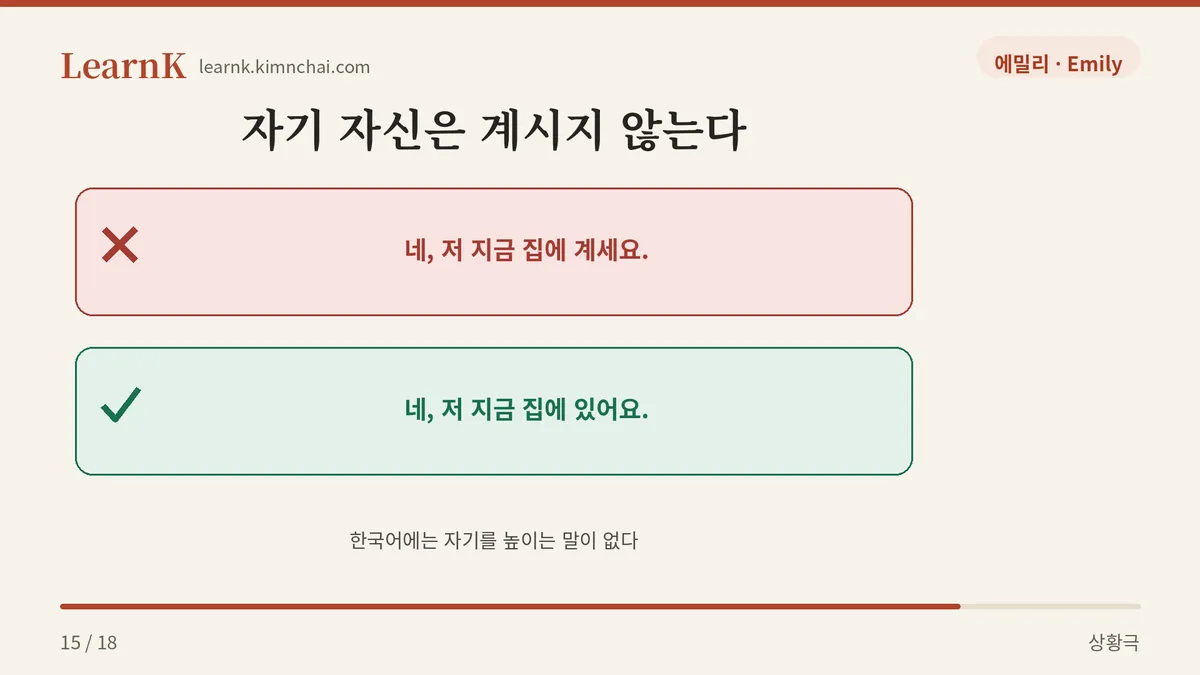
✗ (on the phone with your mother) 네, 저 지금 집에 계세요. ✓ (on the phone with your mother) 네, 저 지금 집에 있어요. → Korean has no way to elevate yourself. 계시다 is only ever for raising someone else up. Use it about yourself and the moment you meant to be humble turns comical instead.
Example sentences by situation
1) Walking in the door (a neighborhood shop)
사장님 계세요? (sajangnim gyeseyo?)
In Korean back-alley shops the owner is often sitting in a back room and comes out at the sound of someone entering. So opening the door and tossing out this one line is the natural procedure. It’s much softer than 「거기 아무도 없어요? (geogi amudo eopseoyo?)」, and it’s a greeting that already shows respect on the way in.
2) Taking a call at the office
죄송합니다, 김 부장님 지금 자리에 안 계십니다. (gim bujangnim jigeum jarie an gyesimnida.)
The standard sentence for reporting that someone is away. The negative goes in front, in the form 「안 계시다 (an gyesida)」. 「계시지 않습니다 (gyesiji anseumnida)」 is also grammatically fine, but on the phone it’s almost always 「안 계십니다」.
3) Elevating an action in progress
할아버지께서 지금 신문 읽고 계세요. (harabeojikkeseo jigeum sinmun ilkko gyeseyo.)
계시다 also attaches behind another verb as 「-고 계시다 (-go gyesida)」 to make the progressive honorific. The honorific of 「읽고 있어요 (ilkko isseoyo)」 is 「읽고 계세요」. Once you’ve picked up this usage, sentences describing an elder’s actions come out naturally in one stroke.
Polite and casual speech, and related expressions
| Expression | Tone / strength | Where it’s used |
|---|---|---|
| 계시다 (gyesida) | Elevates the person directly | When an elder or superior is in a place or position |
| 있으시다 (isseusida) | Elevates indirectly, via something they have | Time, questions, appointments — things that aren’t people |
| 있다 (itda) | Neutral, plain | Yourself, peers, juniors, objects |
| -고 계시다 (-go gyesida) | Elevates the action as well | When an elder is in the middle of doing something |
When you drop into casual speech, the form splits. Telling a friend about an elder, you keep the 계시- and lower only the ending, as in 「할머니 안방에 계셔」 — because the person being talked about is still an elder. Conversely, you don’t use 계시다 to say where a friend is — that’s 「걔 지금 학교에 있어 (gyae jigeum hakgyoe isseo)」.
Cultural background — the one who stays and the one who goes
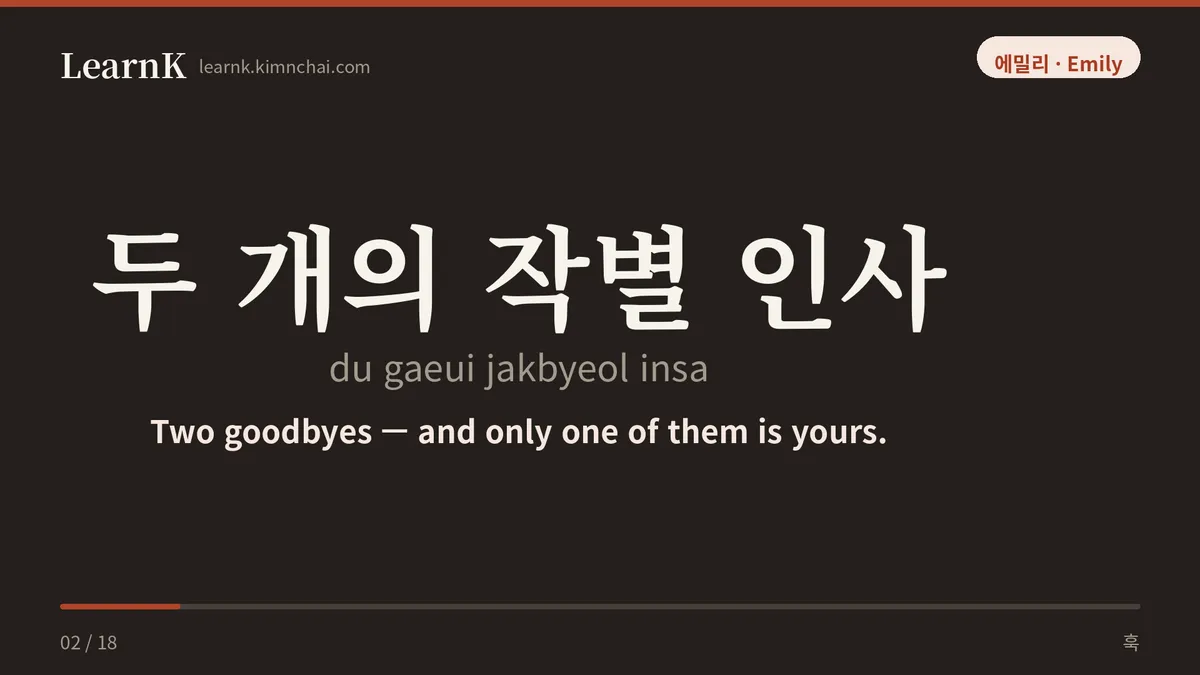
The reason Korean farewells split in two lies in exactly this word. To the person staying behind, 안녕히 계세요 (annyeonghi gyeseyo); to the person heading off, 안녕히 가세요 (annyeonghi gaseyo). They’re shortened forms of 「평안히 계십시오 (pyeonganhi gyesipsio)」 and 「평안히 가십시오 (pyeonganhi gasipsio)」. So the customer leaving a shop says 계세요, and the owner seeing the customer off says 가세요. If both parties are leaving, they trade 「안녕히 가세요」 with each other. Get this one small fork right and Koreans notice immediately — it’s exactly the point where Emily earns her compliment in the dialogue above.
The root of the form is worth a look too. 계시다 was written 「겨시다 (gyeosida)」 in older Korean — an old word meaning “to be” with the honorific -시- (-si-) fused onto it. In other words, the 「계시-」 we see today already has the honorific -시- dissolved inside it. That’s also why you never stack another one on, as in 「계시시다」.
You’ll hear this word often in dramas as well. In historical dramas a retainer asks after the king’s whereabouts with something like 「전하께서 어디 계시냐 (jeonhakkeseo eodi gyesinya)」; in contemporary dramas it shows up when someone checks carefully outside a hospital room — 「어머님 안에 계세요? (eomeonim ane gyeseyo?)」. Even just describing the scene without quoting a line, the temperature comes through — the moment 계시다 appears, the person that sentence is aimed at is someone who cannot be treated lightly.
Today’s quiz
You want to ask your boss for a moment of their time. What belongs in the blank?
사장님, 지금 잠깐 시간 ( )?
① 계세요 ② 있으세요 ③ 계십니까
Answer: ② Time isn’t a person, so 계시다 can’t be used. The right choice is 「있으세요」, which honors the boss indirectly, by way of the time. Had the sentence been 「사장님, 지금 사무실에 ( )?」, the answer would be ① 계세요. Is the thing you’re asking about the person’s physical presence, or something that belongs to them — the fork is always right here.
Definitions and example sentences are from the National Institute of Korean Language’s Basic Korean Dictionary (krdict.korean.go.kr); that portion of this post, including our translations, is licensed under CC BY-SA 2.0 KR.