재택근무 (jaetaekgeunmu) — How to Say "I Work from Home" in Korean
재택근무 (jaetaekgeunmu)
재택근무 (jaetaekgeunmu) means doing your company’s work from home, using the internet and similar tools. If you’ve ever spotted an office worker in sweats picking out an iced coffee at a neighborhood convenience store at three o’clock on a weekday afternoon, that person could probably explain their entire day with this single word. “저 오늘 재택근무예요 (jeo oneul jaetaekgeunmuyeyo)” — “I’m working from home today.” That one line explains everything at once: why they’re here at this hour, why they’re carrying a laptop bag, and why they have to rush home in thirty minutes.
There’s a particular reason this word matters if you’re learning Korean. If you work in Korea, make weekday plans with Korean friends, or exchange emails with a Korean company, this word comes up almost every week. But if you memorize only the dictionary definition and use it from there, it’s easy to miss the mark — because this word doesn’t point to “a day off,” it points to “the same work, just in a different place.” That one distinction is the heart of today’s post.
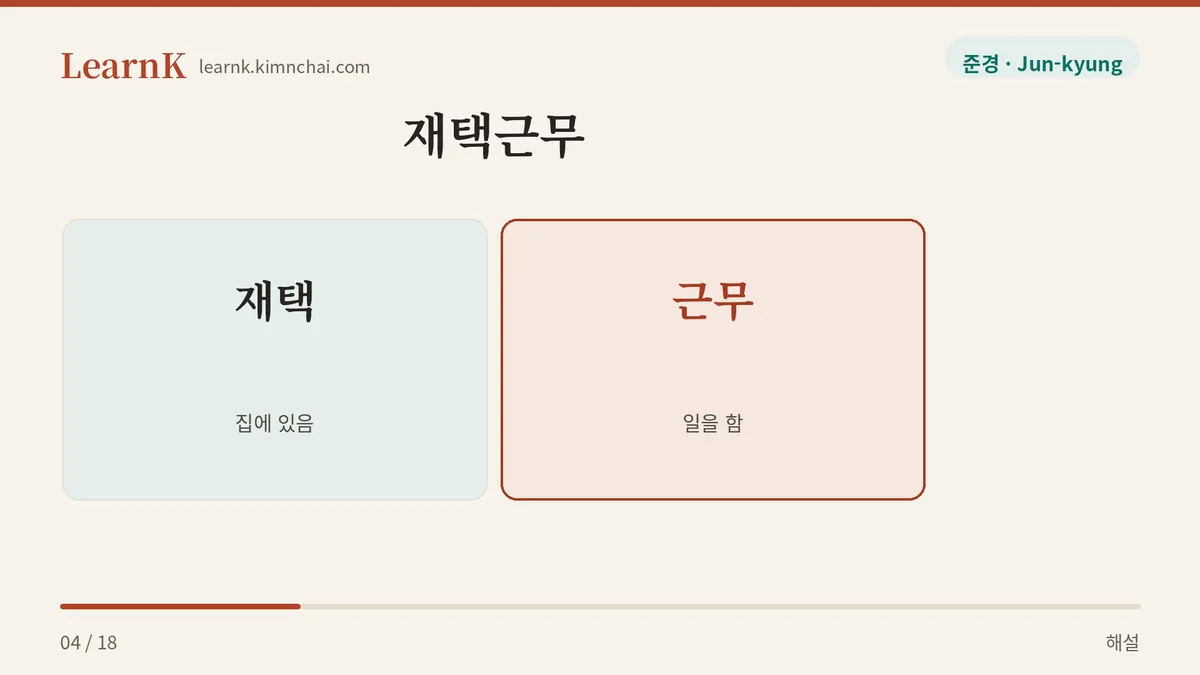
The structure is simple. 재택 (jaetaek) comes from the Chinese characters 在宅, meaning “being at home,” and 근무 (geunmu) is 勤務, “doing one’s work.” Stick them together and you get “work done while at home.” Those last two syllables, 근무, set the temperature of the whole word. It’s a declaration that you’re not off having fun — you’re working.
In tone, it’s neutral and mildly businesslike. It appears word for word in official company announcements, and it’s perfectly normal to say to a friend in casual speech, “나 오늘 재택근무야 (na oneul jaetaekgeunmuya)” — “I’m working from home today.” It isn’t as light as slang, and being a Sino-Korean word doesn’t make it feel stiff either; it sits in a comfortable middle. In real conversation, people very often lop off the ending and just say 재택 (jaetaek). In fact, “나 내일 재택이야 (na naeil jaetaegiya)” is heard more often than “나 내일 재택근무야 (na naeil jaetaekgeunmuya).”
Checking It in the National Institute of Korean Language Dictionary
재택근무 (jaetaekgeunmu) 「noun」 인터넷 등을 이용해 집에서 회사의 업무를 보는 일. [en] telecommuting — The act of working from home by using the Internet, etc. [ja] ざいたくきんむ【在宅勤務】 — インターネットなどを利用して、自宅で会社の業務をすること。 [es] teletrabajo — Trabajo de la empresa que se realiza en el hogar utilizando herramientas como internet. [zh] 居家办公 — 通过网络等在家里做公司业务。 — National Institute of Korean Language, Basic Korean Dictionary (krdict.korean.go.kr)
The Portuguese definition isn’t included in the dictionary, so the following is our own rendering (our translation): teletrabalho — o trabalho da empresa feito em casa com o uso da internet.
The part of the definition worth noticing is the condition “인터넷 등을 이용해 (using the internet, etc.).” A hand-worked side job at home or a cottage industry doesn’t get called by this word. It’s used when someone who belongs to a company handles that company’s work from home while connected over a network.
Below are the dictionary’s actual usage examples, quoted as they appear, with a note on the kind of setting each one comes from.
저번에 고민했던 재택근무는 하기로 한 거야? — National Institute of Korean Language, Basic Korean Dictionary (krdict.korean.go.kr)
(“So did you decide to go ahead with the work-from-home thing you were thinking about?”) This is casual speech traded between friends or close colleagues. The word 고민했던 (“that you were mulling over”) reveals the character of the term: working from home isn’t something the company hands down unilaterally, nor something you decide alone — it’s treated as an option you settle on in discussion with your company.
재택근무가 늘어나면서 회사에서 비대면 회의를 하는 경우가 많아졌다. — National Institute of Korean Language, Basic Korean Dictionary (krdict.korean.go.kr)
(“As working from home has increased, companies are holding more non-face-to-face meetings.”) This is written-style prose you’d expect in a news article or a report. Here the companion word 비대면 (bidaemyeon), “non-face-to-face,” shows up alongside it. If 재택근무 is about where you work, 비대면 is about how you meet. The two travel together like a matched set.
지수의 회사는 재택근무를 위한 인프라를 마련했다. — National Institute of Korean Language, Basic Korean Dictionary (krdict.korean.go.kr)
(“Ji-su’s company put in place the infrastructure for working from home.”) This sentence is about a company’s policies and equipment, not one person’s day. Laptops, internal network accounts, video conferencing software — those are what “인프라 (infrastructure)” refers to. What matters here is that the subject of the sentence isn’t a person but 회사 (“the company”).
재택근무를 확대하다. / 재택근무를 하다. / 재택근무를 채택하다. / 재택근무를 요구하다. / 재택근무가 가능하다. — National Institute of Korean Language, Basic Korean Dictionary (krdict.korean.go.kr)
This list teaches you the particle usage in one shot. Before 하다 (do), 확대하다 (expand), 채택하다 (adopt), and 요구하다 (request), you use 을/를; before 가능하다 (be possible), you use 이/가. And each verb pairs with a different kind of subject. When the company is the subject, you get 채택하다 and 확대하다; when an employee is the subject, you get 하다 and 요구하다. Memorize just this, and most of your sentences will build themselves.
A Real Conversation
Situation: 3 p.m. on a weekday, at the usual in-person handoff spot in front of an apartment complex for secondhand sales. Jun-kyung has come out to sell a monitor stand he no longer uses.
Jun-kyung: 어? 에밀리? 너 이 시간에 웬일이야, 회사 안 갔어? Huh? Emily? What are you doing here at this hour — didn’t you go in to work?
Emily: 나 이번 주부터 재택근무야. 점심 먹고 잠깐 나온 거지. I’ve been working from home since this week. I just stepped out after lunch.
Jun-kyung: 아 좋겠다. 우리 팀은 주 이틀만 재택근무 하고 나머지는 무조건 출근이야. Ah, lucky you. My team only works from home two days a week — the rest we have to come in.
Emily: 이틀이 어디야. 근데 집에서 일하면 자꾸 냉장고 열게 되지 않아? Two days is plenty. But when you work at home, don’t you keep opening the fridge?
Jun-kyung: 어, 그래서 나는 재택근무 하는 날도 일부러 아침에 옷 갈아입어. 안 그러면 하루 종일 늘어져. Yeah — that’s why even on my work-from-home days I deliberately change out of my pajamas in the morning. Otherwise I slouch all day.
Emily: 야, 그거 진짜 맞는 말이다. 아, 이거 받침대 맞지? 잘 쓸게! Hey, that is so true. Oh — this is the stand, right? Thanks, I’ll put it to good use!
Saying It This Way Sounds Off
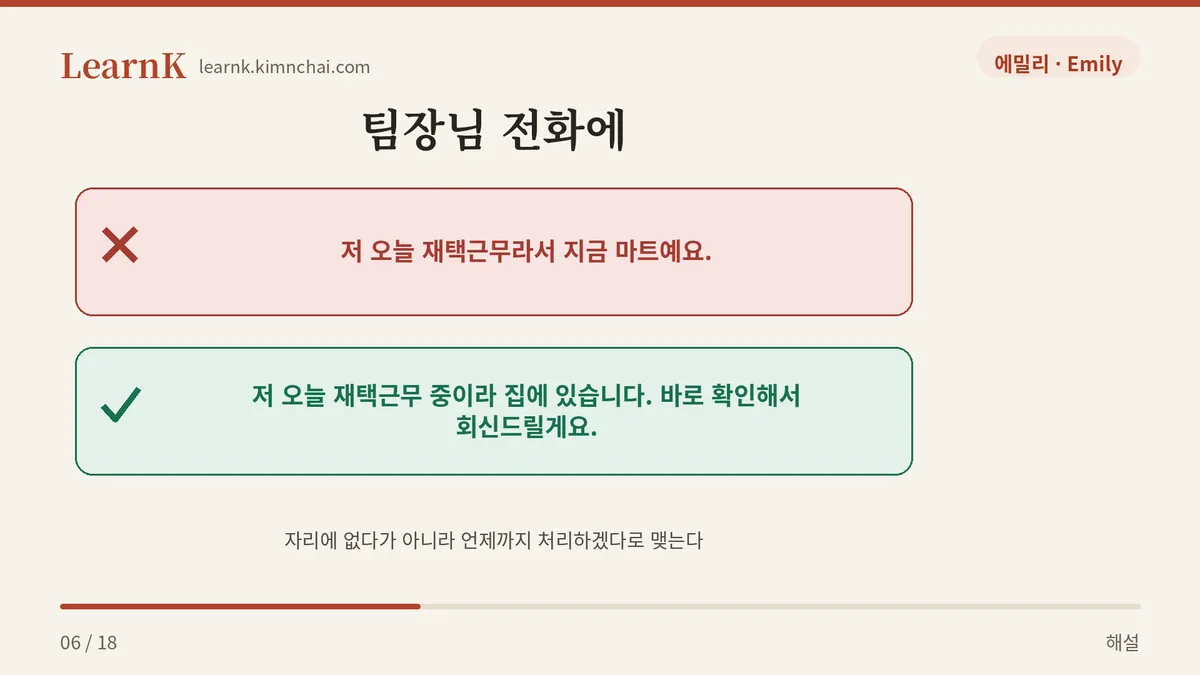
✗ (on a call with your team lead) 저 오늘 재택근무라서 지금 마트예요. 이따 밤에 볼게요. (“I’m working from home today, so I’m at the supermarket right now. I’ll check tonight.”) ✓ (on a call with your team lead) 저 오늘 재택근무 중이라 집에 있습니다. 지금 바로 확인해서 회신드릴게요. (“I’m working from home today, so I’m at home. I’ll check right away and get back to you.”) → 재택근무 is work, not vacation. The first sentence sounds like a declaration that today is a no-work day, and regardless of what the speaker meant, it turns into an attendance issue. Even if you have stepped out for a moment, it’s safer to close with “here’s when I’ll take care of it” rather than “I’m not at my desk right now.”
✗ (as the first question in a job interview) 저는 재택근무만 하고 싶은데, 가능한가요? (“I only want to work from home — is that possible?”) ✓ (as the last question in a job interview) 혹시 재택근무 제도는 어떻게 운영되고 있는지 여쭤봐도 될까요? (“May I ask how your work-from-home policy is run?”) → Both are grammatically fine. What’s off is the setting. The first sets out a condition, which sounds rigid in a room where you don’t know each other yet; the second asks about a policy, so it gets the same information across while staying polite. In Korean, turning what you want from a demand into a question drops the temperature dramatically.
Example Sentences by Situation
1) The one-liner you post in the team chat in the morning
When you start work at home instead of going in, it’s customary at Korean companies to give a short heads-up in the morning. No need to write a lot — two sentences is plenty.
오늘은 재택근무합니다. 급한 일 있으시면 전화 주세요. (oneureun jaetaekgeunmuhamnida. geuphan il isseusimyeon jeonhwa juseyo.) I’ll be working from home today. Please call me if anything urgent comes up.
“전화 주세요 (please call me)” is the key part. It means you’re reachable even though you’re at home, which puts the other person at ease.
2) When a friend suggests meeting during the day on a weekday
In Korea, weekday lunch plans usually get set near the office. If you’re home that day, here’s how to say it.
나 수요일엔 재택이라 점심때 잠깐 나올 수 있어. (na suyoiren jaetaegira jeomsimttae jamkkan naol su isseo.) I’m working from home on Wednesday, so I can pop out for lunch.
Here 재택근무 has been shortened to 재택 (jaetaek). Between friends, this version is far more natural. The word 잠깐 (“for a moment”) matters too — that one word carries the meaning that you’re on the clock and can’t stay long.
3) When checking on the policy at a new company
저희 팀도 재택근무가 가능한가요? (jeohui timdo jaetaekgeunmuga ganeunghangayo?) Is working from home an option for our team as well?
If you ask 재택근무가 가능한가요 (“is working from home possible”) rather than 재택근무를 하고 싶습니다 (“I want to work from home”), the sentence asks about the company’s policy instead of your personal wish. It’s the dictionary’s example phrase 재택근무가 가능하다, alive and in use exactly as listed.
Polite and Casual Forms, and Similar Expressions
재택근무 is a noun, so there’s no honorific level built into the word itself. The politeness is decided by the predicate that follows. In formal settings you say 재택근무합니다 (jaetaekgeunmuhamnida); for soft polite speech, 재택근무해요 (jaetaekgeunmuhaeyo); with friends, 재택근무해 (jaetaekgeunmuhae) or, cutting it off as a noun, 재택이야 (jaetaegiya). As a side note, it’s perfectly natural to add the honorific -시- when asking a superior: “부장님, 오늘 재택근무하세요? (Director, are you working from home today?)”
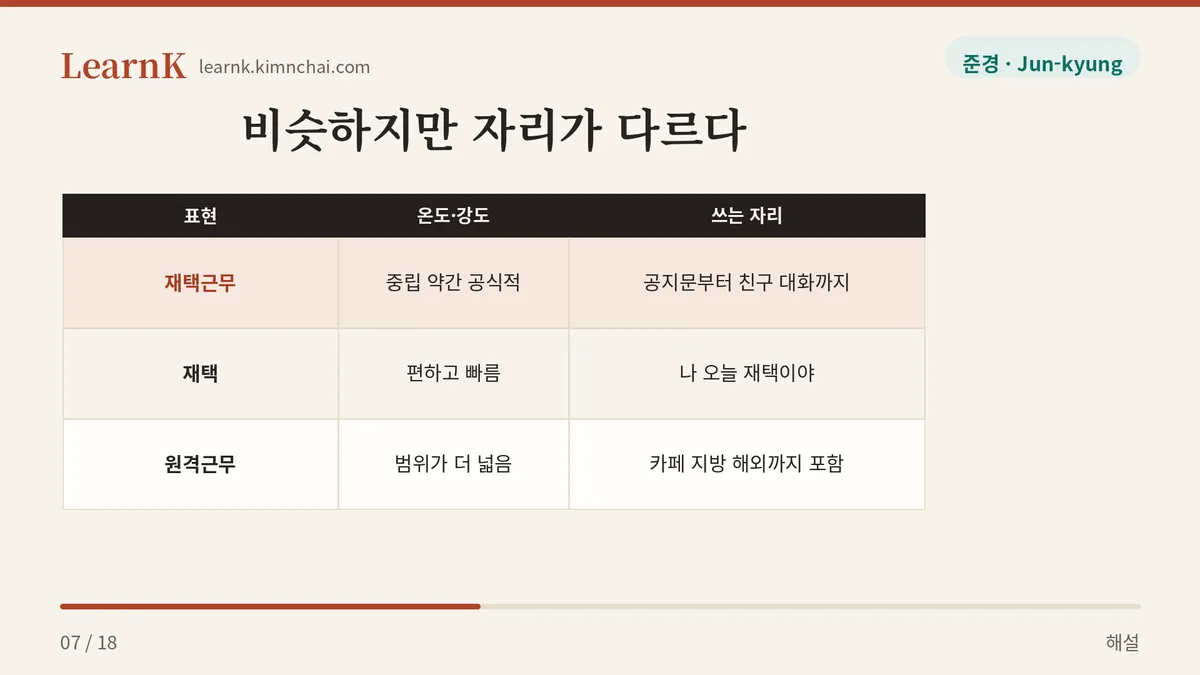
Here’s a comparison of expressions that look similar but belong in different places.
| Expression | Tone / strength | Where it’s used |
|---|---|---|
| 재택근무 (jaetaekgeunmu) | Neutral, slightly official | Anywhere — from announcements and contracts to chats with friends |
| 재택 (jaetaek) | Easy and quick | Among colleagues and friends. “나 오늘 재택이야” |
| 원격근무 (wongyeokgeunmu) | Neutral, broader in scope | Covers working from a café, another region, or overseas — not just home |
| 비대면 (bidaemyeon) | A word for the method | Attaches to meetings, classes, medical appointments. Not a work arrangement itself |
| 출근 (chulgeun) | The exact opposite | Going in to the office. “내일 재택이야, 출근이야?” |
The pair people mix up most is 재택근무 and 원격근무. 재택근무 nails down “home,” while 원격근무 is the wider word that takes in anywhere that isn’t the office. If you’ve opened your laptop at a guesthouse on Jeju Island, that’s 원격근무, not 재택근무.
Cultural Background — The Day the Dining Table Becomes a Desk
Read the Chinese characters straight through and the meaning of this word is right there. 在宅 (재택) says “at home,” and 勤務 (근무) says “applying yourself to work.” Because the Sino-sphere shares the same characters, the dictionary lists the Japanese definition as 在宅勤務 and the Chinese as 居家办公. For a Korean learner, remembering just those two chunks means you’ll never forget what the word means.
The moment this word became everyday language in Korea is relatively easy to pinpoint. Somewhere past 2020 it turned into a fixture of company announcements; a term that until then had been used only in certain industries is now one your parents’ generation knows. As a result, the word carries a distinctive whiff of daily life. Homes in Korean cities generally aren’t large, so the real scene of 재택근무 is often not a study but the dining table. In the morning you clear away the rice bowls and set down a laptop, and that spot becomes an office; come evening, it’s the dinner table again. The fact that workspace and rest space overlap accounts for half of any Korean conversation about working from home.
The other half is response time. At the office, simply sitting at your desk makes it visible that you’re working; at home, that visibility disappears. So even a slightly delayed reply on the messenger app nags at you — and conversely, it gets hard to close the laptop even after quitting time. That’s exactly why Korean office workers split roughly down the middle when asked whether working from home is easier. You save the commute, but you have to draw the line between work and life yourself. When Jun-kyung says in the dialogue that he goes to the trouble of changing clothes even on work-from-home days, that’s a method plenty of real people use.
In Korean office dramas made after 2020, there’s been a marked rise in scenes built entirely around a video call screen: faces laid out in a grid, each in front of a different home background, someone talking to themselves without realizing their mic is off. The very fact that this scene now feels familiar is proof that working from home has moved into everyday Korean life.
Today’s Quiz
It’s two o’clock on a weekday afternoon and your team lead calls. “지금 어디예요? (Where are you right now?)” You’re working from home today — what’s the most natural answer you can give?
① 오늘 재택근무라서 지금 놀고 있어요. (“I’m working from home today, so I’m just goofing off right now.”) ② 오늘 재택근무 중이라 집에서 자료 정리하고 있었습니다. (“I’m working from home today, so I was organizing some materials here at home.”) ③ 오늘 재택근무라서 회사에 없습니다. 내일 얘기해요. (“I’m working from home today, so I’m not at the office. Let’s talk tomorrow.”)
The answer is ②. Because 재택근무 is work in a different location, not a day off, telling the other person what you were actually working on is the way to use this word properly. ① erases the 근무 (“work”) part of the word, and ③ is grammatically correct but sounds like you’re cutting off contact, which doesn’t fit the situation. If you can feel the difference between these three sentences, today’s expression is fully yours.
Definitions and example sentences are from the National Institute of Korean Language’s Basic Korean Dictionary (krdict.korean.go.kr); that portion of this post, including our translations, is licensed under CC BY-SA 2.0 KR.