Jipdeuri (집들이): Korea's Warm Custom of Inviting Friends to a New Home
When Koreans finish moving into a new apartment and are done unpacking, they often say something like this: “When are you going to have your 집들이 (jipdeuri)?” This custom—inviting close friends over to your new place, showing them around, and sharing delicious food together—is a Korean expression of 정(情) (jeong), the warmth of sharing a new beginning with the people around you. Today, let’s take a deep look at this word that any fan of Korean culture has probably heard at least once in a drama.
집들이
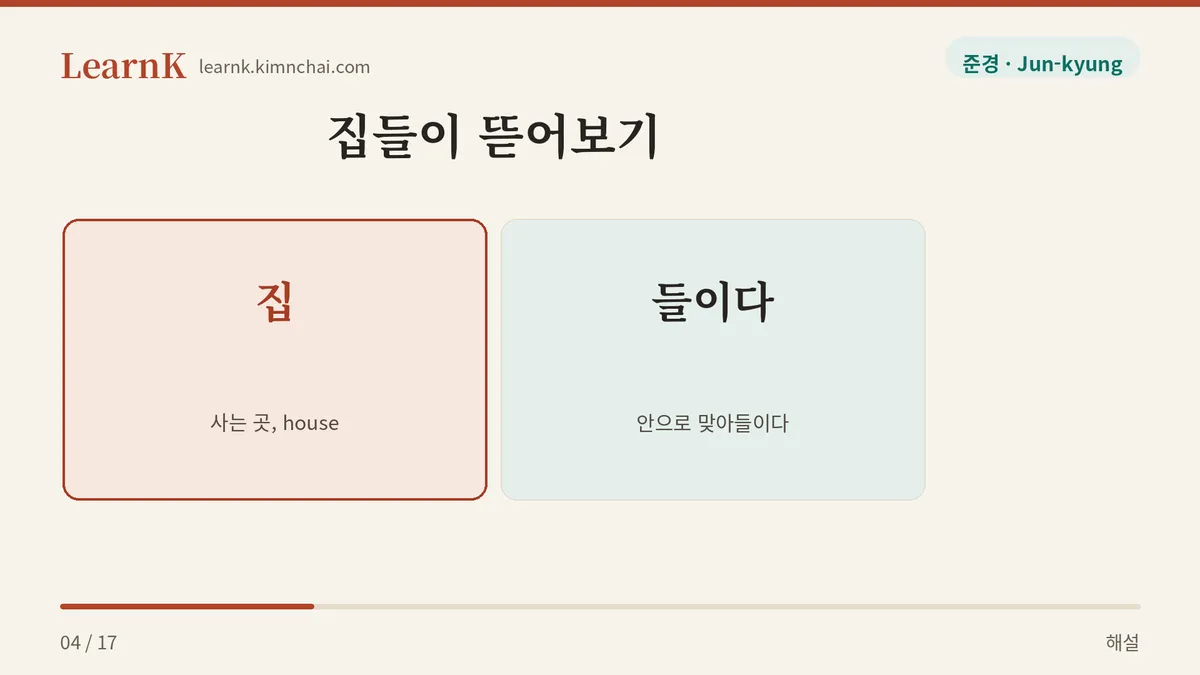
집들이 (jipdeuri) is a combination of ‘집’ (house) and ‘들이다’ (to welcome someone in), carrying the meaning of welcoming people into your new home. It’s not just a party—it’s an occasion to announce “We live here now” and to share good fortune. That’s why invited guests don’t come empty-handed; they bring a gift. As a side note, in Portuguese it could be rendered as something like festa de inauguração da casa nova, but this translation isn’t in the dictionary—it’s one we came up with ourselves.
Checking the National Institute of Korean Language Dictionary
First, let’s look at the definition from an authoritative national institution’s dictionary.
집들이 (noun): The act of inviting close friends over after moving, showing them around the house, and serving them food. [en] housewarming party [ja] 引っ越し祝い [es] fiesta de estreno de una nueva casa [zh] 乔迁宴 — National Institute of Korean Language, Basic Korean Dictionary (krdict.korean.go.kr)
Let’s also look at the real usage examples the dictionary provides.
내가 그날은 친한 친구의 집들이를 가기로 했어. 다음 주는 어때? (naega geunareun chinhan chinguui jipdeurireul gagiro haesseo. daeum jueun eottae?) — National Institute of Korean Language, Basic Korean Dictionary (krdict.korean.go.kr)
This is a situation where a friend’s 집들이 invitation clashes with another appointment, so the speaker is trying to push things back to next week. There’s a nuance here that a 집들이 is a precious commitment—not something you can easily postpone.
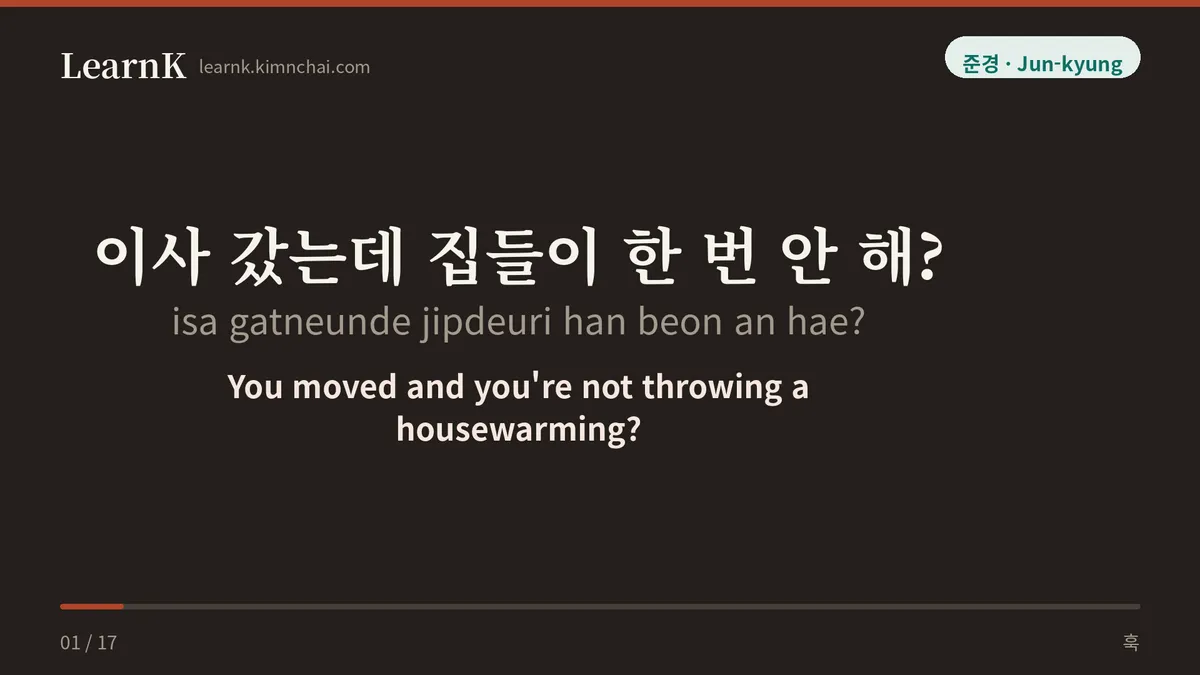
이사 갔는데 집들이 한 번 안 해? (isa gatneunde jipdeuri han beon an hae?) — National Institute of Korean Language, Basic Korean Dictionary (krdict.korean.go.kr)
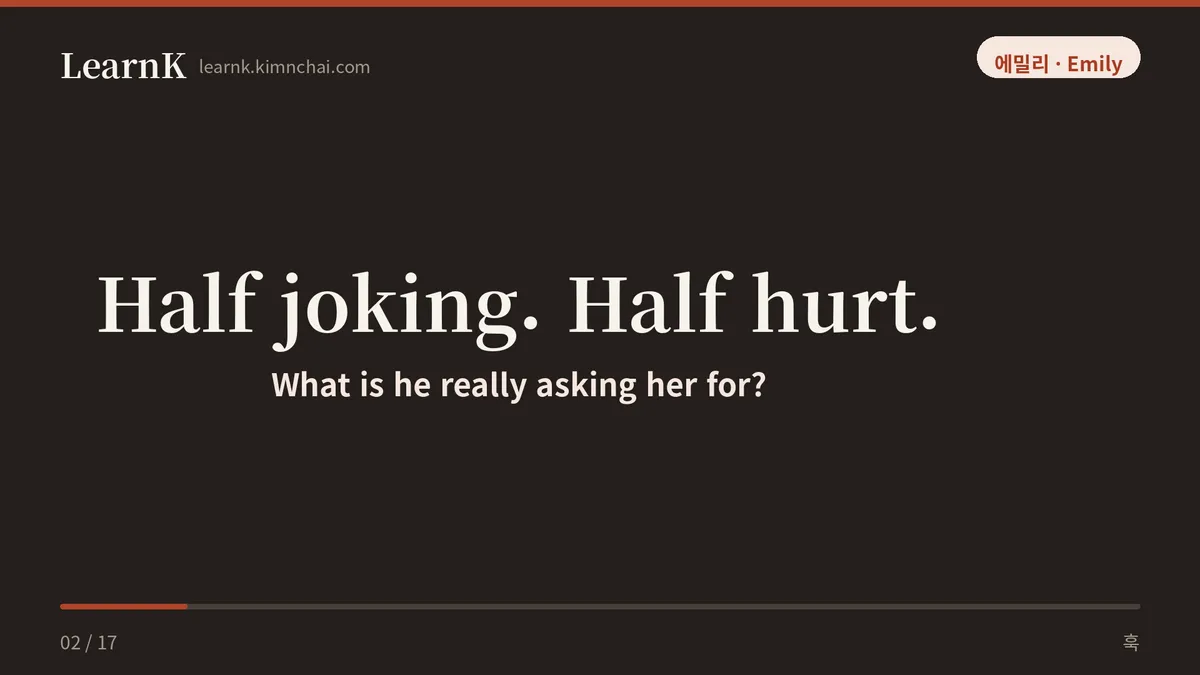
This is what a friend says when they hear you’ve moved—half hurt, half joking—as if to ask, “Why aren’t you inviting us?” It shows that a 집들이 is a cultural step people naturally expect.
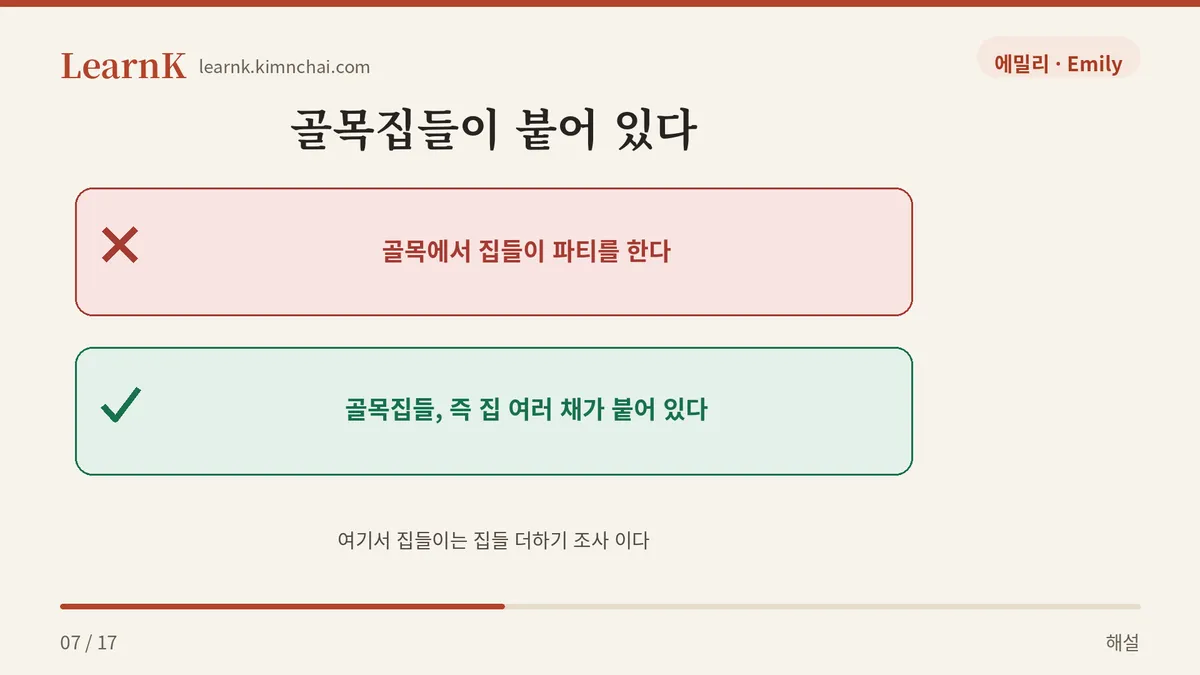
There’s one thing to watch out for. In dictionary examples like “그 동네는 게딱지 같은 집들이 다닥다닥 늘어서 있었다” (that neighborhood had crab-shell-like houses crammed together in a row) or “좁은 골목을 따라 골목집들이 붙어 있다” (alley houses are packed together along the narrow lane), the ‘집들이’ is not today’s expression—it’s the plural of ‘집’ (house), ‘집들’, with the particle ‘이’ attached. Even though it sounds the same, the meaning is completely different, so you’ll need to practice telling them apart by context.
Example Sentences by Situation
Let’s get a feel for how it’s used with some examples we made ourselves.
- 집들이에 뭐 사 갈까? (jipdeurie mwo sa galkka?) — What should I buy to bring to the housewarming? A guest wondering what gift to bring.
- 이번 주말에 집들이 하니까 꼭 와요. (ibeon jumare jipdeuri hanikka kkok wayo.) — We’re having a housewarming this weekend, so please be sure to come. The host politely inviting a guest.
- 집들이 음식으로 잡채랑 전을 준비했어요. (jipdeuri eumsigeuro japchaerang jeoneul junbihaesseoyo.) — I prepared japchae and jeon for the housewarming food. Introducing the menu while setting the table for guests.
Formal vs. Casual Speech and Similar Expressions
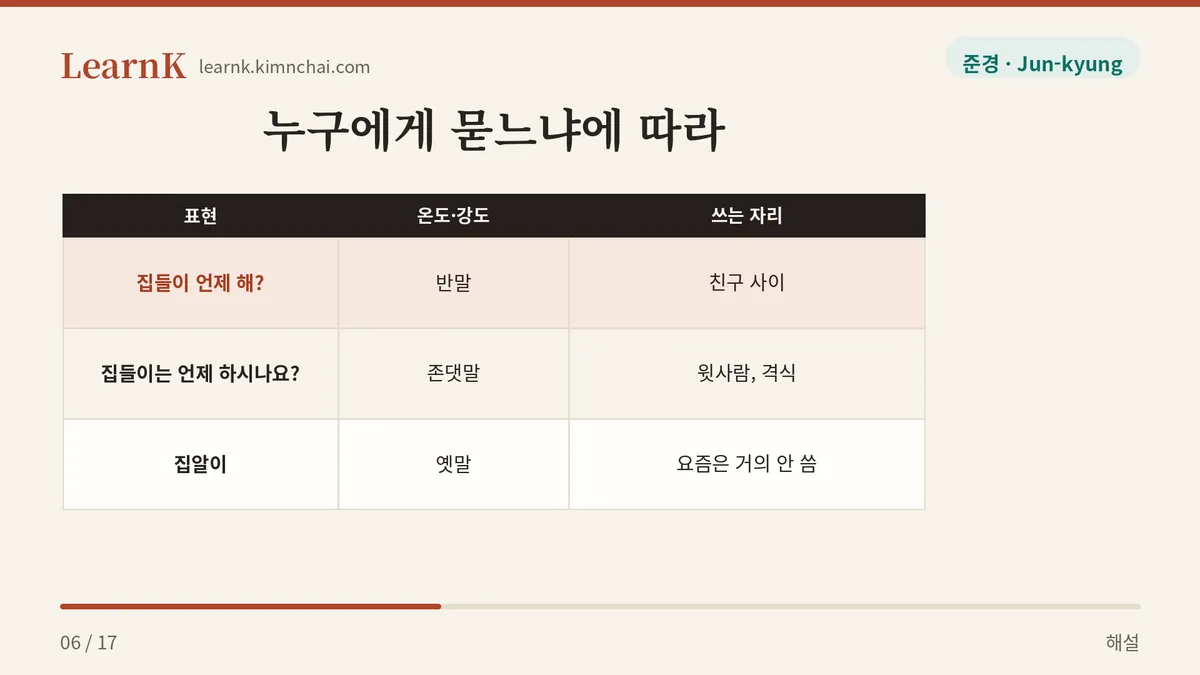
Between friends, you’d say it casually, like “집들이 언제 해? (jipdeuri eonje hae?)”, while with someone older or in a formal setting, you’d say “집들이는 언제 하시나요? (jipdeurineun eonje hasinayo?)”. A similar word is ‘집알이 (jibari)’, which referred to visiting someone’s new home in advance to learn where it was located—but it’s rarely used today, having been merged into the single word 집들이.
Cultural Background
There’s fun symbolism behind 집들이 gifts. Detergent (soap) carries the wish that your wealth will multiply the way bubbles foam up, and rolls of toilet paper carry the wish that everything will unroll smoothly—both have long been classic gifts. In dramas, too, you often see the main character knocking on the door of a new home holding a bundle of toilet paper, which reads to viewers as a signal: “Ah, it’s a housewarming.” These days people also give potted plants or coffee sets, but the heart behind it—wishing someone good fortune—is the same now as it was in the past.
Wrap-up Quiz
You’ve heard that a friend has moved into a new apartment. When you’re invited over to tour their home and are served food, what is that gathering called in Korean? (Hint: it’s the three-syllable word we learned today.)
Answer: 집들이 (jipdeuri)!
Definitions and example sentences are from the National Institute of Korean Language’s Basic Korean Dictionary (krdict.korean.go.kr); that portion of this post, including our translations, is licensed under CC BY-SA 2.0 KR.