부럽다: Saying "I Wish That Were Me" in a Single Word
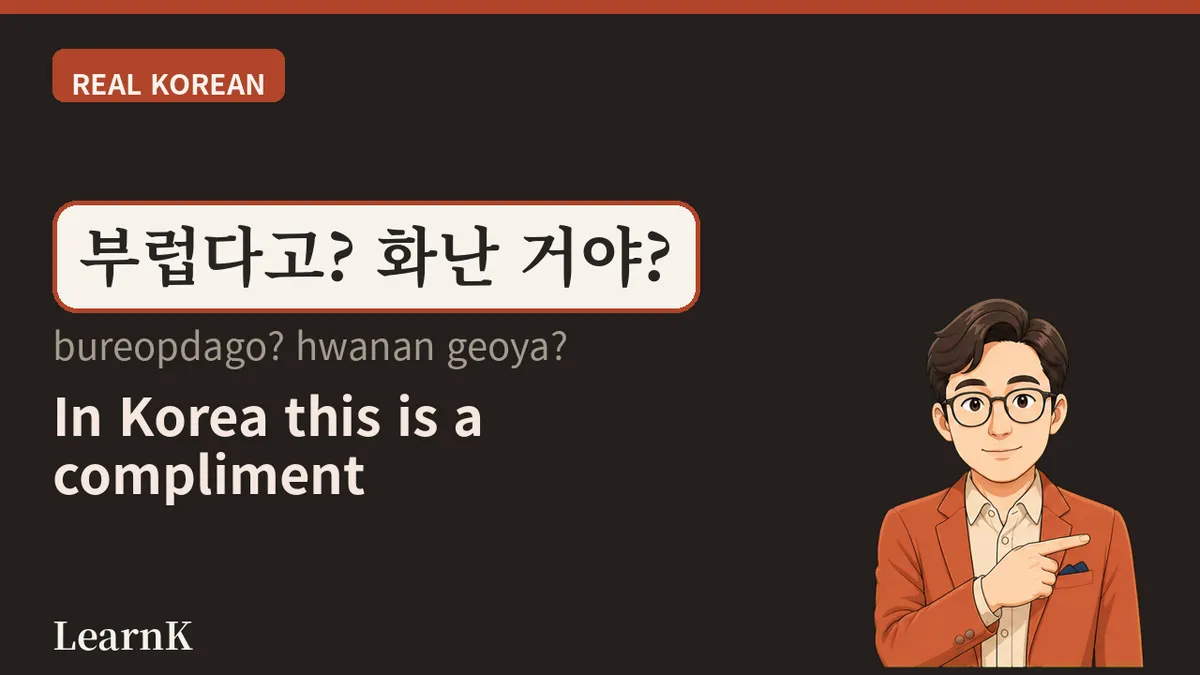
When a friend pulls out a new phone, when a coworker comes first on an exam, when you see someone’s travel photos on social media — there’s that feeling that quietly wells up inside. “Ah, I wish that were me.” In that moment, Korean people toss out one very short, simple word. It’s 부럽다 (bureopda).
Today we’ll take a deep look at an emotion adjective that Koreans use several times a day: 부럽다 (bureopda).
부럽다
부럽다 (bureopda) is an adjective you use when something another person has, has achieved, or the situation they’re in looks so good that you feel “I want that too, I want to be like that too.” It’s close to envious or I’m jealous in English, but Korean 부럽다 (bureopda) is far lighter and warmer. It isn’t a negative feeling of resenting or putting the other person down — rather, it’s closer to an affectionate exclamation that acknowledges them: “You’re so lucky!”
That’s why in Korea, people use 부럽다 (bureopda) almost like a compliment. When a friend shares good news, answering “우와, 부럽다! (uwa, bureopda!)” is a natural expression of both congratulation and empathy.
Checking with the National Institute of Korean Language Dictionary
The National Institute of Korean Language’s Basic Korean Dictionary defines 부럽다 like this:
부럽다 (adjective): 다른 사람의 일이나 물건이 좋아 보여 자기도 그런 일을 이루거나 물건을 갖기를 바라는 마음이 있다. [en] envious of — Desiring to achieve or possess the same kind of feat or thing that others have achieved or possess because they look good. [ja] うらやましい【羨ましい】 — 他人の状態や所有物を見て、自分もそうありたいとかそれを手に入れたいと願う気持ちがある。 [zh] 羡慕,眼馋 — 别人的事情或东西看起来很好时心里希望自己也能够做成那件事或得到那个东西。 — National Institute of Korean Language, Basic Korean Dictionary (krdict.korean.go.kr)
The heart of the definition is “because it looks good” and “a feeling of wanting it too.” In other words, it’s an emotion that holds both a positive judgment of the object and your own wish. Shall we look at some real example sentences the dictionary provides?
민준이는 이번 시험에서도 일 등을 했대. 정말 부럽다. — National Institute of Korean Language, Basic Korean Dictionary (krdict.korean.go.kr)
This is a situation of admiring and envying a friend’s news of a good grade. Adding ‘정말 (jeongmal)’ emphasizes the emotion.
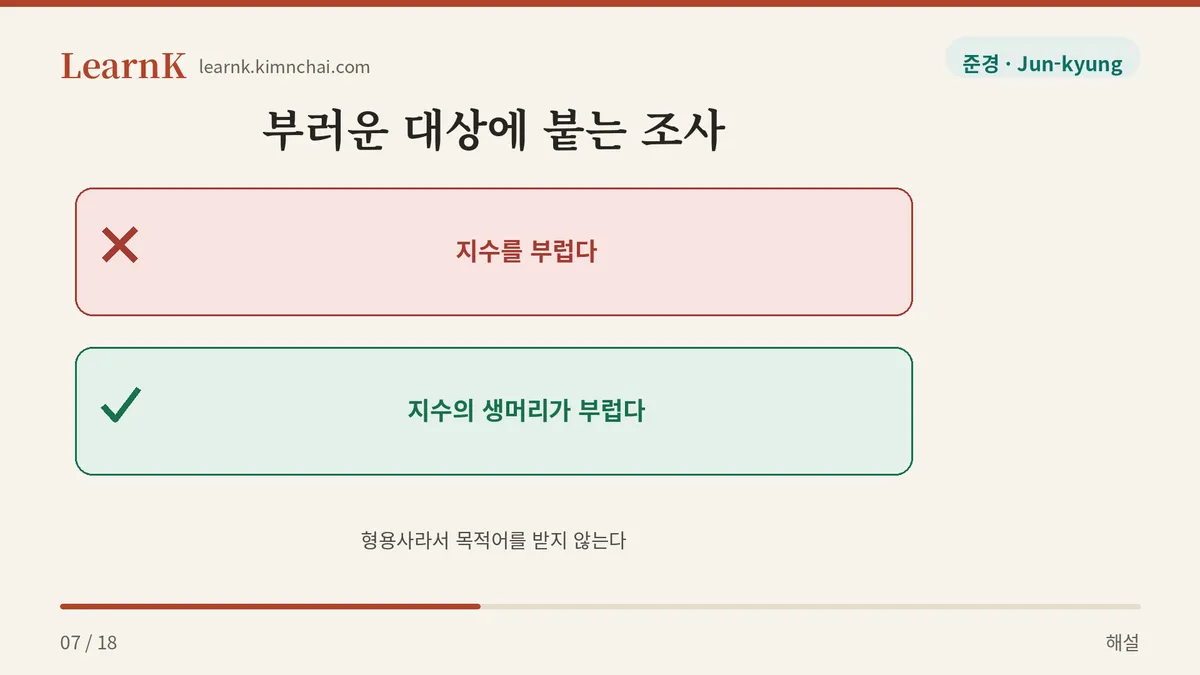
내 머리카락은 곱슬거려서 지수의 생머리가 부럽다. — National Institute of Korean Language, Basic Korean Dictionary (krdict.korean.go.kr)
This is a very concrete, everyday example of envying someone who has something you don’t (straight hair).
부럽다. 나도 언젠가 우주여행을 가 보고 싶어. — National Institute of Korean Language, Basic Korean Dictionary (krdict.korean.go.kr)
Here, a wish — “I want to ~ too” — follows right after. Adding your own desire after 부럽다 (bureopda) is a very typical way to use it.
부럽다! 실물도 그렇게 아름다워? — National Institute of Korean Language, Basic Korean Dictionary (krdict.korean.go.kr)
This is a vivid, conversational expression — tossing it out like an exclamation and then asking the reason.
Example Sentences by Situation
Now let’s get a feel for it with some sentences we made ourselves.
Situation 1 — A friend’s good news about getting hired. A friend you haven’t seen in a while tells you they landed a job.
대기업에 붙었다고? 진짜 부럽다! (daegieobe butdatago? jinjja bureopda!)
‘진짜 (jinjja)’ is an emphatic expression just like ‘정말 (jeongmal)’. It brings out a nuance of heartfelt congratulation.
Situation 2 — Looking at travel photos. A coworker shows you a photo of the Maldives sea.
바다 색깔 좀 봐. 너무 부러워요. (bada saekkkal jom bwa. neomu bureowoyo.)
With ‘너무 (neomu)’ the degree is raised, and adding ‘-워요’ makes it politely spoken.
Situation 3 — Acknowledging talent. To a friend who sings well.
넌 타고난 목소리가 있어서 부럽다. (neon tagonan moksoriga isseoseo bureopda.)
Putting the “reason” you’re envious in front with ‘-아서/어서’ makes the sentence flow much more naturally.
Comparing Polite/Casual Forms and Similar Expressions
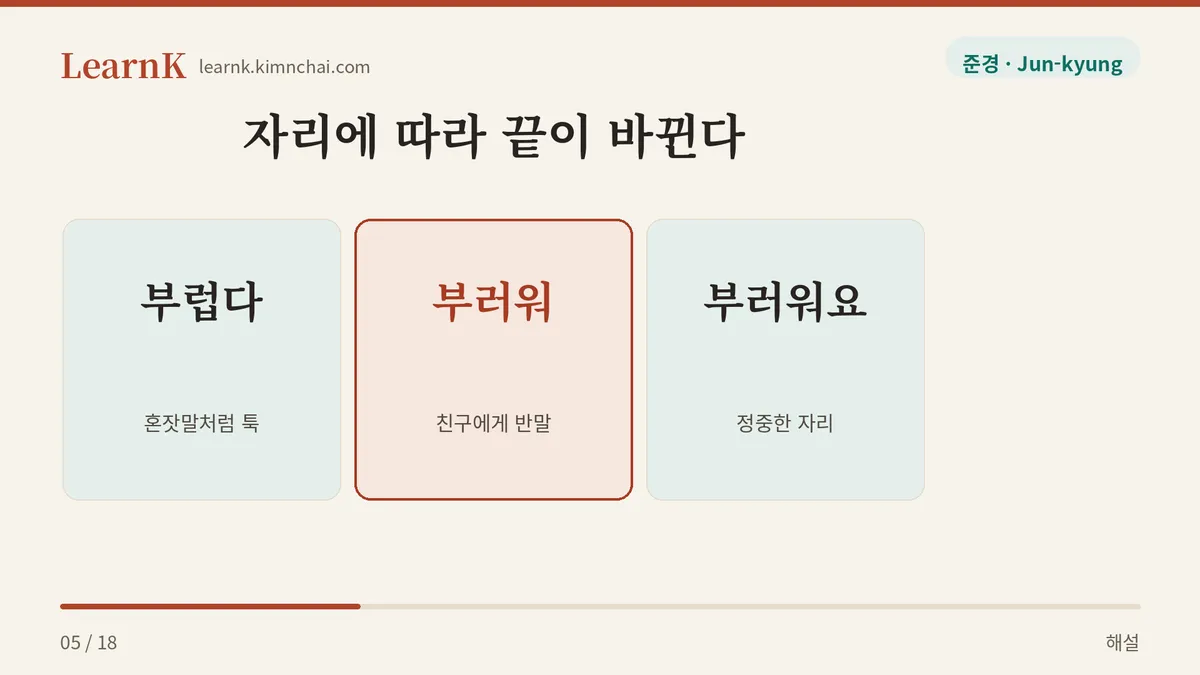
Because 부럽다 (bureopda) is an adjective, you change the ending to fit the situation.
- Casual: 부럽다 / 부러워 (bureopda / bureowo) — between friends
- Polite: 부러워요 / 부럽습니다 (bureowoyo / bureopseumnida) — in polite settings
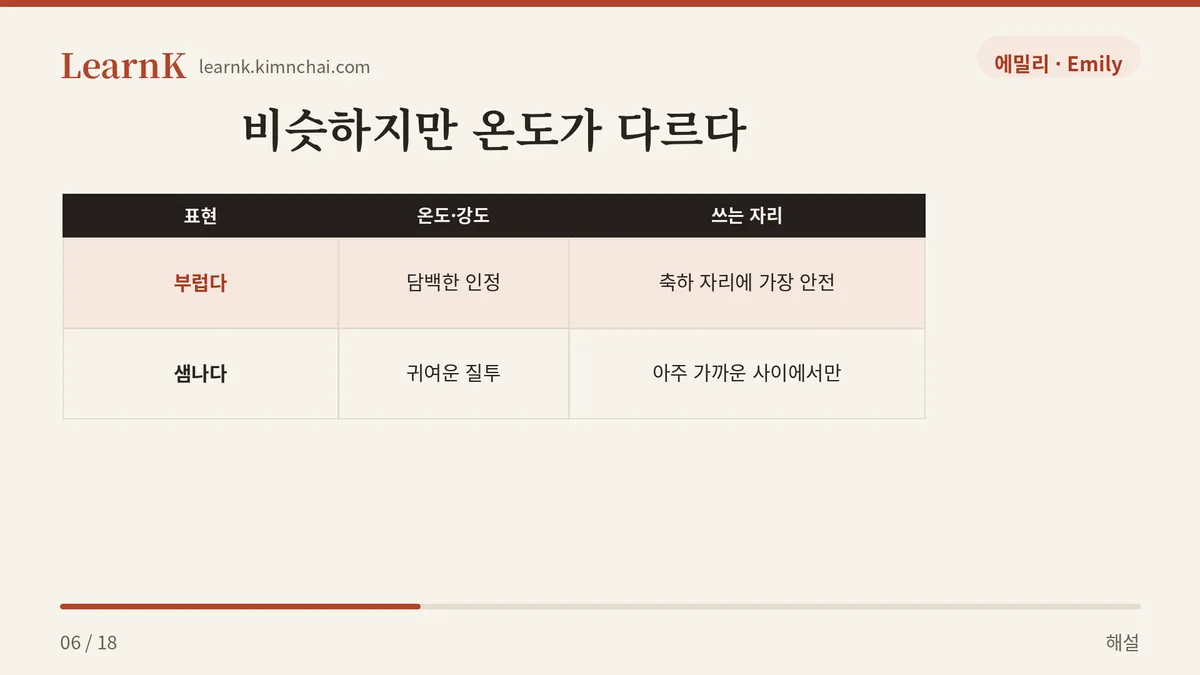
A similar expression is 샘나다 (saemnada). This one has a slightly more childlike, cute nuance mixed with jealousy. 부럽다 (bureopda), on the other hand, has a stronger feeling of acknowledging someone in a mature, understated way. That’s why, in a congratulatory setting, 부럽다 (bureopda) is much safer and more natural.
Cultural Background
Watch Korean dramas and you’ll often see scenes where the main character reveals this feeling while looking at a friend who’s doing well. For example, two friends in different circumstances share soju at a pojangmacha (street food tent), and one envies the other’s stable life until eventually they open up about their worries to each other. In this way, 부럽다 (bureopda) is used not as simple jealousy but as a starting point for empathy that opens the heart. In everyday life, too, the word “부럽다” comes across as a warm signal to the other person: “I’m happy for you because things are going well for you.”
Closing Quiz
A friend brags, “나 이번에 장학금 받았어! (I got a scholarship this time!)” If you wanted to answer naturally in casual speech, congratulating them with a touch of envy, what would you say?
(Example answer: 우와, 진짜 부럽다! (uwa, jinjja bureopda!))
Definitions and example sentences are from the National Institute of Korean Language’s Basic Korean Dictionary (krdict.korean.go.kr); that portion of this post, including our translations, is licensed under CC BY-SA 2.0 KR.