느끼하다 (neukkihada) — The Word That Comes Out on Your Fourth Slice of Pizza, and Why It's Risky to Use on a Person

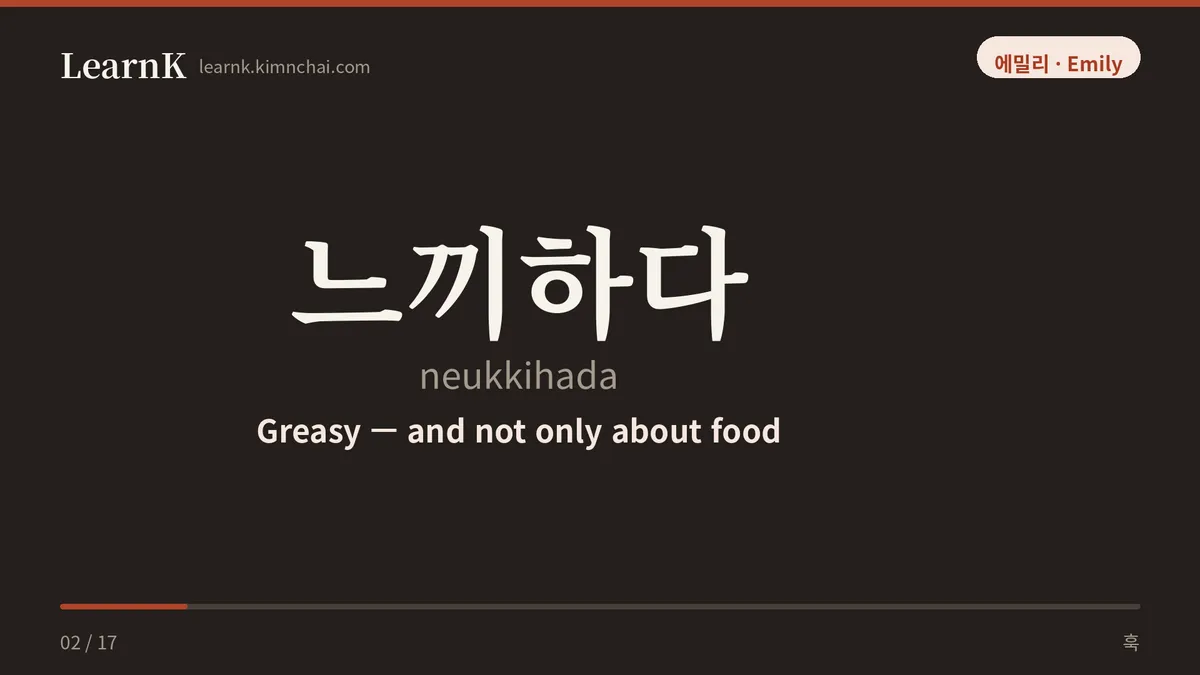
느끼하다
느끼하다 (neukkihada) means food has so much oil in it that your stomach starts to turn. After grilling three servings of 삼겹살 (samgyeopsal), at the fourth slice of pizza, at the bottom of a bowl of pasta with the cheese still stretching — this is what a Korean says as they set down their chopsticks. And what happens next is almost predetermined: they go looking for kimchi.
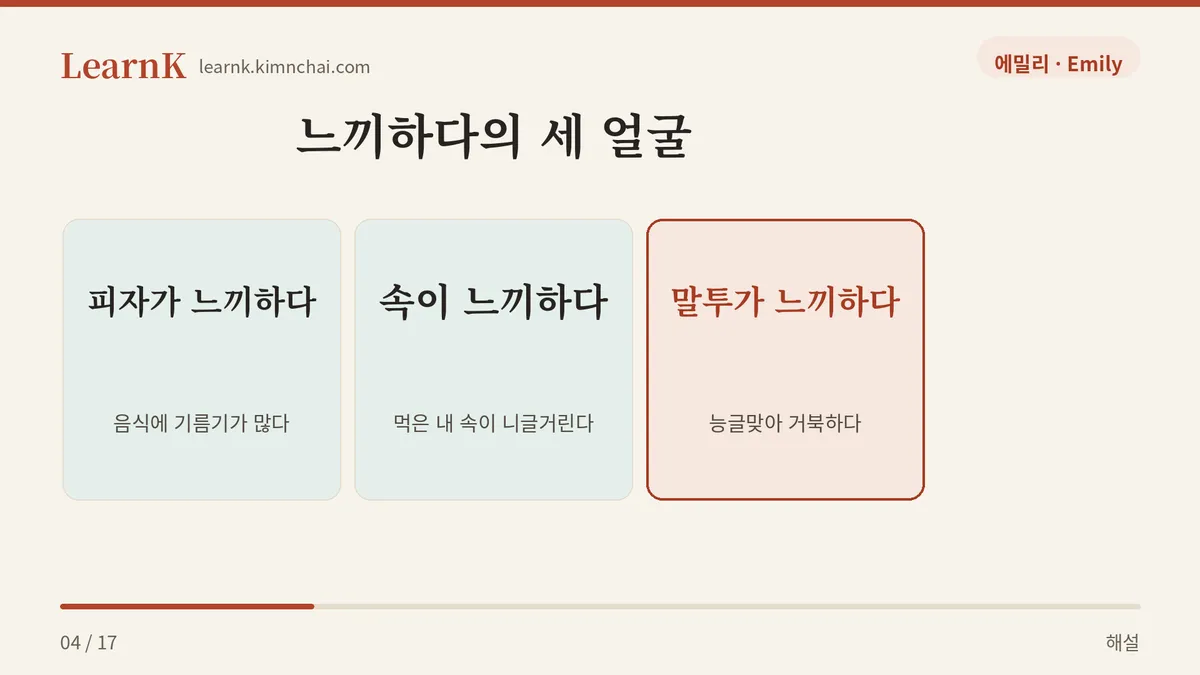
Learners usually meet this word at the dinner table, but its uses don’t stop there. 느끼하다 branches out in four directions: ① food is greasy ② eating that food leaves my stomach queasy ③ a taste or smell doesn’t agree with you and is nauseating ④ a person’s way of speaking or behaving is smarmy, and it makes you uncomfortable. It’s worth noticing that ① and ② point in exactly opposite directions. 피자가 느끼하다 (pijaga neukkihada) describes a property of the food, while 속이 느끼하다 (sogi neukkihada) describes the state of my body after eating it. One word points at cause and effect at the same time — so the subject alone tells you immediately which meaning is in play.
In terms of temperature, 느끼하다 isn’t a strong complaint. It isn’t a word that rejects the cooking the way 맛없다 (mateopda), “it tastes bad,” does. It’s closer to a signal: “my stomach can’t take any more of this right now.” That’s why it comes with 좀 (jom) in front of it — 좀 느끼하다 (jom neukkihada) — in the overwhelming majority of cases. The one exception is the fourth meaning, the one aimed at a person. There the story changes completely. That is never a compliment.
Checking it in the National Institute of Korean Language dictionary
The National Institute of Korean Language’s Basic Korean Dictionary gives this adjective no fewer than four senses. Here they are, one by one.
1. 속이 메스꺼울 정도로 음식에 기름기가 많다. [en] oily; greasy; fatty — Food containing oil so much as to make someone feel nausea. [ja] あぶらっこい【脂っこい・油っこい】 — むかつくほど食品などのあぶら気が多い。 [es] grasiento, graso — Que hay mucha grasa en el alimento como para sentir náuseas. [zh] 油腻,甜腻 — 食物油多得令人恶心。 — National Institute of Korean Language, Basic Korean Dictionary (krdict.korean.go.kr)
2. 기름진 음식을 많이 먹어 속이 메스꺼운 느낌이 있다. [en] nauseated; queasy — Feeling nausea because one has eaten a lot of oily food. [ja] むかむかする。むかつく — 脂っこい食べ物をたくさん食べて、吐き気がする。 [es] nauseabundo, repugnante, repulsivo, asqueroso — Que uno siente náuseas por haber comido una comida grasienta. [zh] 腻,腻得慌 — 吃完油腻的食物,胃里有种恶心的感觉。 — National Institute of Korean Language, Basic Korean Dictionary (krdict.korean.go.kr)
3. 음식의 맛이나 냄새 등이 비위에 맞지 않아 역겹다. [en] nauseating; disgusting — Food being sickening because its taste, smell, etc., does not meet one’s liking. [ja] まずい【不味い】。くさい【臭い】 — 食べ物の味やにおいなどが良くなくて、気持ちが悪い。 [es] nauseabundo, repugnante, repulsivo, asqueroso — Que causa repugnancia el olor o el sabor de un alimento por no caerle bien. [zh] 腻 — 由于食物的味道或气味等不合胃口而感到恶心。 — National Institute of Korean Language, Basic Korean Dictionary (krdict.korean.go.kr)
4. 어떤 사람의 행동이나 말투 등이 능글맞아 역겨운 구석이 있다. [en] disgusting; sickening — Someone’s way of behaving, speaking, etc., being greasy and thus making others feel rather nauseated. [ja] いやらしい【嫌らしい・厭らしい】 — 行動や言い方などが不愉快で気持ちが悪い。 [es] repugnante, desagradable, asqueroso, hediondo — Que causan repugnancia y horror los dichos y hechos de una persona. [zh] 肉麻,腻人 — 某人的行为或口气等油滑且令人反感。 — National Institute of Korean Language, Basic Korean Dictionary (krdict.korean.go.kr)
The dictionary carries no Portuguese translation, so what follows is our own rendering (not a dictionary quotation): for senses 1 and 3, oleoso, gorduroso, enjoativo; for sense 2, enjoado, com náusea; and for sense 4, meloso, melífluo come closest.
Here are five of the dictionary’s real usage examples, quoted exactly as they appear.
맛이 느끼하다. 냄새가 느끼하다. 피자가 느끼하다. 행동이 느끼하다. 말투가 느끼하다. — National Institute of Korean Language, Basic Korean Dictionary (krdict.korean.go.kr)
- 맛이 느끼하다 (masi neukkihada) — the reaction that comes out right after the first bite. Think of the moment you first taste a dish loaded with butter or cream.
- 냄새가 느끼하다 (naemsaega neukkihada) — for when you haven’t even eaten yet and the smell of frying oil alone is already too much for your stomach. You can use it the instant you open the restaurant door and step inside.
- 피자가 느끼하다 (pijaga neukkihada) — the most typical shape of all, with the name of a food as the subject. The reason pizza in Korea arrives with pickles and hot sauce on the side is contained entirely in this one sentence.
- 행동이 느끼하다 (haengdongi neukkihada) — from here on, we’re not talking about food. This is what you say about someone who acts exaggeratedly affectionate or lays on the smarm more than the situation calls for.
- 말투가 느끼하다 (maltuga neukkihada) — for when someone drags out their voice and stretches their sentence endings to sound suggestive. This people-directed usage is the most unfamiliar one for learners, and at the same time the one they’ll run into most often.
The dictionary also includes the example 느글느글 느끼하다 (neugeulneugeul neukkihada). The fact that it travels side by side with an adverb that turns the churn of an unsettled stomach straight into sound shows that this word grew out of the belly rather than the head.
Seeing it in a real conversation
Scene: The afternoon of moving day. They’re sitting on the floor among boxes they haven’t unpacked yet, eating pizza they ordered in.
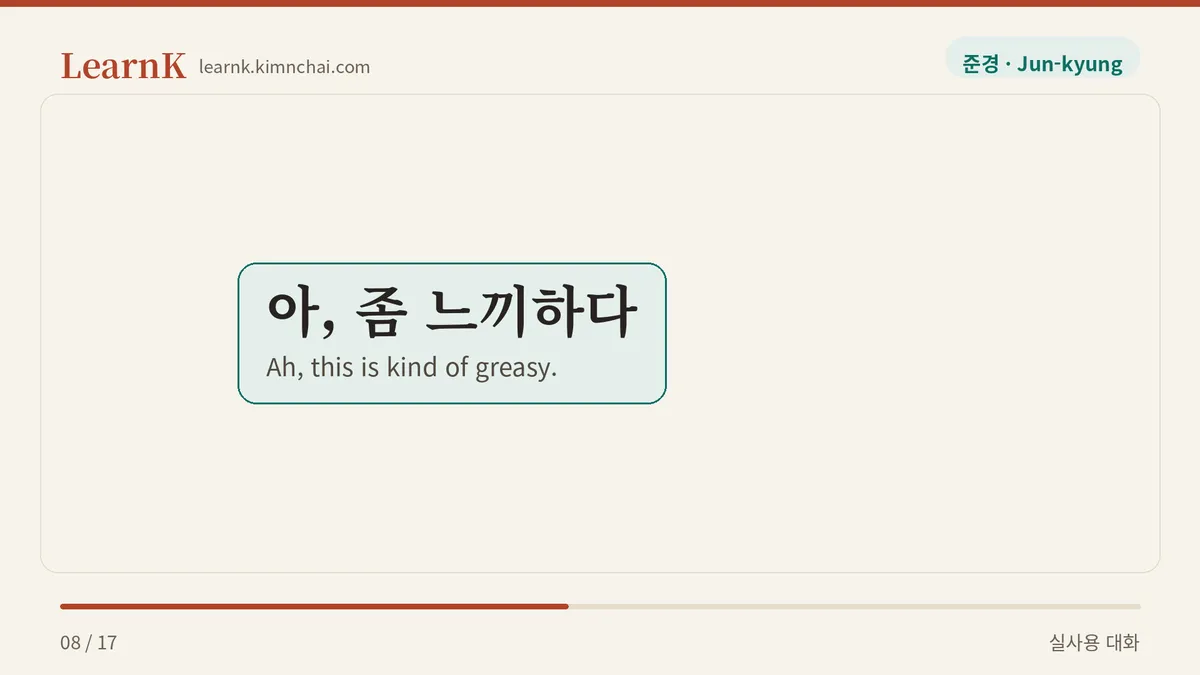
Jun-kyung: 세 조각째인데 왜 이렇게 속이 답답하지. 아, 좀 느끼하다. I’m on my third slice and my stomach feels so heavy. Ah, this is kind of greasy.
Emily: 그럴 줄 알고 김치 챙겨 왔지. 저 상자 맨 위에 있어. I figured that would happen, so I brought kimchi. It’s on top of that box.
Jun-kyung: 야, 너 진짜 캐나다 사람 맞아? 나보다 더 한국인 같아. Hey, are you really Canadian? You’re more Korean than I am.
Emily: 15년 살면 위장도 국적이 바뀌더라고. After fifteen years here, even your stomach changes nationality.
Jun-kyung: 아이고~ 우리 에밀리 없었으면 오늘 형이 어쩔 뻔했을까~ 응? Oh my~ what would I have done today without my dear Emily~ hmm?
Emily: 야, 말투. 피자보다 네 말투가 훨씬 더 느끼해. Hey, that tone. Your tone is way greasier than the pizza.
Those last two lines capture both faces of this word in a single scene. In the first, the subject was food; in the second, it’s a person’s tone of voice. Koreans use that switch as the punchline of a joke.
This is where it goes wrong
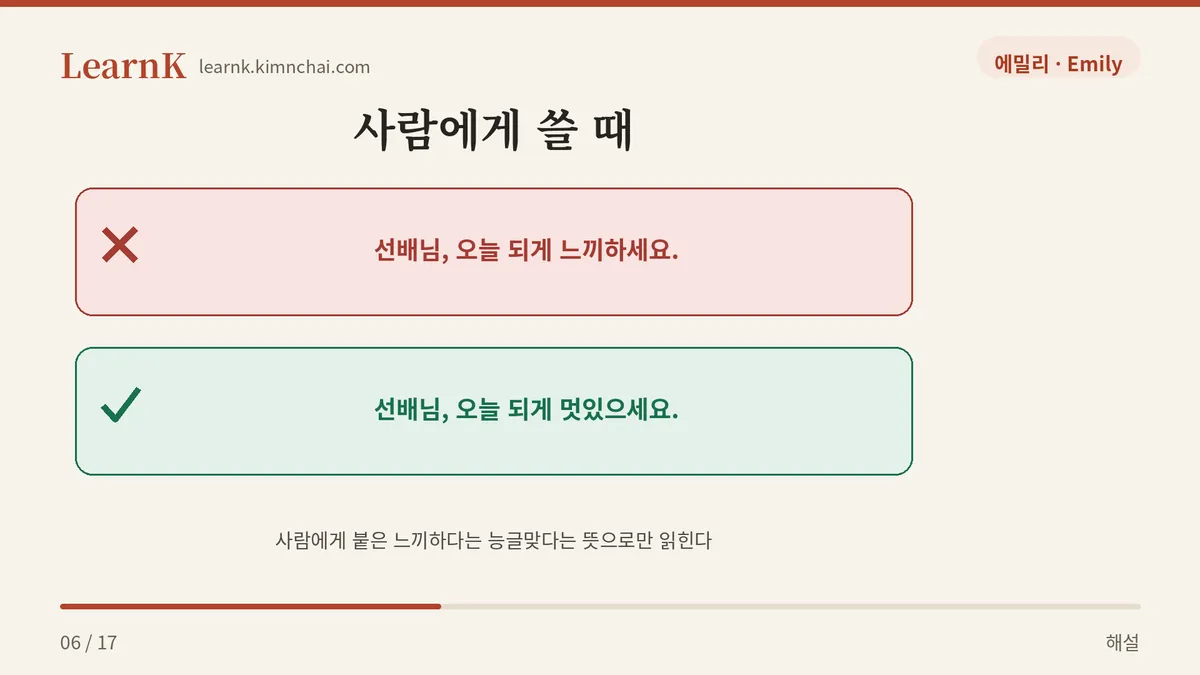
✗ (complimenting a senior colleague’s new hairstyle) 선배님, 오늘 되게 느끼하세요 (neukkihaseyo). ✓ (complimenting a senior colleague’s new hairstyle) 선배님, 오늘 되게 멋있으세요 (meosisseuseyo). — “Sunbae, you look really good today.” → This is a mistake English speakers make constantly, reaching for “greasy hair” and trying to say something about someone’s hair. Attached to a person, 느끼하다 is not a description of appearance — it can only be read as the fourth sense, “smarmy and off-putting.” A compliment turns into a personal attack in an instant.
✗ (being served a meal at the home of a host’s mother) 어머님, 이거 좀 느끼한데요 (neukkihandeyo). ✓ (being served a meal at the home of a host’s mother) 어머님, 맛있어요. 저 김치 좀만 더 주시겠어요? — “This is delicious. Could I have a little more kimchi?” → The grammar is perfect, but the setting is wrong. Pointing out how oily the food is while you’re being hosted comes across as a verdict on the cooking. In that same situation, a Korean wouldn’t name the greasiness directly — they’d go around it by asking for kimchi or water.
Example sentences by situation
1. At a barbecue place, deciding what to order for round two
고기 다 먹었으니까 냉면 시키자. 나 지금 좀 느끼해. (gogi da meogeosseunikka naengmyeon sikija. na jigeum jom neukkihae.) We’ve finished the meat, so let’s order naengmyeon. My stomach is feeling kind of greasy right now.
Finishing off a big meal of 삼겹살 (samgyeopsal) or 갈비 (galbi) with 냉면 (naengmyeon) or 된장찌개 (doenjang-jjigae) is close to an official sequence in Korean dining. Here 느끼하다 isn’t a complaint — it’s the justification for a proposal: “let’s move on to the next course.” The subject is dropped, and the word points to the speaker’s own stomach (sense 2 in the dictionary).
2. Recommending a restaurant — the negative form used as praise
이 집 크림 파스타는 느끼하지 않아서 좋아요. (i jip keurim paseuta-neun neukkihaji anaseo joayo.) I like the cream pasta here because it isn’t greasy.
In Korea, this negative form is one of the highest compliments you can pay a cream pasta, a carbonara, or a cheese dish. It’s more specific — and more trustworthy — than simply saying it’s delicious. It’s a form learners can pull out immediately in reviews or recommendations.
3. Talking to a friend about someone
그 사람 나쁜 건 아닌데, 말투가 좀 느끼해서 부담스러워. (geu saram nappeun geon aninde, maltuga jom neukkihaeseo budamseureowo.) He’s not a bad guy, but his way of talking is kind of smarmy, so it’s a lot to deal with.
This is sense 4. It handles a subtle feeling — “he isn’t a bad person, but he’s uncomfortable to be around” — in a single word. That said, this is strictly the language of gossip and private conversation; using it in front of the person is quite rude.
Polite and casual forms, and similar expressions
The endings change regularly. Casual is 느끼해 (neukkihae), general polite is 느끼해요 (neukkihaeyo), and formal is 느끼합니다 (neukkihamnida). When you’re half talking to yourself, with a note of exclamation, you use 느끼하네 (neukkihane) / 느끼하네요 (neukkihaneyo). But as the misuse examples above show, switching to polite speech does not make it safe to pass judgment on someone else’s food.
Set it against its neighbors and its position comes into focus.
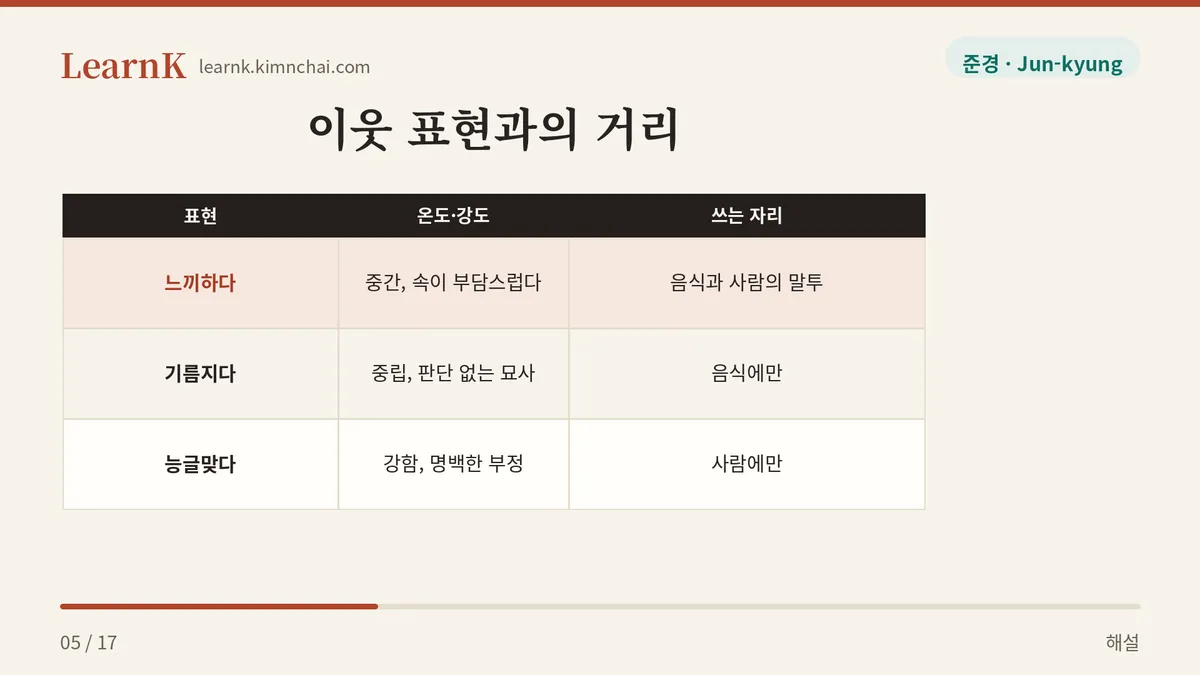
| Expression | Temperature / intensity | Where it’s used |
|---|---|---|
| 느끼하다 (neukkihada) | Medium. A signal that your stomach has had enough | Food in general, plus a person’s tone or behavior |
| 기름지다 (gireumjida) | Neutral. A factual description with no judgment attached | Only the nature of the food. Not used on people |
| 느글거리다 (neugeulgeorida) | Strong. Like you might actually be sick | When you want to emphasize how your own stomach feels |
| 능글맞다 (neunggeulmatda) | Strong. An openly negative judgment | People only. The blunt version of 느끼하다’s fourth sense |
| 오글거리다 (ogeulgeorida) | Light and funny | Cringey lines or scenes. Peers, social media |
The difference from 기름지다 is especially worth locking in. “이 고기는 기름져요 (i gogineun gireumjyeoyo)” describes the condition of the meat, so it isn’t necessarily negative — but “이 고기는 느끼해요 (i gogineun neukkihaeyo)” carries the judgment that your stomach is having trouble handling it. And when it comes to people: 능글맞다 defines the other person’s character itself, while 느끼하다 puts a little more weight on your own side of things — “this is hard for me to take.”
Cultural background — the table that cuts the grease
The Korean table has grease-neutralizing devices built into it structurally. Lettuce and garlic with the meat, pickles with the pizza, pickled radish and cola with the fried chicken, 동치미 (dongchimi) broth with the oily pan-fried 전 (jeon). Even Korean-style Western restaurants serving pasta will quite often bring you kimchi. When foreign guests find the combination curious, the explanation a Korean offers usually ends in one word — “느끼하니까 (neukkihanikka),” because it’s greasy.
Use of this word peaks right after the holidays. Once you’ve spent about two days eating your way through a table of pan-fried 전 (jeon), tossed 잡채 (japchae), and braised 갈비찜 (galbijjim), on the morning of the third day someone at the table will inevitably say “속이 느끼하다” and go hunting for 김칫국 (kimchitguk) or some cool, clear soup. It’s a scene that repeats like a seasonal greeting.
The fourth sense — the one used on people — owes a great deal to Korean dramas and variety shows. Viewers nickname the male character who whispers sweet nothings in an exaggeratedly soft voice a “느끼한 남자 (neukkihan namja),” and when an actor deliberately stretches out his sentence endings and hams it up, broadcast subtitles will fire back with “느끼美 (neukki-mi)” — a pun that pairs the word with the character 美, “beauty.” You don’t need the lines quoted to get the feeling: a tone of voice that’s affectionate in an ambiguous way, where you can’t tell if it’s sincere or a joke — that’s the temperature Koreans call 느끼하다. K-pop has songs that lean into this playful, sly concept too, and the word fans reach for when they talk about that mood is the same one.
There’s no widely agreed-upon explanation of the word’s origin, so we won’t assert one here. But looking at its pairing with 느글느글 (neugeulneugeul), preserved in the dictionary’s examples, one thing is clear: this isn’t a concept word that started from a definition. It grew out of the physical sensation of a stomach turning over.
Today’s quiz
Which of the following three sentences would a Korean not take as a compliment?
- 이 집 돈가스는 느끼하지 않아서 자주 와요. (i jip donkkaseu-neun neukkihaji anaseo jaju wayo.)
- 팀장님, 오늘 정장 입으시니까 진짜 느끼하시네요. (timjangnim, oneul jeongjang ibeusinikka jinjja neukkihasineyo.)
- 튀김을 먹었더니 속이 좀 느끼하네. 사이다 좀 줄래? (twigimeul meogeotdeoni sogi jom neukkihane. saida jom jullae?)
Answer: number 2. Attached to a person, 느끼하다 can only be read as the dictionary’s fourth sense — “smarmy in speech or behavior, and off-putting.” What was meant as a compliment on someone’s outfit comes out as the exact opposite. Number 1 means the food isn’t excessively oily, so it’s clearly praise, and number 3 describes the speaker’s own stomach (sense 2) while asking for something to drink — a perfectly natural sentence.
Definitions and example sentences are from the National Institute of Korean Language’s Basic Korean Dictionary (krdict.korean.go.kr); that portion of this post, including our translations, is licensed under CC BY-SA 2.0 KR.