생신 (saengsin) — The Respectful Word for "Birthday": Who Gets It, and When
생신
You hear this a lot in Korean offices: “다음 주 금요일에 연차 좀 쓰겠습니다. 어머니 생신이라서요.” (“I’d like to take a day off next Friday. It’s my mother’s birthday.”) But when that same person talks about their own birthday, they say “저 다음 주에 생일이에요” (“My birthday is next week”). There’s exactly one reason the word changes. 생신 (saengsin) is the honorific form of ‘생일’ — the day an elder came into the world. The meaning isn’t a hair different from 생일. The only thing that changes is who the day belongs to.
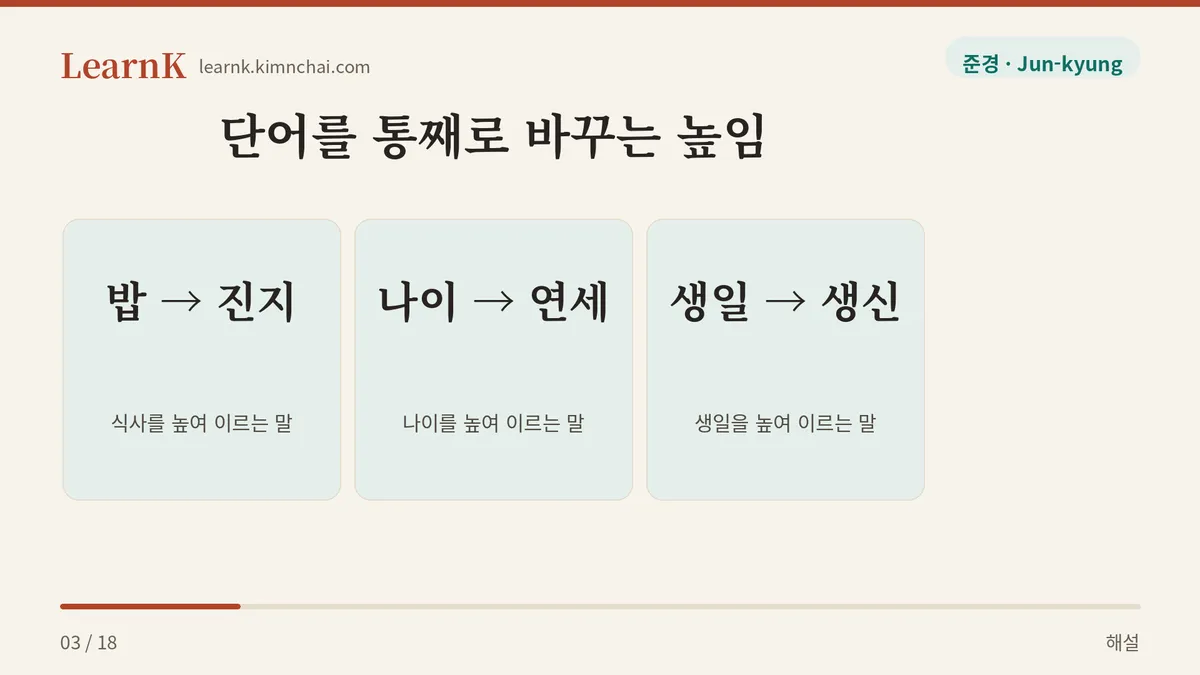
Korean has certain spots where respect isn’t marked with a verb ending but by swapping out the whole word. 밥 becomes 진지 (jinji), 나이 becomes 연세 (yeonse), 이름 becomes 성함 (seongham), 집 becomes 댁 (daek). 생일 becoming 생신 works in exactly the same way. So the moment the word leaves your mouth, it sends a signal along with it: “I am elevating this person right now.” Parents, grandparents, teachers, bosses at work, a friend’s parents — if it’s the birthday of someone you look up to, it’s 생신.
Hold on to just two things here and you’ll almost never get it wrong. First, you don’t use it for yourself. Honorifics are a tool pointed at other people. Second, the person being elevated is not the listener but the person inside the sentence. That’s why it’s perfectly natural to be chatting away in casual speech with a friend and still say “할아버지 생신.” Once you understand this second principle, the range of places you can use 생신 suddenly doubles.
Checking the National Institute of Korean Language dictionary
First, here is exactly how the National Institute of Korean Language’s Basic Korean Dictionary defines the word.
생신 「명사」 (높이는 말로) 사람이 세상에 태어난 날. [en] birthday — (polite form) A person’s day of birth. [ja] おたんじょうび【お誕生日】 — 人が生まれた日を敬っていう語。 [es] cumpleaños — (EXPRESIÓN DE RESPETO) Día del nacimiento de una persona. [zh] 寿辰,诞辰,生日 — (敬语)人出生的日子。 — National Institute of Korean Language, Basic Korean Dictionary (krdict.korean.go.kr)
Those few words at the very front of the definition — ‘(높이는 말로)’, “(as an honorific)” — are the whole story of this word. When you see polite form pinned to the English gloss, EXPRESIÓN DE RESPETO to the Spanish, and 敬っていう語 (“a word used to show respect”) to the Japanese, it becomes clear that the core information in this word isn’t “day of birth” — it’s the respect. For reference, this dictionary carries no Portuguese translation. If we had to render it, aniversário (forma de respeito) would be about right, but let us be clear that this is our translation for this post, not one from the dictionary.
Let’s also read through the real usage examples the dictionary lists. Each one shows you a place this word lives.
엄마! 생신 축하드려요. 제가 미역국을 끓여 봤는데 맛이 있을지 모르겠어요. — National Institute of Korean Language, Basic Korean Dictionary (krdict.korean.go.kr)
(“Mom! Happy birthday. I tried making seaweed soup — I’m not sure how it tastes.”) This is what a child says on their mother’s birthday morning, holding out a bowl of seaweed soup they cooked themselves. Notice that the whole sentence is pitched at the same level: the noun is ‘생신’ and the verb is ‘축하드려요’. Elevate only one side and the sentence tilts.
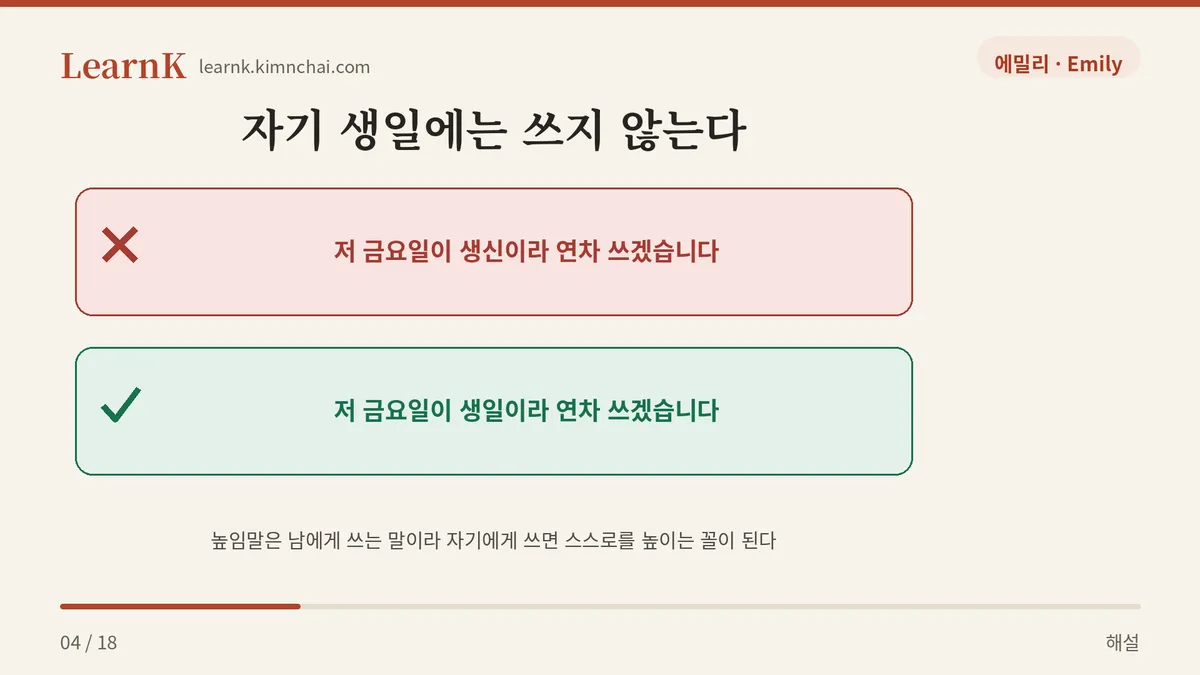
할아버지 생신 선물로 모자를 샀어. 할아버지께서 모자를 좋아하시거든. — National Institute of Korean Language, Basic Korean Dictionary (krdict.korean.go.kr)
(“I bought a hat as a birthday present for my grandfather. He likes hats.”) The sentence ends in ‘샀어’ — fully casual speech. And yet ‘생신’ stays put. The listener is a friend, but the person being elevated is the grandfather inside the sentence. This example puts that second principle on full display.
응, 내가 경애하는 선생님이 한 분 계시는데 생신이라고 하셔서 샀어. — National Institute of Korean Language, Basic Korean Dictionary (krdict.korean.go.kr)
(“Yeah, there’s a teacher I deeply admire, and she said it was her birthday, so I bought it.”) It isn’t only family. A teacher, a mentor, a senior figure at work — anyone you hold in high regard in your heart gets 생신.
고희를 맞으신 할아버지의 생신을 축하하기 위해 온 가족이 다 모였다. — National Institute of Korean Language, Basic Korean Dictionary (krdict.korean.go.kr)
(“The whole family gathered to celebrate the birthday of our grandfather, who was turning seventy.”) 고희 (古稀) is a word for the age of seventy. For milestone birthdays like 칠순 (seventy) and 팔순 (eighty), it’s a long-standing Korean custom for family scattered across the country to gather in one place and throw a feast.
아버지는 돌아가신 어머니의 생신 때만 되면 골수에 스민 어머니에 대한 그리움으로 힘들어하셨다. — National Institute of Korean Language, Basic Korean Dictionary (krdict.korean.go.kr)
(“Whenever my late mother’s birthday came around, my father struggled with a longing for her that had soaked into his bones.”) This is the point that surprises foreign learners most. The birthday of someone who has passed away is still called ‘생신’. Death doesn’t mean the respect gets withdrawn.
A real conversation
Scene: Saturday morning at the neighborhood supermarket. Jun-kyung is loading an armful of dried seaweed into his basket.
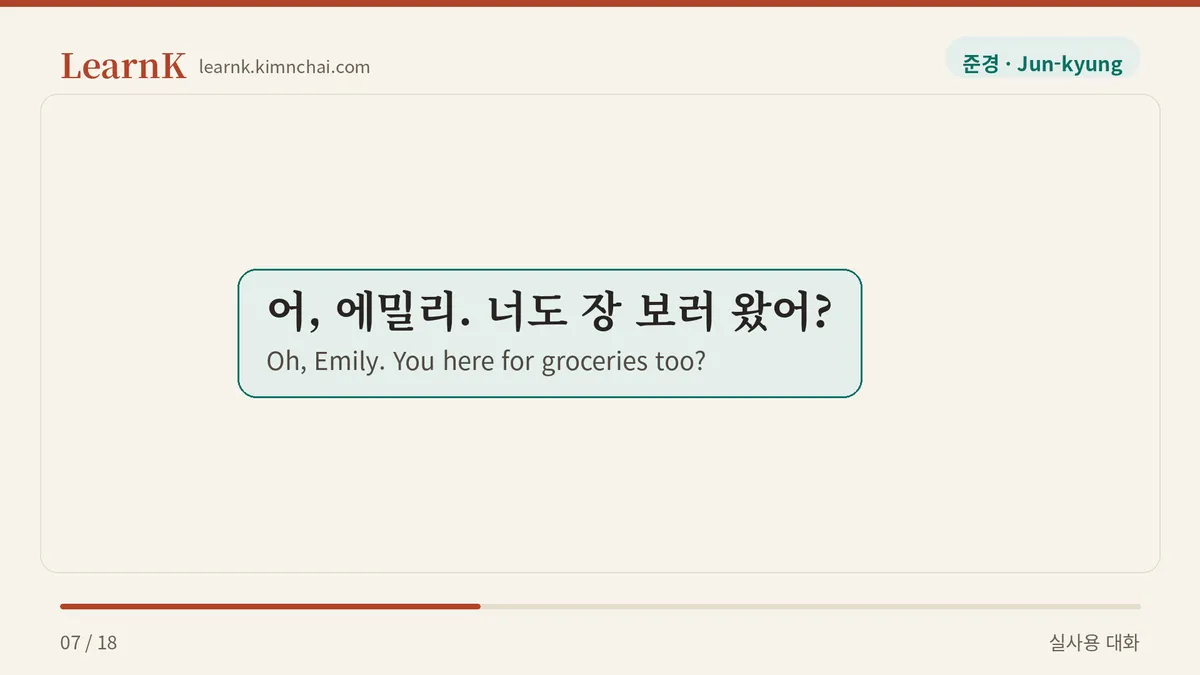
Jun-kyung: 어, 에밀리. 너도 장 보러 왔어? Oh, Emily. You here for groceries too?
Emily: 응. 근데 미역을 왜 그렇게 많이 사? Yeah. But why are you buying so much seaweed?
Jun-kyung: 내일 할머니 생신이거든. 온 식구가 다 모여. It’s my grandmother’s birthday tomorrow. The whole family’s getting together.
Emily: 아, 그럼 미역국은 네가 끓이는 거야? Ah, so you’re the one making the seaweed soup?
Jun-kyung: 어. 우리 엄마 생신 때도 내가 끓였어. Yeah. I made it for my mom’s birthday too.
Emily: 어머님… 돌아가신 분한테도 생신이라고 해? Your mother… you still say 생신 for someone who’s passed away?
Jun-kyung: 응, 높여 드리는 말인데 돌아가셨다고 낮출 순 없잖아. Yeah. It’s a word of respect — you don’t take it back just because they’re gone.
Emily: 그러네. 나 오늘 하나 배웠다. True. I learned something today.
These sound wrong
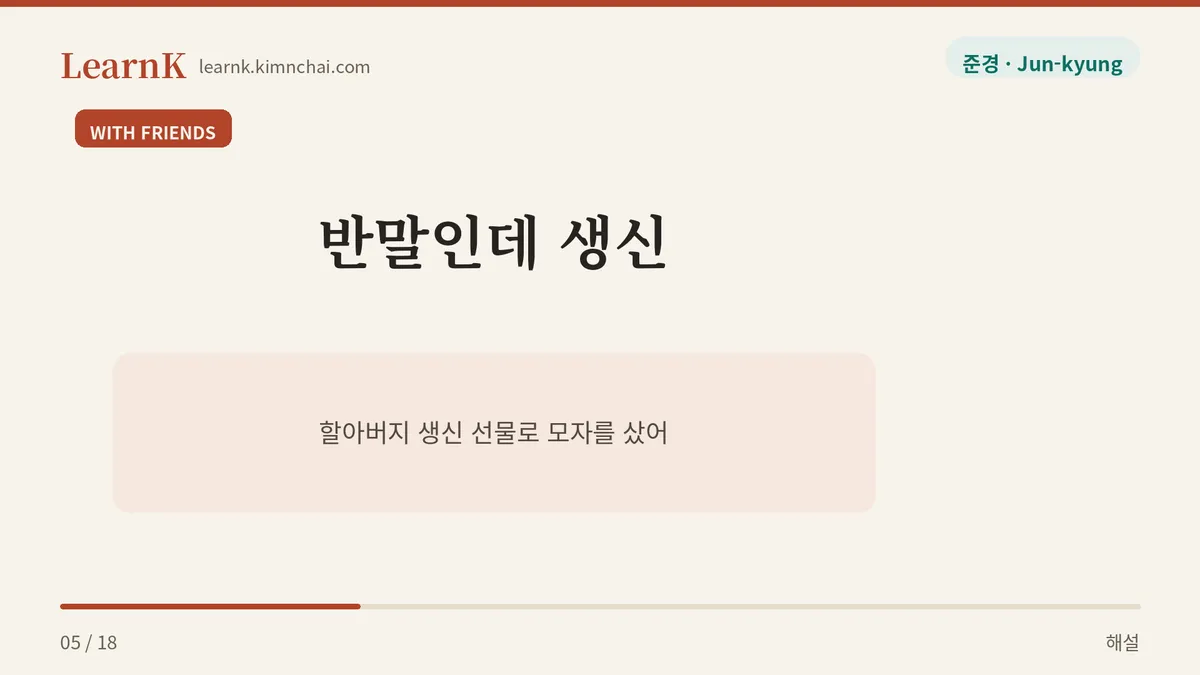
✗ 팀장님, 저 다음 주 금요일이 생신이라 연차 쓰겠습니다. ✓ 팀장님, 저 다음 주 금요일이 생일이라 연차 쓰겠습니다. → Honorifics are for other people, not for yourself. Attaching ‘생신’ to your own birthday amounts to elevating yourself — reaching for politeness and landing on comedy instead. No matter how senior the person you’re speaking to, your own birthday is just 생일.
✗ 할머니, 생신 축하해요. ✓ 할머니, 생신 축하드려요. → If you elevate only the noun and leave the verb alone, the sentence rises only halfway and sounds off. Once you’ve reached for 생신, it’s natural to carry the respect through to the end with 축하드립니다 (chukhadeurimnida) or 축하드려요 (chukhadeuryeoyo).
Example sentences by situation
Situation 1 — Greeting the host at a friend’s father’s 70th birthday feast. At celebrations like this, it’s customary to follow your congratulations with a wish for good health.
아버님, 생신 진심으로 축하드립니다. 오래오래 건강하세요. (abeonim, saengsin jinsimeuro chukhadeurimnida. oraeorae geonganghaseyo.) “Sir, my sincere congratulations on your birthday. I wish you long life and good health.”
Situation 2 — Giving your reason for time off at work. In Korean workplaces, a parent’s birthday is an extremely common and well-accepted reason for taking a day of annual leave.
어머니 생신이라 하루 연차를 냈습니다. (eomeoni saengsinira haru yeonchareul naetseumnida.) “It’s my mother’s birthday, so I’ve taken a day of leave.”
Situation 3 — Making plans with a friend in casual speech. The listener is a friend, but the person being elevated is the grandmother — so ‘생신’ stays alive.
이번 주말에 할머니 생신이라 본가 내려가. 다음 주에 보자. (ibeon jumare halmeoni saengsinira bonga naeryeoga. daeum jue boja.) “It’s my grandmother’s birthday this weekend, so I’m heading home. Let’s meet up next week.”
Related expressions across formal and casual speech
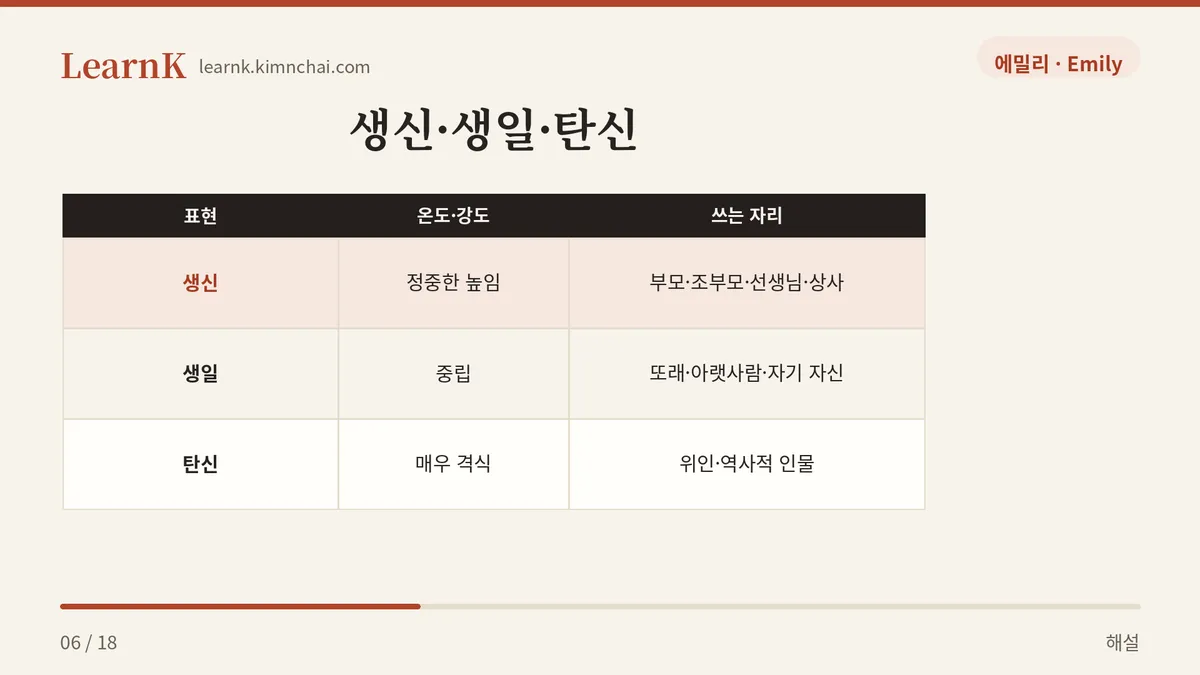
| Expression | Tone & intensity | Where it’s used |
|---|---|---|
| 생신 (saengsin) | Polite honorific | Birthdays of people you elevate — parents, grandparents, teachers, bosses. Also used for those who have passed away |
| 생일 (saengil) | Neutral | Peers, people junior to you, yourself. The basic form |
| 탄신 (tansin) | Highly formal, historical/public | For great historical figures or saints, as in 세종대왕 탄신일 (King Sejong’s birthday). Not used in everyday conversation |
| 돌 (dol) | Celebratory and affectionate | A baby’s first birthday. It means “first birthday” rather than an age, so it can’t be used for adults |
It helps to memorize the matching verbs alongside them. For peers, 생일 축하해 (saengil chukhahae); for elders, 생신 축하드립니다 (saengsin chukhadeurimnida). Remember these two as whole chunks and you’ll never fumble assembling the words on the spot.
Cultural background — the weight of a bowl of seaweed soup
생신 comes from the Sino-Korean 生辰. 生 is the character for “to be born” and 辰 means “time,” so literally it’s “the time of birth.” Where 생일 (生日) uses “day,” 생신 uses “time” — and this method of raising the register by swapping in a different Sino-Korean word for the same meaning repeats exactly in 성함 (姓銜) and 연세 (年歲). It reflects a long-standing instinct in Korean that Sino-Korean vocabulary feels more formal.
No Korean birthday table is complete without 미역국 (miyeokguk), seaweed soup. It comes from the long-standing custom of new mothers eating seaweed soup to recover after giving birth, which means eating seaweed soup on your birthday amounts to remembering the person who gave birth to you. That’s why the dictionary example “제가 미역국을 끓여 봤는데” (“I tried making seaweed soup”) isn’t simply talk about cooking. A child cooking seaweed soup for a parent’s 생신 flips the order for once — and it’s a scene Korean dramas love to use when portraying parent-child relationships. Without a single line of dialogue, one bowl of seaweed soup on the table explains the whole relationship.
For the big birthdays like 칠순 and 팔순, the entire family gathers for a feast. The expression ‘교자상의 상다리가 부러질 정도로’ (“enough to break the legs of the banquet table”) that appears in dictionary examples isn’t exaggeration but an idiom — it describes how densely the table is loaded with food by pointing at the table legs. The birthdays of those who have passed, by contrast, are quiet. Many families cook a big pot of seaweed soup that day and sit together telling stories about the person. The fact that the word 생신 survives even after death shows that Korean honorifics are not only rules of etiquette but also a device for holding a relationship in place.
Today’s quiz
Which of the following sentences uses 생신 (saengsin) incorrectly?
- 할아버지, 생신 축하드려요. 오래오래 건강하세요.
- 저 내일이 생신이라 친구들이랑 저녁 먹기로 했어요.
- 부장님 어머님 생신이라고 해서 다들 화환 보냈대.
The answer is number 2. Using ‘생신’ about your own birthday means elevating yourself, so it has to be corrected to “저 내일이 생일이라.” In number 1, both the person being elevated and the verb are correct. Number 3 ends in ‘보냈대’, which is casual speech, but the person being elevated isn’t the friend listening — it’s the department head’s mother — so ‘생신’ is exactly right.
Definitions and example sentences are from the National Institute of Korean Language’s Basic Korean Dictionary (krdict.korean.go.kr); that portion of this post, including our translations, is licensed under CC BY-SA 2.0 KR.