상견례 (sanggyeonnye) — The Day Two Families First Sit Down Together
상견례 (sanggyeonnye)
상견례 (sanggyeonnye) means the act of several people meeting formally for the first time and greeting one another — and above all, the occasion when the parents and families of a couple about to marry sit down together for the first time. Read literally, it is a plain enough idea: to meet and greet for the first time. But to a Korean ear the word rarely sounds plain. When someone with a wedding coming up says 다음 주에 상견례예요 (daeum jue sanggyeonnyeyeyo) — I have my 상견례 next week — the listener almost reflexively answers 긴장되겠다 (ginjangdoegetda), that must be nerve-racking. It is not one person meeting another person; it is two families looking at each other for the first time. Worth memorizing alongside the spelling: it is written 상견례, but it is pronounced [상견녜] (sanggyeonnye).
The meaning splits in two. The broader sense is any occasion where a newly assembled group formally greets one another for the first time — a new coach meeting his squad, first-year students greeting their upperclassmen. The narrower sense, and by far the more common one today, is the first meeting between the two families of an engaged couple. Say 상견례 with no further explanation, and nine Koreans out of ten will hear that second meaning.
The tone is heavy and formal. Because it is a noun, it takes verbs: 상견례를 하다 (sanggyeonnyereul hada), 상견례를 가지다 (sanggyeonnyereul gajida), and — with a little more weight behind it — 상견례를 치르다 (sanggyeonnyereul chireuda). The very fact that 치르다 (chireuda) can attach tells you what kind of occasion this is: it is the verb used for exams and funerals, for things you have to get through.
Checking It in the National Institute of Korean Language Dictionary
First, let’s see how the national institution’s dictionary lays this word out.
상견례 (sanggyeonnye) 「명사」 noun
- The act of several people meeting officially for the first time and greeting one another. [en] first meeting — An official meeting where many people see and get introduced to each other for the first time. [ja] かおあわせ【顔合わせ】 — 多数の人が公式的に初めて会合し、互いに挨拶すること。 [es] reunión — Acto en que se reúnen un conjunto de personas por primera vez, particularmente para saludar o conocerse entre sí. [zh] 见面礼,见面仪式 — 许多人正式初次见面并互相打招呼的仪式。 — National Institute of Korean Language, Basic Korean Dictionary (krdict.korean.go.kr)
상견례 (sanggyeonnye) 「명사」 noun 2. The act of the parents or families of a marrying couple meeting for the first time and greeting one another. [en] first meeting between the bride and bridegroom’s families — The first meeting between the bride and bridegroom’s families where they are introduced to each other. [ja] りょうけのかおあわせ【両家の顔合わせ】 — 結婚予定の二人の両親や家族が初めて会い挨拶すること。 [es] reunión — Acto en que se reúnen familias de una pareja por primera vez, particularmente para saludar o conocerse entre sí. [zh] 见面礼 — 即将结婚的男女的父母及家人初次见面并互相打招呼的仪式。 — National Institute of Korean Language, Basic Korean Dictionary (krdict.korean.go.kr)
This dictionary carries no Portuguese definition. For reference, it would come out roughly as primeiro encontro formal entre as famílias dos noivos — but let it be clear that this is our own rendering for this post, not the dictionary’s translation.
Let’s also look at the real usage examples in the same dictionary. Examples show the air around a word better than definitions do.
상견례 자리에 무슨 옷을 입고 가야 할지 고민이야. (sanggyeonnye jarie museun oseul ipgo gaya halji gominiya.) I can’t figure out what to wear to the 상견례. — National Institute of Korean Language, Basic Korean Dictionary (krdict.korean.go.kr)
This sentence holds the very first worry of anyone with a 상견례 ahead of them. They are going out for a meal, and the first thing on their mind is clothes — which shows just how conscious of formality this occasion is.
어른들께서 상견례 장소는 어디로 정하느냬. (eoreundeulkkeseo sanggyeonnye jangsoneun eodiro jeonghaneunyae.) The parents are asking where we’re going to hold the 상견례. — National Institute of Korean Language, Basic Korean Dictionary (krdict.korean.go.kr)
정하느냬 (jeonghaneunyae) is a colloquial contraction of 정하느냐고 해 (jeonghaneunyago hae), they’re asking where to decide on. It is the engaged couple relaying their parents’ words to each other, and it shows that the venue gets settled in consultation with the elders.
상견례에서는 무슨 말이 오갔어? (sanggyeonnyeeseoneun museun mari ogasseo?) So what was said at the 상견례? — National Institute of Korean Language, Basic Korean Dictionary (krdict.korean.go.kr)
This is what a friend or family member asks once the 상견례 is over. The act of asking what words were exchanged already assumes that every single remark made there carries weight.
최 감독은 내일 새로 부임한 구단 선수들과 상견례를 가질 예정이다. (Choe gamdogeun naeil saero buimhan gudan seonsudeulgwa sanggyeonnyereul gajil yejeongida.) Coach Choi is scheduled to hold a first meeting tomorrow with the players of the club he has just joined. — National Institute of Korean Language, Basic Korean Dictionary (krdict.korean.go.kr)
Nothing to do with marriage here. This is the first sense — an organization’s official first greeting. It is a usage you see constantly in sports reporting.
입학식이 끝나면 곧바로 신입생과 재학생 선배들의 상견례가 있다고 한다. (ipaksigi kkeunnamyeon gotbaro sinipsaenggwa jaehaksaeng seonbaedeurui sanggyeonnyega itdago handa.) Apparently right after the entrance ceremony there’s a first meeting between the new students and the returning upperclassmen. — National Institute of Korean Language, Basic Korean Dictionary (krdict.korean.go.kr)
An example from school. It is rather fun that the same word covers both wedding preparations and the gathering after an entrance ceremony. They have exactly one thing in common — it is not individuals but group meeting group, formally, for the first time.
A Real Conversation
Scene: Saturday afternoon, the menswear floor of a department store. Jun-kyung is picking out a jacket for next week, and Emily is standing beside him offering advice.
Jun-kyung: 이거 너무 튀나? 다음 주에 상견례 있어서. Is this too flashy? I’ve got the first meeting with my fiancée’s family next week.
Emily: 어, 드디어? 그 자리엔 무난한 게 나아. 그냥 남색으로 가. Oh, finally? For that occasion, plain is better. Just go with navy.
Jun-kyung: 넥타이는 매야 되나. 안 매면 성의 없어 보이려나? Should I wear a tie? Would it look careless if I don’t?
Emily: 매. 나 예전에 친구 상견례 따라갔다가 놀랐잖아. 다들 각 잡고 나왔더라. Wear one. I tagged along to a friend’s family meeting once and was shocked. Everyone showed up all dressed up.
Jun-kyung: 하… 장소는 아버지가 정하신대. 아마 한정식집일걸. Ugh… my dad says he’ll pick the place. Probably a Korean set-menu restaurant.
Emily: 잘됐네. 거긴 조용해서 말 끊길 일 없어. 긴장 풀고 다녀와. That’s good. Those places are quiet, so the conversation won’t die. Relax and go.
Where This Sounds Wrong
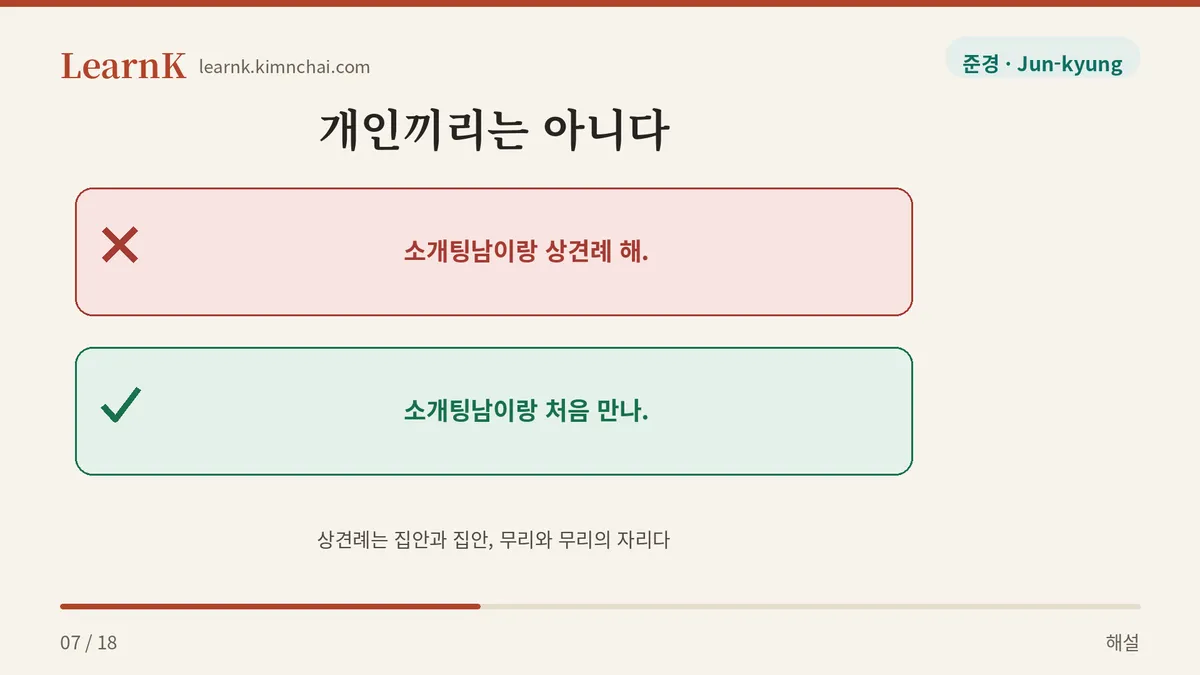
✗ (to a friend, on your way to a blind date) 나 오늘 저녁에 소개팅남이랑 상견례 해. (na oneul jeonyeoge sogaetingnamirang sanggyeonnye hae.) ✓ (to a friend) 나 오늘 저녁에 소개팅남이랑 처음 만나. (na oneul jeonyeoge sogaetingnamirang cheoeum manna.) — I’m meeting my blind date for the first time tonight. → A 상견례 is not two people but family meeting family, group meeting group, with full formality. Use it for a private first date and it sounds like an occasion that presupposes marriage — your listener will be startled.
✗ (to your future father-in-law) 아버님, 저희 상견례 언제 번개로 한번 하시죠. (abeonim, jeohui sanggyeonnye eonje beongaero hanbeon hasijyo.) ✓ (to your future father-in-law) 아버님, 상견례 날짜는 두 집안 편하신 때로 잡아 주시면 저희가 맞추겠습니다. (abeonim, sanggyeonnye naljjaneun du jiban pyeonhasin ttaero jaba jusimyeon jeohuiga matchugetseumnida.) — Sir, if you set the 상견례 date for whenever suits both families, we’ll work around it. → The grammar is fine, but the temperature is off. 번개 (beongae), literally lightning, is a light, casual word for a spur-of-the-moment get-together, so pairing it with an occasion built on formality gives the impression that you are treating your elders lightly. The date and the place are normally settled by asking the elders’ wishes first.
Example Sentences by Situation
① To a friend in the middle of wedding preparations (casual speech)
Scene: Before the subject of invitations comes up, you quietly ask how things are going.
상견례 날짜는 잡혔어? 어디서 하기로 했어? (sanggyeonnye naljjaneun japyeosseo? eodiseo hagiro haesseo?) Has the 상견례 date been set? Where did you decide to have it? The most common way to ask how far along someone’s wedding preparations are. In Korea, preparations are only felt to have begun once the 상견례 is done.
② At work (polite, formal)
Scene: Announcing next week’s schedule in the team chat.
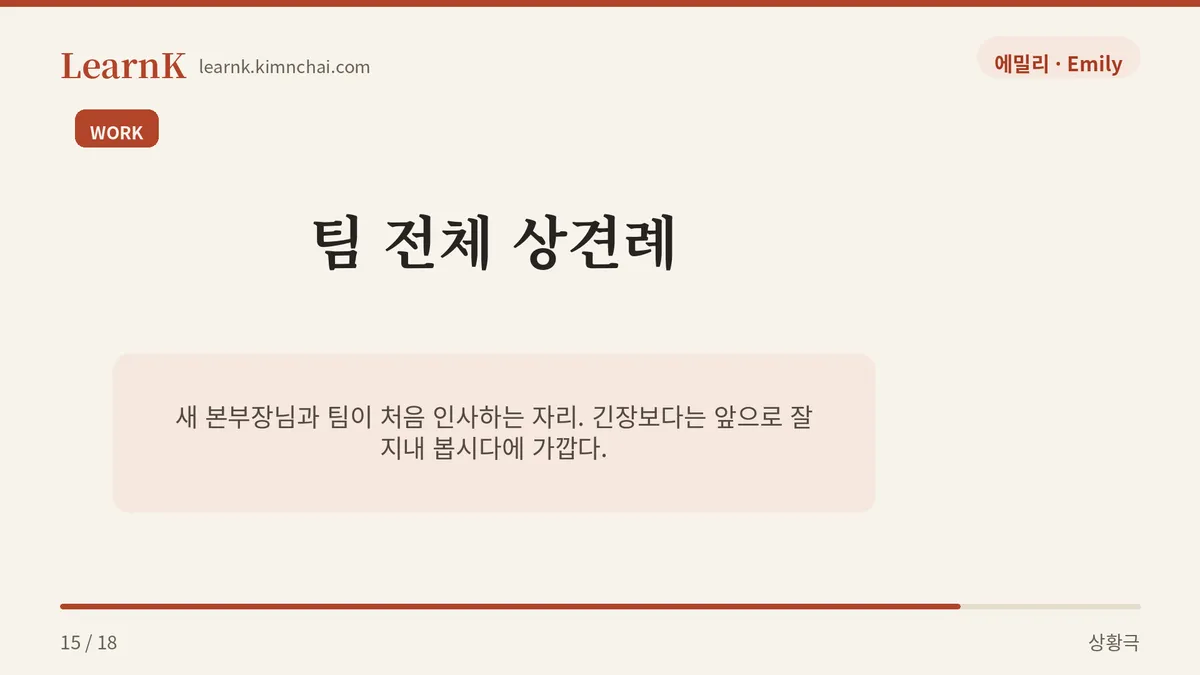
다음 주 월요일 오전 열 시에 새로 오신 본부장님과 팀 전체 상견례가 있습니다. (daeum ju woryoil ojeon yeol sie saero osin bonbujangnimgwa tim jeonche sanggyeonnyega itseumnida.) Next Monday at ten in the morning, the whole team has a first meeting with our new division head. This is the first sense, unrelated to marriage. You could say 첫 미팅 (cheot miting), first meeting, but 상견례 adds the nuance of an occasion for simply seeing one another’s faces.
③ To your future spouse’s parents (very politely)
Scene: After receiving their blessing, you explain the next step.
상견례 자리는 저희가 몇 군데 알아보고 말씀드리겠습니다. (sanggyeonnye jarineun jeohuiga myeot gunde arabogo malsseumdeurigetseumnida.) As for the 상견례 venue, we’ll look into a few places and report back to you. Ending with 말씀드리겠습니다 (malsseumdeurigetseumnida) leaves the decision in the elders’ hands. It contains Korean etiquette in miniature: the young people do the legwork, the elders make the call.
Honorifics, Casual Speech, and Similar Expressions
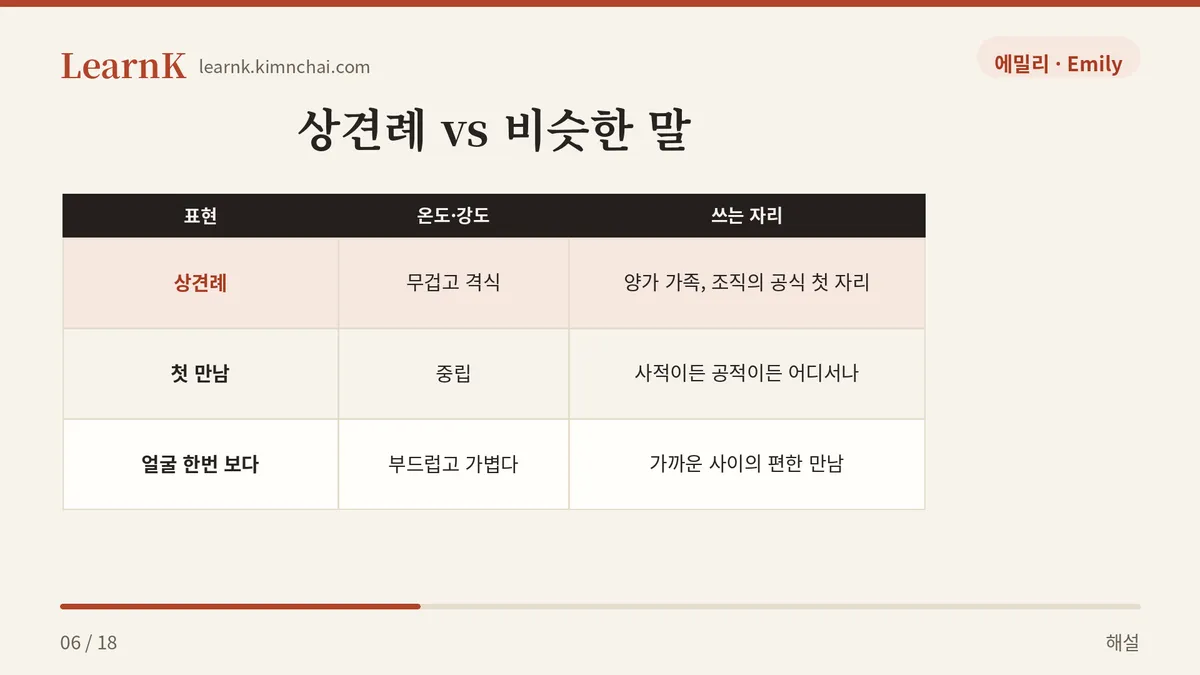
Because 상견례 is a noun, the politeness level is decided by the verb that follows it. To an elder it becomes 상견례는 잘하셨어요? (sanggyeonnyeneun jalhasyeosseoyo?), and to a friend 상견례 잘했어? (sanggyeonnye jalhaesseo?). The word already carries formality inside it, so even spoken casually, the weight of the occasion does not disappear.
| Expression | Tone / Intensity | Where it’s used |
|---|---|---|
| 상견례 (sanggyeonnye) | heavy and formal | the first meeting of two families; an organization’s official first greeting |
| 첫 만남 (cheot mannam) | neutral | anywhere, private or public alike |
| 얼굴 한번 보다 (eolgul hanbeon boda) | soft and light | meeting casually among people who are close |
| 인사드리다 (insadeurida) | polite but brief | being introduced to someone older and simply paying your respects |
The same meeting, called 얼굴 한번 보는 자리 (eolgul hanbeon boneun jari), lets your shoulders drop; called 상견례, it summons up suits and a Korean set-menu restaurant at once. In fact, elders who want to take the pressure off will deliberately soften it to 그냥 밥이나 한번 먹자 (geunyang babina hanbeon meokja) — let’s just have a meal sometime.
Cultural Background — The Day Two Families First Sit Down Together
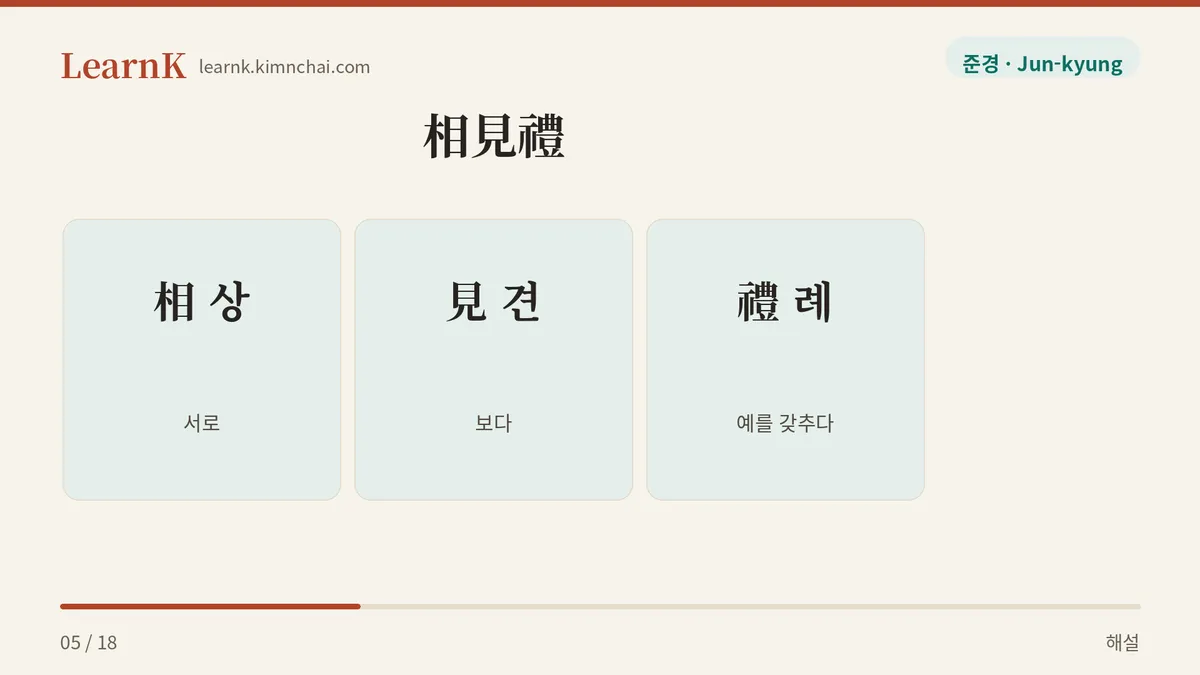
상견례 is built from the Chinese characters 相 (서로 상, each other), 見 (볼 견, to see), and 禮 (예도 례, propriety). Unpacked literally, it is the propriety of seeing each other. The heart of it is not the meeting but the 예 (ye), the propriety. It does not mean merely running into someone; the backbone of the word is looking at each other while observing proper form — which is why it attaches only to formal occasions.
An actual 상견례 usually unfolds like this. Both sets of parents and the couple to be married gather at a quiet Korean set-menu restaurant or a hotel’s Korean dining room. The elders exchange greetings first, then each of the young people pays their respects to the other’s parents. Rather than boasting about their own child, both sides speak with consideration for the other family, and once the mood loosens, talk turns naturally to the wedding date and the venue. Clothes that don’t stand out, a quiet setting, careful words — those three things are the long-standing custom. These days it has grown much simpler, and more families wrap it up quickly at a café or an ordinary restaurant, but the sense that wedding preparations only start once you’re past this remains firmly in place.
This is also why 상견례 scenes turn up so often in Korean dramas. The two families’ circumstances, speech patterns, and values are all laid bare at once over a single table. So a 상견례 scene rarely ends warmly. A single gesture offering a side dish, a single tone of voice asking about someone’s job, and the nerves start showing — and one remark made at that table becomes several episodes’ worth of conflict. When you’re watching a Korean drama and the characters put on suits and sit down in a Korean set-menu restaurant, you can guess in advance what is about to happen.
The 상견례 used in the first sense, meanwhile, is far more low-key: a new coach meeting the squad, a newly appointed executive meeting the staff, first-year students greeting their seniors. That kind of 상견례 is less about nerves and closer to let’s get along from here on. That one word can be used at two such different temperatures is part of the fun of learning it.
Today’s Quiz
Which of the following sentences uses 상견례 naturally?
- 어제 소개팅에서 그 사람이랑 상견례 했는데 괜찮더라. (Yesterday I had a 상견례 with that person on the blind date, and they seemed nice.)
- 다음 달에 양가 부모님 모시고 상견례를 하기로 했어요. (Next month we’ve decided to have a 상견례 with both sets of parents.)
- 오랜만에 만난 친구랑 카페에서 상견례를 했다. (I had a 상견례 at a café with a friend I hadn’t seen in ages.)
The answer is number 2. 상견례 refers to family meeting family, or group meeting group, formally and for the first time. For private meetings between individuals, as in 1 and 3, 처음 만났다 (cheoeum mannatda), we met for the first time, or 얼굴 봤다 (eolgul bwatda), we saw each other, is the natural choice.
Definitions and example sentences are from the National Institute of Korean Language’s Basic Korean Dictionary (krdict.korean.go.kr); that portion of this post, including our translations, is licensed under CC BY-SA 2.0 KR.