세배 (sebae) — On New Year's Morning, the Greeting That Comes Before Words
세배 (sebae)
세배 (sebae) means the bow you make as a greeting to your elders on Seol, Lunar New Year’s Day. On New Year’s morning, once the 떡국 (tteokguk) bowls have been cleared away, the house goes quiet for a moment. The elders sit in a row on the warm part of the floor or over on the sofa, and the children and younger relatives line up in front of them. As soon as someone says “이제 세배해야지 (ije sebae-haeyaji)” — “time for sebae now” — the talking stops for a few minutes. You kneel, fold your hands, and lower your body until your forehead touches the backs of your hands. If you asked Koreans to reduce Seol to a single photograph, most of them would probably pick this scene.
세배 (sebae) is the name of a physical movement, but it also stands for the entire first greeting of the new year. So when someone says “세배 왔습니다 (sebae watseumnida),” it doesn’t mean “I’ve come to bow once” — it means “I’ve come to pay my New Year’s respects.” What matters is that direction is built into this word. 세배 (sebae) only travels upward. A younger person does it for an older person, and the reverse simply doesn’t exist. After receiving the bow, the elder offers 덕담 (deokdam) — words wishing you a good year ahead — and then 세뱃돈 (sebaetdon), New Year’s money, changes hands. Bow → 덕담 (deokdam) → 세뱃돈 (sebaetdon): those three beats come as one package.
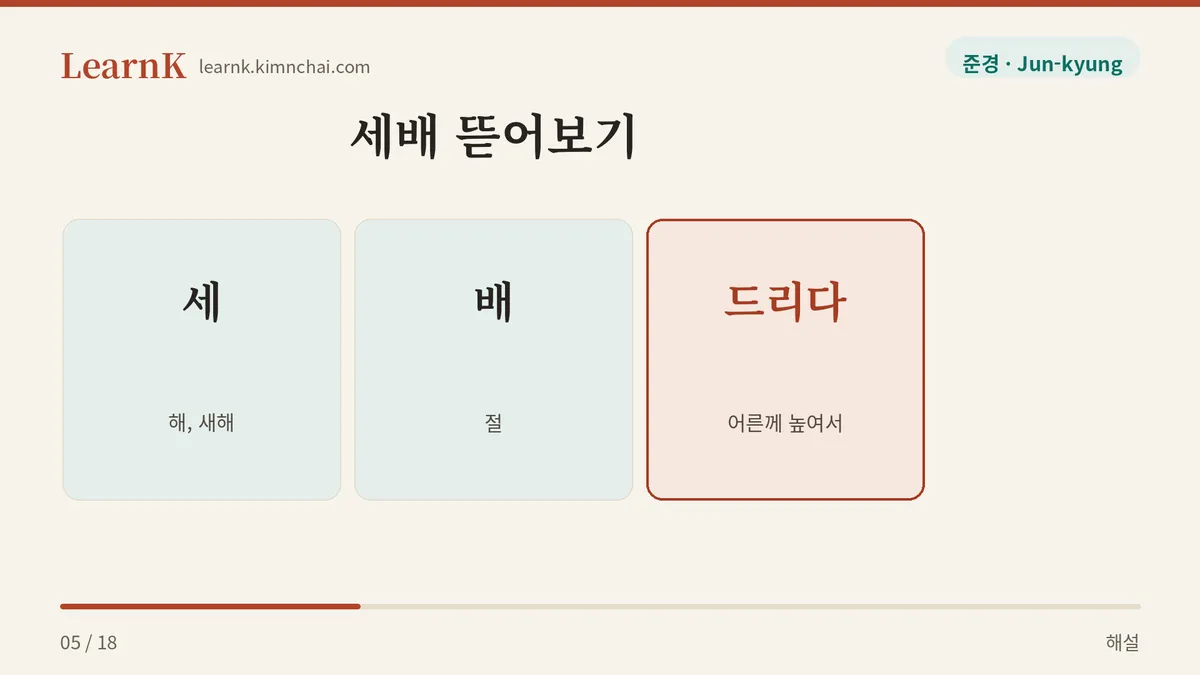
It helps to memorize the verbs that usually attach to it. 세배를 하다 (sebae-reul hada) is the basic form, and when you want to elevate the elder you use 세배를 드리다 (sebae-reul deurida). Going from house to house to do it is 세배를 다니다·돌다 (sebae-reul danida / dolda).
Checking the National Institute of Korean Language dictionary
세배 (sebae) 「noun」 설에 웃어른에게 인사로 하는 절. A bow performed as a greeting to one’s elders on Seol, Lunar New Year’s Day. [en] sebae — new year’s bow: The act of performing a traditional bow to pay respect to one’s elders on Seol, New Year’s Day. [ja] セベ【歳拝】 — お正月に目上の人に対するあいさつとして行うお辞儀。 [es] sebae, reverencia de Año Nuevo — Genuflexión que se hace a los mayores en Año Nuevo como saludo y muestra de respeto. [zh] 拜年 — 春节向长辈行的跪拜礼。 — National Institute of Korean Language, Basic Korean Dictionary (krdict.korean.go.kr)
That one-line definition contains all three conditions. ① The time is 설 (Seol), ② the target is 웃어른 (uteoreun), your elders, and ③ the nature of the act is 인사 (insa), a greeting. If even one of the three is off, it isn’t 세배 (sebae) anymore. The dictionary carries no Portuguese definition, so we translated one ourselves — sebae — reverência de Ano Novo: gesto tradicional de curvar-se aos mais velhos como saudação no Seol, o Ano Novo coreano. (Our own translation, not the dictionary’s text.)
Now let’s look at the dictionary’s actual usage examples.
아이들이 구정을 맞아 할머니께 세배를 한다. — National Institute of Korean Language, Basic Korean Dictionary (krdict.korean.go.kr)
aideuri gujeong-eul maja halmeoni-kke sebae-reul handa. (The children do their sebae for their grandmother now that the Lunar New Year has come.) This is the most typical picture of all. 구정 (gujeong, 舊正) is an older way of referring to the lunar new year; these days people more often say 설 (Seol) or 설날 (Seollal). Notice the particle 께 (kke). The person receiving the 세배 (sebae) is always someone to be honored, so 께 (kke) sounds natural rather than 에게 (ege).
나는 설날에 부모님께 세배를 한 후 건강을 기원하는 덕담을 올렸다. — National Institute of Korean Language, Basic Korean Dictionary (krdict.korean.go.kr)
naneun seollal-e bumonim-kke sebae-reul han hu geongang-eul giwonhaneun deokdam-eul ollyeotda. (On Seollal I did my sebae for my parents, and afterward offered them deokdam wishing them good health.) The order — words come after the bow — is written right into the sentence. Usually the elder gives 덕담 (deokdam) to the younger person, but it’s also common for grown children to offer words wishing their parents good health.
할아버지께 세배를 드리러 갔더니만 어딜 가셨는지 안 계시더라고. — National Institute of Korean Language, Basic Korean Dictionary (krdict.korean.go.kr)
harabeoji-kke sebae-reul deurireo gatdeoniman eodil gasyeonneunji an gyesideorago. (I went over to give Grandfather my sebae, but he’d gone off somewhere and wasn’t home.) This sentence shows that 세배 (sebae) is something you travel to do. As the -러 가다 (-reo gada) ending tells you, the act of going to where the elder is counts as part of 세배 (sebae) too. Here the honorific 드리다 (deurida) is used.
설날 아침 때때옷을 차려입은 아이는 어른들께 세배를 드렸다. — National Institute of Korean Language, Basic Korean Dictionary (krdict.korean.go.kr)
seollal achim ttaettae-os-eul charyeo-ibeun aineun eoreundeul-kke sebae-reul deuryeotda. (On New Year’s morning, the child, dressed in bright holiday clothes, gave sebae to the grown-ups.) 때때옷 (ttaettae-ot) refers to the colorful striped clothes children wear on holidays. It shows that 세배 (sebae) is a formal greeting — formal enough that even your outfit is part of it.
세배를 돌다. — National Institute of Korean Language, Basic Korean Dictionary (krdict.korean.go.kr)
sebae-reul dolda. (To go around doing sebae.) This is how you describe making the rounds — not just one house, but relatives’ homes and neighbors’ homes, one after another. In country villages of the past, children would spend the whole morning of Seollal circling the neighborhood doing 세배 (sebae).
A real conversation
Setting: New Year’s morning, the living room of Jun-kyung’s family home. The tteokguk table has just been cleared, and the elders have sat down in a row by the sofa.
Jun-kyung: 에밀리야, 떡국 다 먹었으면 이제 세배 할 차례야. 나 따라 하면 돼. Emily, if you’re done with the tteokguk, it’s time for sebae now. Just follow me.
Emily: 나도 해? 나 며느리도 아니고 그냥 친구인데 껴도 되나… Me too? I’m not family, just a friend — is it okay for me to join?
Jun-kyung: 되지, 그럼. 손 이렇게 포개고. 남자는 왼손이 위, 너는 오른손 위로 하면 돼. Of course it is. Fold your hands like this. Men put the left hand on top; you put your right on top.
Emily: 절하면서 “새해 복 많이 받으세요” 하는 거 아니었어? 나 그거 연습했는데. Aren’t you supposed to say “Happy New Year” while bowing? I practiced that.
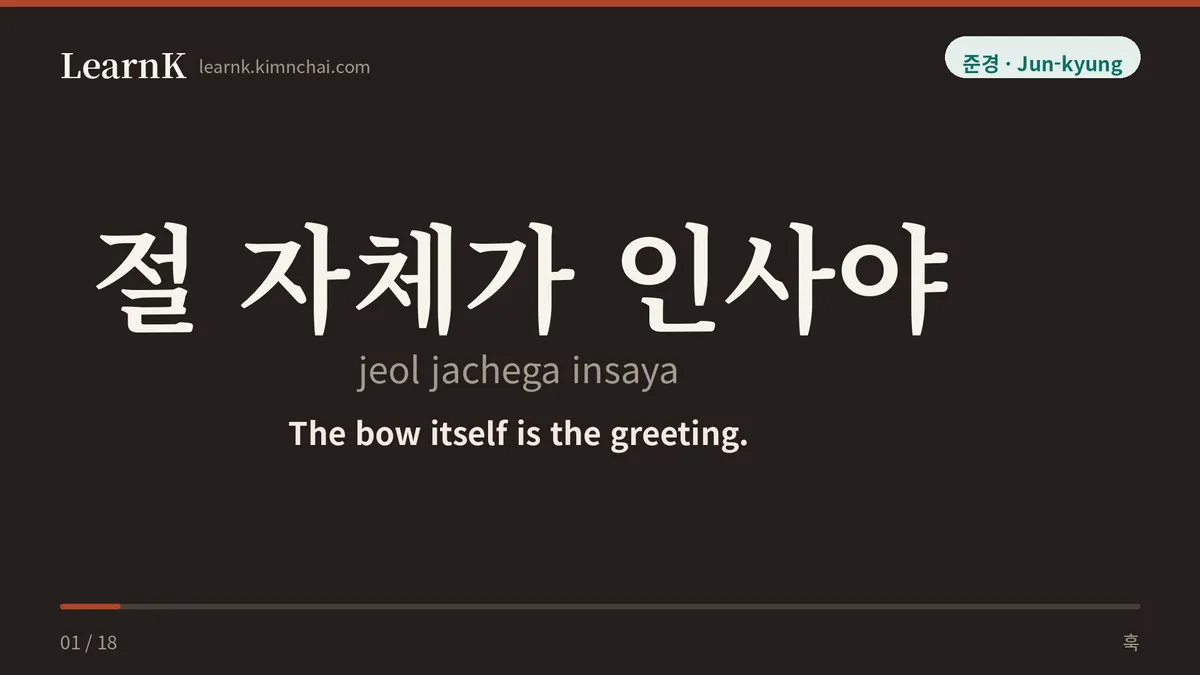
Jun-kyung: 아니, 절 자체가 인사야. 끝나고 어른이 덕담 주시면 그때 말씀드려. No — the bow itself is the greeting. Say it after, when the elders give you their blessing.
Emily: 아, 그렇구나. 나 세배 처음이라 손 떨려. 세뱃돈은 됐어, 나 서른둘이야. Ah, I see. My hands are shaking — it’s my first sebae. And no New Year’s money for me, I’m thirty-two.
This sounds off in Korean
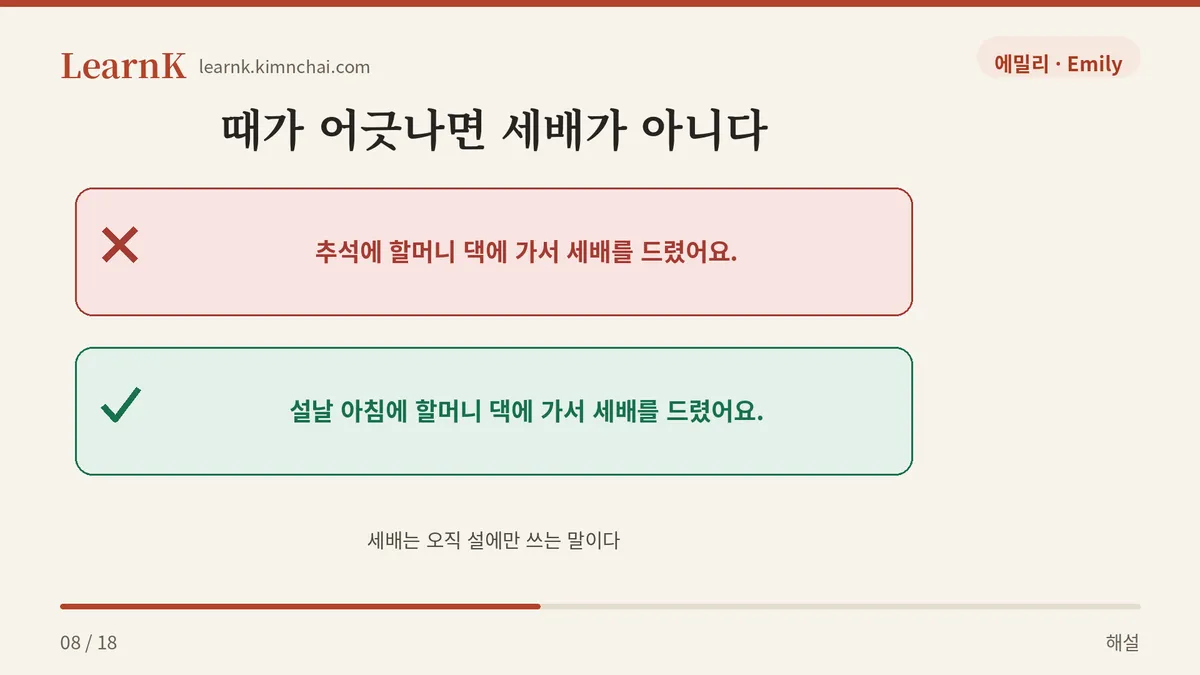
✗ 추석에 할머니 댁에 가서 세배를 드렸어요. (I went to my grandmother’s house on Chuseok and gave her my sebae.) ✓ 설날 아침에 할머니 댁에 가서 세배를 드렸어요. (I went to my grandmother’s house on Seollal morning and gave her my sebae.) → 세배 (sebae) is a word used only for 설 (Seol). People bow to their elders on Chuseok too, but that’s simply 인사드리다 (insa-deurida) or 절하다 (jeolhada); the rite performed for ancestors is 차례 (charye). Assuming that any holiday bow is 세배 (sebae) is the single most common learner mistake.
✗ (to a friend the same age) 야, 너도 나한테 세배 한 번 해 봐. (Hey, why don’t you do a sebae for me too?) ✓ (to a nephew) 지호야, 큰아버지께 세배부터 드리고 오렴. (Ji-ho, go give your uncle his sebae first.) → 세배 (sebae) has a fixed direction, so you can’t demand it from someone younger or from a peer. Say this to a friend and you’ll typically get a joking “Since when are you my elder?” in return; say it to a junior colleague at work and it sounds genuinely rude.
Example sentences by situation
① The year you can’t make it back to your hometown, greeting them by video call
할머니, 올해는 못 내려가서 화면으로 세배 드릴게요.
harmeoni, olhaeneun mot naeryeoga-seo hwamyeon-euro sebae deurilgeyo. (Grandma, I couldn’t come down this year, so I’ll do my sebae over the screen.) People who can’t travel home for the holiday really do say this. Bowing in front of a camera may look a little silly, but elders usually find the gesture all the more endearing.
② Making the rounds of several houses over the Seol holiday
오전엔 큰집에서 차례 지내고, 오후엔 외가 쪽으로 세배를 돌 거예요.
ojeon-en keunjib-eseo charye jinaego, ohu-en oega jjog-euro sebae-reul dol geoyeyo. (In the morning we hold the charye rite at the eldest uncle’s, and in the afternoon we’ll go around doing sebae at my mother’s side of the family.) One sentence makes the difference between 차례 (charye) and 세배 (sebae) clear: 차례 (charye) is for ancestors who have passed away, 세배 (sebae) for elders who are alive.
③ Teaching a child the right order
세뱃돈부터 받으면 어떡해. 세배부터 드리고 “새해 복 많이 받으세요” 해야지.
sebaetdon-buteo badeumyeon eotteokhae. sebae-buteo deurigo “saehae bok mani badeuseyo” haeyaji. (You can’t take the money first! Do your sebae, then say “Happy New Year.”) A scolding you’ll hear in Korean living rooms just about every New Year’s morning.
Politeness levels and related expressions
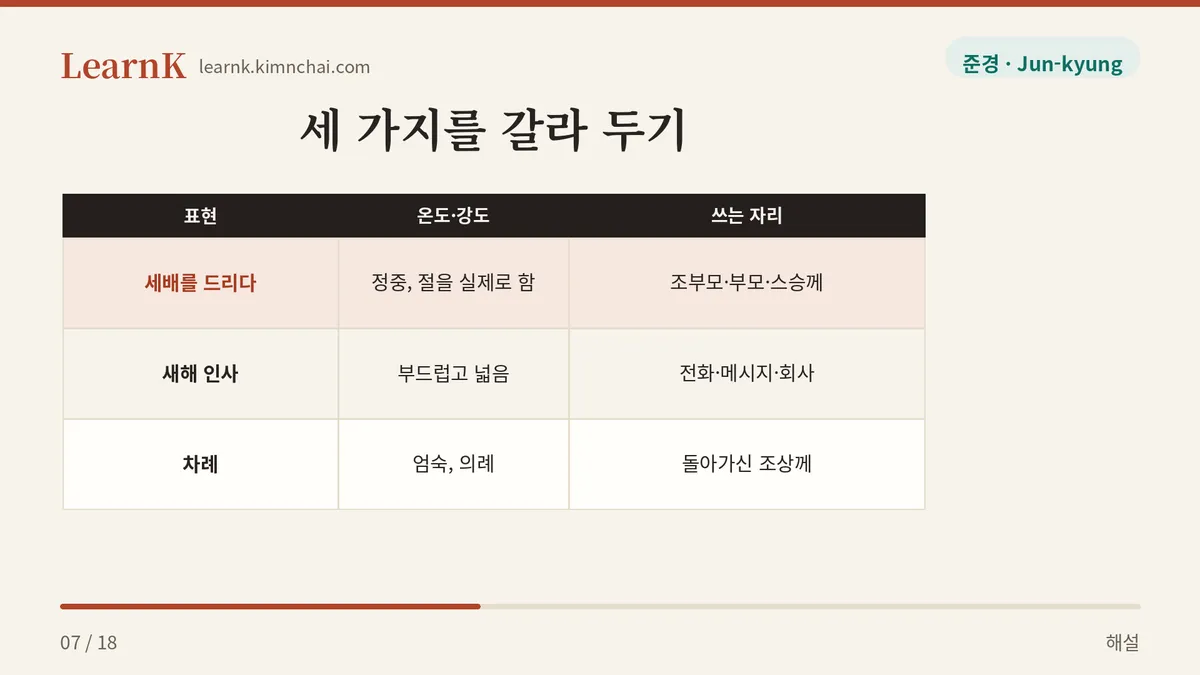
| Expression | Tone / strength | Where it’s used |
|---|---|---|
| 세배를 드리다 (sebae-reul deurida) | Polite; clearly elevates the other person | For actual elders — grandparents, parents, teachers. The safest form |
| 세배를 하다 (sebae-reul hada) | Neutral, descriptive | When stating a fact, or when a child is the subject. Slightly less polite if you’re speaking directly to an elder |
| 큰절 (keunjeol) | Refers to the physical bow itself | Formal deep bows in general — not only 세배 (sebae) but weddings, funerals, and so on. 세배 (sebae) is performed as a 큰절 (keunjeol) |
| 새해 인사 (saehae insa) | Soft and broad | Situations with no bowing — phone calls, messages, the office. The easiest one for foreigners to use |
| 차례 (charye) | Solemn, ceremonial | The memorial rite for ancestors who have passed away. Completely different recipients from 세배 (sebae) |
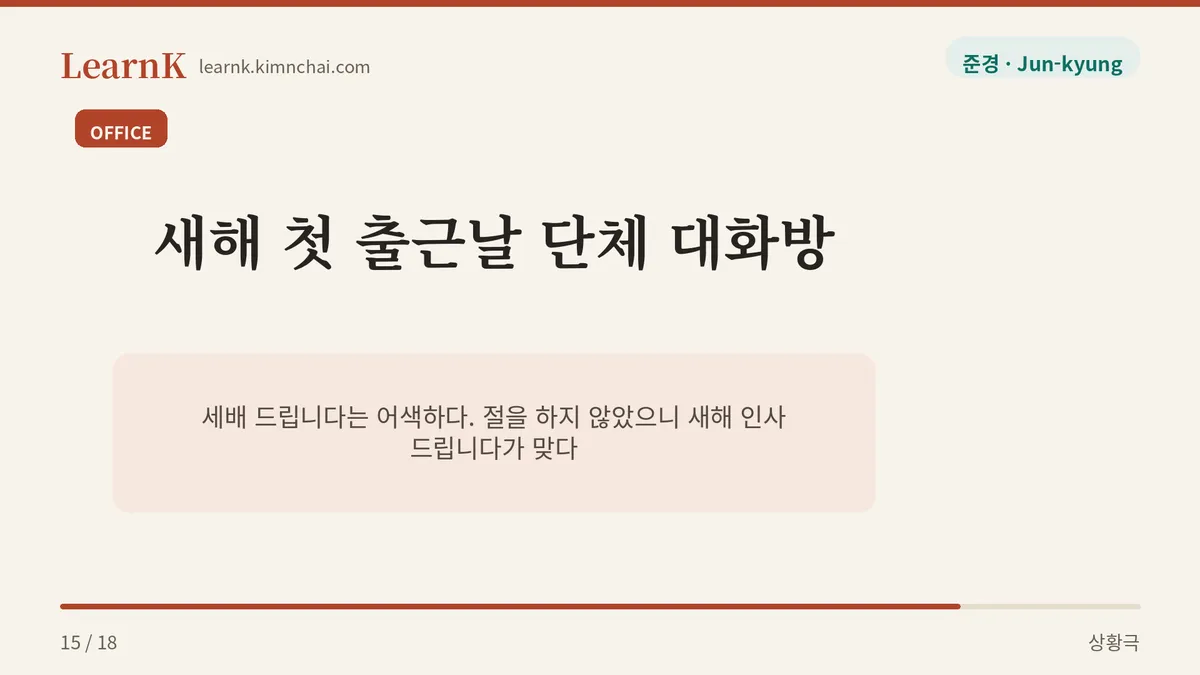
The last two rows are the easy ones to mix up. Writing “세배 드립니다 (sebae deurimnida)” in your company group chat sounds strange — you didn’t bow. What belongs there is “새해 인사 드립니다 (saehae insa deurimnida).”
Cultural background — a whole year folded into one bow
세배 (sebae, 歲拜) is a Sino-Korean word. 세 (歲), meaning “year,” joins 배 (拜), meaning “bow,” to give “the bow of the new year.” The characters look dry, but the way the word actually works in life is much warmer.
The form is fixed. 세배 (sebae) is done as a 큰절 (keunjeol), and for the way you fold your hands — 공수 (gongsu) — you’re taught that men place the left hand on top and women the right. And there’s one point that even Koreans often get wrong: according to the National Institute of Korean Language’s standard etiquette guidelines, you do not say “새해 복 많이 받으세요 (saehae bok mani badeuseyo)” while you are bowing. The bow is already the greeting. When the elder offers a 덕담 (deokdam) like “올해는 시험 꼭 붙어라” (“May you pass your exam this year”), that’s when you answer, “네, 새해 복 많이 받으세요.” This is exactly where Emily tripped up in the conversation above.
세뱃돈 (sebaetdon) was originally the children’s share. Once you get a job you cross over from receiving to giving, and Koreans talk about that switch as a marker of adulthood. Saying “올해부터 세뱃돈 주는 입장 됐다” — “as of this year I’m on the giving side of the New Year’s money” — is another way of saying “I earn my own living now.”
In TV dramas, a 세배 (sebae) scene speaks through blocking rather than dialogue. In a work like Reply 1988 (tvN, 2015), which shows an entire neighborhood’s holiday, who kneels in front of whom lays out the whole map of a family. That’s why the conflict in a holiday episode usually erupts right before or right after the 세배 (sebae) — it’s the one moment when a family that rarely gathers is all seated in the same room. So when you’re watching a Korean drama and the elders line up in a row with the younger people standing before them, you can safely expect something to happen shortly.
Today’s quiz
In which of the following situations can you naturally use 세배 (sebae)?
① On Chuseok morning, at Grandma’s house ② On Seollal morning, to your grandfather ③ At a friend’s birthday party ④ To a junior colleague at the company New Year’s party
Answer: ②
세배 (sebae) comes with three conditions: the time is Seol, the recipient is an elder, and the nature of the act is a greeting. ① fails because the holiday isn’t Seol, ③ fails because it isn’t Seol and the other person isn’t an elder, and ④ fails because the direction is reversed. Demanding 세배 (sebae) from a junior colleague as in ④ is risky even as a joke.
Definitions and example sentences are from the National Institute of Korean Language’s Basic Korean Dictionary (krdict.korean.go.kr); that portion of this post, including our translations, is licensed under CC BY-SA 2.0 KR.