설마 그럴 리가 — The One Word That Holds Both Surprise and Doubt: '설마'
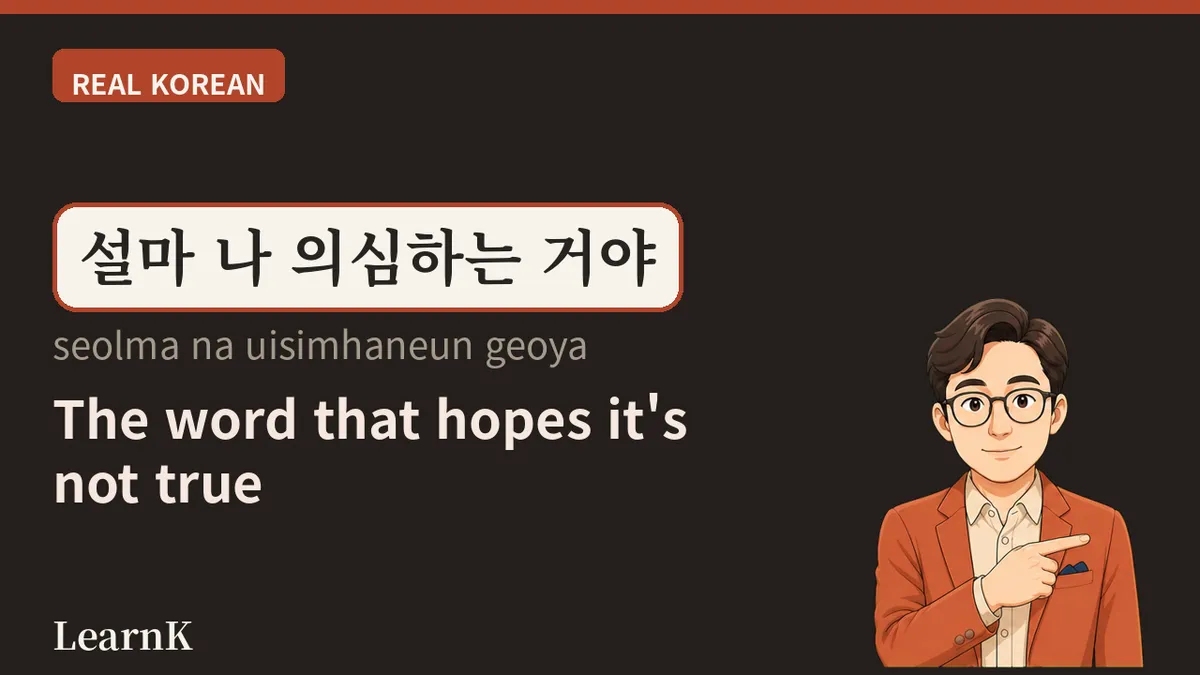
When you watch Korean dramas, you’ll often run into a scene where the main character opens their eyes wide and trails off with “설마…” It’s the one word that slips out on its own when you hear news you don’t want to believe, or when a bad feeling flickers through your mind. Today we’ll take a deep dive into an adverb that works almost like an exclamation — one Koreans use several times a day: 설마 (seolma).
설마
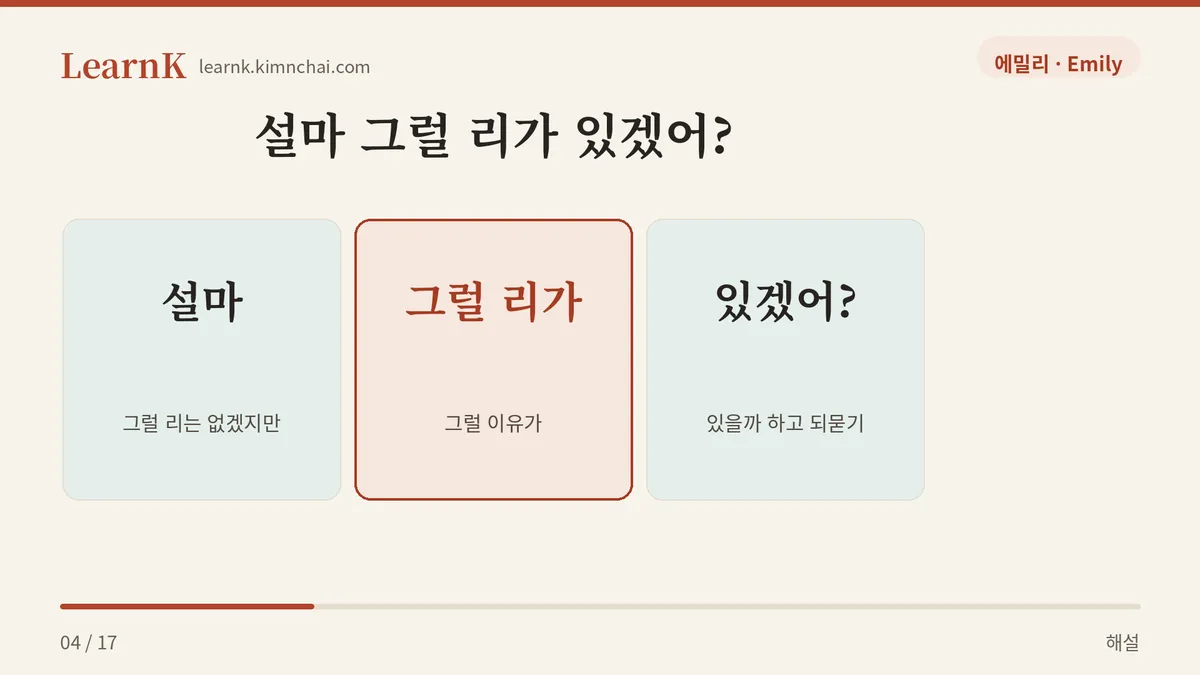
설마 (seolma) is an expression that packs the feeling of “surely it can’t be… but just in case” into a single word. You use it when you’re hoping something isn’t true, yet a corner of your heart is still uneasy, thinking, “but what if it really is?” It’s very close in nuance to the English No way… or You don’t say…, and the Japanese まさか (masaka).
The key point is that it carries two emotions at once. The first is the denial and hope of “it can’t be so,” and the second is the anxiety and doubt of “but still, what if.” That’s why 설마 is usually followed by a rhetorical question like ~겠어?, ~ㄹ 리가 있겠니?, or ~ㄹ까?, giving it the tone of confirming — to the other person or to yourself — “there’s no way that’s true, right?”
Checking with the National Institute of Korean Language dictionary
The National Institute of Korean Language’s Basic Korean Dictionary defines 설마 as follows.
설마 (adverb) Probably not, but just in case. [en] really — Probably not, but it is possible [ja] まさか — そんなはずはないだろうが、もしかして。 [es] de ninguna manera, jamás — Imposible pero tal vez sí. [zh] 难道;难不成 — 不会是那样而说不定。 — National Institute of Korean Language, Basic Korean Dictionary (krdict.korean.go.kr)
Shall we also look at the real usage examples listed in the dictionary?
걱정 마세요. 설마 고 사이에 무슨 일이 있겠어요? — National Institute of Korean Language, Basic Korean Dictionary (krdict.korean.go.kr)
This is a situation where you’re reassuring someone. It’s a warm usage that eases their worry — “Surely nothing could happen in such a short while, right?”
설마, 고의적으로 인사 안 하고 가는 건 아니겠지? — National Institute of Korean Language, Basic Korean Dictionary (krdict.korean.go.kr)
You can see the wish to interpret the other person’s behavior charitably — feeling a little hurt, yet thinking, “they surely didn’t do it on purpose.”
설마 친했던 사람들이 갑자기 너를 차갑게 대할 리가 있겠니? — National Institute of Korean Language, Basic Korean Dictionary (krdict.korean.go.kr)
This is a comforting word for someone who’s feeling down. With ~ㄹ 리가 있겠니? attached, it becomes a reassurance close to certainty — “there’s absolutely no way that could happen.”
설마가 사람 잡는답디다. — National Institute of Korean Language, Basic Korean Dictionary (krdict.korean.go.kr)
This is a very famous proverb. It means that while you let your guard down thinking “surely that could never happen,” you end up facing real trouble — a lesson to always be prepared for the worst.
Practice sentences by situation
Now let’s get a feel for it with some sentences of our own.
① Waiting for exam results (to yourself)
나 이번엔 진짜 열심히 했는데… 설마 (seolma) 또 떨어진 건 아니겠지?
A scene where you’re trying to calm your own nervous heart. “There’s no way” and “but what if it’s real?” are all mixed together.
② Reacting to a friend’s surprising news
A: 민수랑 지현이 사귄대! B: 설마 (seolma)! 둘이 맨날 싸웠잖아.
Here 설마 is used almost like a standalone exclamation, expressing the shock of “No way!”
③ When you have a bad feeling
지갑이 안 보여… 설마 (seolma) 아까 버스에 두고 내린 거야?
This is the moment of cautiously putting into words a possibility you don’t want to believe.
Comparing formal/informal speech and similar expressions
Since 설마 itself is an adverb unrelated to politeness levels, you adjust the formality through the sentence ending.
- Informal: 설마 그럴 리가 있겠어? (seolma geureol riga itgesseo?)
- Formal: 설마 그럴 리가 있겠어요? (…itgesseoyo?)
Shall we also compare it with some similar expressions?
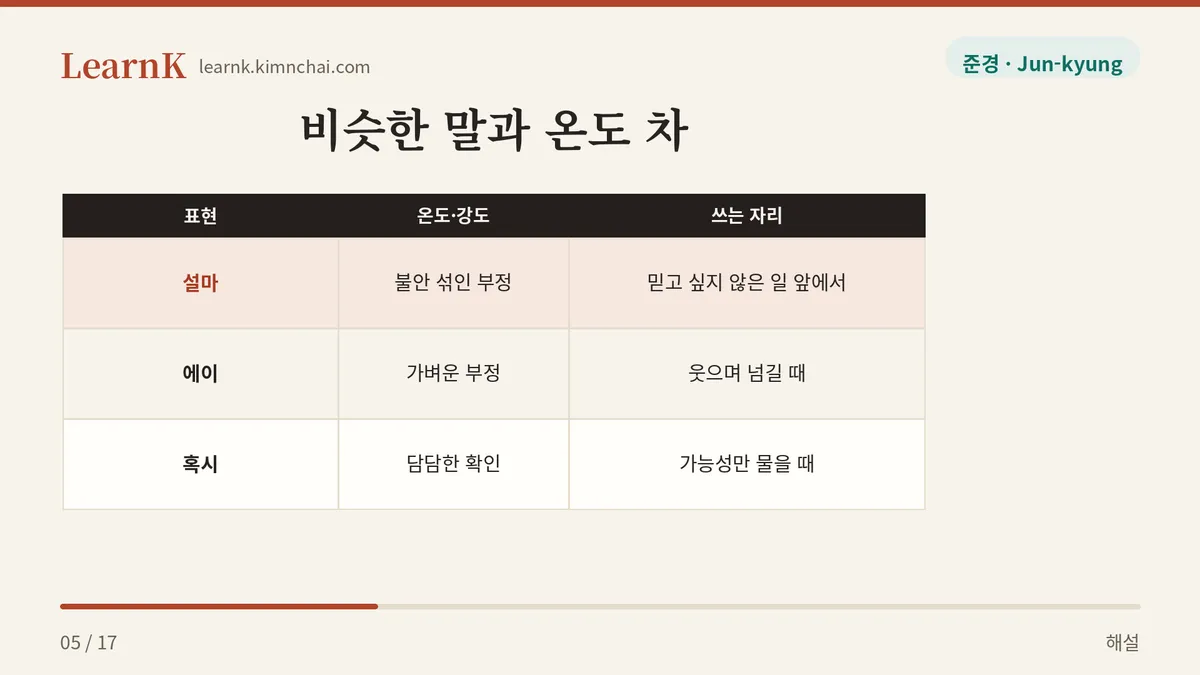
- 에이 (ei): Used for a light dismissal. As in “에이, 아니겠지,” it carries less anxiety than 설마.
- 아무리 그래도 (amuri geuraedo): An expression that draws a line, meaning “even so, surely not to this extent.”
- 혹시 (hoksi): 혹시 is a pure sounding-out of possibility, so it has little color of anxiety or hope, whereas 설마 carries far stronger emotion.
Cultural background — ‘설마’ in dramas
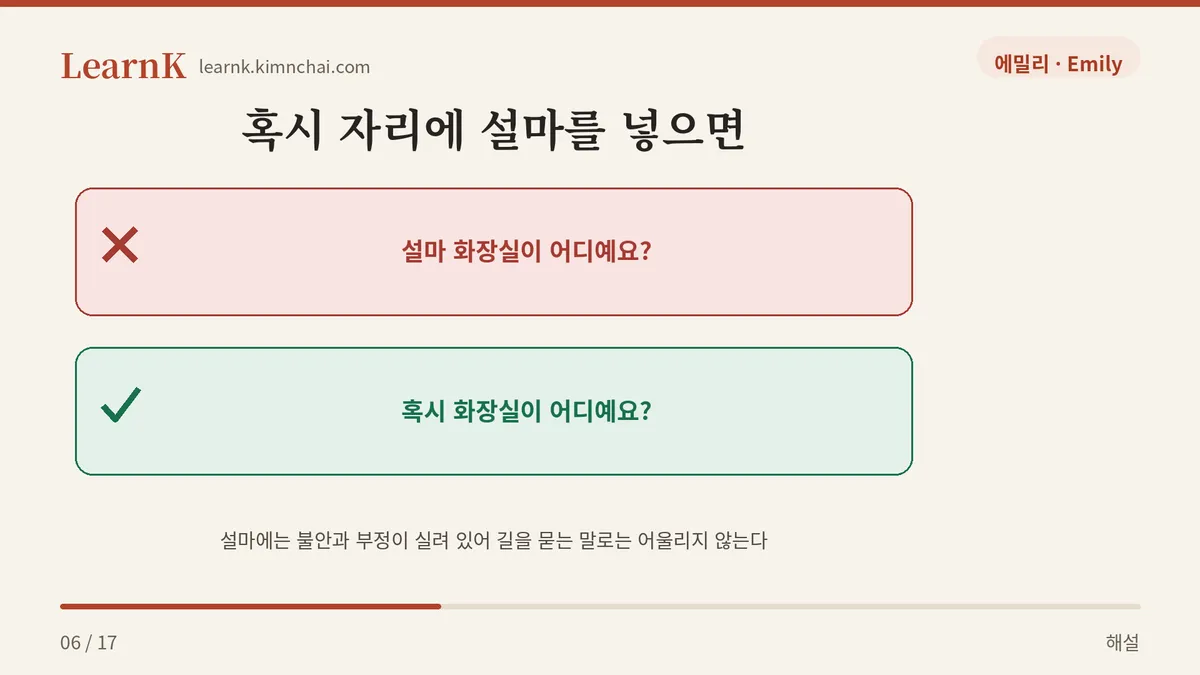
In a plot-twist scene, the moment a character catches on to the truth, this one word never fails to appear in the script. Picture the main character, sensing betrayal, hurling it at the other person.
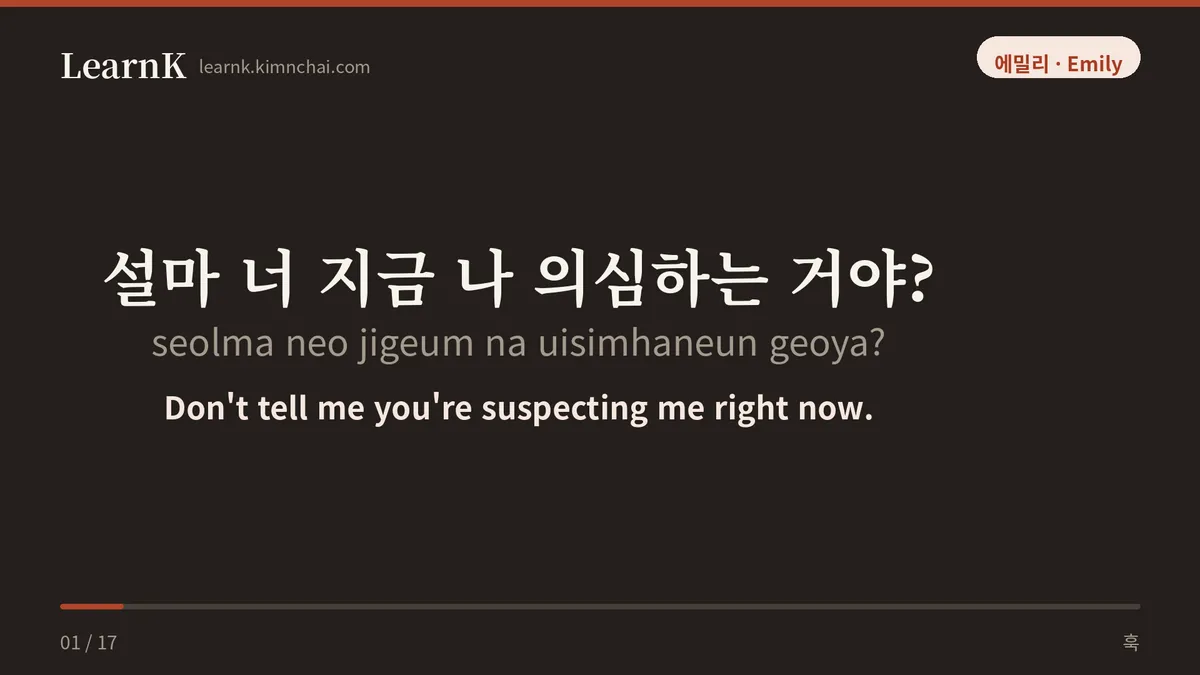
설마 너 지금 나를 도둑으로 의심하는 거니? — National Institute of Korean Language, Basic Korean Dictionary (krdict.korean.go.kr)
The indignation of being doubted by someone you trusted, and the hope of “please tell me it isn’t so” — both explode in a single sentence. In this way, 설마 is like a compressed file of emotion, carrying surprise, doubt, hurt, and anxiety all at once. That’s why using just this one word well can make you sound like a native speaker.
Today’s quiz
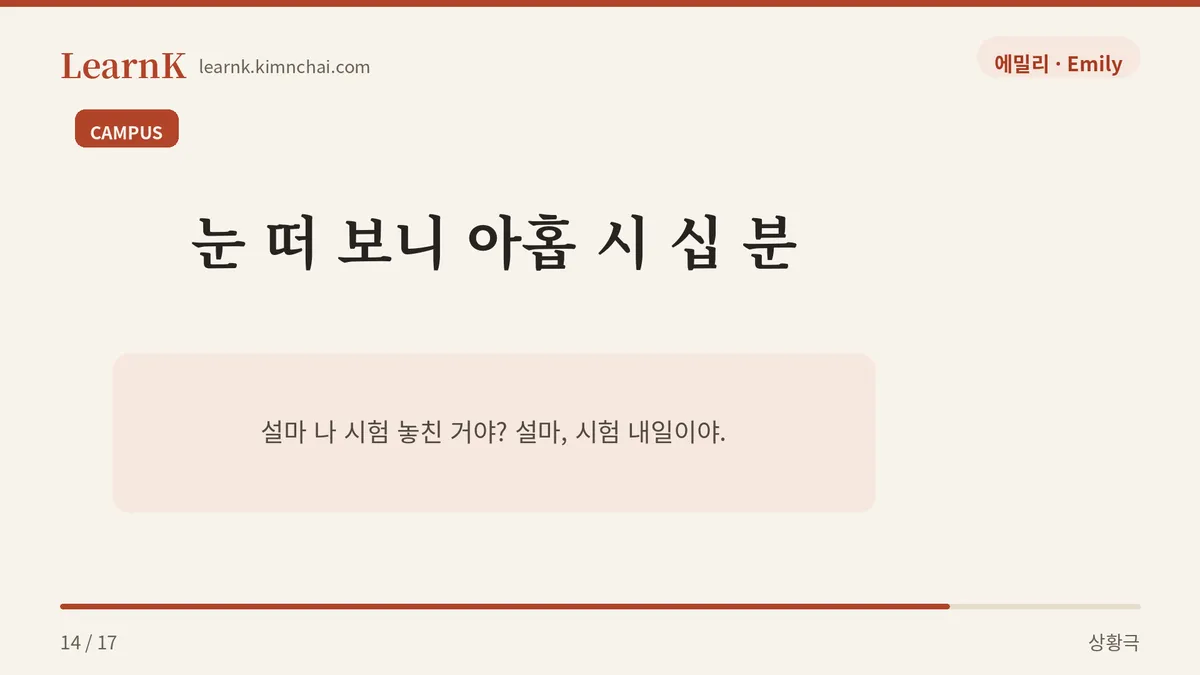
A friend brings you the news, “Our team made it to the finals this time!” If you wanted to answer using 설마 to convey a happy, unbelievable surprise, how could you say it? (Hint: try using the rhetorical-question form ~겠어?.)
Definitions and example sentences are from the National Institute of Korean Language’s Basic Korean Dictionary (krdict.korean.go.kr); that portion of this post, including our translations, is licensed under CC BY-SA 2.0 KR.