선생님 (seonsaengnim) — The Title You Hear More Often Outside the Classroom
선생님
선생님 (seonsaengnim) is the honorific word for a person who teaches students — and also a polite word you attach after someone’s family name or job title to raise that person up a notch. That is why this word walks straight out through the classroom door. Go to a hospital in Korea and you call the doctor 선생님 (seonsaengnim). The same word goes back and forth in a lawyer’s office, at a Korean medicine clinic, at your kid’s daycare. It comes out when you stop an adult on the street whose name you don’t know at all. This is exactly why it is the first word Korean learners memorize and the word that confuses them the longest — there is one meaning, but three different seats it can sit in.
This word was born honorific. 선생 (seonsaeng) stands as a word on its own, but when you actually address a person you almost always add the honorific suffix -님 (-nim) and say 선생님 (seonsaengnim). And once this word enters a sentence, the grammar around it rises along with it. The subject marker shifts from 선생님이 (seonsaengnimi) to 선생님께서 (seonsaengnimkkeseo); the dative marker shifts from 선생님에게 (seonsaengnimege) to 선생님께 (seonsaengnimkke); and the verb becomes 말씀하셨다 (malsseumhasyeotda) rather than 말했다 (malhaetda). In short, think of it this way: the moment you use this word, the entire sentence switches into honorific mode.
The second seat is the one right after a family name or an occupation. Attach it to a surname, as in 김 선생님 (Gim seonsaengnim), and you can call the person by name while still being polite — and it doesn’t matter whether they are a teacher at all. The third seat is the one learners find strangest. When you have to speak to an older adult whose name and job you don’t know, 저기요 (jeogiyo) can sound a little blunt. Use 선생님 (seonsaengnim) instead and the word treats that person one level up. They are neither a teacher nor a doctor, but in that moment this word is close to English “Sir/Madam.”
Checking It in the National Institute of Korean Language Dictionary
Let’s look at exactly how the national institute’s dictionary splits this word apart. The headword is the noun 선생님 (seonsaengnim), and it has three senses.
선생님 「noun」 ① (높이는 말로) 학생을 가르치는 사람. [en] teacher; master — (polite form) A person who teaches students. [ja] せんせい【先生】 — 生徒を教える人を敬っていう語。 [es] profesor — (EXPRESIÓN DE RESPETO) Persona que enseña a los alumnos. [zh] 老师,教师 — (敬语)教授学生的人。 — National Institute of Korean Language, Basic Korean Dictionary (krdict.korean.go.kr)
선생님 「noun」 ② 어떤 사람의 성이나 직업에 붙여 그 사람을 높이는 말. [en] Mr.; Ms. — A word attached in front of a person’s family name or occupation to address him/her politely. [ja] せんせい【先生】 — 名字や職業などに付けて敬称として使う語。 [es] señor — Dícese de expresión de respeto para llamar a alguien, seguida de su apellido o profesión. [zh] 先生 — 加在某人的姓氏或职业之后,以表示对其的尊敬。 — National Institute of Korean Language, Basic Korean Dictionary (krdict.korean.go.kr)
선생님 「noun」 ③ (높이는 말로) 나이가 어지간히 든 사람을 대접하여 이르는 말. [en] Sir; Madam — (polite form) A word used to refer to an aged person respectfully. [ja] せんせい【先生】 — 年配の人を敬っていう語。 [es] señor — (EXPRESIÓN DE RESPETO) Palabra que se usa para aludir respetuosamente a alguien de edad más o menos mayor. [zh] 先生 — (敬语)对上了一定年纪的人的敬称。 — National Institute of Korean Language, Basic Korean Dictionary (krdict.korean.go.kr)
The dictionary above carries no Portuguese definition. For reference, here is our own rendering: ① would be professor(a) — pessoa que ensina alunos (tratamento respeitoso), and ②·③ come out as roughly senhor / senhora. Please note that this Portuguese part alone is our translation, not the dictionary’s original text.
Let’s also look at the real usage examples printed in the same dictionary. All five sentences below are taken from it word for word.
수학 선생님께서 숙제를 내주셨는데 가감승제 문제가 삼십 개나 되었다. — National Institute of Korean Language, Basic Korean Dictionary (krdict.korean.go.kr)
Suhak seonsaengnimkkeseo sukjereul naejusyeonneunde gagamseungje munjega samsip gaena doeeotda. — “The math teacher gave us homework, and it came to thirty arithmetic problems.”
This is a student grumbling that there’s too much homework. The thing to watch here is 선생님께서 (seonsaengnimkkeseo). Instead of 선생님이 (seonsaengnimi), the marker -께서 is attached, and because of that the verb that follows is elevated too: 내주셨는데 (naejusyeonneunde). That “switch into honorific mode” we mentioned earlier is visible right here in one sentence.
김 선생님은 마흔 가까이 되어 보였다. — National Institute of Korean Language, Basic Korean Dictionary (krdict.korean.go.kr)
Gim seonsaengnimeun maheun gakkai doeeo boyeotda. — “Mr. Kim looked to be close to forty.”
A textbook case of the second sense. The surname 김 (Gim) is followed directly by 선생님. From this sentence alone you can’t tell whether this person is a schoolteacher or a doctor at a hospital — and you don’t need to. In Korean, putting 선생님 after a family name means “I’m calling you by name, but politely”; it is not a statement about the person’s job.
선생님이 학생 이름을 가나다순으로 배열해 번호를 매겼다. — National Institute of Korean Language, Basic Korean Dictionary (krdict.korean.go.kr)
Seonsaengnimi haksaeng ireumeul ganadasuneuro baeyeolhae beonhoreul maegyeotda. — “The teacher arranged the students’ names in 가나다 (alphabetical) order and numbered them.”
A classroom scene at the start of a term. Unlike the previous example, this one takes the plain subject marker: 선생님이 (seonsaengnimi). In writing that narrates events matter-of-factly, it’s used this way too. So attaching -님 doesn’t oblige you to go all the way to -께서. It’s a question of how high the speaker is raising the person at that particular moment.
선생님 목소리는 너무 가늘어서 교실 뒤에서는 잘 들리지 않는다. — National Institute of Korean Language, Basic Korean Dictionary (krdict.korean.go.kr)
Seonsaengnim moksorineun neomu ganeureoseo gyosil dwieseoneun jal deulliji anneunda. — “The teacher’s voice is so thin that you can’t hear it well from the back of the classroom.”
A complaint from a student in the back row. As in 선생님 목소리 (seonsaengnim moksori), running nouns together directly without the possessive marker -의 (-ui) is far more natural in spoken Korean.
우리는 김 선생님의 생각을 전혀 가늠할 수 없었다. — National Institute of Korean Language, Basic Korean Dictionary (krdict.korean.go.kr)
Urineun Gim seonsaengnimui saenggageul jeonhyeo ganeumhal su eopseotda. — “We couldn’t begin to guess what Mr. Kim was thinking.”
This sentence, by contrast, is written style, so it keeps -의 (-ui). You can picture students whispering about an adult they simply can’t read.
A Real Conversation
Scene: the waiting room of a neighborhood internal medicine clinic. A cold hasn’t cleared up in two weeks, so the two of them came in together. They’ve just finished checking in.
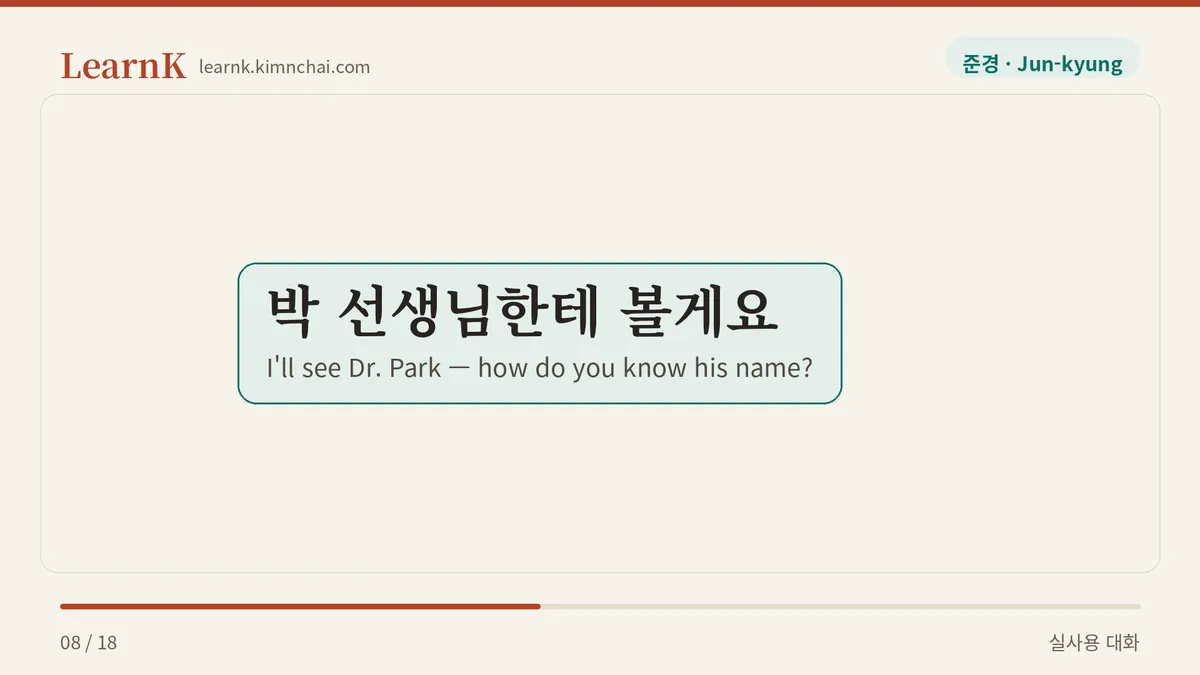
Jun-kyung: 너 아까 접수할 때 “박 선생님한테 볼게요” 하던데, 의사 이름을 어떻게 알아? Just now at the desk you said “I’ll see Dr. Park” — how do you know the doctor’s name?
Emily: 저번에 왔을 때 명패 봤지. 근데 의사한테 선생님이라고 하는 거, 나 처음엔 진짜 헷갈렸어. I saw the nameplate last time. But calling a doctor “seonsaengnim” — honestly that confused me at first.
Jun-kyung: 그치. 학교 밖에서 더 많이 써. 변호사, 약사, 한의사… 성 뒤에 붙이면 다 돼. Right. It’s used more outside school, actually. Lawyers, pharmacists, oriental-medicine doctors — just stick it after the family name.
Emily: 아, 근데 아까 저 어르신은 나한테도 “선생님, 이쪽에 앉으세요” 하시더라. 나 선생 아닌데? Oh, but that elderly gentleman said to me, “Seonsaengnim, sit over here.” I’m not a teacher though?
Jun-kyung: 그건 그냥 높여 부른 거야. 이름 모르는 어른한테 “저기요”보다 훨씬 정중하거든. That’s just a polite way of addressing you. It’s far more courteous than “excuse me” when you don’t know someone’s name.
Emily: 아하. 그럼 나도 너한테 써 볼까? 준경 선생님, 물 좀 떠다 주세요. Ah-ha. Should I try it on you, then? Mr. Jun-gyeong, kindly fetch me some water.
Jun-kyung: 야, 그건 놀리는 거잖아. Hey, now you’re just making fun of me.
These Uses Sound Off
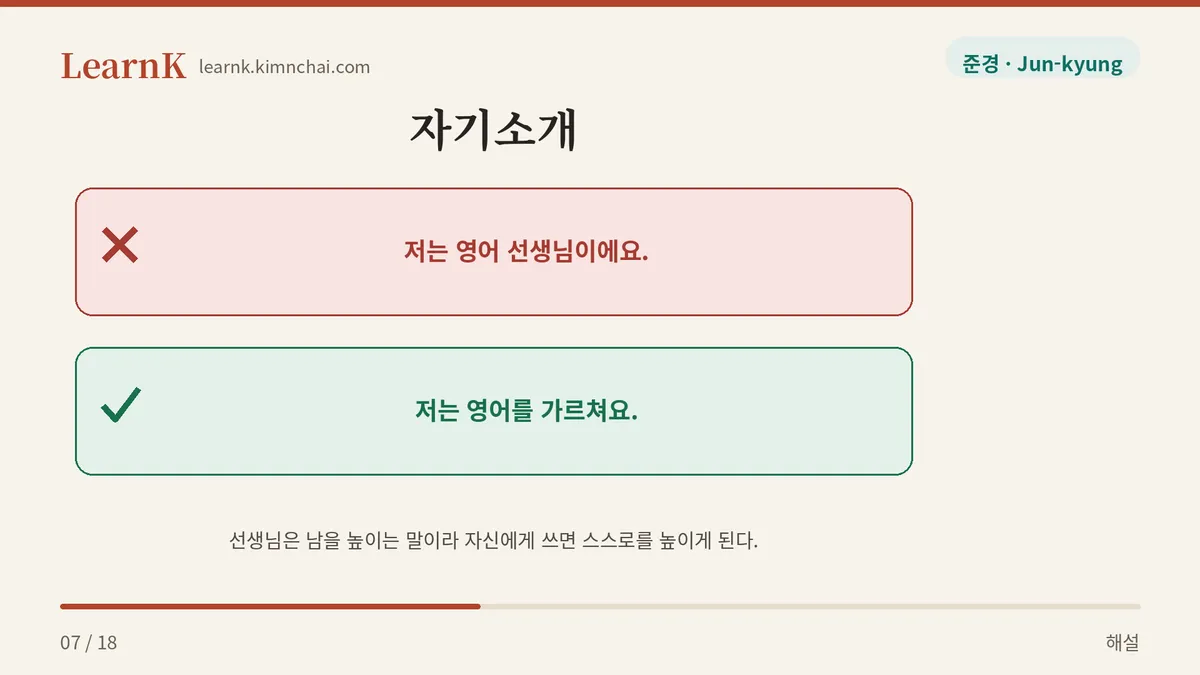
✗ (introducing yourself) 안녕하세요, 저는 영어 선생님이에요. ✓ (introducing yourself) 안녕하세요, 저는 영어를 가르쳐요. / 저는 영어 교사입니다. → 선생님 is a word for raising other people up, so using it about yourself amounts to elevating yourself. When you talk about your own job, drop the -님 and use 교사 (gyosa), or just spell it out with 가르쳐요 (gareuchyeoyo), “I teach.”
✗ (to your advisor in a university classroom) 선생님, 이번 과제 언제까지예요? ✓ (to your advisor in a university classroom) 교수님, 이번 과제 언제까지예요? → The grammar is perfectly fine and it isn’t rude, but at a university 교수님 (gyosunim) is the correct seat. Calling a professor 선생님 leaves the impression that you’ve knocked their title down a rung. In the other direction, calling an elementary, middle, or high school teacher 교수님 is just as off.
Example Sentences by Situation
① Booking a hospital appointment over the phone — you’re specifying the doctor you want to see. If you know the name, attach it after the family name.
안녕하세요, 이번 주에 박 선생님 진료 예약 되나요?
Annyeonghaseyo, ibeon jue Bak seonsaengnim jillyo yeyak doenayo? — “Hello, can I book an appointment with Dr. Park this week?”
② When a stranger on the street drops something — you don’t know their name or their job, but they’re a good deal older than you. This is the moment dictionary sense ③ comes alive.
선생님, 잠깐만요. 이거 떨어뜨리셨어요.
Seonsaengnim, jamkkanmanyo. Igeo tteoreotteurisyeosseoyo. — “Excuse me, sir — just a moment. You dropped this.”
③ Getting in touch with a former teacher years after graduating — in Korea you go on calling your old homeroom teacher 선생님 long after you graduate. Even once you’re no longer a student, the title lasts a lifetime.
선생님, 저 기억하세요? 2015년에 3반이었던 지수입니다.
Seonsaengnim, jeo gieokhaseyo? Icheonsibonyeone sambanieotdeon Jisuimnida. — “Teacher, do you remember me? I’m Ji-su, from class 3 back in 2015.”
Similar Expressions, from Polite to Casual
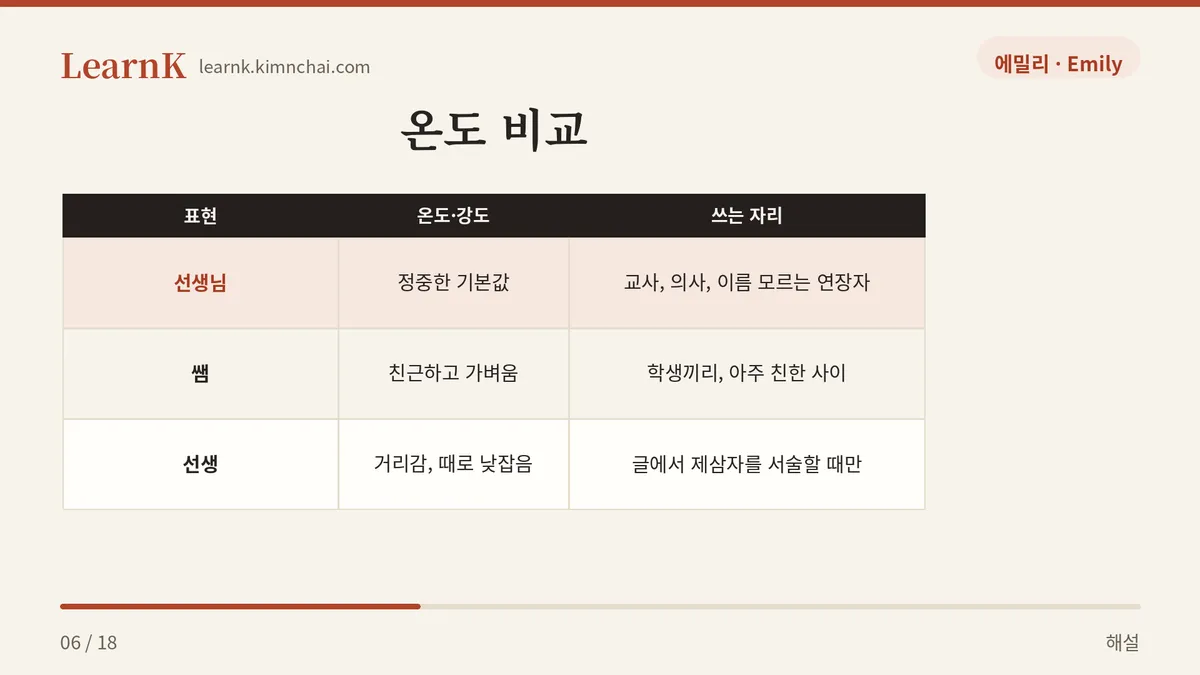
| Expression | Warmth / intensity | Where it’s used |
|---|---|---|
| 선생님 (seonsaengnim) | polite, and a safe default | teachers, doctors, lawyers, pharmacists; older people whose names you don’t know. Fine in almost any situation |
| 쌤 (ssaem) | friendly and light | students talking about a teacher among themselves; very close relationships. Not for formal settings or documents |
| 교수님 (gyosunim) | formal respect | university professors only. Odd for schoolteachers |
| 선생 (seonsaeng) | with -님 dropped: distant, sometimes even condescending | written style describing a third person. Can sound rude said to someone’s face |
| -씨 (-ssi) | neutral, equal footing | peers and coworkers. Not for someone older or higher in rank |
The box to watch most carefully is 선생 (seonsaeng). The dictionary headword is 선생님, but the moment you drop -님 the temperature falls sharply. In news articles and novels it appears naturally — 김 선생은 평생 아이들을 가르쳤다 (Gim seonsaengeun pyeongsaeng aideureul gareuchyeotda), “Mr. Kim taught children all his life” — but say the same thing to someone’s face, 김 선생, 이리 와 보세요 (Gim seonsaeng, iri wa boseyo), and it comes across as putting the other person below you. As a learner, you’re safer sticking to the form with -님 attached.
Cultural Background — The One Born First
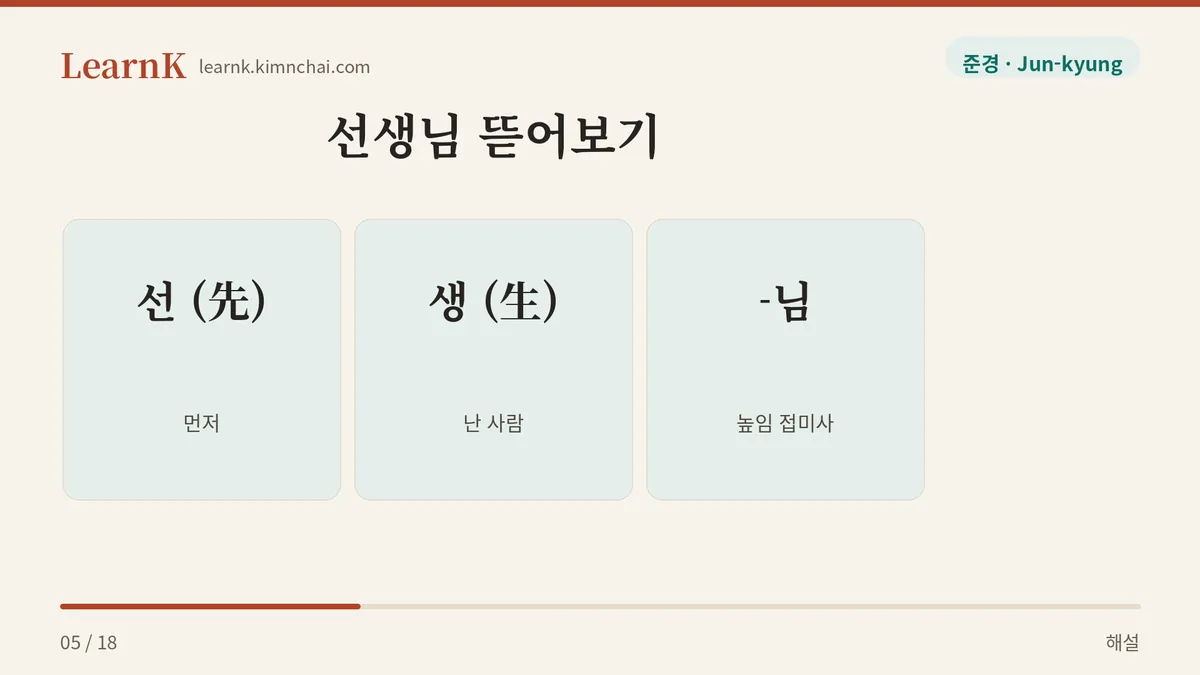
선생 (seonsaeng) is a Sino-Korean word written 先生. 선(先) means “first,” 생(生) means “born” — literally, “a person born before me.” Add the honorific suffix -님 (-nim) and you get 선생님. Once you know that structure, it clicks instantly why this word gets used outside the classroom. It was never a word for “the teaching profession” to begin with; it was a word for elevating “someone who has lived longer than I have.” The dictionary’s third sense — addressing an older person with respect — isn’t some forced extension at all. It’s actually the seat closest to the original meaning.
The contrast gets sharper when you compare the neighboring countries that use the same characters. Japanese せんせい(先生) overlaps almost entirely with the Korean word and is used for teachers and doctors alike, but Chinese goes its own way. Look at the translations in the dictionary above: the first sense is rendered 老师·教师, while the second and third are rendered 先生. In other words, Chinese 先生 is close to “Mr.” and does not mean “teacher.” This single word shows that identical characters don’t guarantee identical meaning.
Watch enough Korean dramas and you’ll notice how often the weight of this title becomes the axis of the story. In school dramas, the distance between the moment a student says 선생님 and the moment they say 쌤 lays bare the relationship between the two people. In medical dramas, a junior doctor calling a senior 선생님 packs respect and fear into the same word — and later, a single wobble in the voice is enough to announce that the relationship has changed. Even without following the lines word for word, listen to a scene with this word in it without subtitles and you can hear the difference in temperature. In Korean, a form of address isn’t information — it’s a declaration of a relationship.
Today’s Quiz
You’re at a pharmacy in an unfamiliar neighborhood, about to ask a pharmacist you’ve never met how to take your medicine. All three sentences below ask “How many times a day do I take this medicine?” Which one is the most natural?
- 약사씨, 이 약 하루에 몇 번 먹어요?
- 선생님, 이 약 하루에 몇 번 먹어요?
- 저기 약사, 이 약 하루에 몇 번 먹어요?
Show the answer
Answer: 2. When you’re addressing a professional whose name you don’t know, 선생님 (seonsaengnim) is the safest choice. 약사님 (yaksanim) is just as natural, so either one is fine.
Option 1 sounds off because -씨 (-ssi) is a form of address for people on equal footing. Used on a professional you’re meeting for the first time, it sounds rude. Option 3 uses the job title bare, with no -님 — the same problem as 선생 above, giving the impression that you’re placing the other person below you. Keep this as your default: in Korean, when you address someone you don’t know, you always go with -님 attached.
Definitions and example sentences are from the National Institute of Korean Language’s Basic Korean Dictionary (krdict.korean.go.kr); that portion of this post, including our translations, is licensed under CC BY-SA 2.0 KR.