시청률 (sicheongnyul) — The Number That Comes Out the Morning After a Drama Ends

시청률 (sicheongnyul)
Eleven o’clock on a Sunday night: the final episode of a drama ends and the closing credits roll. From that moment on, the same question starts appearing on Korean community boards — “How many percent do you think it got?” 시청률 (sicheongnyul) means the proportion of people watching a given television program. The unit attached to it is always a percentage (%), and that number becomes a headline the next morning.
If you started learning Korean because of dramas, there’s no getting around this word. News articles, actor interviews, press conferences, fan communities — it turns up anywhere drama talk happens. The meaning is simple, but the temperature this word actually runs at is a little hotter than the dictionary lets on.
On the surface, 시청률 is an emotionless statistical term. In the broadcasting world, though, this number is closer to a report card. When it’s good, an actor’s asking price for their next project goes up; when it’s bad, the drama gets stuck with the label “a flop.” That’s why this word always travels with verbs that carry feeling. In casual speech people say 시청률이 터지다 (sicheongnyuri teojida) — the ratings blew up, 시청률이 잘 나오다 (sicheongnyuri jal naoda) — the ratings came out well, or 시청률이 바닥을 치다 (sicheongnyuri badageul chida) — the ratings hit rock bottom. In stiffer settings like articles or meetings, they reach for 시청률을 기록하다 (sicheongnyureul girokada) — to record a rating, or 시청률이 저조하다 (sicheongnyuri jeojohada) — the ratings are poor. It’s the same number; only the temperature gets swapped out.
Checking it in the National Institute of Korean Language dictionary

시청률 (sicheongnyul) 「noun」 텔레비전의 한 프로그램을 시청하는 사람들의 비율. The proportion of people who watch a particular program on television. — National Institute of Korean Language, Basic Korean Dictionary (krdict.korean.go.kr)
Definitions in several other languages are included as well.
[en] television ratings — The rate of people who watch a certain program on television. [ja] しちょうりつ【視聴率】 — テレビの一つの番組を視聴する人たちの比率。 [es] índice de audiencia — Porcentaje de personas que atienden algún programa de televisión [zh] 收视率 — 收看某一电视节目的人的比例。 — National Institute of Korean Language, Basic Korean Dictionary (krdict.korean.go.kr)
A Portuguese definition isn’t carried in this dictionary. If we had to put one down, it would be something like índice de audiência — but that’s our own rendering, not dictionary material, so treat it as a rough guide only.
The dictionary’s real usage examples show at a glance what kind of sentence this word lives inside.
큰 인기를 누린 그 드라마는 방송국 개국 이래 최고의 시청률을 기록하였다. That enormously popular drama recorded the highest ratings since the station first went on the air. — National Institute of Korean Language, Basic Korean Dictionary (krdict.korean.go.kr)
This is the most typical success sentence there is. 기록하다 (girokada) is the stiff verb that pairs with numbers, used almost like a formula in headlines and press releases. Between friends, “터졌대” sounds far more natural than “기록했대.”
우리 드라마는 시청률이 저조하여 결론적으로 실패했다는 평가를 받았다. Our drama had poor ratings and in the end was judged a failure. — National Institute of Korean Language, Basic Korean Dictionary (krdict.korean.go.kr)
The sentence from the other side. 저조하다 (jeojohada) is the formal version of 낮다 (natda, to be low) — it states the low number plainly, yet disappointment seeps through. It stings more because it’s the production team saying it about their own work.
드라마는 한 자릿수의 시청률에 머물며 고전을 겪고 있다. The drama is struggling, stuck in single-digit ratings. — National Institute of Korean Language, Basic Korean Dictionary (krdict.korean.go.kr)
한 자릿수 (han jaritsu) means single digits — that is, under 10 percent. You’ll see this expression until you’re sick of it in Korean drama coverage, so it’s worth memorizing whole. The opposite is “두 자릿수를 회복했다 (recovered into double digits).”
광고주들은 시청률이 높은 프로그램에 광고를 내는 것을 선호한다. Advertisers prefer to place their ads on programs with high ratings. — National Institute of Korean Language, Basic Korean Dictionary (krdict.korean.go.kr)
This sentence explains why the number matters so much. Ratings mean ad rates, and ad rates mean whether there’s a next season.
지나친 시청률 경쟁은 민영 방송뿐만 아니라 공영 방송 프로그램의 질도 떨어뜨렸다. Excessive competition over ratings lowered the quality of programs on public broadcasters, not just commercial ones. — National Institute of Korean Language, Basic Korean Dictionary (krdict.korean.go.kr)
This is the sentence you use to criticize. 시청률 경쟁 (sicheongnyul gyeongjaeng, ratings competition) is a set pairing that shows up constantly in Korean media, placed right up front whenever sensational programming is being scolded.
Seeing it in a real conversation

Setting: a neighborhood fried-chicken place on a Sunday night. On the TV mounted on the wall, the final episode of a drama has just ended.
Jun-kyung: 와, 이걸 이렇게 끝낸다고? 나 지금 소름 돋았어. Whoa, they’re ending it like this? I’ve got goosebumps right now.
Emily: 마지막 회 시청률 얼마 나왔을까? 이 정도면 20퍼센트는 넘겠지? I wonder what the ratings were for the finale. Surely over 20 percent, right?
Jun-kyung: 야, 요즘 그렇게 안 나와. 두 자릿수만 넘겨도 대박이야. Hey, it doesn’t go that high these days. Breaking into double digits alone is a huge hit.
Emily: 아 맞다, 다들 OTT로 보니까. 근데 왜 아직도 시청률 얘기부터 해? Oh right, everyone watches on streaming now. But why does everyone still start with ratings?
Jun-kyung: 습관이지 뭐. 그래도 시청률이 높은 드라마는 다음 날 회사에서 다 얘기하잖아. Just habit, I guess. Still, a drama with high ratings is what everyone talks about at work the next day.
Emily: 하긴. 내일 아침 사무실 난리 나겠다. 나 스포일러 안 당하려면 일찍 자야겠어. True. The office is going to be a mess tomorrow morning. I should sleep early to avoid spoilers.
These usages sound unnatural

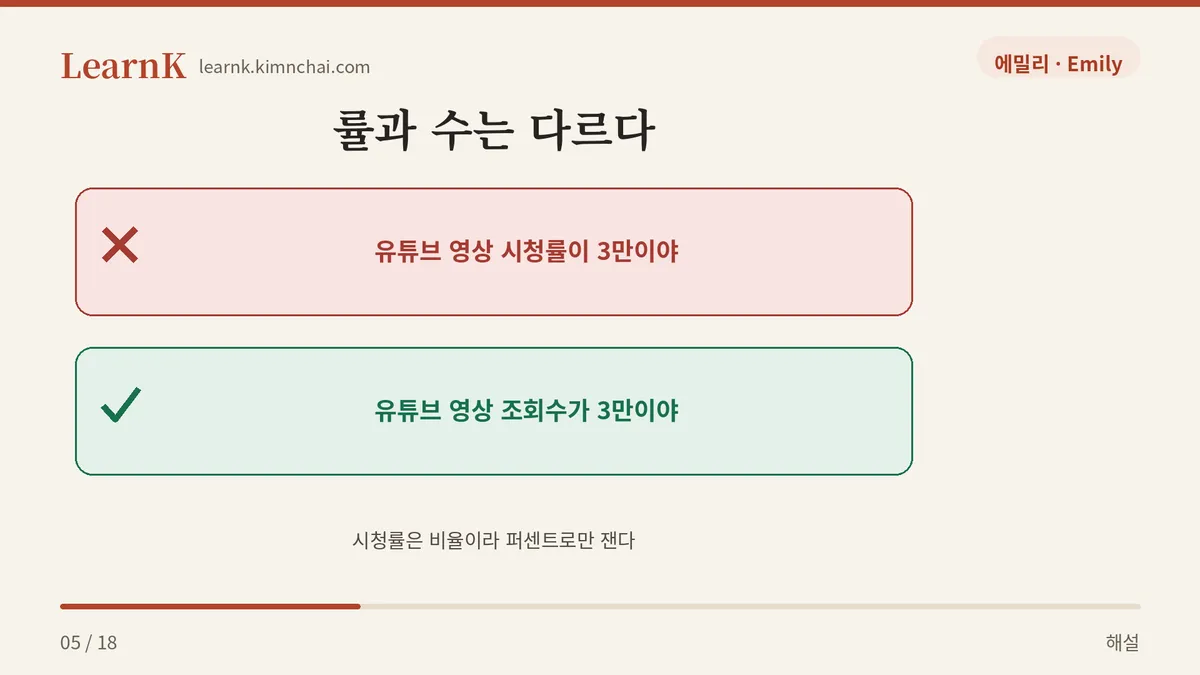
✗ 어제 올린 유튜브 영상 시청률이 3만이야. ✓ 어제 올린 유튜브 영상 조회수가 3만이야. The YouTube video I uploaded yesterday has 30,000 views. → 시청률 is a word for television programs, and above all it’s a rate, so it’s measured only in percentages. When you’re counting how many times something was played, as on YouTube, you use 조회수 (johoesu, view count).
✗ 그 드라마 시청률이 500만 명이었대. ✓ 그 드라마 시청률이 15퍼센트였대. / 그 드라마 시청자가 500만 명이었대. I heard that drama’s ratings were 15 percent. / I heard that drama had five million viewers. → Same reason. If you want to talk about a number of people, you have to switch to 시청자 (sicheongja, viewers). This distinction between 률 (ryul, rate) and 수 (su, count) is exactly where Korean learners slip most often.
Example sentences by situation
1) Talking about a drama with a friend (casual speech)
그 드라마 시청률 대박 났대. 나만 안 봤나 봐. geu deurama sicheongnyul daebak natdae. namman an bwanna bwa. I heard that drama’s ratings blew up. Looks like I’m the only one who hasn’t seen it. Among people the same age, you clip it short like this. Dropping the particle 이 and running it together as “시청률 대박 났대” sounds much more like real speech.
2) To your boss in a broadcasting company meeting (polite speech)
이번 주 시청률이 지난주보다 소폭 올랐습니다. ibeon ju sicheongnyuri jinanjuboda sopok ollatseumnida. This week’s ratings are up slightly from last week. Since you’re dealing with numbers, “올랐습니다” is the right call rather than “올랐어요.” Throw in Sino-Korean words like 소폭 (sopok, slightly) and 대폭 (daepok, sharply) and the report-style register is complete.
3) An actor at a press conference (making a promise)
시청률이 20퍼센트를 넘으면 제가 광화문에서 춤을 추겠습니다. sicheongnyuri isip peosenteureul neomeumyeon jega gwanghwamuneseo chumeul chugetseumnida. If the ratings go over 20 percent, I’ll dance in Gwanghwamun. This is the 시청률 공약 (sicheongnyul gongyak, ratings pledge), a long-standing custom at Korean drama promotional events. Plenty of actors actually follow through, and the footage becomes another news story after the broadcast.
Formality levels and similar expressions
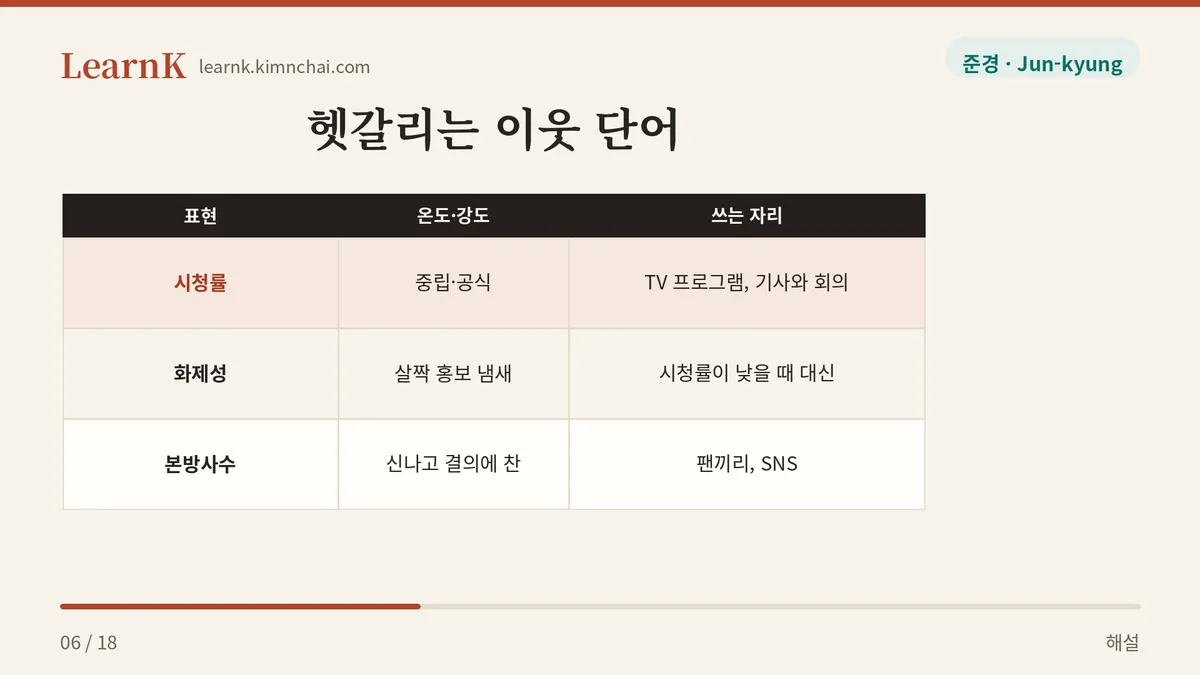
시청률 is a noun, so there’s no honorific built into the word itself. The temperature is set at the end of the sentence — 시청률 높아 (casual) / 시청률 높아요 (everyday polite) / 시청률이 높습니다 (formal). What you do have to watch out for are the neighboring words that are easy to mix up.
| Expression | Temperature / intensity | Where it’s used |
|---|---|---|
| 시청률 (sicheongnyul) | Neutral, official | TV programs. Articles, meetings, and everyday conversation alike |
| 조회수 (johoesu) | Neutral | YouTube and social media videos. A count, not a rate |
| 화제성 (hwajeseong) | A faint whiff of PR | Buzz — put forward instead when the ratings are low |
| 본방사수 (bonbangsasu) | Excited, full of resolve | Among fans, on social media. Never in official documents |
화제성 in particular needs to be read with some savvy. If you spot a sentence like “시청률은 아쉽지만 화제성은 최고 (the ratings are a letdown, but the buzz is the best),” reading it as “the numbers didn’t come out well” will usually be right.
Cultural background — the Monday morning report card
시청률 is a Sino-Korean word. 시청 (視聽) means “to watch and listen,” and 률 (率) means “rate.” Since you don’t watch the radio, only listen to it, radio uses a different word: 청취율 (cheongchwiyul, 聽取率). And here you get a spelling rule thrown in for free. If the preceding syllable ends in a vowel or in ㄴ, you write 율; otherwise you write 률. So 청취 ends in a vowel and becomes 청취율, while 시청 ends in ㅇ and becomes 시청률. The same rule applies straight across to other words like 합격률 (hapgyeongnyul, pass rate) and 이자율 (ijayul, interest rate).
Knowing how this number is measured also makes the articles readable. Research companies attach meters to sample households across the country and tally from there, so ratings aren’t “this many people watched” so much as “this percentage of the sample had that channel on at that time.”
The feel for the numbers has changed completely with the times. In the 1990s the whole family watched the same channel at the same time, so there were several “national dramas” that cleared 60 percent. Now there are hundreds of channels plus streaming splitting the audience, and clearing even 10 percent gets you called a hit. So when you read Korean drama coverage, you can’t measure old records and today’s numbers with the same ruler.
The reason the word hasn’t disappeared anyway is that ratings measure something beyond mere statistics: the sense that “we all watched the same thing at the same time.” The very fact that watching a show live, at its scheduled hour, gets its own name — 본방사수 (bonbangsasu) — comes from the same feeling. Even in an age overflowing with replays, if you want to talk about that scene from last night with everyone at the office the next morning, you had to watch it with them last night.
Today’s quiz
Which of the following sentences is natural?
- 어제 올린 영상 시청률이 5만이야.
- 그 드라마는 마지막 회에서 18퍼센트의 시청률을 기록했다.
- 그 드라마 시청률이 500만 명이나 됐대.
Answer: number 2. Because 시청률 is a rate, it always has to be stated as a percentage, and in formal sentences it pairs with 기록하다. Number 1 is about a YouTube video, so 조회수 is correct, and number 3 counts people, so it has to be changed to 시청자.
Definitions and example sentences are from the National Institute of Korean Language’s Basic Korean Dictionary (krdict.korean.go.kr); that portion of this post, including our translations, is licensed under CC BY-SA 2.0 KR.