실례합니다 (sillyehamnida): The Most Polite Way to Approach a Stranger
You want to ask for directions, but the person in front of you looks busy. You need to squeeze through the crowd to get off a packed subway. You open a meeting room door and feel the eyes of everyone already seated turn toward you — in all of these moments, there’s one phrase Koreans reach for almost reflexively. It’s 실례합니다 (sillyehamnida). If you watch enough K-dramas, you’ll come across countless scenes where the main character says this phrase right before approaching a stranger or stepping into someone else’s space.
실례합니다
실례합니다 (sillyehamnida) literally unpacks to “I am doing something that goes against good manners.” ‘실례(失禮)’ is a Sino-Korean word meaning ‘to lose one’s manners’ — in other words, ‘to be rude’ — and it’s completed by attaching the polite ending ‘-합니다’. The interesting part is that it’s not actually a declaration that you’re about to be rude. Rather, it’s a humble expression that asks for the other person’s understanding in advance for briefly disturbing their time or space.
It’s closest to the English “Excuse me,” but the nuance is a little more formal and careful. It’s a classic example of honorific speech — raising the other person up while lowering yourself at the same time. That’s why it feels especially natural with strangers, people older than you, and in formal settings.
Example Sentences by Situation
① When asking for directions (striking up a conversation with a stranger)
실례합니다, 혹시 강남역이 어느 쪽인가요? (sillyehamnida, hoksi gangnamyeogi eoneu jjogingayo?)
Before suddenly asking a stranger a question, you toss out this phrase first to gently open the door to conversation. If you skip ‘실례합니다’ and jump straight to “강남역 어디예요? (Where’s Gangnam Station?),” it can sound a bit blunt.
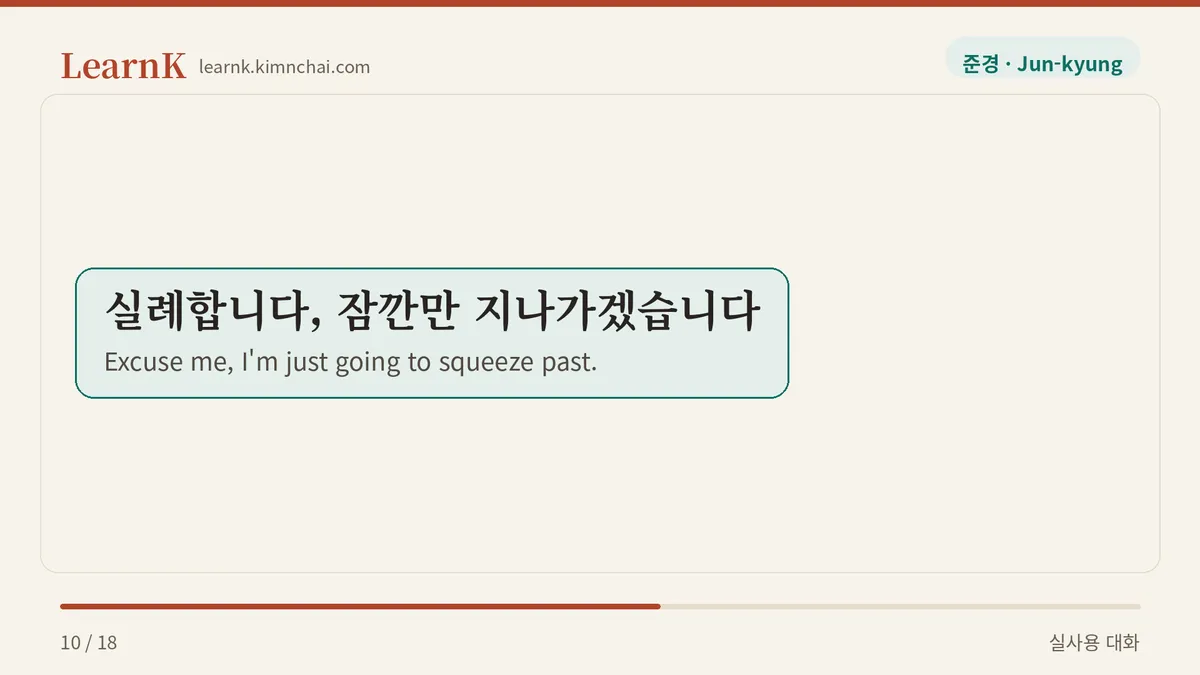
② When passing between people
실례합니다, 잠깐 지나가겠습니다. (sillyehamnida, jamkkan jinagagetseumnida.)
When you can’t avoid brushing against someone in a crowded elevator or subway, this is the phrase you use to ask for understanding ahead of time. It’s like apologizing in advance for the ‘rudeness’ of physical contact.
③ When making a phone call or entering a room
실례합니다, 김 부장님 자리에 계신가요? (sillyehamnida, gim bujangnim jarie gyesingayo?)
Right before you open an office door or make a phone call and get to your business, this politely signals that you’re aware you’re interrupting the other person’s work.
Comparing Honorific/Casual Speech and Similar Expressions
‘실례합니다’ is itself a formal, polite expression, so it isn’t really used in casual (반말) form. Among friends, you’d swap it out for lighter phrases like 저기 (jeogi) or 잠깐만 (jamkkanman).
- 실례합니다 (sillyehamnida) — the most polite; for strangers and formal situations
- 저기요 (jeogiyo) — semi-polite; for calling a server at a restaurant or striking up a casual conversation
- 미안하지만 (mianhajiman) — for adding a request, as in “미안하지만 … (Sorry, but …)”
- 실례지만 (sillyejiman) — placed before a careful question, as in “실례지만, 나이가 어떻게 되세요? (Excuse me, but how old are you?)”
In particular, 실례지만 (sillyejiman) is used very often as a cushion before raising a sensitive question, so it’s worth learning alongside the others.
Cultural Background
Korean is deeply infused with a spirit of modesty — ‘lowering yourself to raise the other person up.’ ‘실례합니다’ is a signature expression that distills that spirit. In dramas, too, you’ll often see the main character standing at the gate of an unfamiliar house, or before an elder they’re meeting for the first time, carefully offering this phrase while dipping their head slightly. When you watch the facial expression and body language along with it, you can naturally sense that this single phrase isn’t just a greeting — it’s a signal that says ‘I respect your space.’ Packing social distance and courtesy into a single phrase — this is the charm of Korean honorific speech.
Closing Quiz
You need to get off the subway, but people are standing in front of the door. What’s the most natural thing to say in order to pass between them?
- 비켜! (bikyeo!)
- 실례합니다, 잠깐 지나가겠습니다. (sillyehamnida, jamkkan jinagagetseumnida.)
- 안녕히 계세요. (annyeonghi gyeseyo.)
The answer is number 2. Number 1 is a casual command that sounds rude, and number 3 is a farewell greeting you say when parting ways. Starting today, when you approach a stranger, open the door politely with ‘실례합니다’!