순대 (sundae): The Winter Snack of Steamy Market Alleys
In a winter market alley billowing with steam, there’s a dark reddish food bubbling away on top of a big red basin. Today’s expression is the star player of Korean street food, 순대 (sundae). Together with 떡볶이 (tteokbokki) and 튀김 (twigim, fried snacks), it’s known as one of the “big three” of 분식 (bunsik, Korean snack food). It looks unfamiliar at first, but once you develop a taste for it, it’s the very flavor that comes to mind whenever you miss a Korean winter.
순대
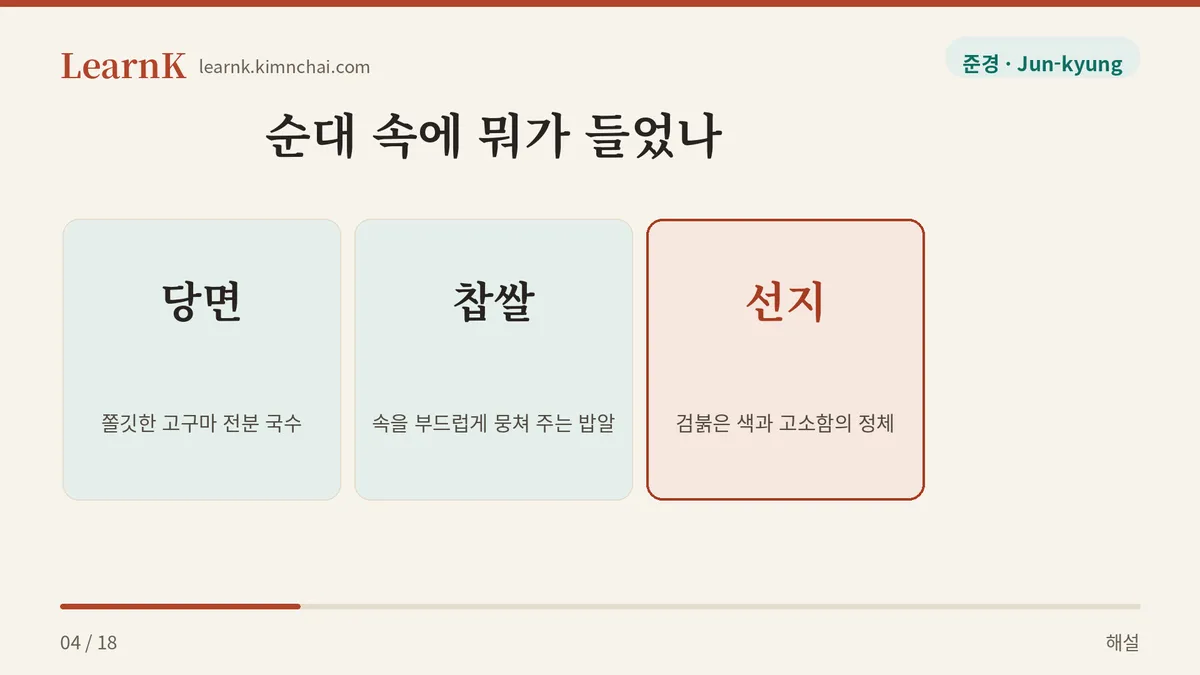
순대 (sundae) is a dish made by stuffing pig intestines with a seasoned mixture of 당면 (dangmyeon, glass noodles), 찹쌀 (chapssal, glutinous rice), 선지 (seonji, blood curd), and various vegetables, then steaming it. It’s a distant cousin of Western blood sausage, but its chewy casing, soft filling, and the combination of the 간 (liver) and 허파 (lung) served alongside create a texture all its own. Fresh-steamed sundae from the market is dipped in salt or 막장 (makjang, a fermented soybean paste); as 순댓국 (sundaetguk) it’s enjoyed with a hot, savory broth; and as 순대볶음 (sundae-bokkeum) it’s stir-fried spicy. It’s cheap and filling — truly a food of the common people.
Checking the National Institute of Korean Language Dictionary
Let’s look directly at the definition from the National Institute of Korean Language, a government body.
순대 「noun」
- A dish made by seasoning glass noodles, tofu, glutinous rice, etc., stuffing them into pig intestines, and steaming.
- A dish made by stuffing seasoned ingredients into things like squid, pollock, or eggplant and steaming them. — National Institute of Korean Language, Basic Korean Dictionary (krdict.korean.go.kr)
Looking at the foreign-language translations makes the meaning even clearer.
[en] sundae — A dish made by steaming seasoned sweet potato noodles, tofu, glutinous rice, etc. which are stuffed into a pig’s intestine. [ja] スンデ — 豚の腸詰め:春雨や豆腐、もち米などに味付けして豚の腸に入れた後、蒸して作った食べ物。 [es] sundae — Embutido preparado con tripas de cerdo rellenas con una mezcla condimentada de fideos de alforfón, tofu, arroz glutinoso, etc.. [zh] 血肠,米肠 — 在粉条、豆腐和糯米等食材中放入作料后,灌进猪肠子里,并上锅蒸熟而成的食物。 — National Institute of Korean Language, Basic Korean Dictionary (krdict.korean.go.kr)
The Portuguese translation isn’t in the dictionary, so we’ve added our own — sundae: prato coreano feito de tripa de porco recheada com macarrão de batata-doce, arroz glutinoso e temperos, cozido no vapor. (our own translation)
Here are a few of the actual example sentences the dictionary provides, quoted as-is.
- 돼지 간 볶음이나 순대 등이 있어요.
- 우리 집 앞 분식점에 들러서 떡볶이랑 순대를 먹고 가자.
- 순대를 먹다.
- 순대를 만들다.
- 순대 재료. — National Institute of Korean Language, Basic Korean Dictionary (krdict.korean.go.kr)
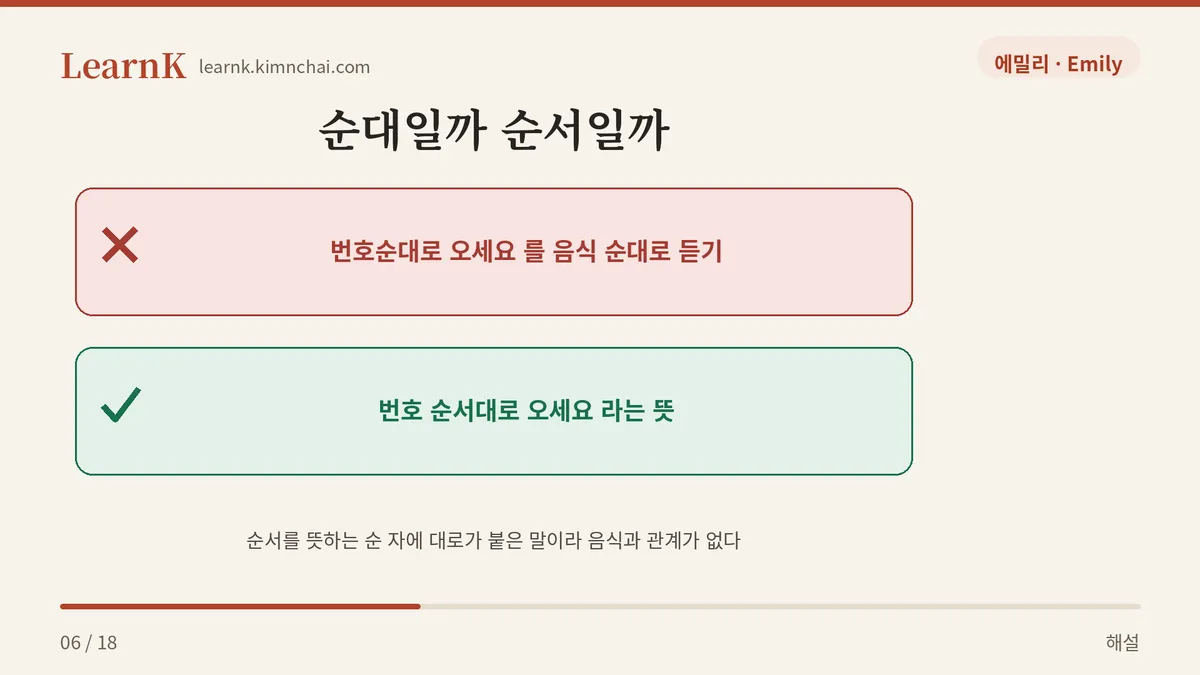
The first sentence is a situation where someone introduces what’s on the menu at a restaurant or market, showing that sundae comes bundled as a set with sides like liver and lung. The second is a casual, informal (반말) sentence suggesting something to a friend, so it naturally reveals that sundae is a bunsik menu item paired with tteokbokki. The last three are basic collocations showing how sundae goes with verbs like ‘먹다’ (to eat) and ‘만들다’ (to make), and with the noun ‘재료’ (ingredients). By the way, among the dictionary’s examples, ‘번호순대로’ and ‘수순대로’ have nothing to do with the food sundae — they come from ‘순서(順)대로’ (“in order”), a completely different word, so don’t get them mixed up.
Seeing It in a Real Conversation
Scene: A winter evening in the sundae alley of a traditional market. Two people stand in front of a steaming sundae stall.
Jun-kyung: 여기 순대 진짜 잘해. 한 접시 시키자. The sundae here is really good. Let’s get a plate.
Emily: 좋아. 근데 나 간이랑 허파는 좀 부담스럽더라. Sounds good. But the liver and lung are a bit much for me.
Jun-kyung: 에이, 순대는 원래 간까지 같이 먹어야 제맛이야. Come on, sundae tastes best when you eat it with the liver too.
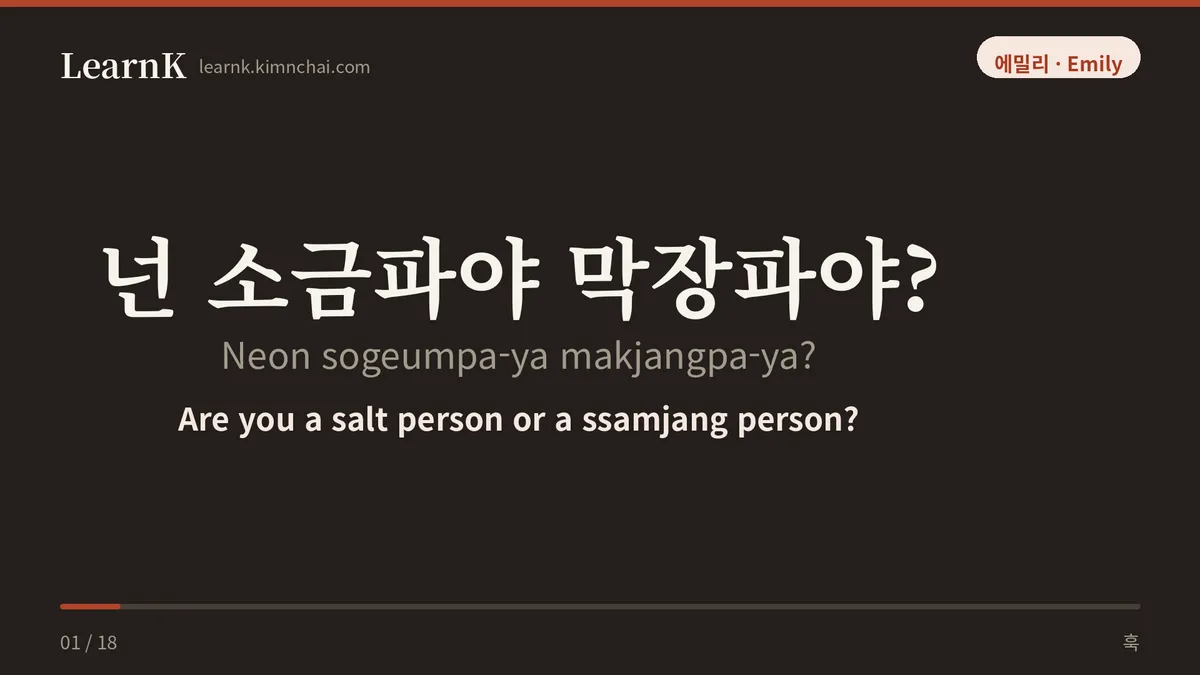
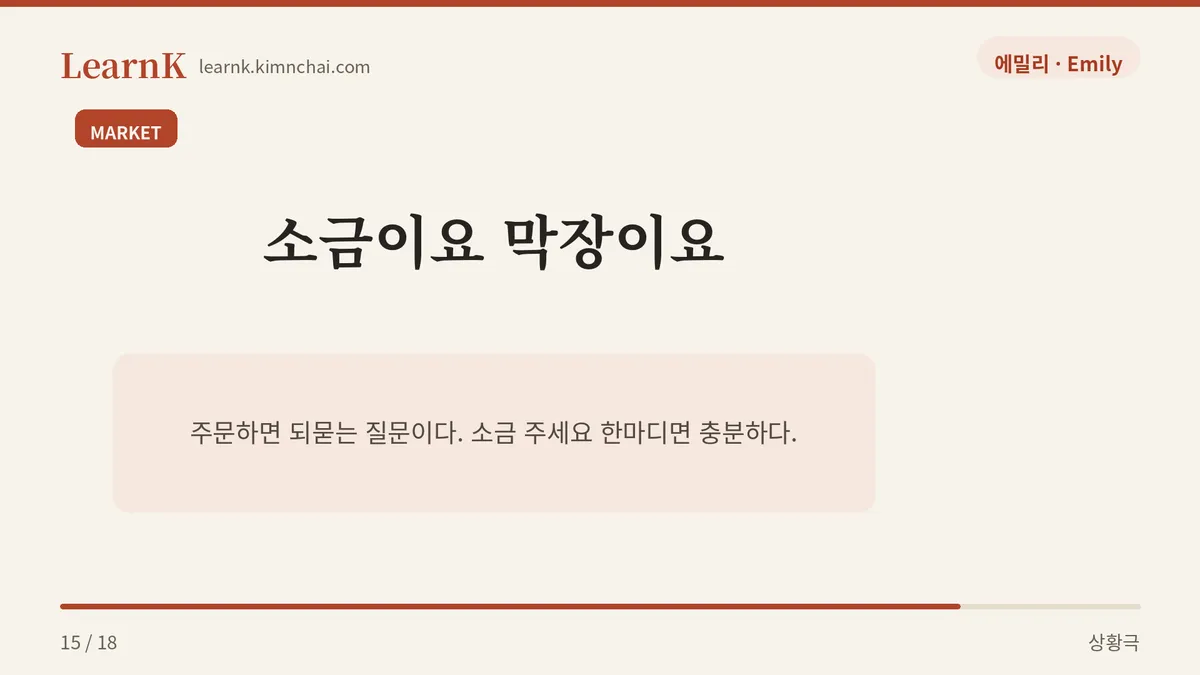
Emily: 알지, 알지. 그건 그렇고, 넌 소금파야 막장파야? I know, I know. Anyway, are you a salt person or a ssamjang person?
Jun-kyung: 난 무조건 소금. 순대에 막장은 좀… Salt, no question. Ssamjang on sundae is kinda…
Emily: 오, 통했다. 나도 소금 아니면 안 먹어. Oh, we’re on the same page. I won’t eat it without salt.
Example Sentences by Situation
- When ordering at the market — 이모, 순대 (sundae) 한 접시 주세요. 소금 넉넉히요! (“Auntie, one plate of sundae, please. Plenty of salt!” — at markets there’s a custom of affectionately calling the owner ‘이모’ (imo, aunt).)
- When suggesting it to a friend — 오늘 저녁 출출한데 순대 (sundae) 먹으러 갈래? (“I’m a little peckish tonight — want to go get some sundae?” — a casual everyday expression using 반말, informal speech.)
- When talking about your preference — 난 떡볶이 국물에 순대 (sundae) 찍어 먹는 게 제일 좋아. (“I love dipping sundae in tteokbokki sauce the most.” — one of Koreans’ favorite ways to eat sundae.)
Formal vs. Informal Speech, and Similar Words
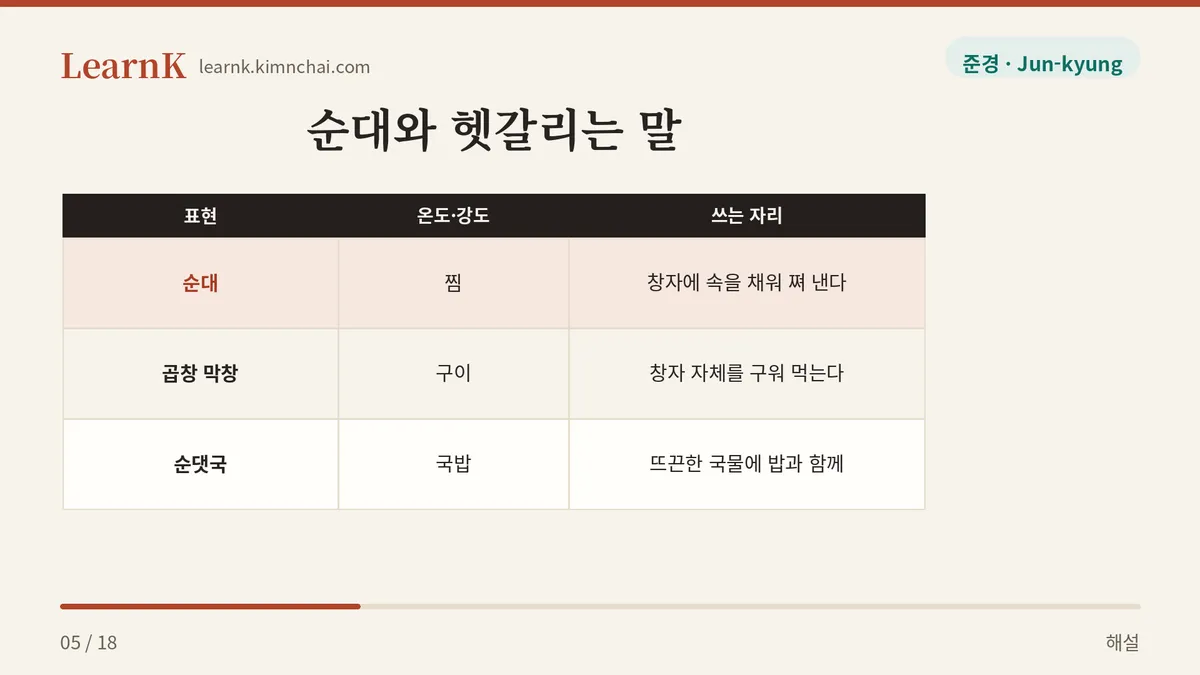
Since sundae is a noun, it doesn’t itself carry formal or informal speech, but the distinction shows up in how you order. Informal is 순대 먹으러 가자 (sundae meogeureo gaja) (“Let’s go eat sundae”), while formal is 순대 한 접시 주세요 (sundae han jeopsi juseyo) (“One plate of sundae, please”). It’s good to know some related words too — 순댓국 (sundaetguk, rice and broth), 순대볶음 (sundae-bokkeum, a spicy stir-fry), 백순대 (baeksundae, steamed with no seasoning), and 아바이순대 (abai-sundae, the thick, hearty Hamgyeong-style version). It’s easy to confuse sundae with 곱창 (gopchang) or 막창 (makchang), but those are grilled intestines themselves, whereas sundae is intestine stuffed with filling and steamed — that’s the difference.
Cultural Background — The Warmth of Markets and Street Stalls
Sundae is a food of markets, 포장마차 (pojangmacha, street food tents), and bunsik shops — a dish steeped in the warmth of ordinary people. Like Sokcho’s abai-sundae, it’s also a regional food carrying the history of displaced people. In dramas, it’s a recurring scene: characters who’ve had a hard day sit at a street tent, sharing sundae over a glass of soju as they open up about what’s on their minds. That’s how much sundae symbolizes “the warmth of sharing a meal together.”
Closing Quiz
Q. When ordering sundae at the market and speaking politely to the owner (imo), what should go in the blank?
‘이모, 순대 한 접시 ___.’ (Hint: the polite imperative form of ‘주다’, to give)
The answer is 주세요 (juseyo)! Today, feel the Korean winter with a warm plate of sundae.
Definitions and example sentences are from the National Institute of Korean Language’s Basic Korean Dictionary (krdict.korean.go.kr); that portion of this post, including our translations, is licensed under CC BY-SA 2.0 KR.