야시장 (yasijang) — Just a Street by Day, a Market Once It's Past Six
야시장 (yasijang)
야시장 (yasijang) means a market that opens at night. During the day it’s an alley with nothing but parked cars and shuttered shops; once the sun goes down, stalls get laid out and strings of bulbs come on, and after midnight it all gets packed away and the street goes back to being empty, as if nothing had happened. 야시장 (yasijang) is one of the first place-words people end up memorizing on a trip to Korea, and the reason is simple. By the time you’ve dropped your bags at your accommodation it’s already evening, and at that hour the night market is the most fun place there is.
For Koreans, this word arrives as a temperature before it arrives as information. “야시장 갈까? (yasijang galkka?)” — “Want to hit the night market?” — carries let’s eat, let’s walk a while, and I’m not heading home early tonight, all at once. So it’s less a word that gets written on an itinerary than one that pops out around dinnertime.
There are two conditions to hold onto in the nuance. First, it has to be night. Staying open late and setting up at night are two different things. Second, it goes up temporarily. A 야시장 (yasijang) isn’t a building, it’s a stretch of time. That’s why Korean pairs it with the verb “서다 (seoda)” — to stand, to go up — rather than “있다 (itda)” — to be there: 야시장이 서다 (yasijangi seoda). That sense of a market going up and then coming down is the backbone of the word. Layered on top of that is its food-first character. What you buy at a 야시장 (yasijang) is mostly stuff you hold in your hand and eat while walking, which is why this word travels so closely with 구경하다 (gugyeonghada), to look around. It’s less a place you go to buy things than a place you go to walk through and look at.
Checking It in the National Institute of Korean Language Dictionary
야시장 (yasijang) 「noun」 밤에 열리는 시장. (A market that opens at night.) [en] night market — A market that opens at night. [ja] よいち【夜市】。よみせ【夜店】 — 夜に立つ市。 [es] mercado nocturno — Mercado que abre de noche. [zh] 夜市 — 晚上开的市场。 — National Institute of Korean Language, Basic Korean Dictionary (krdict.korean.go.kr)
The dictionary doesn’t carry a Portuguese definition, so we should note that the line below is our own rendering — mercado noturno: mercado que funciona à noite.
Below are the real usage examples the dictionary lists, quoted as they are, with a note on the kind of situation each one comes out of. First, three short collocations.
야시장에 나가다. 야시장을 구경하다. 야시장이 서다. — National Institute of Korean Language, Basic Korean Dictionary (krdict.korean.go.kr)
야시장에 나가다 (yasijange nagada) — “to go out to the night market.” The interesting part is that it’s 나가다 (nagada), to head out, not 가다 (gada), to go. It carries the sense of being inside a house or a guesthouse and stepping out, so you can picture someone finishing dinner and slowly getting moving. In Korean, a night market really is a place you go out to, not a place you go into.
야시장을 구경하다 (yasijangeul gugyeonghada) — “to look around the night market.” This pairing shows exactly the character described above. You don’t go to buy, you go to look. Even if you end up buying something, the state of mind you set out with is looking.
야시장이 서다 (yasijangi seoda) — “a night market goes up.” This is the expression learners pick up last and the most Korean of the three. A market can open, sure, but above all it stands. It means the market goes up briefly — every Friday, right before a holiday, during a festival — and then it’s gone.
Next, full-sentence examples.
밤중에 야시장을 돌아다니면서 길거리 음식을 먹었던 게 기억에 남아. (bamjunge yasijangeul doradanimyeonseo gilgeori eumsigeul meogeotdeon ge gieoge nama.) What stuck with me was wandering around the night market late at night eating street food. — National Institute of Korean Language, Basic Korean Dictionary (krdict.korean.go.kr)
This is something you’d say to a friend in casual speech after getting back from a trip. The ending “기억에 남아 (gieoge nama)” — “it stayed with me” — matters, because it shows what emotion 야시장 (yasijang) is tied to in Korean. Nothing dramatic happened; the memory of walking around at night and eating is itself what remains.
그 가게 주인은 밤에 야시장에서 물건을 도매로 사다가 낮에 장사를 했다. (geu gage juineun bame yasijangeseo mulgeoneul domaero sadaga naje jangsareul haetda.) The shop owner bought goods wholesale at the night market at night and sold them during the day. — National Institute of Korean Language, Basic Korean Dictionary (krdict.korean.go.kr)
This sentence is a reminder that a night market isn’t only a tourist spot. Goods move wholesale at night, and during the day those same goods get sold again. What’s a night view to a traveler is a workplace to someone else.
친구와 나는 가끔씩 야시장에 나가 쇼핑을 한다. (chinguwa naneun gakkeumssik yasijange naga syopingeul handa.) My friend and I go out to the night market once in a while to shop. — National Institute of Korean Language, Basic Korean Dictionary (krdict.korean.go.kr)
Notice the frequency adverb “가끔씩 (gakkeumssik)” — every so often. A night market isn’t somewhere you go daily; it’s somewhere you decide to head out to now and then. And here it says “쇼핑 (syoping)” rather than looking around, so picture one of the bigger markets with stalls of clothes and household goods.
Seeing It in Real Conversation
Setting: the second evening of a trip to Busan. The alley in front of the guesthouse, the sun having just gone down.
Jun-kyung: 저녁은 그냥 나가서 때우자. 여기서 열 걸음이면 야시장이야. Let’s just grab dinner out. The night market is ten steps from here.
Emily: 진짜? 나 어제 낮에 저기 지나갔는데 아무것도 없었는데. Really? I walked past there yesterday afternoon and there was nothing.
Jun-kyung: 낮엔 그냥 길이지. 여섯 시 넘어야 야시장이 서. During the day it’s just a street. The night market only sets up after six.
Emily: 아, 그래서 사람들이 다 저쪽으로 몰려가는구나. 씨앗호떡도 있어? Ah, that’s why everyone’s heading that way. Do they have seed hotteok too?
Jun-kyung: 있지. 대신 현금 좀 챙겨. 카드 안 되는 데 아직 많아. They do. But bring some cash — a lot of stalls still don’t take cards.
Emily: 오케이. 오늘은 야시장 구경만 하고 안 사려고 했는데, 글렀다. Okay. I was gonna just look around the night market and not buy anything, but that’s out the window.
Using It This Way Sounds Off
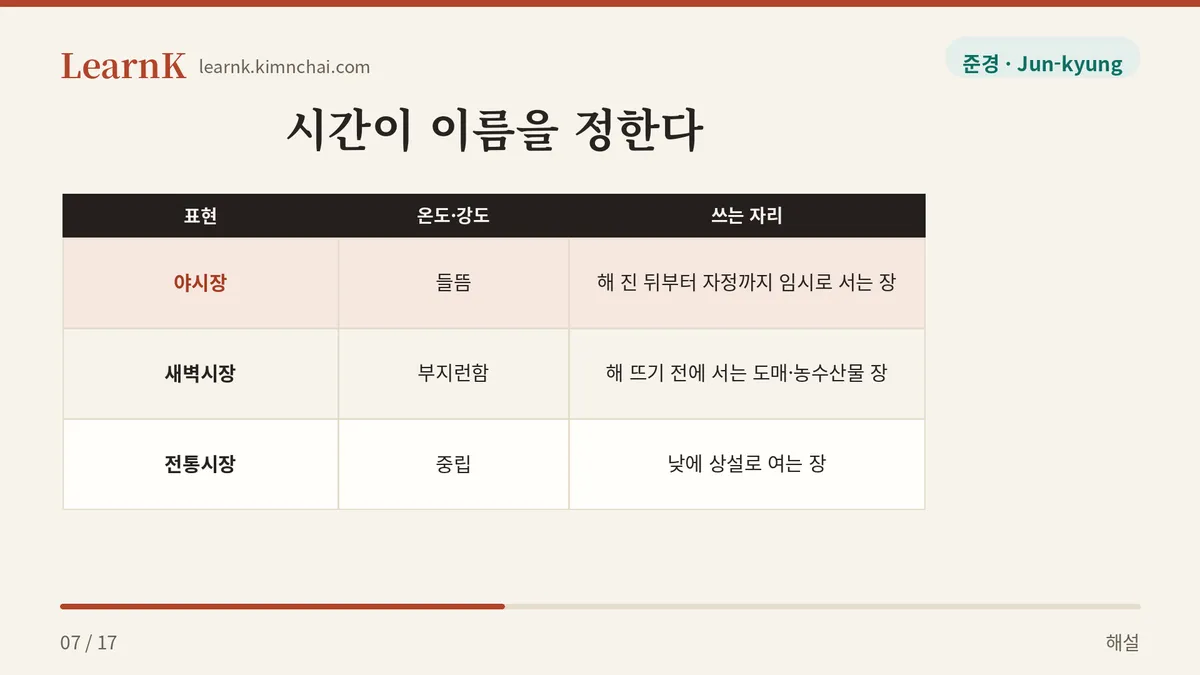
✗ 저희 편의점은 밤 늦게까지 해서 야시장이에요. (Our convenience store is open late, so it’s a night market.) ✓ 저희 편의점은 밤 늦게까지 영업해요. (Our convenience store is open until late at night.) → A 야시장 (yasijang) refers to a market that goes up and then comes down for a short stretch at night. A permanent shop or supermarket that stays open late is not a night market, no matter how late it closes.
✗ 새벽 네 시에 야시장에 가서 생선을 떼 왔어요. (I went to the night market at four in the morning and picked up fish.) ✓ 새벽 네 시에 **도매시장 (domaesijang)**에 가서 생선을 떼 왔어요. (I went to the wholesale market at four in the morning and picked up fish.) → The time window for a 야시장 (yasijang) runs from after sunset to around midnight. A market that goes up before dawn is called a 새벽시장 (saebyeoksijang), an early-morning market, or a 도매시장 (domaesijang), a wholesale market. They may both look like “night,” but Korean splits the two into different words.
Example Sentences by Situation
1. In a group chat sorting out a weekend trip
토요일 저녁은 야시장에서 해결하자. 거기 가면 다 있어. (toyoil jeonyeogeun yasijangeseo haegyeolhaja. geogi gamyeon da isseo.) Let’s sort out Saturday dinner at the night market. They’ve got everything there.
This is what comes up when you’re deciding whether or not to book a restaurant. Adding “해결하자 (haegyeolhaja)” — literally “let’s solve it” — gives it the sense of keeping things casual and just grabbing something, and it fits a night market especially well.
2. Showing a coworker who just moved to Korea around the neighborhood
이 골목은 금요일마다 야시장이 서니까 그날 저녁에 한번 와 보세요. (i golmogeun geumyoilmada yasijangi seonikka geunal jeonyeoge hanbeon wa boseyo.) A night market sets up in this alley every Friday, so come by that evening.
Even in polite speech, 서다 (seoda) stays exactly as it is. Mentioning the day of the week is a kind of courtesy owed to this word, because a 야시장 (yasijang) only holds together if its timing is fixed.
3. Posting photos after a trip
어제 야시장 구경만 하려다가 결국 두 손 가득 들고 나왔어요. (eoje yasijang gugyeongman haryeoda gyeolguk du son gadeuk deulgo nawasseoyo.) I meant to just look around the night market yesterday, but I came out with both hands full.
“구경만 하려다가 (gugyeongman haryeodaga)” — “I was only going to look” — follows night-market write-ups so reliably it’s practically an idiom. As we saw earlier, this word is paired with looking, so the joke is built by breaking that premise.
Formality Levels and Similar Expressions
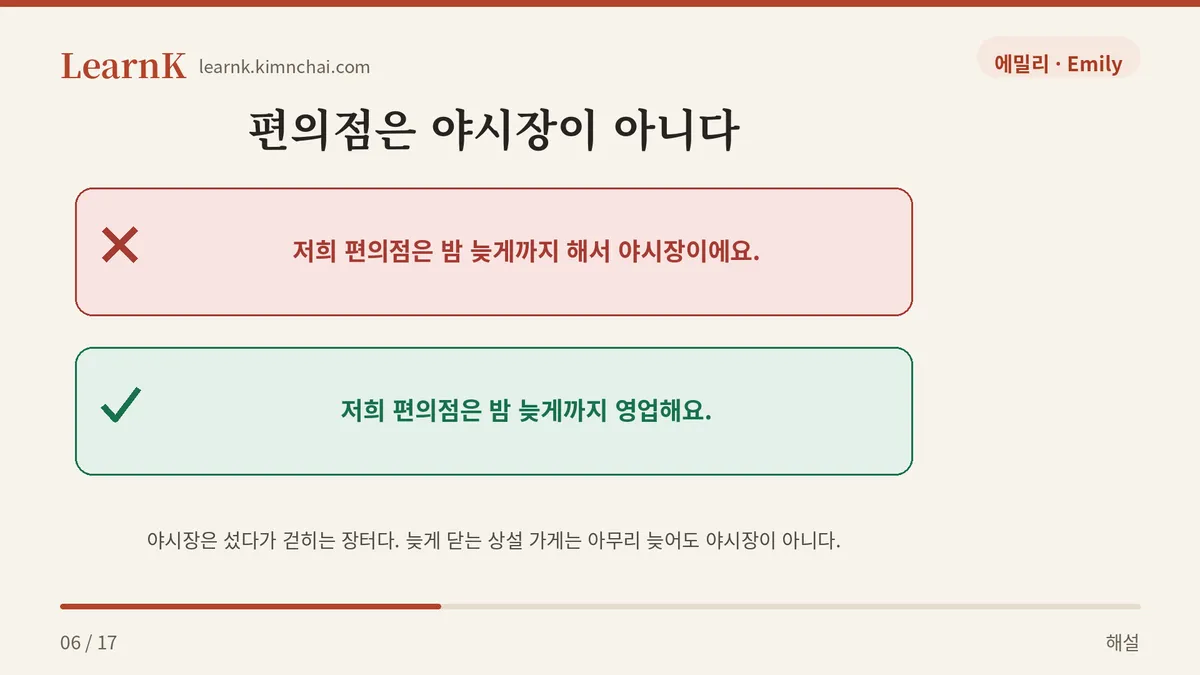
야시장 (yasijang) is a noun for a thing or a place, so it carries no politeness level of its own. The level is set by whatever predicate follows it — with a friend, 야시장 갈래? (yasijang gallae?); with someone older, 야시장 한번 가 보시겠어요? (yasijang hanbeon ga bosigesseoyo?). What actually trips learners up isn’t the honorifics, though — it’s the other market names that sound similar.
| Expression | Temperature / Intensity | Where it’s used |
|---|---|---|
| 야시장 (yasijang) | Buzzy. A market that goes up temporarily at night | Travel and neighborhood tips; comes with talk about food |
| 새벽시장 (saebyeoksijang) | Industrious. A market before sunrise | Wholesale, produce and seafood; stories about people at work |
| 전통시장 (jeontongsijang) | Neutral. A permanent market open during the day | Public-facing contexts like notices and news |
| 플리마켓 (peullimaket) | Light and trendy | Weekend markets, social media; secondhand and handmade goods |
전통시장 (jeontongsijang) and 야시장 (yasijang) do overlap sometimes. In plenty of places, an alley that goes back to being a traditional market during the day turns into a night market come evening. When that happens, Koreans call the same place by different names depending on the hour.
Cultural Background — The Alley That Only Lights Up at Night
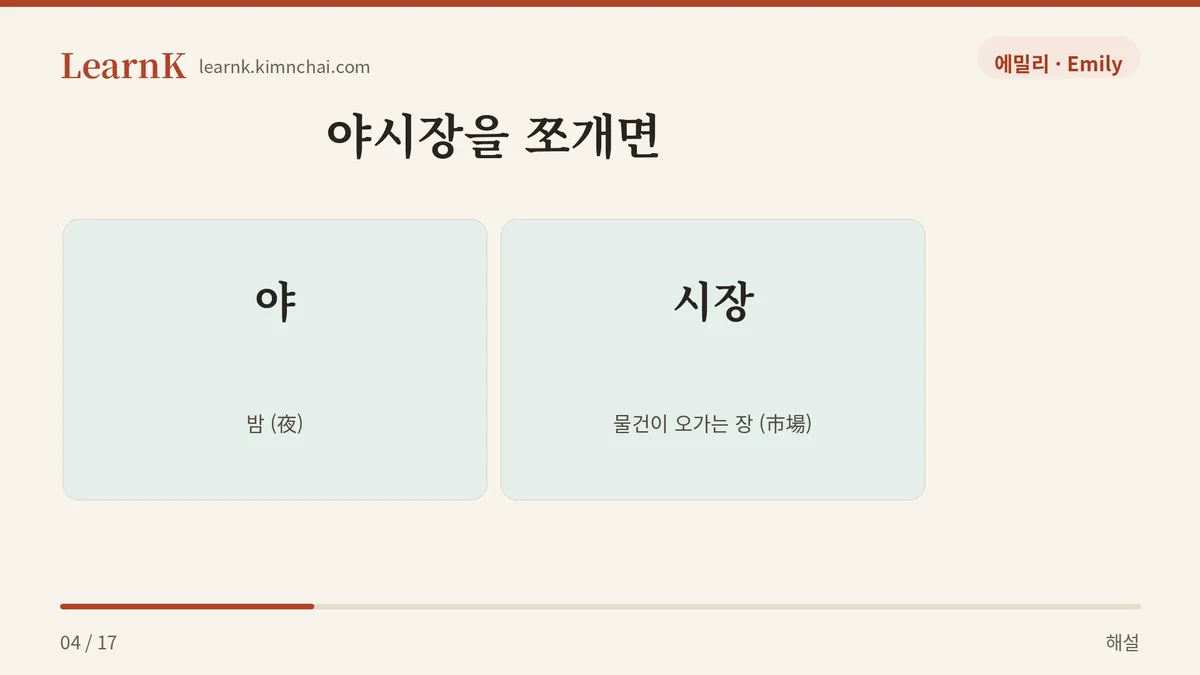
야시장 (yasijang) is a Sino-Korean word. It joins 야 (夜, night) and 시장 (市場, market), so it’s literally “night market.” Because of that, a lot of learners translate it straight across and say 밤 시장 (bam sijang), but the form that’s settled in Korean is 야시장 (yasijang). It also gets shortened to 야시 (yasi).
This word became a travel word the way it is now in the 2010s. Before that, 야시장 (yasijang) had a somewhat run-down, rowdy ring to it, but as markets jointly run by local governments and merchant associations took hold one by one — Busan’s Bupyeong Kkangtong Night Market, the Jeonju Nambu Market night market, Seoul’s Bamdokkaebi Night Market — its character shifted. These days it turns up in almost every piece of writing that introduces a region.
A few rules of the night market are worth knowing before you go. Most start between six and seven in the evening and wrap up around eleven or midnight. More and more stalls have card readers, but cash is still faster. And most of the eating happens standing up or on the move. It’s no accident that in Korean dramas, the scenes where characters finally say what they’ve been holding in so often take place at a night market or a 포장마차 (pojangmacha), a street tent bar. It isn’t a place where you sit face to face and talk while looking each other in the eye — it’s a place where you talk walking side by side, and that’s how things come out that couldn’t be said in daylight.
So “야시장 갈까? (yasijang galkka?)” is also an invitation. It’s a proposal to walk side by side for an hour or so, and if the answer is “좋아 (joa)” — sure — that night generally runs long.
Today’s Quiz
Which of the following sentences uses 야시장 (yasijang) naturally?
- 저희 가게는 24시간 영업이라 야시장이에요. (jeohui gageneun isipsasigan yeongeobira yasijangieyo.)
- 이 광장에는 매주 토요일 밤에 야시장이 섭니다. (i gwangjangeneun maeju toyoil bame yasijangi seomnida.)
- 새벽 다섯 시에 야시장에 가서 채소를 떼 왔어요. (saebyeok daseot sie yasijange gaseo chaesoreul tte wasseoyo.)
Show the answer
Answer: 2
A 야시장 (yasijang) is a market that goes up temporarily on set nights, so “매주 토요일 밤에 야시장이 섭니다” — “a night market goes up here every Saturday night” — is the most natural. Number 1 is just a permanent shop that stays open late, so it isn’t a night market, and the pre-dawn market in number 3 should be called a 새벽시장 (saebyeoksijang) or a 도매시장 (domaesijang).
Definitions and example sentences are from the National Institute of Korean Language’s Basic Korean Dictionary (krdict.korean.go.kr); that portion of this post, including our translations, is licensed under CC BY-SA 2.0 KR.