드리다 (deurida) — The One Word That Raises the Person Receiving
드리다
드리다 (deurida) is the honorific form of 주다 (juda), “to give” — to hand something to another person so they can have it or use it. The hand motion is exactly the same; what changes is that the word lifts up the person on the receiving end.
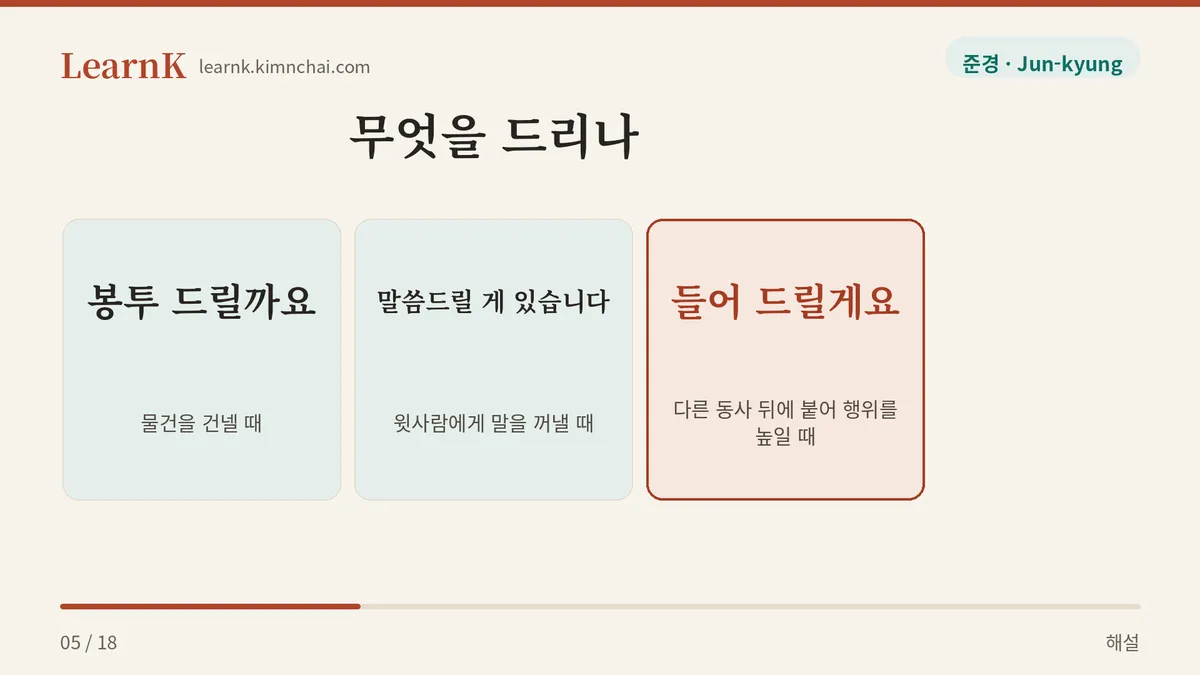
Somewhere along the way in learning Korean, a strange moment arrives. At the convenience store counter, the part-timer asks 봉투 드릴까요? (bongtu deurilkkayo?) — “Would you like a bag?” At the office, your team lead says 제가 대표님께 말씀드리겠습니다 (jega daepyonimkke malsseumdeurigetseumnida) — “I’ll speak to the CEO about it.” On Lunar New Year morning, a nephew says 세배 드릴게요 (sebae deurilgeyo) — “I’ll bow to you.” An object, words, a bow — everything being handed over is different, but the word is one. Today we pin that one word down.
Korean honorifics move along three tracks. Subject honorification raises the subject of the sentence (‘-시- (-si-)’); listener honorification raises the person you’re speaking to (‘-요 (-yo)’, ‘-습니다 (-seumnida)’); and object honorification raises the person the action is aimed at inside the sentence. 드리다 (deurida) handles that third one. What makes it distinctive is that you don’t tack on an ending — the entire word swaps out. In the same family: 뵙다 (boepda), 여쭙다 (yeojupda), 모시다 (mosida). These four are essentially all the object-honorific vocabulary left in modern Korean, so learn them once and you’ll use them for life.
Here’s something important. 드리다 (deurida) runs independently of how the sentence ends.
이거 할머니께 드려. (igeo halmeonikke deuryeo.)
That’s 반말 (banmal), casual speech, spoken to a friend. And yet 할머니 (halmeoni), the grandmother receiving it, is still elevated. Casual sentence ending, elevated object inside the sentence — the two axes turn separately. So if you memorize “using 드리다 (deurida) means polite speech,” you’re guaranteed to get it wrong. To be precise, it’s the word you use when the person receiving is above you.
Second. 드리다 (deurida) isn’t only for physical objects. It’s used for words and feelings too. 인사드리다 (insadeurida), 말씀드리다 (malsseumdeurida), 감사드리다 (gamsadeurida), 부탁드리다 (butakdeurida), 사과드리다 (sagwadeurida) — you’ll hear these ten times a day at a Korean company. The spacing trips people up: 감사드리다 (gamsadeurida)·말씀드리다 (malsseumdeurida)·인사드리다 (insadeurida)·부탁드리다 (butakdeurida) are listed in the dictionary as single words, so write them closed up; when a particle slips in between, space it out, as in 감사를 드리다 (gamsareul deurida).
Third. It also attaches behind another verb to elevate the whole action. 들어 드릴게요 (deureo deurilgeyo), 안내해 드리겠습니다 (annaehae deurigetseumnida). This ‘-아/어 드리다 (-a/eo deurida)’ is the backbone of Korean service-industry speech. Half the sentences you hear in cafés, banks, and hospitals come out of it.
Checking it in the National Institute of Korean Language dictionary
드리다 (deurida) (verb)
- (Honorific form of 주다 (juda).) To give; to hand something over to someone or allow someone to use it. [en] give; offer [ja] さしあげる【差し上げる】 — 「与える」の謙譲語。何かを誰かに渡して持たせたり使わせたりする。 [es] obsequiar — (TRATAMIENTO HONORÍFICO) Dar. Traspasar una cosa a una persona para que se adueñe o la aproveche. [zh] 致,呈,献,奉上 — (尊称)给。 — National Institute of Korean Language, Basic Korean Dictionary (krdict.korean.go.kr)
- To say something or to greet an elder. [en] say; say hello [ja] もうしあげる【申し上げる】 — 目上の人に何かを言ったり挨拶をしたりする。 [es] saludar al mayor — Expresar un saludo o dirigirse al superior o al mayor. [zh] 致,道 — 向上级或年长者说话或打招呼。 — National Institute of Korean Language, Basic Korean Dictionary (krdict.korean.go.kr)
- To pray to God or perform a ceremony of worship. [en] pray; worship [ja] ささげる【捧げる】。くようする【供養する】 — 神に祈ったり、敬拝する儀式を行なったりする。 [es] ofrendar — Brindar culto o adoración a Dios mediante un ritual. [zh] 献上,奉上,献给 — 向神祈祷或敬拜神的仪式。 — National Institute of Korean Language, Basic Korean Dictionary (krdict.korean.go.kr)
The Portuguese translation isn’t carried in the dictionary, so what follows is our own rendering, not a dictionary quotation: 1) dar, oferecer — (honorífico) entregar algo a alguém para que o possua ou utilize; 2) saudar — dizer algo a alguém mais velho ou cumprimentá-lo; 3) ofertar — rezar a Deus ou realizar um ritual de adoração.
That third meaning almost never shows up in everyday conversation. It survives only in fixed places, like 제사상에 술을 드리다 (jesasange sureul deurida), offering liquor at an ancestral rite, or 기도를 드리다 (gidoreul deurida), offering a prayer.
Here are three of the dictionary’s actual usage examples, quoted as they appear.
- 간언을 드리다. (ganeoneul deurida.)
- 간청을 드리다. (gancheongeul deurida.)
- 감사를 드리다. (gamsareul deurida.) — National Institute of Korean Language, Basic Korean Dictionary (krdict.korean.go.kr)
간언을 드리다 (ganeoneul deurida) — 간언 (ganeon) is a carefully worded remark pointing out a superior’s mistake. It belongs to that scene in a historical drama where a subject prostrates himself before the king. You’ll never need it in modern conversation, but when you meet it in sageuk subtitles, this is what it means.
간청을 드리다 (gancheongeul deurida) — to plead earnestly. These days 부탁드립니다 (butakdeurimnida) has taken over almost this entire territory. It survives only in written style and formal correspondence.
감사를 드리다 (gamsareul deurida) — of the three, this is the one still said every single day. In formal settings the greeting stretches out with the particle, as in 여러분께 감사를 드립니다 (yeoreobunkke gamsareul deurimnida); in daily life it comes out short and closed up as 감사드립니다 (gamsadeurimnida).
One more note: searching the dictionary for ‘드리다 (deurida)’ also pulls up example sentences for unrelated verbs that merely share the letters, like 두드리다 (dudeurida) and 건드리다 (geondeurida). Those mean something entirely different, so they aren’t included here.
Seeing it in a real conversation
Scene: In front of the door of Jun-kyung’s family home. Emily is standing there holding a red ginseng gift set. Right before pressing the doorbell.
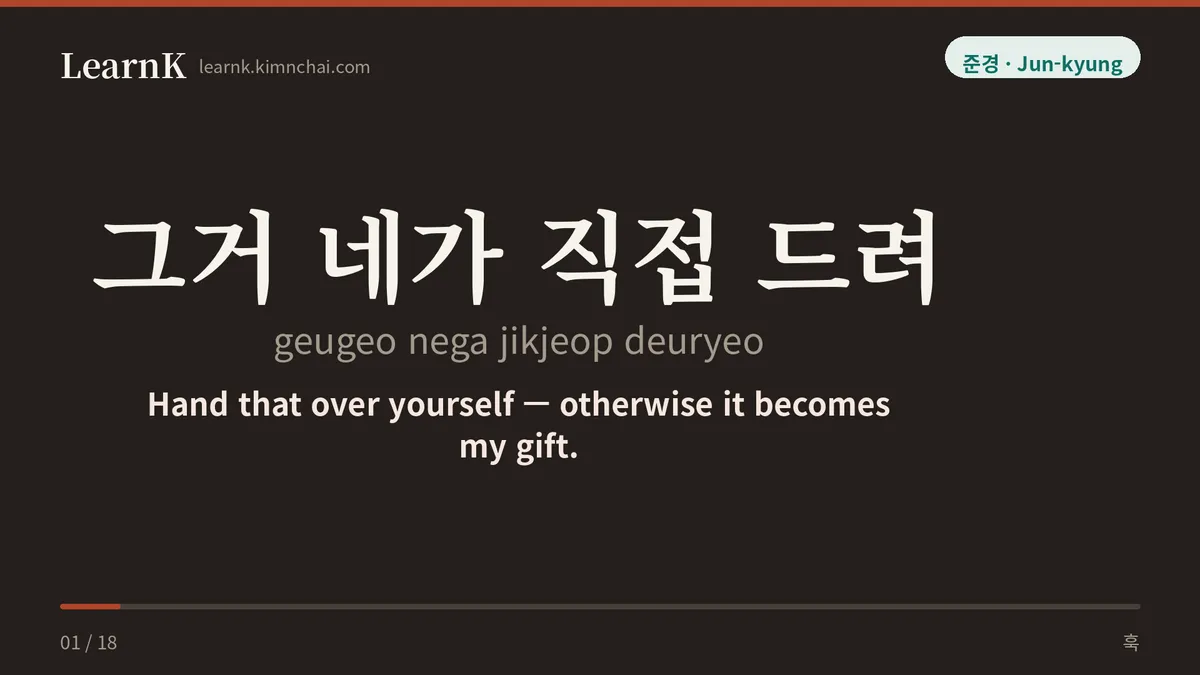
Jun-kyung: 그거 네가 직접 드려. 내가 들고 들어가면 내 선물 되는 거야. Hand that over yourself. If I carry it in, it becomes my gift.
Emily: 알았어. 근데 뭐라고 해? “이거 드립니다” 하면 너무 딱딱하지 않아? Okay. But what do I say? Wouldn’t “이거 드립니다” sound too stiff?
Jun-kyung: “약소하지만 드리려고 가져왔어요” 해. 그게 제일 무난해. Say “It’s not much, but I brought this for you.” That’s the safest.
Emily: 인사부터 하는 게 맞지? 처음 뵙는 거니까. I should greet them first, right? It’s my first time meeting them.
Jun-kyung: 응, 고개 숙이고 “처음 뵙겠습니다” 먼저. 말씀 드리는 건 그다음이야. Yeah, bow and say “처음 뵙겠습니다” first. Talking comes after.
Emily: 야, 나 손 떨려. 벨은 네가 눌러. Hey, my hands are shaking. You ring the bell.
These uses sound off
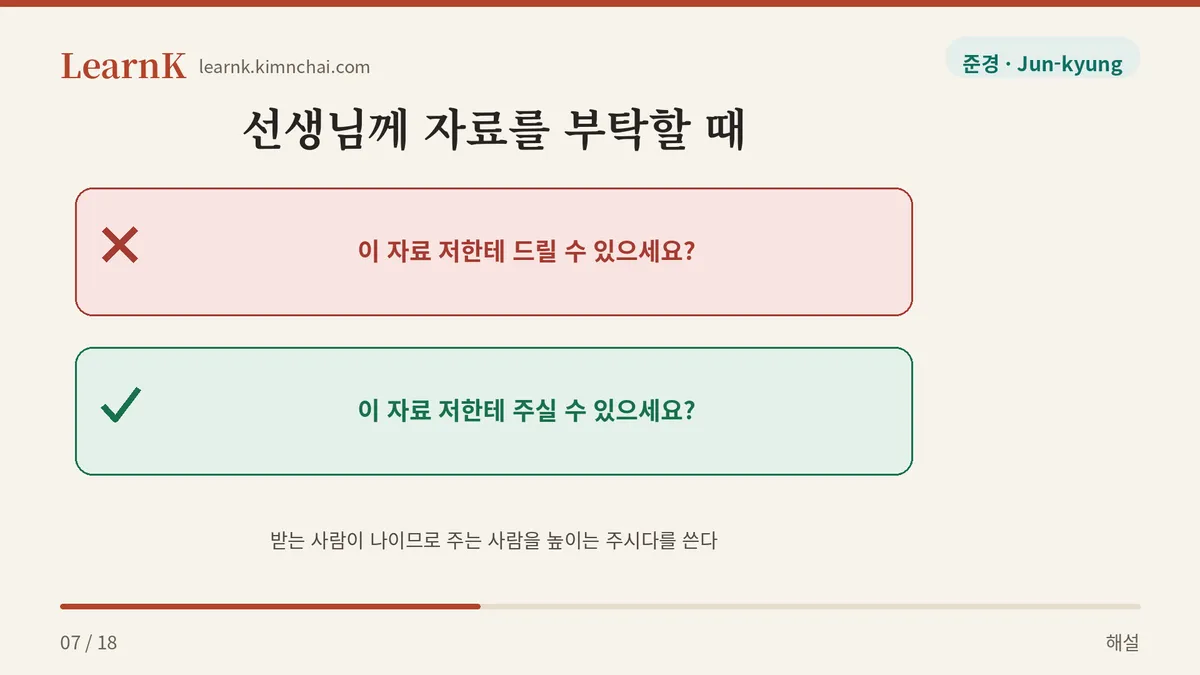
✗ (to a teacher) 선생님, 이 자료 저한테 드릴 수 있으세요? (seonsaengnim, i jaryo jeohante deuril su isseuseyo?) ✓ (to a teacher) 선생님, 이 자료 저한테 주실 수 있으세요? (seonsaengnim, i jaryo jeohante jusil su isseuseyo?) → 드리다 (deurida) elevates the person receiving, but here the receiver is me. You end up elevating yourself. When someone above you gives something to you, use 주시다 (jusida), which elevates the giver.
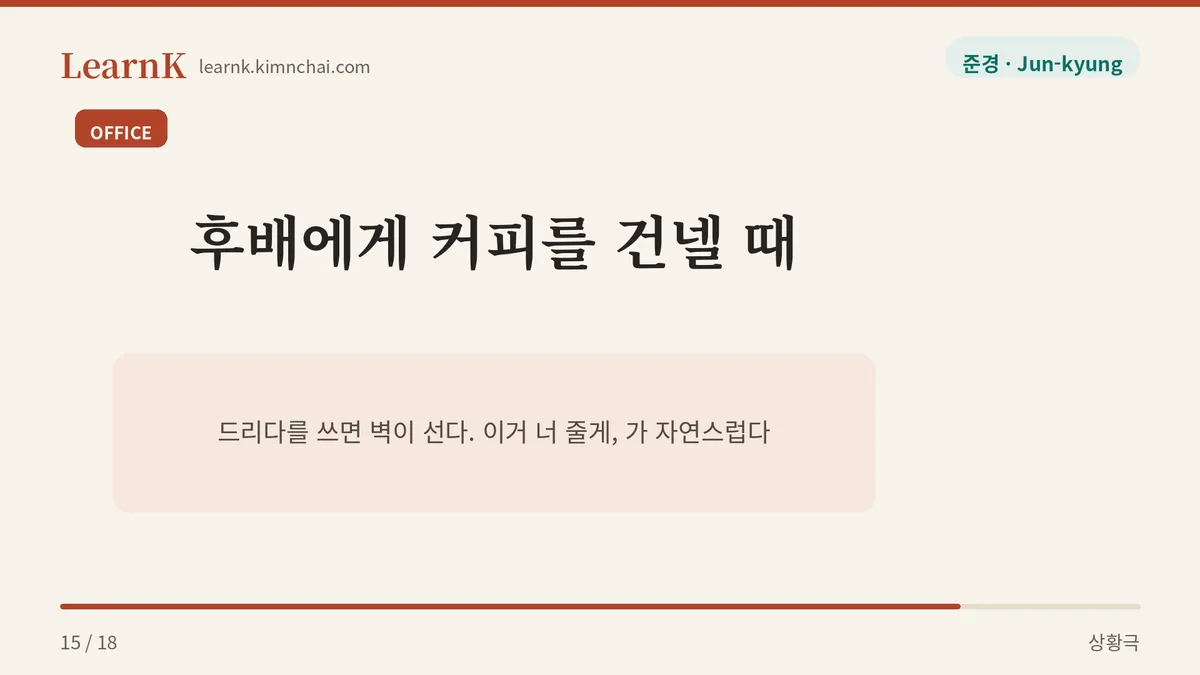
✗ (to a junior colleague) 이거 너한테 드릴게. (igeo neohante deurilge.) ✓ (to a junior colleague) 이거 너 줄게. (igeo neo julge.) → The grammar is perfectly fine; the social position is off. Using 드리다 (deurida) with a friend or someone junior to you suddenly feels like putting up a wall, and depending on the situation it lands as sarcasm.
Example sentences by situation
1) Opening a report (at work) 부장님, 잠깐 말씀드릴 게 있습니다. (bujangnim, jamkkan malsseumdeuril ge itseumnida.) This is the standard opening line for approaching your boss at a Korean company. Rather than launching straight into your business, taking one beat with 말씀드릴 게 있습니다 (malsseumdeuril ge itseumnida) counts as good manners. Without this one sentence, no matter how polite your content is, you come across as hasty.
2) Holiday morning, after the bow (family) 할머니, 새해 인사드립니다. 건강하세요. (halmeoni, saehae insadeurimnida. geonganghaseyo.) This is what you say as you finish the bow and raise your head. The word 인사드리다 (insadeurida) is so tightly bound to the act of bowing that if you say 인사할게요 (insahalgeyo) in this moment, the elders’ faces get subtly awkward.
3) At the register (a shop) 영수증 드릴까요? (yeongsujeung deurilkkayo?) Here, the customer is the one above. Regardless of age, the side receiving the service is elevated. A twenty-year-old part-timer says this to an eighteen-year-old customer too. It’s the clearest demonstration that 드리다 (deurida) follows position, not age.
One practice run with the auxiliary use as well. 제가 들어 드릴게요. (jega deureo deurilgeyo.) — a sentence for standing beside an elderly person carrying something heavy. 제가 들게요 (jega deulgeyo) isn’t wrong either, but adding ‘드리다 (deurida)’ engraves into the sentence the fact that the help is directed toward the other person.
Polite and casual speech, and similar expressions
드리다 (deurida) has no casual counterpart of its own. 주다 (juda) is the plain word and 드리다 (deurida) is its honorific form, so if you want to speak casually, you just go back to 주다 (juda). That said, as we saw earlier, you can end the sentence casually and leave 드리다 (deurida) in place — like 할머니께 드려 (halmeonikke deuryeo).
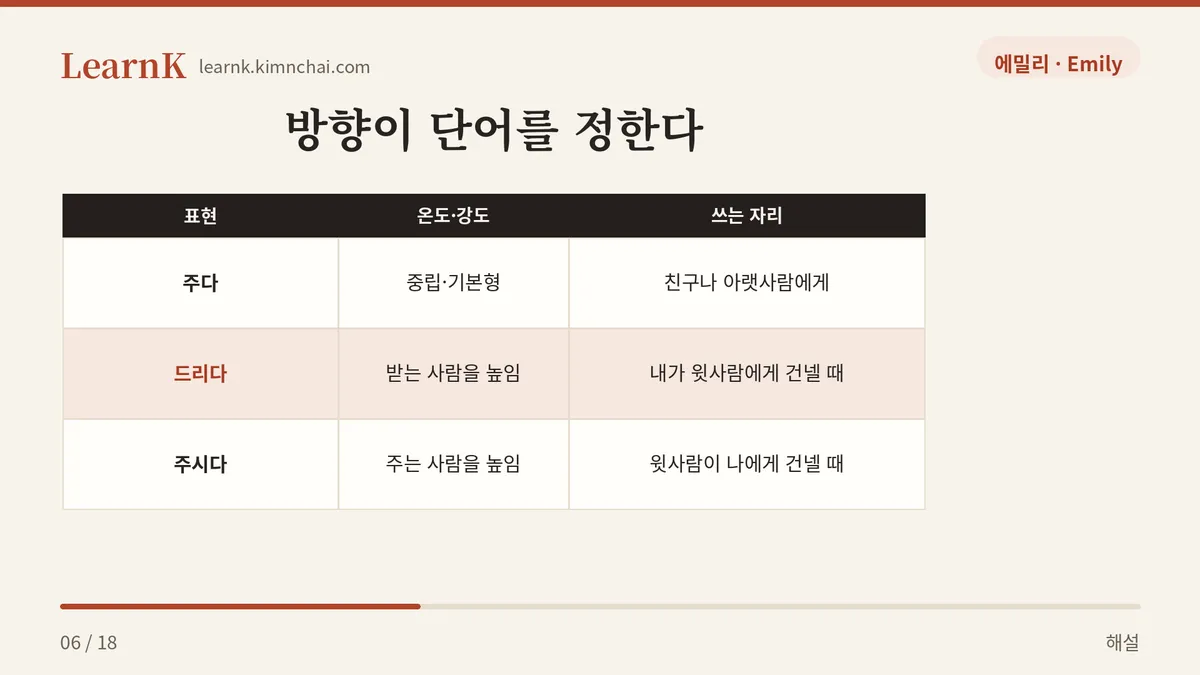
| Expression | Tone / intensity | Where it’s used |
|---|---|---|
| 주다 (juda) | Neutral, base form | Friends, people below you. No restriction on direction |
| 드리다 (deurida) | Elevates the receiver | When I hand something to someone above me |
| 주시다 (jusida) | Elevates the giver | When someone above me hands something to me |
| 올리다 (ollida) | Formal, ceremonial | Letter closings (‘○○ 올림 (ollim)’), ancestral rites. Not used in everyday conversation |
| 바치다 (bachida) | Heavy, solemn | Before one’s country, God, a great cause. Overblown if used toward a person |
One easily confused neighbor is worth flagging. 드시다 (deusida) is the honorific form of 먹다 (meokda), “to eat,” and has nothing to do with 드리다 (deurida). 할머니, 많이 드세요 (halmeoni, mani deuseyo) is correct, but 할머니, 많이 드리세요 (halmeoni, mani deuriseyo) means something completely different — you’d be telling grandma to give a lot to someone. The sounds are close enough that this is where learners slip most often.
Cultural background — the moment of handing something over with two hands
드리다 (deurida) almost always comes with a gesture. In Korea, when you hand something to someone above you, you give it with both hands. If the situation forces one hand, you lightly support that arm underneath with the other. You’ll see this posture when pouring and offering a glass at a drinking table, when handing over an envelope at a holiday, when passing documents in an interview room. Word and body are a set, so saying 드리다 (deurida) with your mouth while thrusting your hand out carelessly actually makes things more awkward, not less.
Envelope culture is bound up with this word too. Wedding congratulatory money, funeral condolence money, Lunar New Year 세뱃돈 (sebaetdon) — all of it goes into a white envelope and is handed over with two hands. Passing bare bills is nearly unheard of. Wrapping something as blunt as money in a single layer of paper is itself the attitude of ‘드리다 (deurida)’.
Watch a drama and you’ll see the word used as a thermometer for relationships. The distance in a daughter-in-law’s 제가 해 드릴게요 (jega hae deurilgeyo) when things are still stiff with her mother-in-law; conversely, the peace offering in a son who has long been at odds with his father asking to pour him a drink — the same word becomes a wall in one scene and a bridge in another. It’s a layer that a single word like “give” in the subtitles can never show. If you want to watch Korean dramas without subtitles, words like this are where your ear should start.
Today’s quiz
You’re asking your teacher for last week’s class materials. What belongs in the parentheses?
“선생님, 지난주 자료 좀 ( )?” (seonsaengnim, jinanju jaryo jom ( )?)
① 드릴 수 있으세요 (deuril su isseuseyo) ② 주실 수 있으세요 (jusil su isseuseyo)
Answer: ②
The person receiving the materials is me. Using 드리다 (deurida), which elevates the receiver, means elevating yourself. The one who needs elevating here is the teacher who will hand over the materials, so you use 주시다 (jusida). Flip it around — if I am handing materials to the teacher — and “선생님, 자료 드릴게요 (seonsaengnim, jaryo deurilgeyo)” is correct. Change the direction and the word changes. That one line is the key to mastering 드리다 (deurida).
Definitions and example sentences are from the National Institute of Korean Language’s Basic Korean Dictionary (krdict.korean.go.kr); that portion of this post, including our translations, is licensed under CC BY-SA 2.0 KR.