말씀 (malsseum) — The One Word That Raises Someone Else's Speech and Lowers Your Own
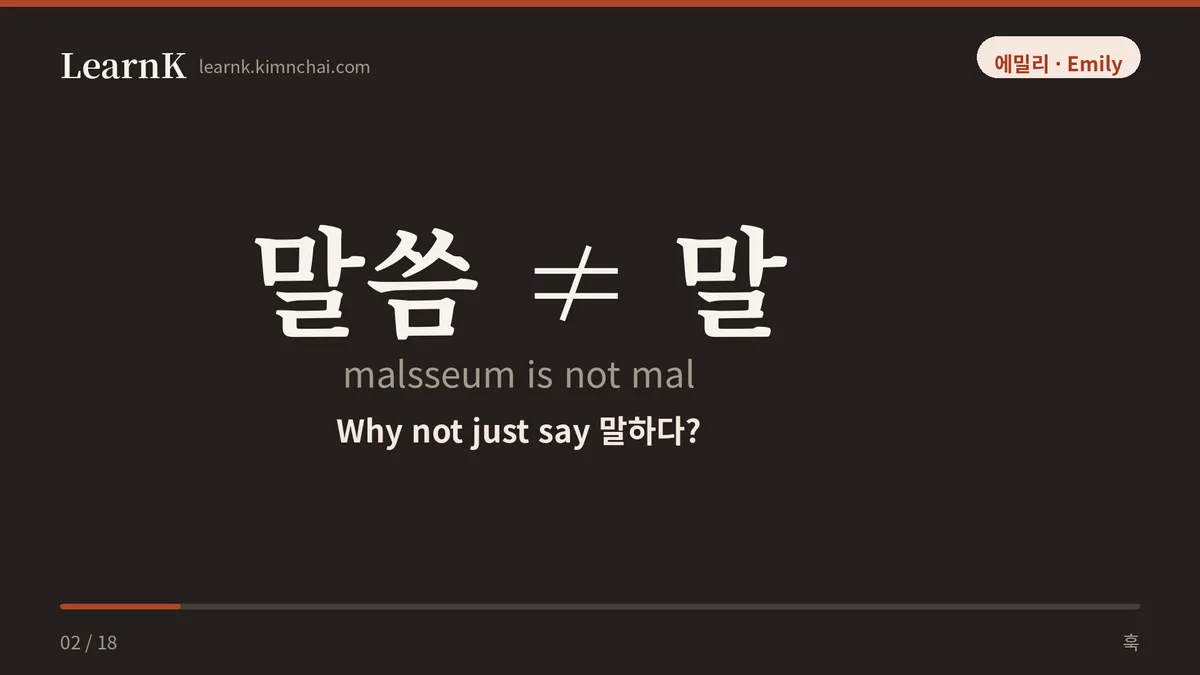
There is one sentence that every foreigner working at a Korean company ends up memorizing whole, before anything else: 확인해 보고 말씀드리겠습니다 (hwaginhae bogo malsseumdeurigetseumnida) — “Let me check and get back to you.” 말씀 (malsseum) is the word you use to raise someone else’s speech and, at the very same time, to lower your own — in short, it is the honorific form of 말 (mal), “words” or “speech.” Because a single word moves in two directions at once, it is also the shortest possible demonstration of how Korean honorifics are built.
The places this word turns up are wider than you would think. A phone call reporting to your boss. Passing along a doctor’s instructions. Relaying, at the holiday dinner table, something an elder said earlier. A wedding MC introducing the officiant. A pastor opening the Bible at church. It is a word you walk past at least once a day, and yet it stays stubbornly slippery for learners. You cannot simply swap the noun 말 (mal) for 말씀 (malsseum) and call it done — depending on what you attach behind it, the person being honored flips to the exact opposite.
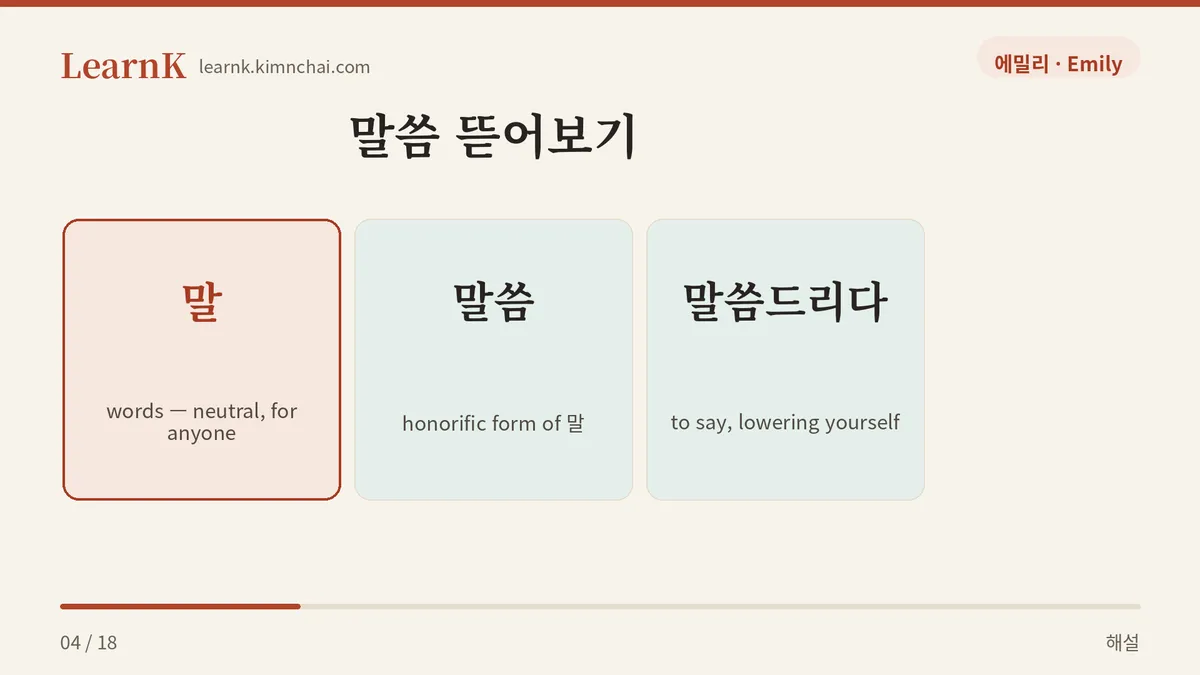
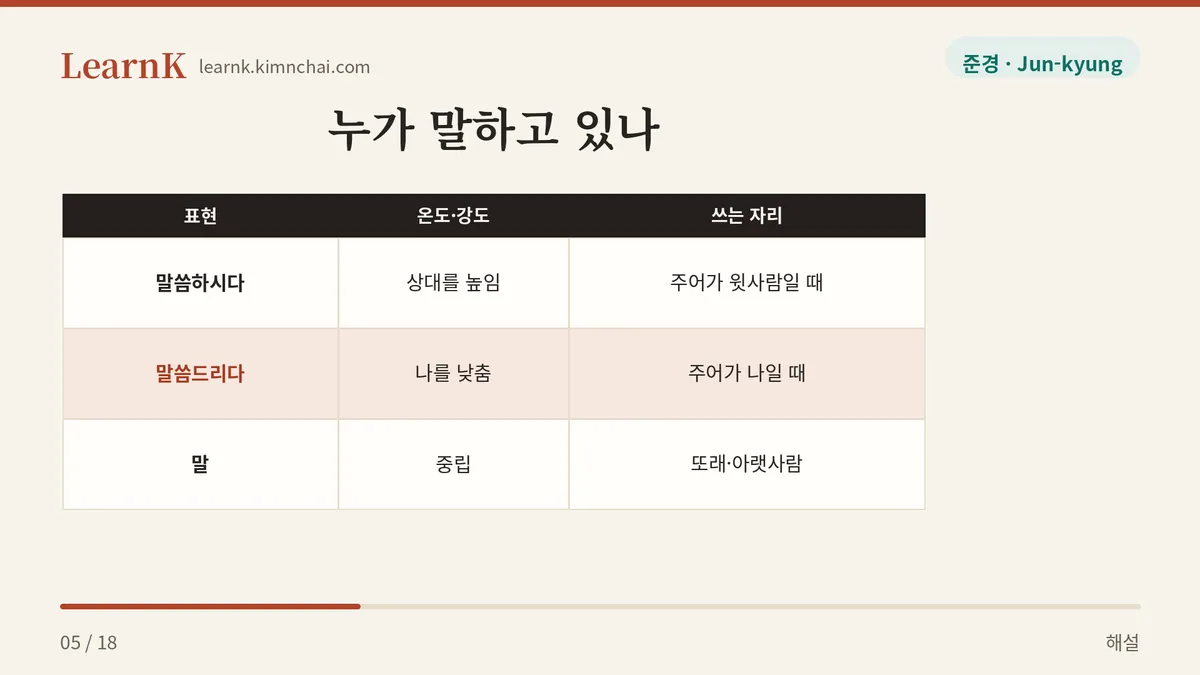
There are two directions. First, when it points at someone else’s words. Used as in 선생님의 말씀 (seonsaengnimui malsseum), “what the teacher said,” or 어머님이 말씀하셨어요 (eomeonimi malsseumhasyeosseoyo), “Mother said so,” it elevates the person who did the speaking. The verb that pairs with it here is 말씀하시다 (malsseumhasida). Second, when it points at your own words. Used as in 제가 말씀드리겠습니다 (jega malsseumdeurigetseumnida), “I’ll tell you,” it lowers your own speech and thereby raises the listener. Its partner here is 말씀드리다 (malsseumdeurida). The same noun — and one verb behind it flips the arrow of respect.
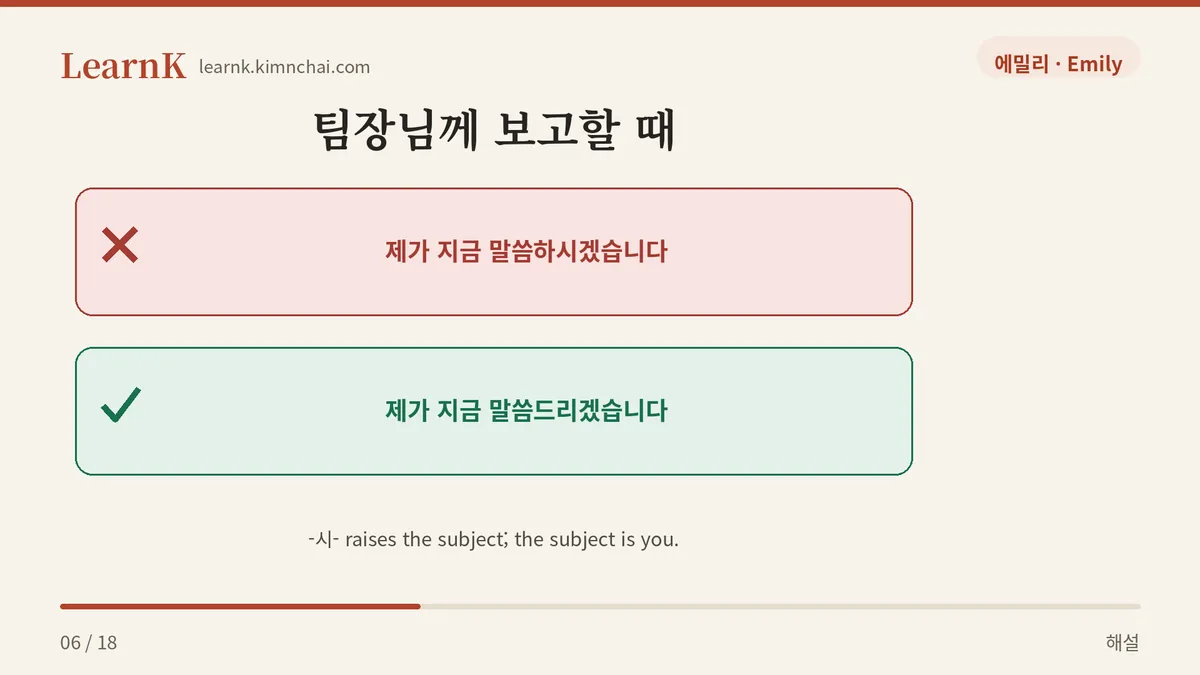
So a single test is enough. Who is doing the talking right now? If someone above you is speaking, it’s 말씀하시다 (malsseumhasida). If you are speaking, it’s 말씀드리다 (malsseumdeurida). Hold on to just this one thing and half your mistakes vanish.
On top of that comes a third use. In religion — especially in Protestant and Catholic contexts — 말씀 (malsseum) by itself refers to a Bible passage or a sermon. 오늘 말씀은 요한복음입니다 (oneul malsseumeun yohanbogeumimnida), “Today’s Word is from the Gospel of John,” works with no explanation before or after it. You’ll hear this usage often in church and cathedral scenes in Korean dramas, so knowing it opens up one more layer for your ears.
Checking It in the National Institute of Korean Language Dictionary
말씀 (malsseum) 「Noun」
- (높이는 말로) 남의 말. [en] words — (polite form) Words of another person. [ja] おはなし【お話】。おことば【お言葉】。おおせ【仰せ】 — 他人の言葉を敬っていう語。 [es] (EXPRESIÓN DE RESPETO) El habla del otro. [zh] 话 — (敬语)别人的言语。 — National Institute of Korean Language, Basic Korean Dictionary (krdict.korean.go.kr)
- (낮추는 말로) 자기의 말. [en] words — (impolite form) One’s own words. [ja] はなし【話】。ことば【言葉】 — 自分の言葉をへりくだっていう語。 [es] (EXPRESIÓN DE HUMILDAD) Habla propia. [zh] 话 — (谦词)自己的言语。 — National Institute of Korean Language, Basic Korean Dictionary (krdict.korean.go.kr)
- 성경에 있는 하느님의 말. [en] words in the Bible — The words of God in the Bible. [ja] おはなし【お話】。おことば【お言葉】。おおせ【仰せ】 — 聖書に書いてある神様の言葉。 [es] palabra de Dios — Palabra de Dios que se encuentra en la Biblia. [zh] 神默示,神谕 — 《圣经》中神的话语。 — National Institute of Korean Language, Basic Korean Dictionary (krdict.korean.go.kr)
Notice that honorific use (sense 1) and humble use (sense 2) sit side by side under a single headword. The reason the dictionary goes to the trouble of separating “(높이는 말로)” — as an elevating word — from “(낮추는 말로)” — as a lowering word — is exactly the flipping arrow described above. For reference, the Basic Korean Dictionary does not carry a Portuguese gloss, so the following is our own translation rather than a dictionary quotation — palavras (forma de respeito): as palavras de outra pessoa / palavras (forma de humildade): as próprias palavras / a palavra de Deus na Bíblia.
Here are the actual example sentences carried in the dictionary.
네, 일단 해 보고 말씀드리겠습니다. (ne, ildan hae bogo malsseumdeurigetseumnida.) Sure, let me try it first and then get back to you. — National Institute of Korean Language, Basic Korean Dictionary (krdict.korean.go.kr)
This is the form you’ll hear most often at work. It’s also the sentence that buys you time when you can’t give an answer right this second. Since the speaker is “I,” it becomes 말씀드리겠습니다 (malsseumdeurigetseumnida).
그러니까 제가 말씀드리고 싶은 것은……. (geureonikka jega malsseumdeurigo sipeun geoseun…….) So what I’d like to say is… — National Institute of Korean Language, Basic Korean Dictionary (krdict.korean.go.kr)
This is the signal for returning to the point when you’ve been rambling in a meeting or a presentation. Note that the subject is 제 (je), “I” — which locks in perfectly with 말씀드리다 (malsseumdeurida).
엄마한테 반에서 일 등을 했다고 말씀드렸는데 별 반응이 없으셨어요. (eommahante baneseo il deungeul haetdago malsseumdeuryeonneunde byeol ban-eungi eopseusyeosseoyo.) I told Mom I came first in my class, but she didn’t really react. — National Institute of Korean Language, Basic Korean Dictionary (krdict.korean.go.kr)
Proof that 말씀 (malsseum) is not company-only vocabulary. Within a family too, what you say to a parent takes 말씀드리다 (malsseumdeurida). It’s also worth noticing that the ending 없으셨어요 (eopseusyeosseoyo) is matched to the honorific level as well.
알고 있습니다. 선생님의 말씀 새겨듣도록 하겠습니다. (algo itseumnida. seonsaengnimui malsseum saegyeodeutdorok hagetseumnida.) I understand. I’ll take your words to heart. — National Institute of Korean Language, Basic Korean Dictionary (krdict.korean.go.kr)
Here the noun stands on its own, with no verb attached. 선생님의 말씀 (seonsaengnimui malsseum) — it points at someone else’s words, so this is sense 1. It’s a set phrase for graciously accepting advice you’ve just received, well worth memorizing whole.
아버지는 양심에 가책되는 일은 하지 말고 늘 떳떳하게 살라고 말씀하셨다. (abeojineun yangsime gachaekdoeneun ireun haji malgo neul tteotteothage sallago malsseumhasyeotda.) Father told me never to do anything my conscience would sting at, and to always live with my head held high. — National Institute of Korean Language, Basic Korean Dictionary (krdict.korean.go.kr)
This is the case of relaying, later on, something an elder said. Since the subject is 아버지 (abeoji), “Father,” the honorific infix -시- (-si-) is attached, giving 말씀하셨다 (malsseumhasyeotda). It points in exactly the opposite direction from the examples above.
See It in a Real Conversation
Setting: Chuseok evening, in the kitchen of Jun-kyung’s family home. The table has been cleared and the two of them are doing the dishes.
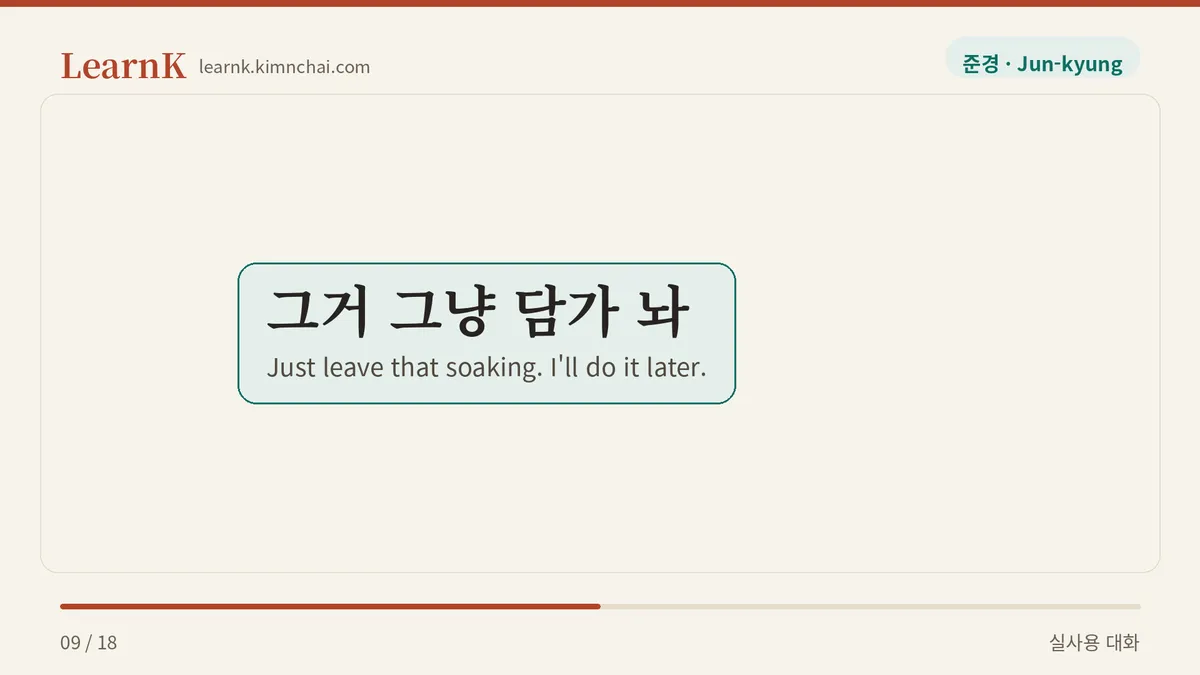
Jun-kyung: 그거 그냥 담가 놔. 이따 내가 할게. Just leave that soaking. I’ll do it later.
Emily: 어, 근데 아까 어머님이 말씀하신 거 있잖아. 김치 두 통 가져가라는 거, 진심이셔? Oh, but that thing your mom said earlier? Take two containers of kimchi — was she serious?
Jun-kyung: 진심이지. 아까부터 김치통 꺼내 놓으셨잖아. Dead serious. She’s had the containers out this whole time.
Emily: 아 어떡해, 우리 집 냉장고 자리 없는데. 나 솔직하게 말씀드려도 돼? Oh no, there’s no room in our fridge. Can I just tell her honestly?
Jun-kyung: 드려. 근데 ‘필요 없어요’ 말고 ‘다음에 꼭 받을게요’로. Go ahead. But say ‘I’ll definitely take some next time,’ not ‘I don’t need it.’
Emily: 알았어. 진짜, 어머님 말씀 거절하는 게 제일 어렵다니까. Got it. Honestly, turning down your mom is the hardest thing there is.
The two of them speak to each other in casual speech. And yet, inside that casual speech, every part that refers to his mother rises faithfully into 말씀하신 (malsseumhasin), 말씀드려도 (malsseumdeuryeodo), 말씀 (malsseum). Korean honorifics attach not only to the person listening, but to the people who appear inside the sentence — and this conversation shows that exact scene in miniature.
This Is Where It Sounds Wrong
✗ (팀장님께) 팀장님, 제가 지금 말씀하시겠습니다. ((timjangnimkke) timjangnim, jega jigeum malsseumhasigetseumnida.) ✓ (팀장님께) 팀장님, 제가 지금 말씀드리겠습니다. ((timjangnimkke) timjangnim, jega jigeum malsseumdeurigetseumnida.) → The infix -시- (-si-) marks respect for the subject of the sentence. When the subject is 제 (je), “I,” attaching -시- means honoring yourself — an attempt at politeness that comes out funny instead.
✗ (후배에게) 아까 네가 한 말씀, 다시 해 봐. ((hubaeege) akka nega han malsseum, dasi hae bwa.) ✓ (후배에게) 아까 네가 한 말, 다시 해 봐. ((hubaeege) akka nega han mal, dasi hae bwa.) → Using 말씀 (malsseum) toward a peer or someone junior doesn’t sound polite — it sounds sarcastic. Koreans deploy this kind of excessive honorific like a weapon when they want to put deliberate distance between themselves and the other person, or when they’re angry.
Example Sentences by Situation
1. At the hospital reception desk, relaying instructions you were given at last week’s appointment
지난번에 선생님께서 말씀하신 검사, 오늘 받으러 왔어요. (jinanbeone seonsaengnimkkeseo malsseumhasin geomsa, oneul badeureo wasseoyo.)
I’m here today for the test the doctor mentioned last time.
This is a case of repeating a doctor’s words as they were said. Because the person who spoke ranks above you, 말씀하시다 (malsseumhasida) is used. What’s interesting is that although you’re speaking to the receptionist, the person who has to be honored inside the sentence is the doctor, who isn’t even there.
2. Before a real estate contract, the moment you make the first phone call
계약서 때문에 여쭤볼 게 있는데, 잠깐 말씀 나눌 수 있을까요? (gyeyakseo ttaemune yeojjwobol ge inneunde, jamkkan malsseum nanul su isseulkkayo?)
I have something to ask about the contract — could we talk for a moment?
말씀 나누다 (malsseum nanuda) is a polite way of naming the act of conversation itself. You can use it with a complete stranger without any awkwardness, and it opens the door far more gently than 이야기 좀 하죠 (iyagi jom hajyo), “let’s talk.”
3. Cutting in one last time as a meeting winds down
제가 마지막으로 한 말씀만 드리겠습니다. (jega majimageuro han malsseumman deurigetseumnida.)
Let me just say one last thing.
한 말씀 (han malsseum), literally “one word,” is advance notice that you’ll keep it short. That nobody can actually guarantee it will be short is the long-running joke about this expression.
Related Expressions in Polite and Casual Speech
| Expression | Temperature / weight | Where it’s used |
|---|---|---|
| 말씀 (malsseum) | Formal and heavy | The words of someone above you, or your own words directed at them |
| 말 (mal) | Neutral | Anywhere. This is the one for peers and juniors |
| 말씀하시다 (malsseumhasida) | Raises the other person | When the subject is someone above you |
| 말씀드리다 (malsseumdeurida) | Lowers yourself | When the subject is you |
| 여쭈다 (yeojjuda) | Lowers yourself, questions only | Only when asking someone above you |
| 이야기하다 (iyagihada) | Soft and easy | Low-formality settings, light polite speech |
There’s one cell missing from the table. 말씀 (malsseum) has no casual-speech counterpart. Friends don’t say 네 말씀 (ne malsseum) to each other; they just say 네 말 (ne mal). It’s a word that exists only in the honorific register, so the moment it appears, you can assume the temperature of the room has gone up a notch.
Cultural Background — “A Few Words” at the Microphone
At official Korean events, the slot for 한 말씀 (han malsseum) is all but fixed. The officiant at a wedding. The department head before the first glass at a company dinner. The principal at graduation. The oldest guest at a housewarming. When the MC says 한 말씀 부탁드립니다 (han malsseum butakdeurimnida), “a few words, please,” everyone in the room knows it does not literally mean one sentence. This is also why office dramas keep returning to the scene where a new hire gets suddenly called on at a company dinner and freezes. It’s not that they aren’t ready to speak — it’s that they aren’t ready to speak in the honorific register.
For the same reason, there’s one sentence even Koreans get wrong all the time. You’ll often hear at events: 사장님 말씀이 계시겠습니다 (sajangnim malsseumi gyesigetseumnida). The verb 계시다 (gyesida) is used for people, but the subject of that sentence isn’t a person — it’s 말씀 (malsseum). Standard language etiquette recommends 사장님 말씀이 있으시겠습니다 (sajangnim malsseumi isseusigetseumnida) instead. The rule distinguishes between honoring a person directly and honoring them indirectly, through something that belongs to them. When a learner knows this, it’s the Korean who ends up surprised.
It’s no accident, either, that Emily in the conversation above found the kimchi so hard to refuse. The moment it’s called 어머님 말씀 (eomeonim malsseum), “what Mother said,” it has already stopped being a simple offer and become something to be accepted. The word carries the weight of the relationship in advance.
Today’s Quiz
You’re reporting to your team leader. What belongs in the blank?
팀장님, 제가 확인해 보고 다시 ( ). (timjangnim, jega hwaginhae bogo dasi ( ).)
① 말씀하시겠습니다 (malsseumhasigetseumnida) ② 말씀드리겠습니다 (malsseumdeurigetseumnida) ③ 말씀이 계시겠습니다 (malsseumi gyesigetseumnida)
Answer: ② 말씀드리겠습니다 (malsseumdeurigetseumnida)
The speaker is 저 (jeo), “I,” so you use the self-lowering 말씀드리다 (malsseumdeurida). Option ① has you as the subject yet uses -시- (-si-) to honor yourself, and option ③ has 말씀 (malsseum) — not a person — as its subject, so it doesn’t pair with 계시다 (gyesida) in the first place. Get just this one sentence onto the tip of your tongue today, and you’ll survive that first phone call on your first day working in Korea.
Definitions and example sentences are from the National Institute of Korean Language’s Basic Korean Dictionary (krdict.korean.go.kr); that portion of this post, including our translations, is licensed under CC BY-SA 2.0 KR.