사장님 (sajangnim) — From Shop Owners to Strangers, the Most-Used Form of Address in Korea

One of the most common difficulties for someone who has just arrived in Korea is this: “What am I supposed to call that person?” You don’t know their name, you don’t know their age, and their job title is even more of a mystery. In moments like that, there’s one word Koreans reach for without a second thought. 사장님 (sajangnim) means the polite way of addressing someone who runs a shop or a company. You’ll hear it in front of a fruit stall at the market, from a salon chair, and on the phone with a business contact. It’s rare for a single word to cover this much ground.
사장님 (sajangnim)
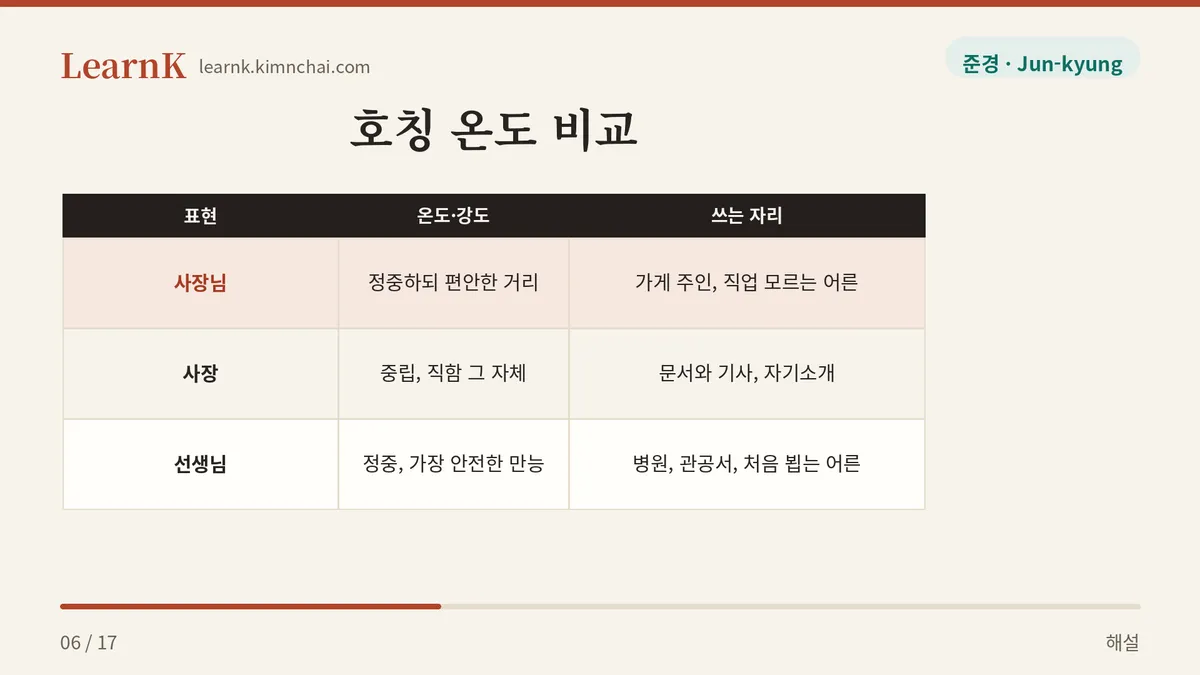
The structure is simple: the job title 사장 (sajang) plus -님 (-nim), the suffix that raises the person you’re talking about. But that one little -님 (-nim) does a lot of work. 사장 (sajang) is the bare title, the form you use when describing someone in the third person — so if you call out to the person standing in front of you with just “사장!”, it doesn’t sound like you’re addressing them, it sounds like you’re picking a fight. When you address someone directly, it’s always 사장님 (sajangnim).
Two things matter most in the nuance. First, size is irrelevant. The head of a 200-employee company is a 사장님 (sajangnim), and so is the woman rolling gimbap by herself in a tiny snack shop. In Korea this word doesn’t mean “CEO of a big corporation” so much as “a person who runs their own business.”
Second, it’s polite without being stiff. It’s not the language of a highly formal occasion, and it’s not something you toss out casually to a friend either — it sits right in the middle. It lifts the other person up a little while keeping a comfortable distance. That makes it perfect for an adult you’re meeting for the first time, and in practice Koreans reach for it even when they aren’t sure the person actually owns anything. There’s no real cost to being wrong.
Looking it up in the National Institute of Korean Language dictionary
사장님 (sajangnim) 「noun」 (높이는 말로) 가게나 회사의 사장. (as an honorific) The owner of a store or company. [en] president — (polite form) The president of a store or company. [ja] しゃちょう【社長】 — 店や会社の社長を敬っていう語。 [es] presidente, ta — (EXPRESIÓN DE RESPETO) Presidente de una tienda o empresa. [zh] 老板, 经理 — (敬语)店铺或公司的负责人。 — National Institute of Korean Language, Basic Korean Dictionary (krdict.korean.go.kr)
The phrase at the very front of the definition — (높이는 말로) (nopineun mallo), “as an honorific” — is the heart of this word. The fact that the dictionary defines it simply as 사장 (sajang) and then tags an honorific marker onto the front tells you something: what the word points at is identical to 사장 (sajang). The only thing that changes is your attitude toward the person.
The Portuguese definition isn’t included in the dictionary, so the translation below is our own. (Not from the dictionary.)
[pt] patrão / chefe — (forma respeitosa) dono de uma loja ou empresa.
Now let’s look at the real usage examples the dictionary provides.
사장님, 무슨 일부터 할까요? (Sajangnim, museun il-buteo halkkayo?) “Sir, what should I start with?” — National Institute of Korean Language, Basic Korean Dictionary (krdict.korean.go.kr)
This is an employee arriving at work and checking what’s on the agenda. Putting the form of address at the very front of the sentence and breaking it off with a comma is the most typical pattern of all. In Korean, it feels natural to call the person first and get to your business second.
사장님, 이번 일은 제가 모두 맡아서 처리하도록 하겠습니다. (Sajangnim, ibeon il-eun jega modu mataseo cheorihadorok hagetseumnida.) “Sir, I’ll take full responsibility for this matter and handle it myself.” — National Institute of Korean Language, Basic Korean Dictionary (krdict.korean.go.kr)
This is far more formal than the previous example. Paired with the weighty ending -도록 하겠습니다 (-dorok hagetseumnida), it becomes an official declaration that you’re taking responsibility. It shows how the same form of address changes temperature depending on what follows it.
가뜩 힘들어 죽겠는데 사장님이 야근을 하라고 하셔서. (Gatteuk himdeureo jukgenneunde sajangnim-i yageun-eul harago hasyeoseo.) “I’m already dying here, and then the boss told me to work late.” — National Institute of Korean Language, Basic Korean Dictionary (krdict.korean.go.kr)
This one isn’t said to the boss’s face — it’s a complaint to a coworker. Even while grumbling, the speaker still says 사장님 (sajangnim) and still uses the honorific verb form 하셔서 (hasyeoseo). It’s a nice illustration of how Korean honorifics are a device tied to relationship, kept up independently of how you happen to feel.
사장님이 책상을 주먹으로 내리치자 직원들의 눈길이 모두 사장님에게로 갔다. (Sajangnim-i chaeksang-eul jumeogeuro naerichija jigwondeul-ui nungil-i modu sajangnim-egero gatda.) “When the boss slammed his fist on the desk, every employee’s eyes turned to him.” — National Institute of Korean Language, Basic Korean Dictionary (krdict.korean.go.kr)
Here the word isn’t being used to address anyone — it’s third-person description. Even in this position, the normal choice is 사장님이 (sajangnim-i), not 사장이 (sajang-i). When someone inside a company talks about their own company’s head, they attach -님 (-nim) even when he isn’t in the room.
아니. 김 사장님은 가난뱅이 농사꾼의 아들에서 지금 그렇게 성공하신 거래. (Ani. Gim sajangnim-eun gananbaeng-i nongsakkun-ui adeul-eseo jigeum geureoke seonggonghasin georae.) “No — apparently Mr. Kim started out as a poor farmer’s son and worked his way up to what he is now.” — National Institute of Korean Language, Basic Korean Dictionary (krdict.korean.go.kr)
This is the form where you attach it to a family name: 김 사장님 (Gim sajangnim), 박 사장님 (Bak sajangnim). Skipping the full name and stacking a title on top of that single-syllable surname is the safest all-purpose formula for referring to an adult in Korea.
A real conversation

Scene: Emily’s first weekend after moving in. She’s out grocery shopping at the neighborhood traditional market with Jun-kyung.
에밀리: 저기 아저씨, 이 복숭아 얼마예요? Excuse me, mister, how much are these peaches?
준경: (작게) 야, 여기선 사장님이라고 불러야지. (quietly) Hey, here you should call him sajangnim.
에밀리: 어? 가게가 이렇게 조그만데도? Huh? Even though the shop is this small?
준경: 크기랑 상관없어. 자기 가게 하시는 분은 다 사장님이야. Size has nothing to do with it. Anyone running their own shop is a sajangnim.
에밀리: 아하. 사장님, 이거 두 상자 주세요! Ah-ha. Sajangnim, two boxes of these, please!
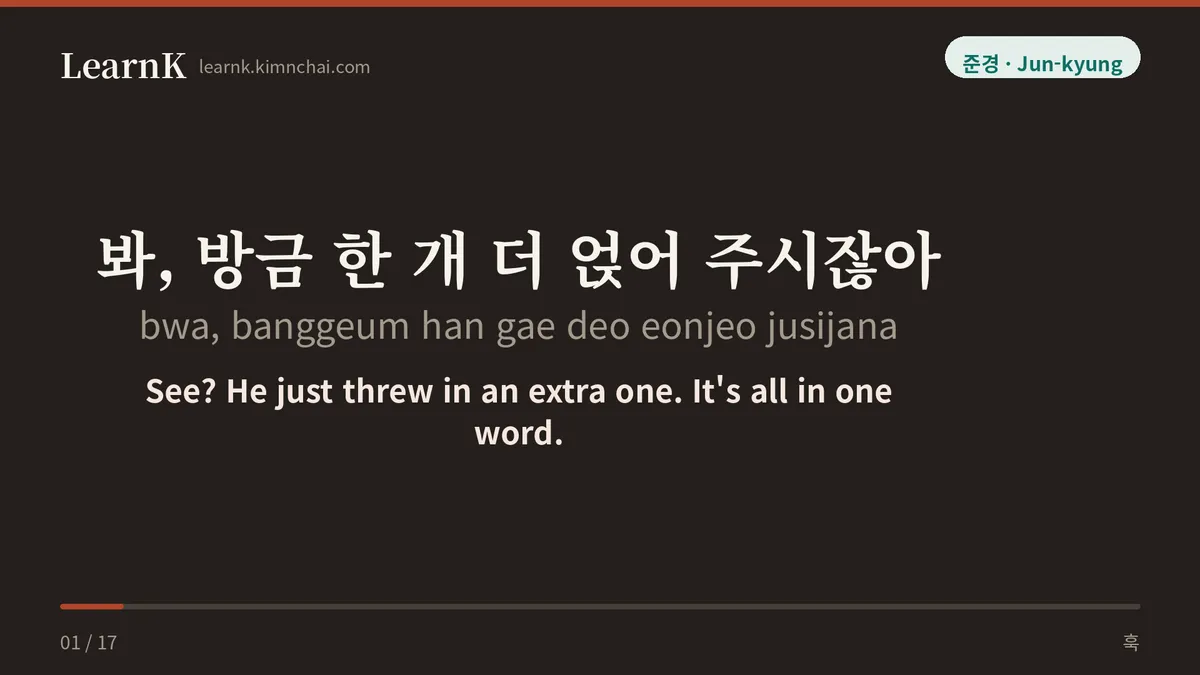
준경: 봐, 방금 한 개 더 얹어 주시잖아. 말 한마디 차이야. See? He just threw in an extra one. It’s all in one word.
These usages sound off
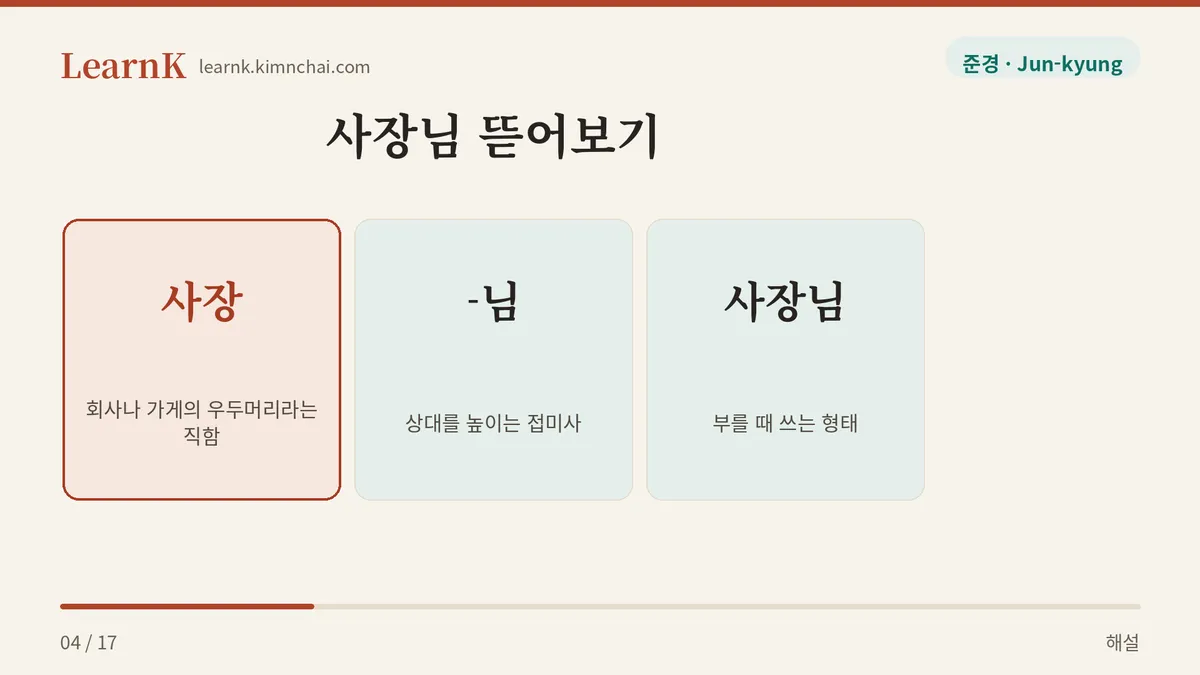
✗ (handing over a business card) 안녕하세요, 제가 이 회사 사장님입니다. ✓ (handing over a business card) 안녕하세요, 제가 이 회사 사장입니다. “Hello, I’m the head of this company.” → -님 (-nim) elevates other people, so you can’t stick it on yourself. When introducing yourself, use the bare title: 사장 (sajang), 대표 (daepyo). The grammar is fine, but your listener will be biting back a smile.
✗ (at a district office service window) 사장님, 이 서류 어디에 내면 돼요? ✓ (at a district office service window) 선생님, 이 서류 어디에 내면 될까요? “Excuse me, where do I submit this form?” → 사장님 (sajangnim) presupposes that the person is in business. Use it on a civil servant, a doctor, or a professor — people whose work has nothing to do with running a shop — and you’ve misread them; some will even take it as a subtle put-down. For an adult whose job you don’t know, 선생님 (seonsaengnim) is the safest bet.
Example sentences by situation
① At your regular hair salon, when the owner is cutting your hair personally
사장님, 오늘은 앞머리만 조금 다듬어 주세요. (Sajangnim, oneureun apmeori-man jogeum dadeumeo juseyo.) “Just a light trim on the bangs today, please.”
Salons are one of the places this word gets used most. At a bigger shop with several stylists, the head stylist may be called 원장님 (wonjangnim), but at a small neighborhood salon run by one person, 사장님 (sajangnim) is the default.
② Dropping by a noodle shop you used to frequent, after a long absence
사장님, 저 기억하세요? 작년에 매주 오던 사람인데요. (Sajangnim, jeo gieokhaseyo? Jangnyeon-e maeju odeon saram-indeyo.) “Do you remember me? I came every week last year.”
With one word you signal: I’m a customer, but I’m not a stranger. At a neighborhood shop in Korea, a conversation that starts this way very often ends with a free side dish on the house.
③ Wrapping up a phone call with a business partner
그럼 김 사장님, 다음 주 수요일에 사무실로 찾아뵙겠습니다. (Geureom Gim sajangnim, da-eum ju suyoil-e samusillo chajaboepgetseumnida.) “All right then, Mr. Kim — I’ll come by your office next Wednesday.”
This is the formal version, attached to a surname. Saying the person’s title once more as you close a call or an email makes you sound considerably more courteous.
Similar expressions, formal and casual
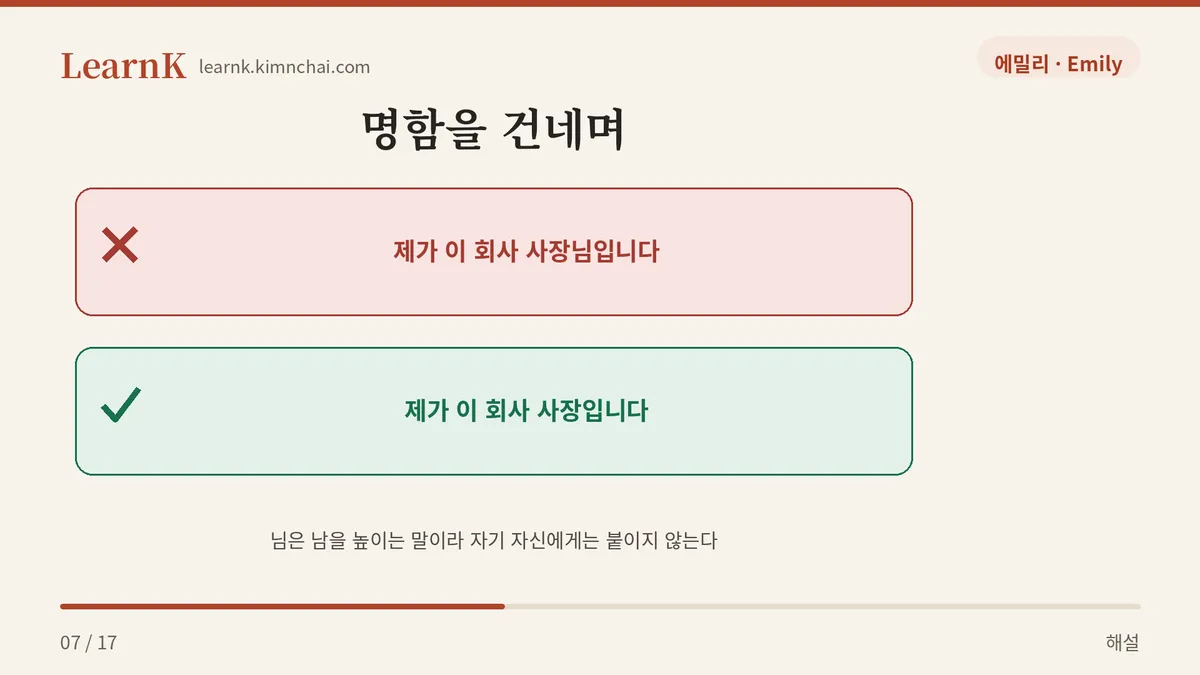
| Expression | Tone & intensity | Where it’s used |
|---|---|---|
| 사장님 (sajangnim) | Polite but at an easy distance | Shop owners, heads of small and mid-size businesses, filling the naming gap when you don’t know someone’s job |
| 사장 (sajang) | Neutral, the bare title | Documents, news articles, introducing yourself. Never used to address someone face to face |
| 대표님 (daepyonim) | Formal and modern | Startups, industry meetings. Someone whose card says 대표 (daepyo) |
| 기사님 (gisanim) | Polite, with a clear occupation | Taxi, bus, delivery, movers. People who drive and carry for a living |
| 선생님 (seonsaengnim) | Polite, the safest all-purpose choice | Hospitals, government offices, an older adult you’re meeting for the first time |
| 아저씨 (ajeossi) / 아주머니 (ajumeoni) | Friendly, but risks talking down to someone | Increasingly avoided these days unless you’re genuinely close |
Cultural background — the wild card in a country that doesn’t use names
사장 (sajang) comes from the Sino-Korean 社長. 社 means company or organization and 長 means head, so literally it’s “head of the company.” Add the native Korean honorific suffix -님 (-nim) and you get the modern form. It belongs to the same family as 선생님 (seonsaengnim), 기사님 (gisanim), and 손님 (sonnim).
So why did this particular word spread so far? Part of the answer is that Korean simply lacks a good word for addressing an adult you’ve never met. 저기요 (jeogiyo) — the rough equivalent of English excuse me or Japanese すみません — only functions to get attention; it doesn’t elevate the person at all. Using someone’s name is rude unless you’re reasonably close, and 아저씨 (ajeossi) / 아주머니 (ajumeoni) pin an age on the person, which can land badly. 사장님 (sajangnim) filled that empty slot. On top of that, Korea has an unusually high share of self-employed people, so there’s a decent chance the adult you pass on the street really does own some shop. The risk of being wrong is low, and if you’re right, you’ve made someone’s day a little better.
Watch Korean dramas and you’ll see the word used as a device for showing power relations, too. In workplace dramas, you can sketch the whole org chart just by noticing who gets called 사장님 (sajangnim) and who gets called by name. In a series like Misaeng (미생, tvN, 2014), famous for its fine-grained portrait of office life, the moment a form of address changes is the moment a character’s position changes. Flip it around to a scene set in a market or a back alley and the same word turns much warmer — a regular customer pushing open the door and calling out 사장님 (sajangnim) is closer to saying hello and asking how you’ve been.
So learning this expression isn’t a matter of memorizing one more word. It’s closer to picking up a piece of the Korean instinct for how you place another person.
Today’s quiz
You want to order a coffee from the forty-something owner who runs a neighborhood café single-handedly. What’s the most natural way to open?
- 사장, 아메리카노 하나요.
- 사장님, 아메리카노 한 잔 주세요.
- 제가 이 카페 사장님인데요, 아메리카노 하나요.
The answer is number 2. Number 1 drops the -님 (-nim), so it doesn’t sound like addressing someone — it sounds like summoning a subordinate. Number 3 attaches -님 (-nim) to yourself, which turns the sentence into a customer suddenly pretending to be the owner. No matter how small the shop, the owner is a 사장님 (sajangnim), and that -님 (-nim) always goes on the other person, never on you.
Definitions and example sentences are from the National Institute of Korean Language’s Basic Korean Dictionary (krdict.korean.go.kr); that portion of this post, including our translations, is licensed under CC BY-SA 2.0 KR.